Fleurette is a flower without a heavy botanical outline. Van Cleef & Arpels places seven round diamonds together so that their combined contour supplies the petals and centre. The stones do more than fill a shape already drawn in metal; their arrangement is the shape. Seen at a distance, the jewel reads as a clear floral accent. Seen closer, it becomes a small exercise in circles, neighbouring edges and the spaces that remain between them.
A flower made from intervals
The maison traces its precious-stone corolla interpretations to the 1920s. The current Fleurette presentation carries that motif into pendants, rings, earrings and necklaces. This article considers the objects shown in that presentation, rather than treating a longstanding design vocabulary as a new 2026 launch. The official workshop and worn photographs offer a useful sequence: complete form, smaller construction and the flower restored to the scale of the body.
The seven-diamond description belongs to the individual motif. A necklace carrying several flowers has a different total stone arrangement from a single pendant; other jewellery visible in a styled portrait may belong to a separate line. Those distinctions are worth retaining because the collection’s visual clarity comes from a repeated unit, not from every object having an identical specification.
The circle becomes a petal through proximity
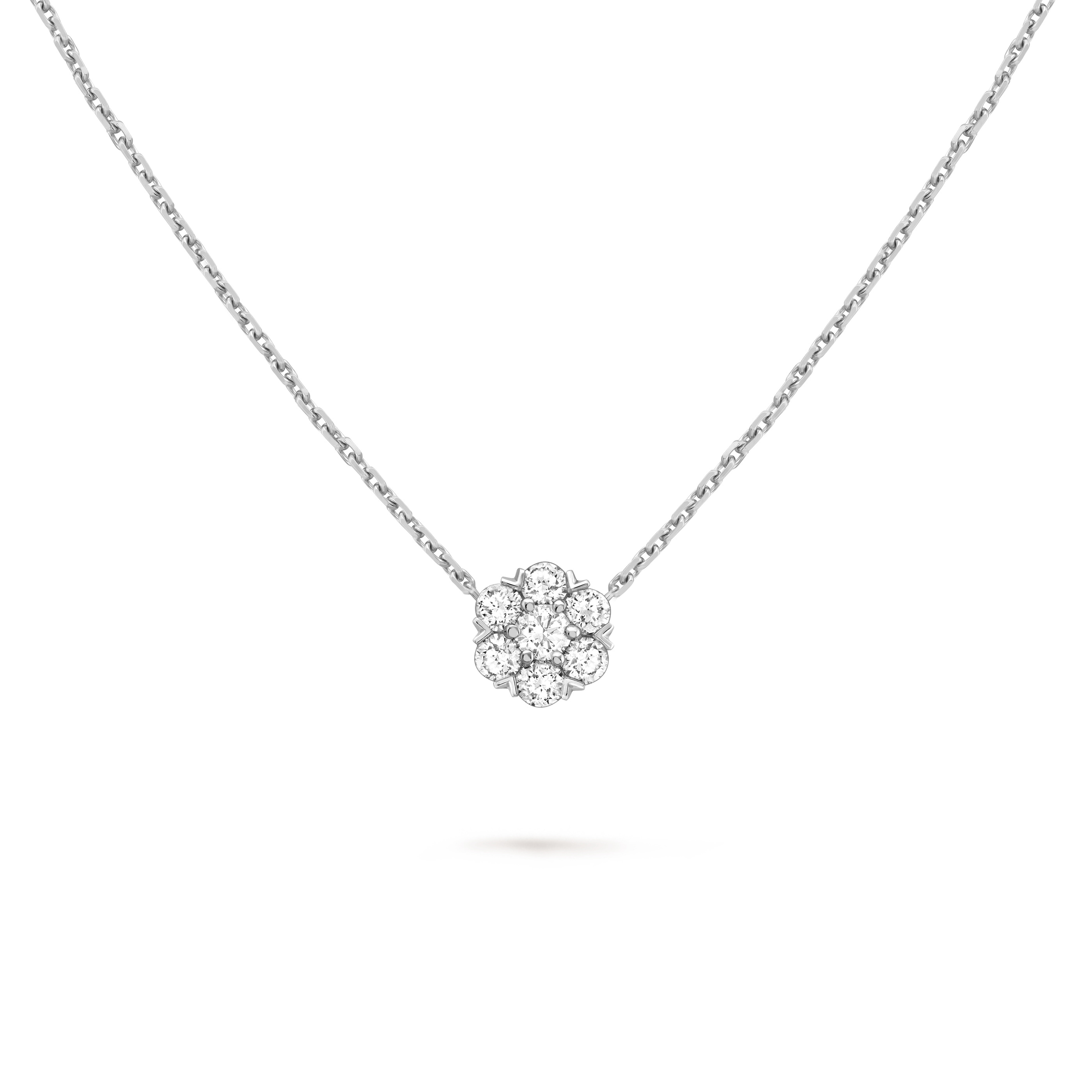
The pendant’s complete product photograph makes the organising idea easy to see. Rounded stones meet in a compact cluster, and their outer edges give the jewel a scalloped perimeter. The flower is suggested through placement rather than through a literal reproduction of a stem, leaf and petal. That degree of abstraction is important. It allows the motif to remain legible as jewellery even when the object is small and its individual components are seen only as points of light.
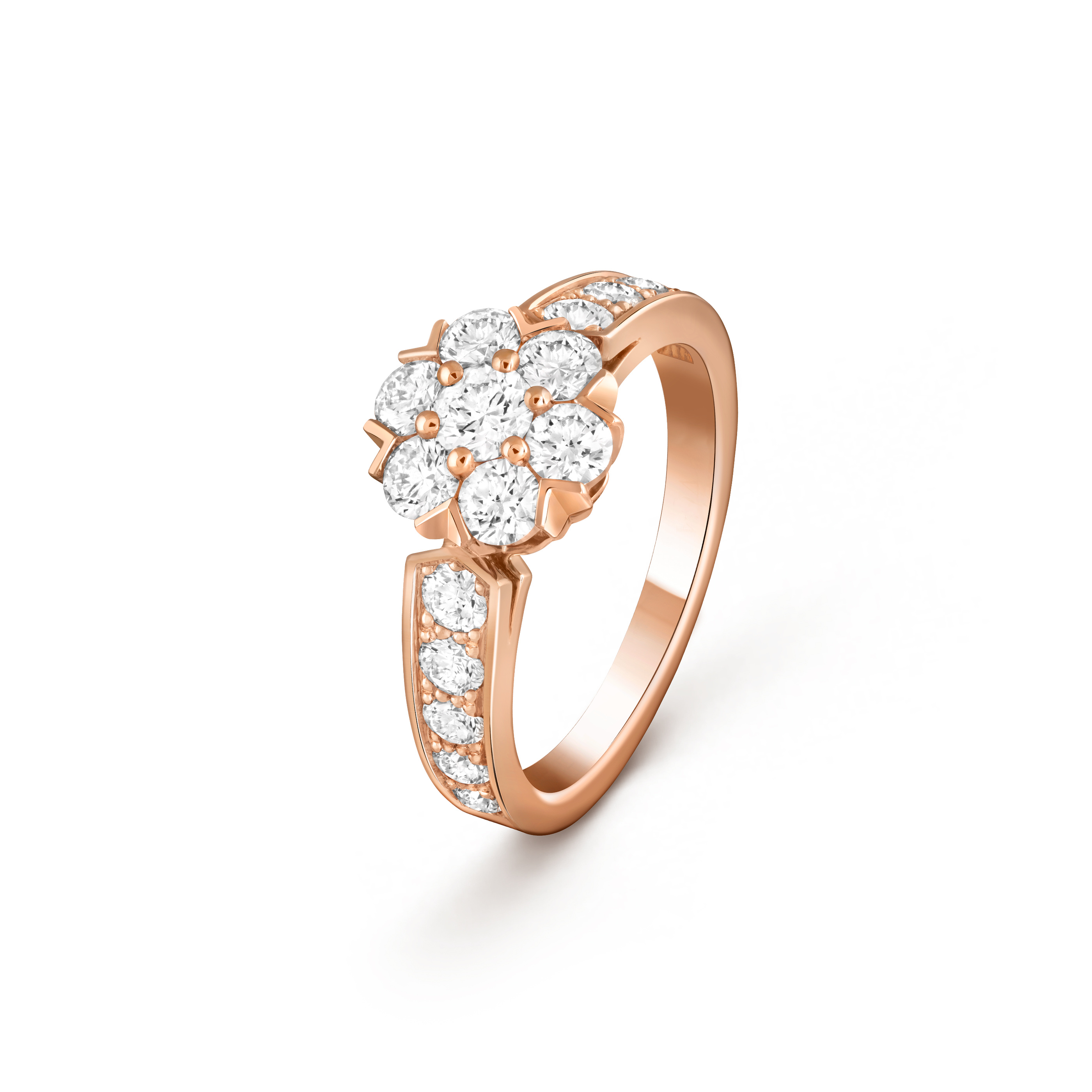
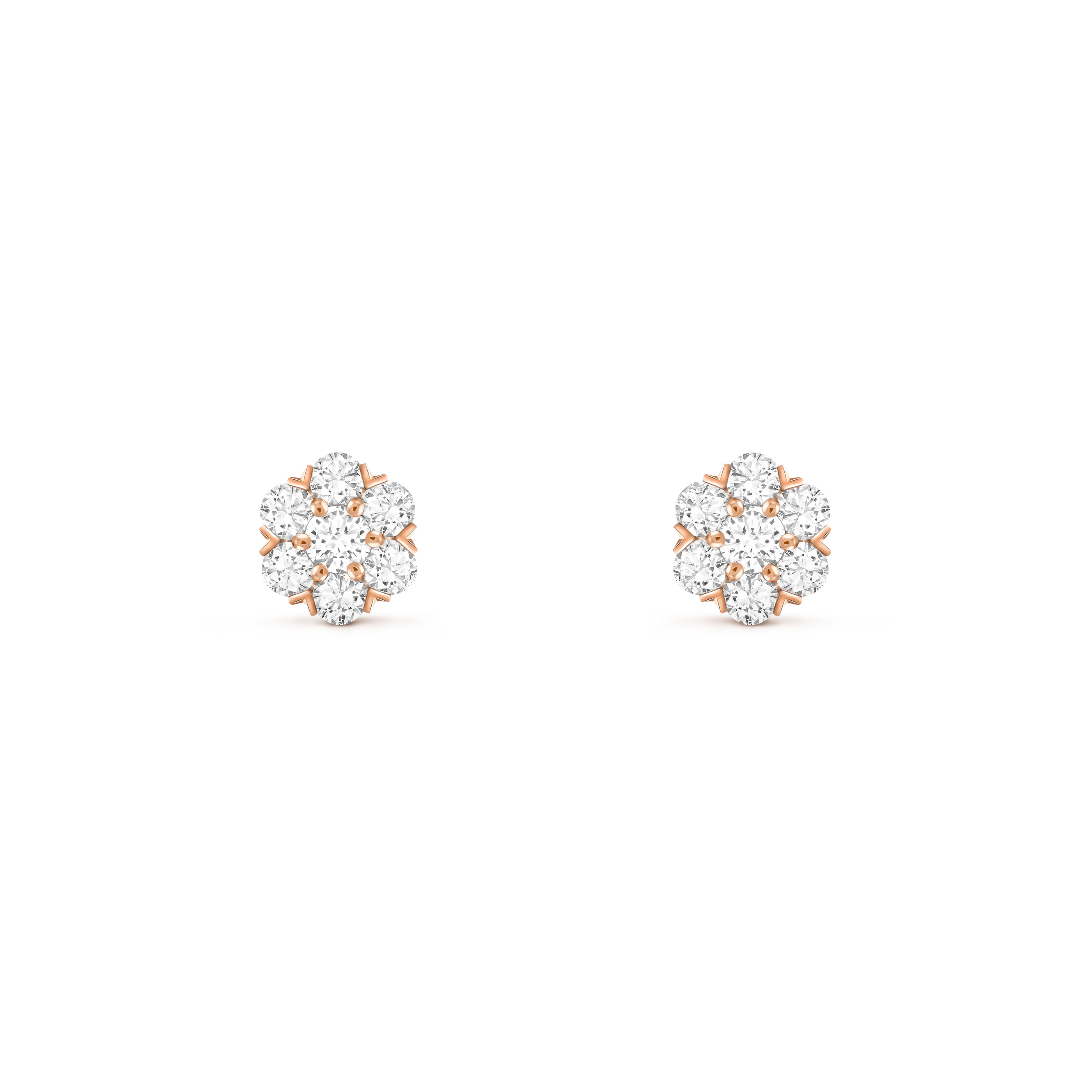
The rose-gold ring and earrings introduce a warmer visible framework. The gold tone changes the relation between bright stones and the surrounding object, but the arrangement still supplies the same floral contour. The comparison is more interesting when the full pieces are kept in view. A tight crop of the centre would make them appear more alike, whereas the ring’s band and the earrings’ complete outlines show how the motif is supported in different contexts.
The house’s exact rose-gold pendant record, VCARPEBC00, identifies 18K rose gold and diamond for that reference. It should not be used to assign the same metal to the white-metal pendant or every necklace in the collection imagery. At collection scale, the shared information is the motif and its design logic. At reference scale, it is the precise material description, dimensions and stone particulars. A considered presentation needs both levels without allowing one to erase the other.
The setting needs to serve the outline
Van Cleef & Arpels describes an openwork structure that lets light pass through the stones. This is the maker’s account of the setting; the finished photographs are not independent optical measurements. Their useful visual evidence is the restrained presence of the support around the flower. The eye meets the rounded diamond arrangement first, with the framework appearing to follow rather than overwhelm its perimeter.
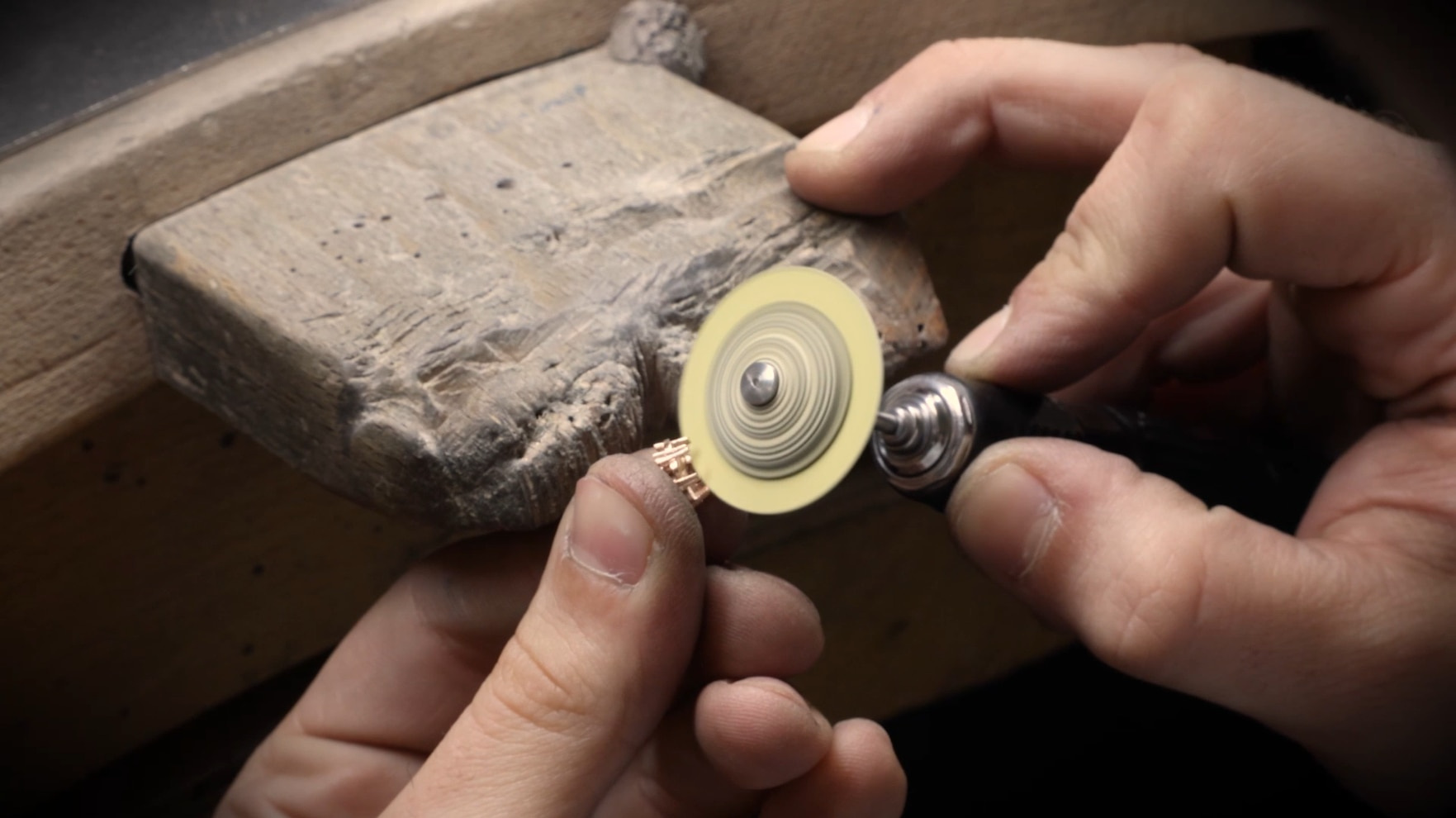
The workshop photograph changes the pace. A polishing operation at the bench brings the object into a working environment, away from the quiet completeness of a studio product view. It reminds the reader that a small floral silhouette still depends on surfaces, edges and carefully finished metal. The image does not need to prove a universal claim of perfection. It gives construction a specific place in the story and makes the transition from workbench to finished outline visible.
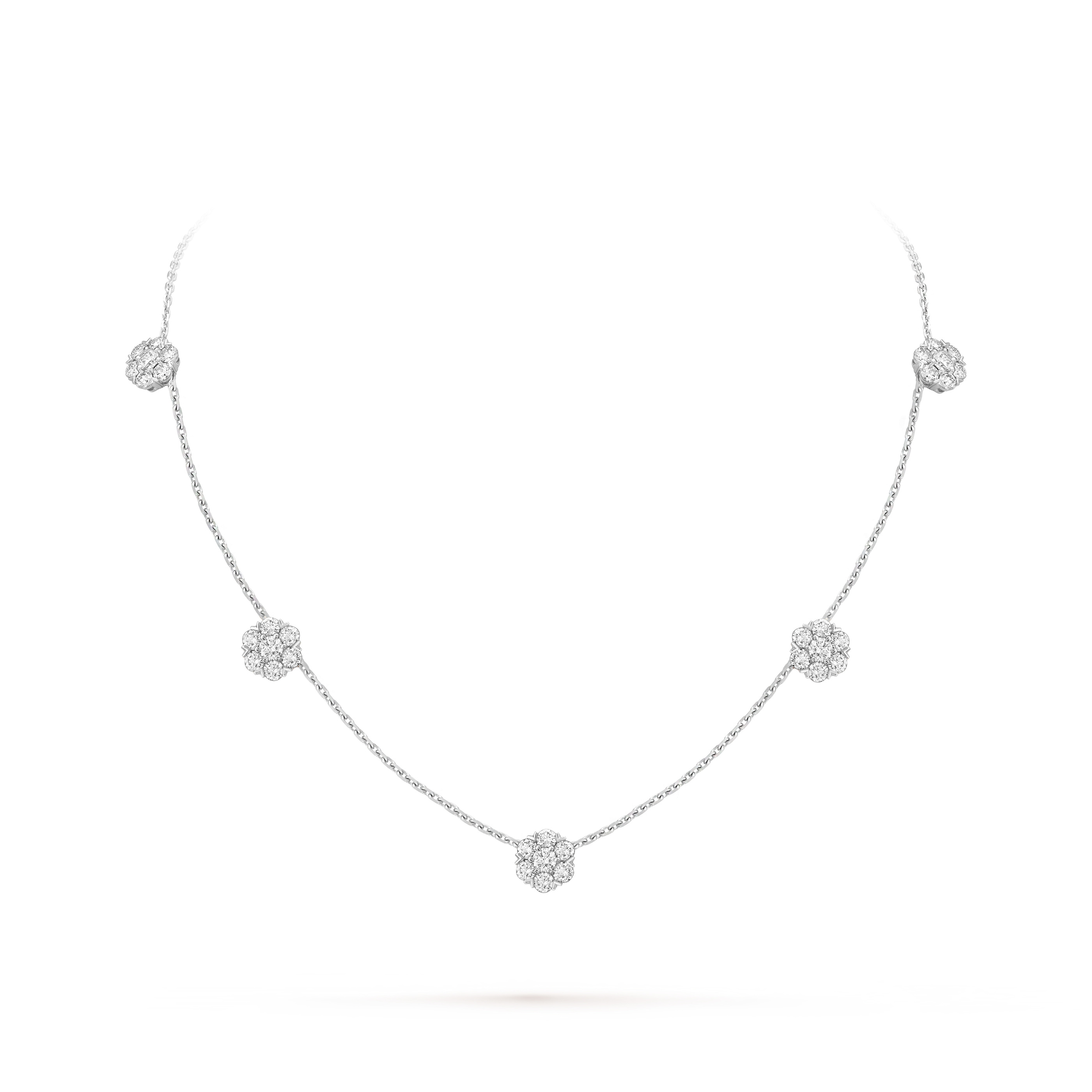
Look again at the product photographs after that workshop frame. The spaces between the stones become more noticeable, as do the small boundaries around the perimeter. Fleurette’s apparent simplicity is a compositional effect: several circles have to read as one flower without losing their individual rounded character. That is a more precise description of its visual interest than simply calling it delicate. The motif is compact, but the relationship between its parts is still available to be examined.
One flower and five flowers occupy different spaces
The five-flower necklace should be seen complete. Its identity comes from the intervals between floral units as well as from each unit’s shape. A single pendant creates one focal point below a chain. Several flowers produce a broader route around the neckline, with repeated concentrations of brightness separated by quieter sections. The motif remains the same design language, but the composition changes from punctuation to sequence.
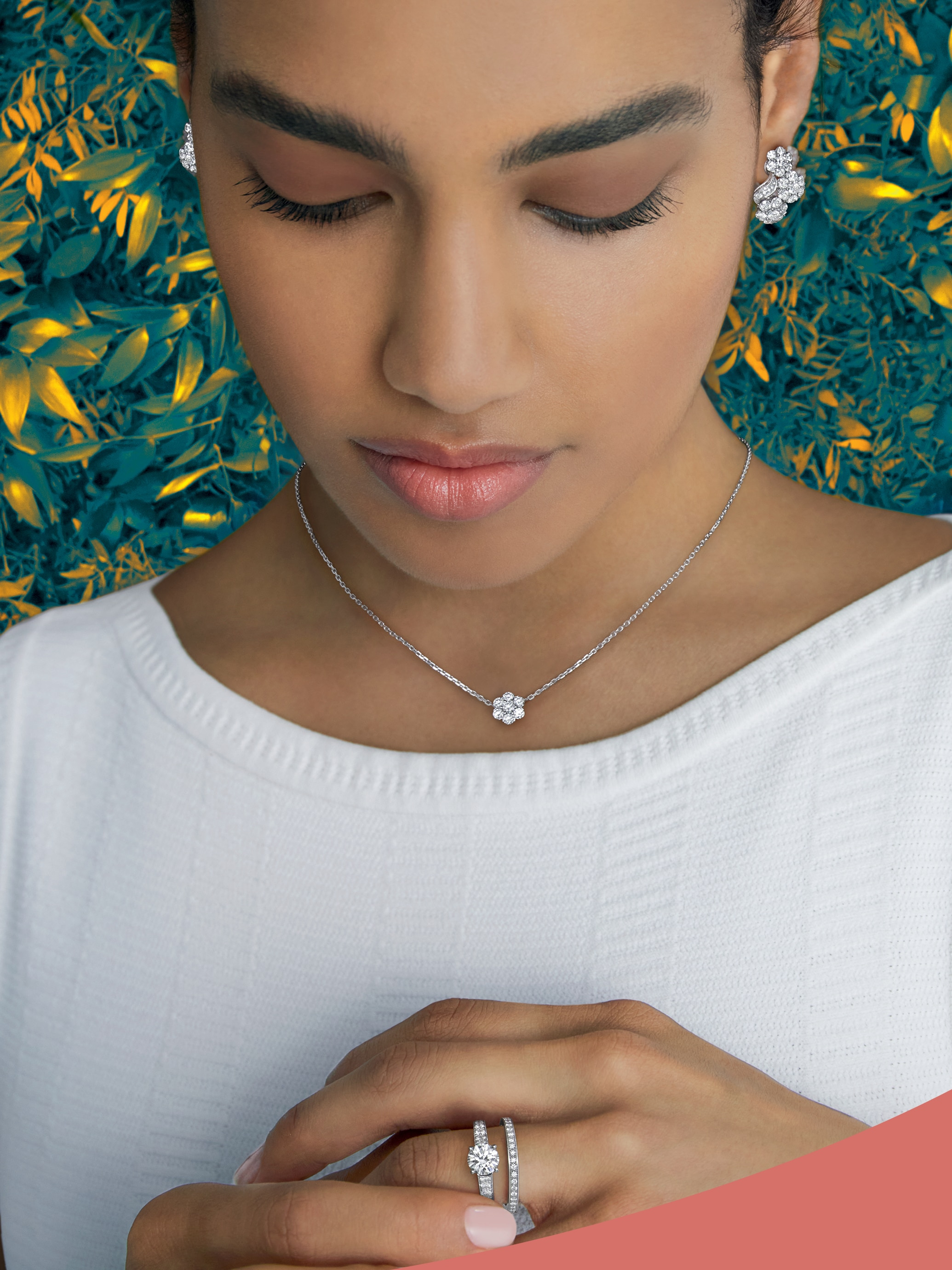
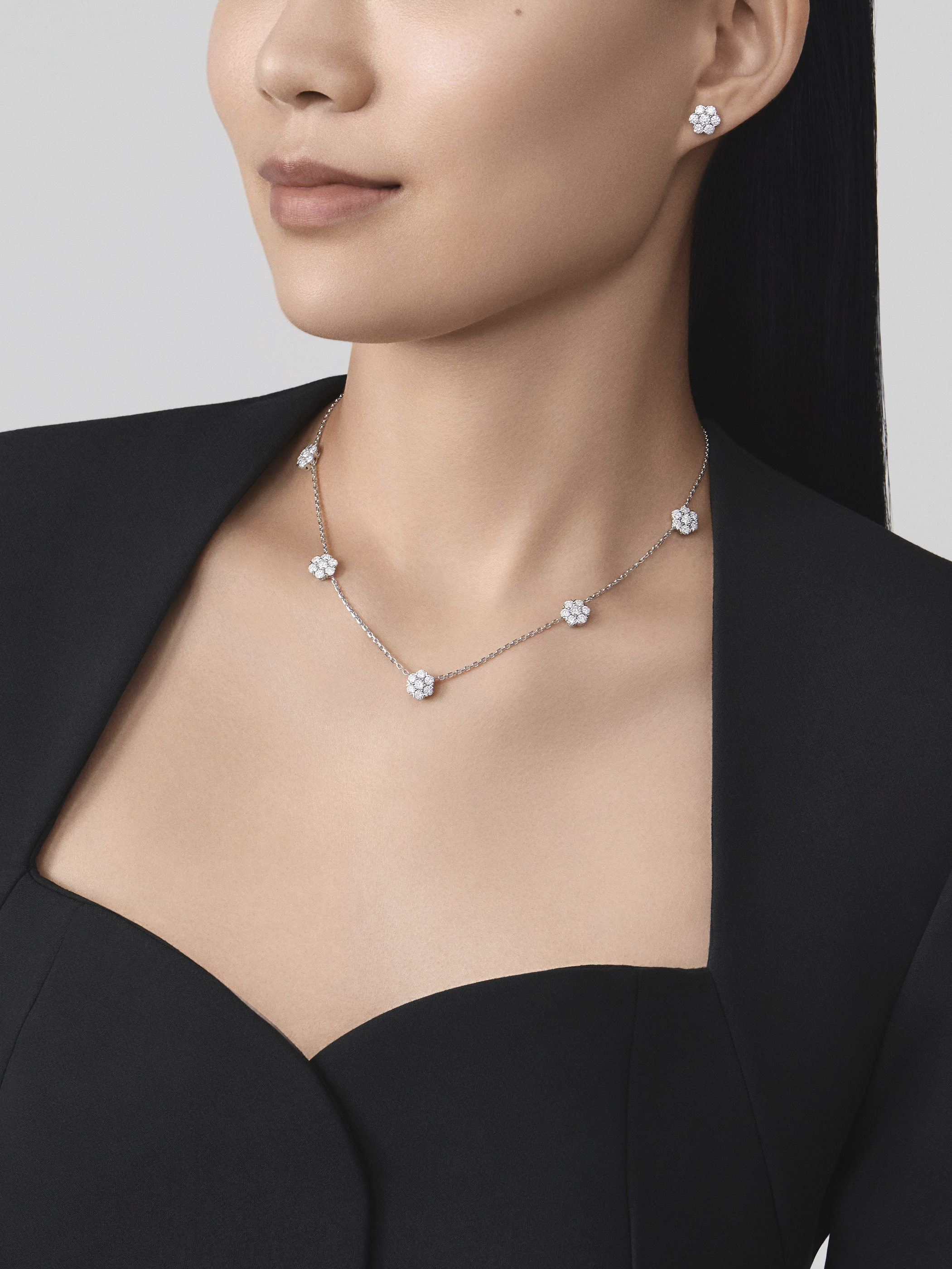
The worn necklace photograph establishes those intervals against the body. It restores the scale that a large studio image can conceal and shows how the floral line meets the curve of the neck. The portrait also makes the surrounding clothing relevant. A neckline can leave the flowers in a clear field of skin or bring fabric close to their lower edge. The official image shows one deliberate arrangement; it is a reference for looking, not a fitting guarantee.
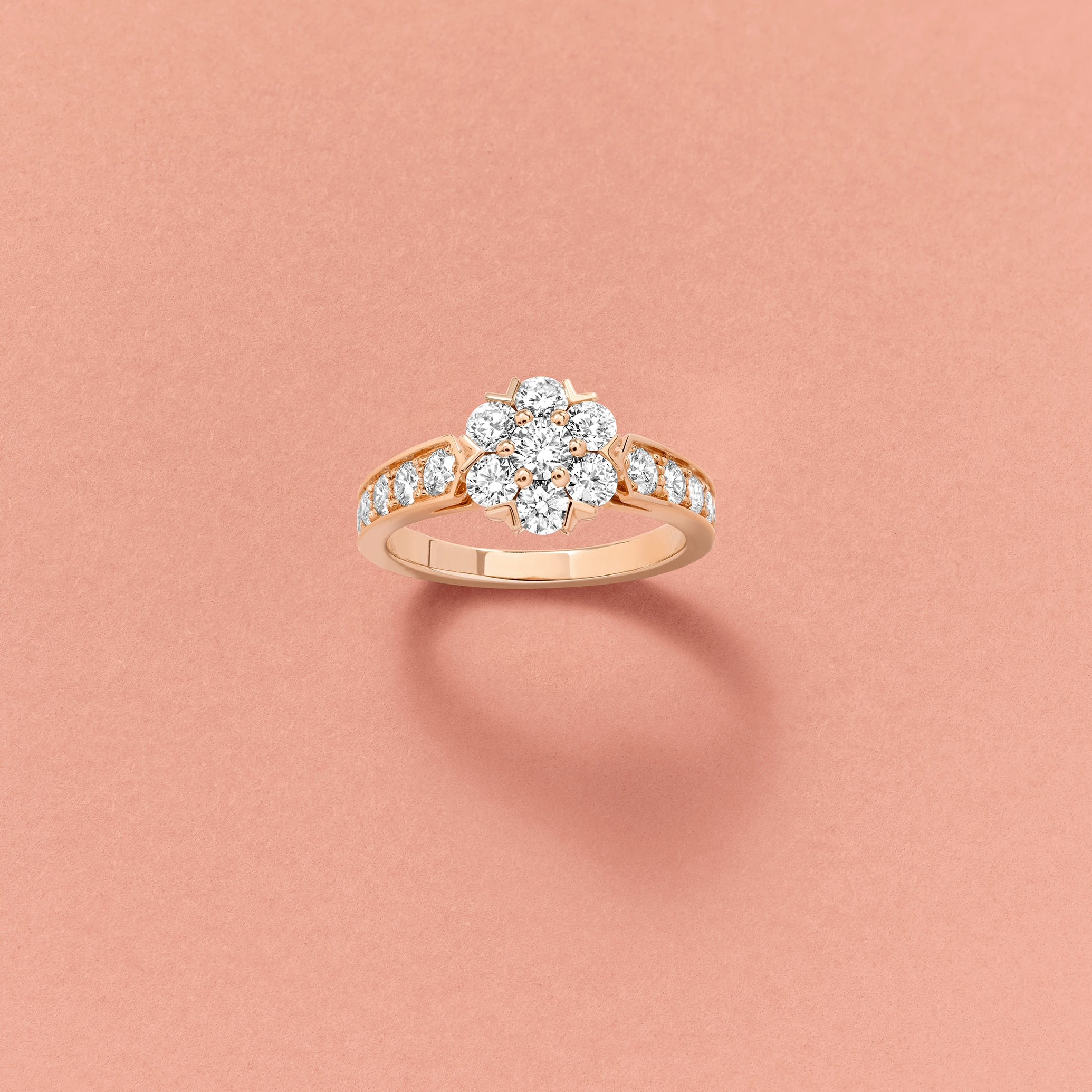
The pink display photograph creates another kind of comparison. Against that coloured field, the ring is read as an object with a clear boundary, while the portrait keeps it attached to a hand and an outfit. Together, these views avoid making every frame perform the same task. A prospective wearer can use them to decide which proportion is appealing before asking for the exact ring size, pendant length, earring closure or necklace dimensions. Those practical details remain specific to the chosen creation.
The motif and the object
| Scale | Visible design decision | Reference-specific check |
|---|---|---|
| Single flower | Seven round diamonds form a corolla | Exact metal, stone description and dimensions |
| Ring or earrings | The flower meets a band or paired support | Size, projection, fastening and worn proportion |
| Five-flower necklace | Repetition creates a broader line | Complete length and spacing on the intended neckline |
| Workshop view | Metal edges and surfaces are worked | The image illustrates craft, not independent certification |
The same floral language can appear in several materials and configurations. Total stone counts and weights should come from the actual reference, not from multiplying a motif description across a photograph. The collection images and workshop view are official material; no independent wear or light-performance test is implied.
The Luxe Digital view
Fleurette’s strongest design decision is allowing the diamonds’ arrangement to draw the flower. The motif retains enough space and a clear enough perimeter to work from a small pendant to a broader necklace. Its appeal becomes easier to understand when complete objects, workmanship and worn scale are given separate moments of attention.
Fleurette’s strongest design decision is allowing the diamonds’ arrangement to draw the flower.
Sources & credits
Sources and methodology
Independent visual analysis of current official imagery and named product records, checked on 14 October 2026. Historical introductions, manufacturer specifications and visual observations are kept distinct. No visit, interview, independent handling or appraisal is implied.
- Van Cleef & Arpels — source 1: Current official collection, named designs, dated context and selected image provenance.
- Van Cleef & Arpels — source 2: Exact rose-gold Fleurette pendant and seven-round-diamond motif.