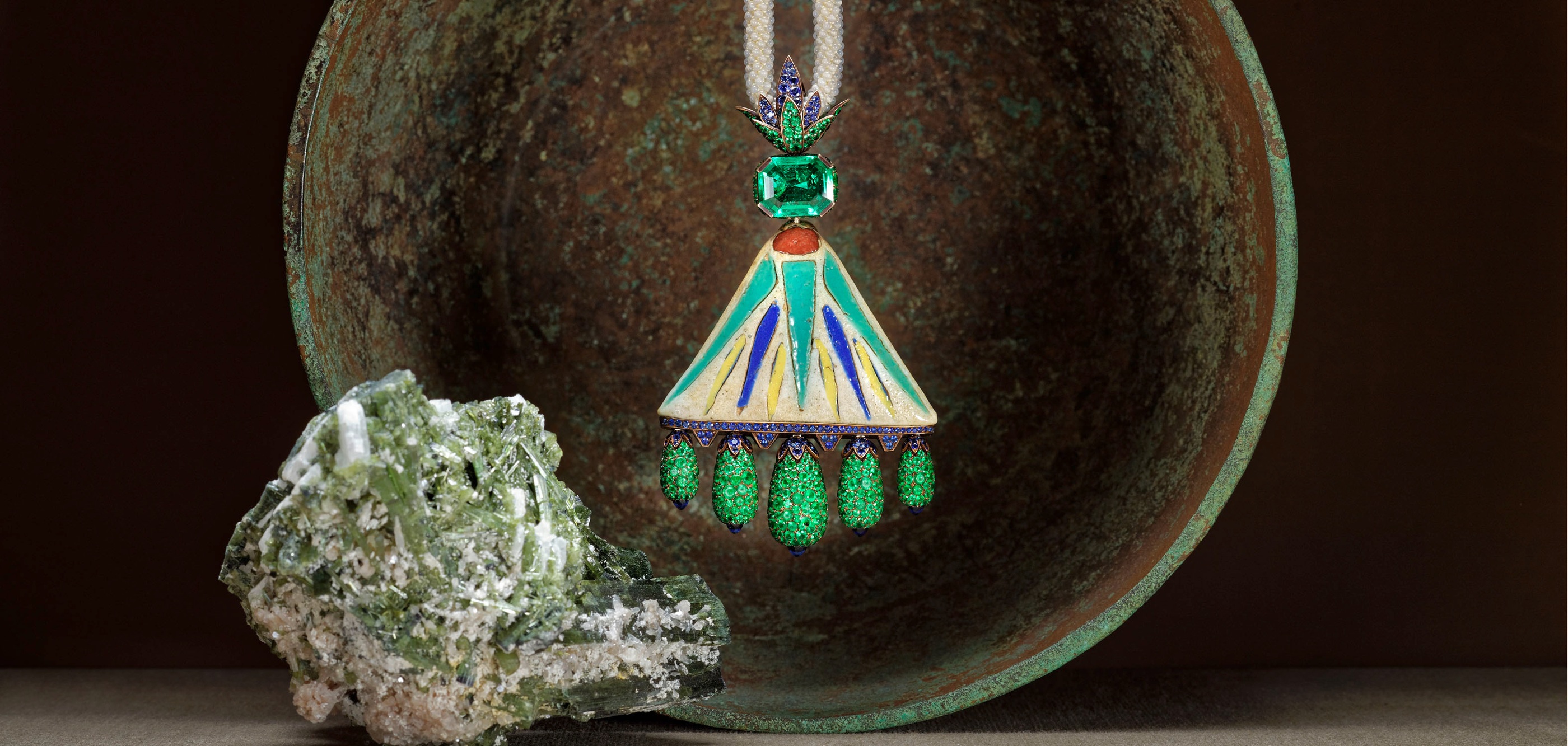
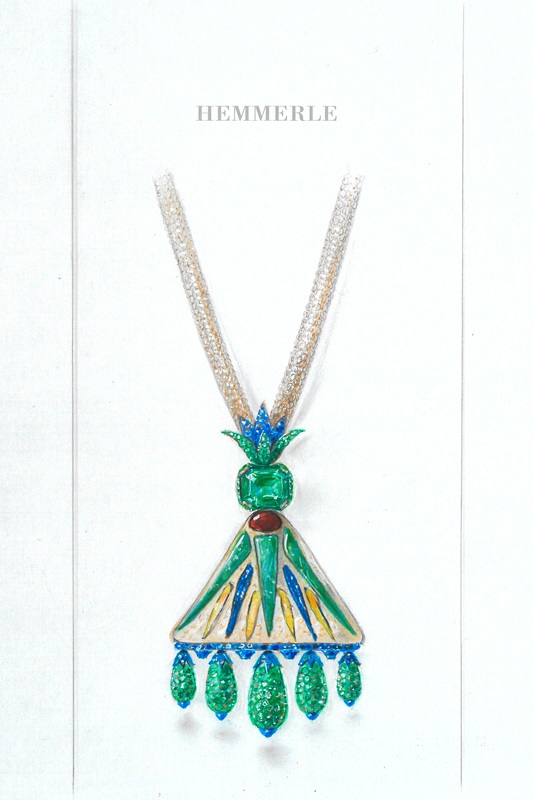
A small blue-and-white floral element becomes the centre of a necklace, with green and blue stones extending its colours into a new composition. In Hemmerle’s Revived Treasures, the meeting between an earlier object and a contemporary setting remains visible. The design question is how to give something with an existing character a new place in jewellery, while allowing the eye to recognise the difference between the parts.
An earlier object sets the terms
Hemmerle presented Revived Treasures as part of its 125th anniversary in 2018. The project draws on Egyptian forms and includes elements the house describes as ancient faience and amulets. This is a reading of that documented body of work, rather than a claim that the jewels are a new release or currently available for acquisition.
An element with an existing surface and shape gives a designer a different starting point from a newly cut stone. The line may be irregular, the colour softly varied and the image already complete. A frame cannot simply replace those qualities with its own. It must decide which to echo, where to establish a boundary and how much space to leave around the earlier object.
That makes the setting an active part of the story. A narrow outline can emphasise a shape, while a larger structure can give it an architectural presence. A new material may pick up a colour without trying to imitate the older surface. The most interesting relationship is often legible precisely because the two parts have different jobs.
A frame can change the way we look
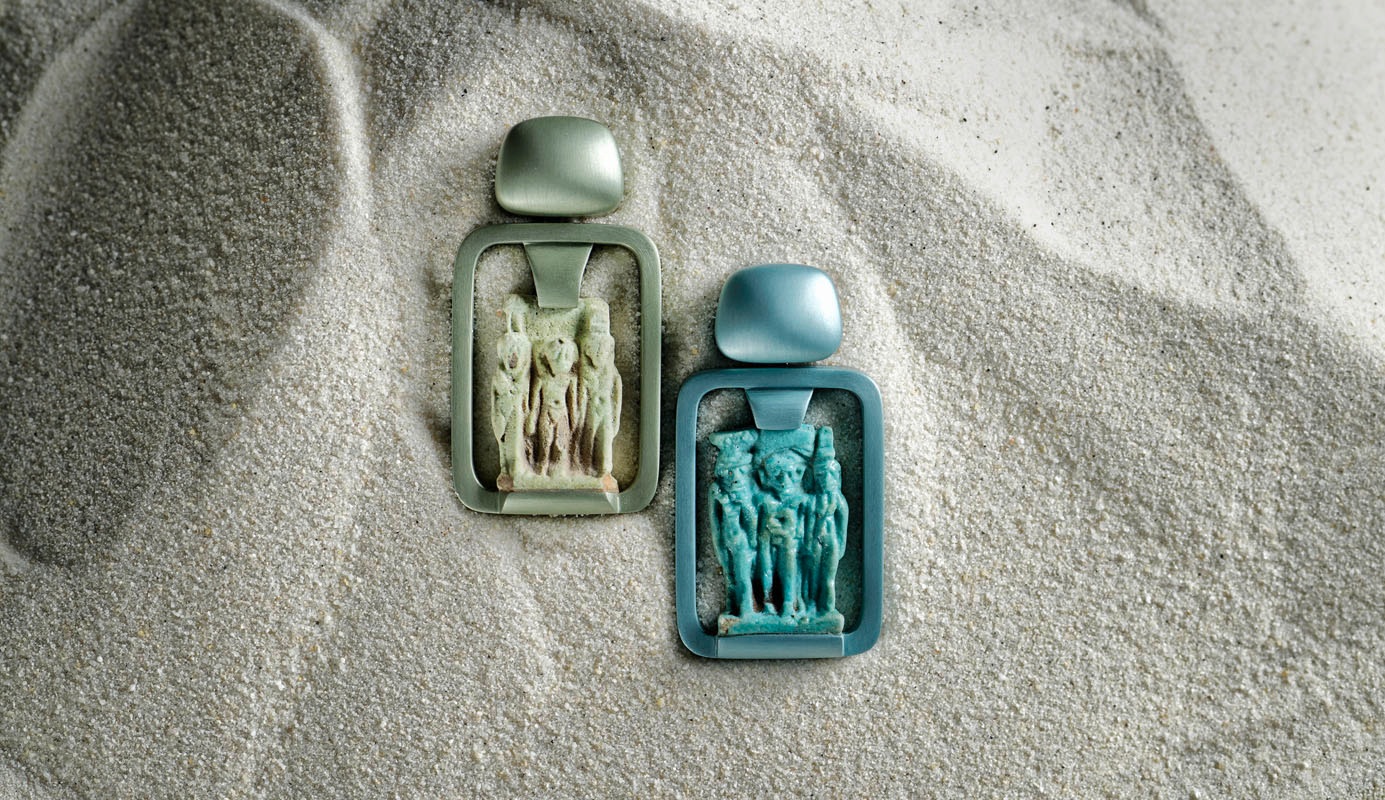
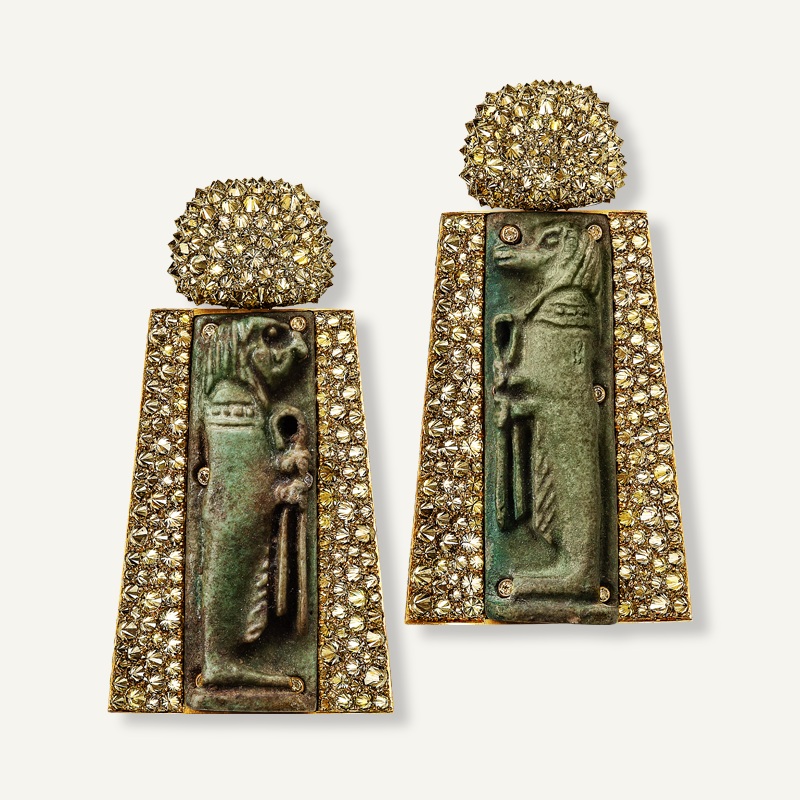
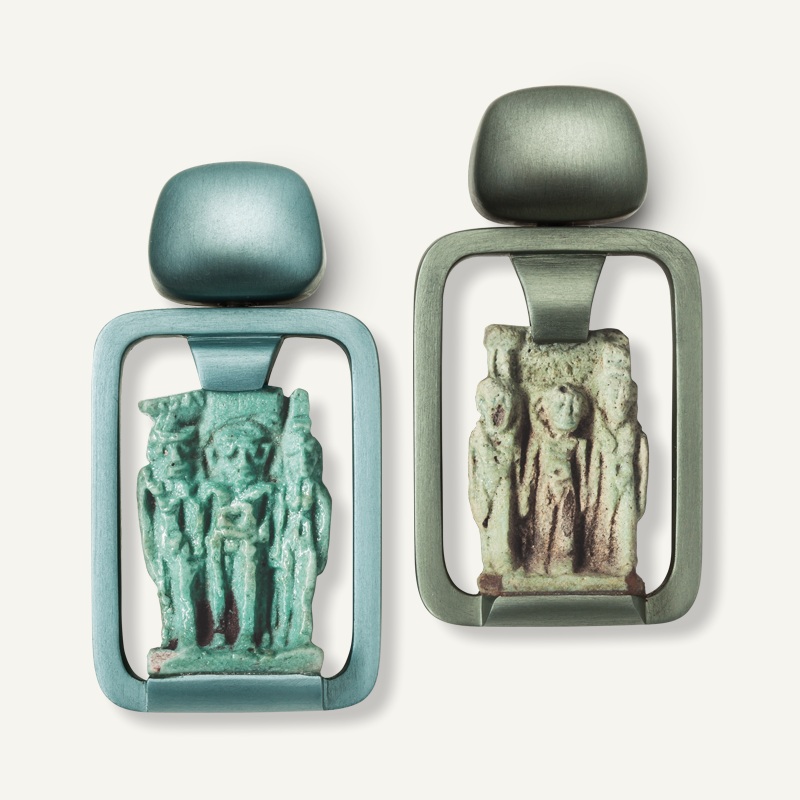
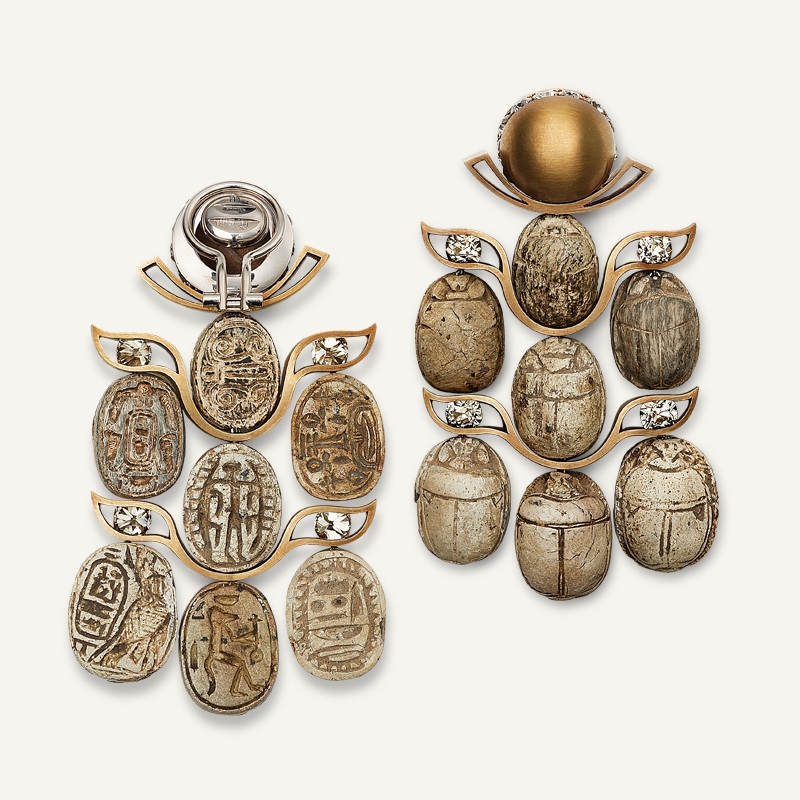
The project places small figures inside geometric surrounds. In the house’s named Sons of Horus earrings, bronze and diamonds build a structure around faience elements. Elsewhere, the official photographs show amulets within softly coloured open frames. The first effect is enclosure; the second allows the space around an object to remain part of its appearance.
Compare the borders with the surfaces they surround. A repeated line of bright points can sharpen the edge of an uneven central element. A quieter outline can direct attention towards its colour and relief. Neither approach needs to conceal the difference between the earlier element and its new setting. Instead, the contrast tells the eye where to linger.
The complete-object views matter here. A close photograph may make a small figure seem monumental; the whole earring reveals how that figure relates to the upper element, the border and its companion. Looking at both scales is a useful habit whenever the appeal of a jewel depends on something already carrying an image or a history.
The workshop is where the relationship is resolved
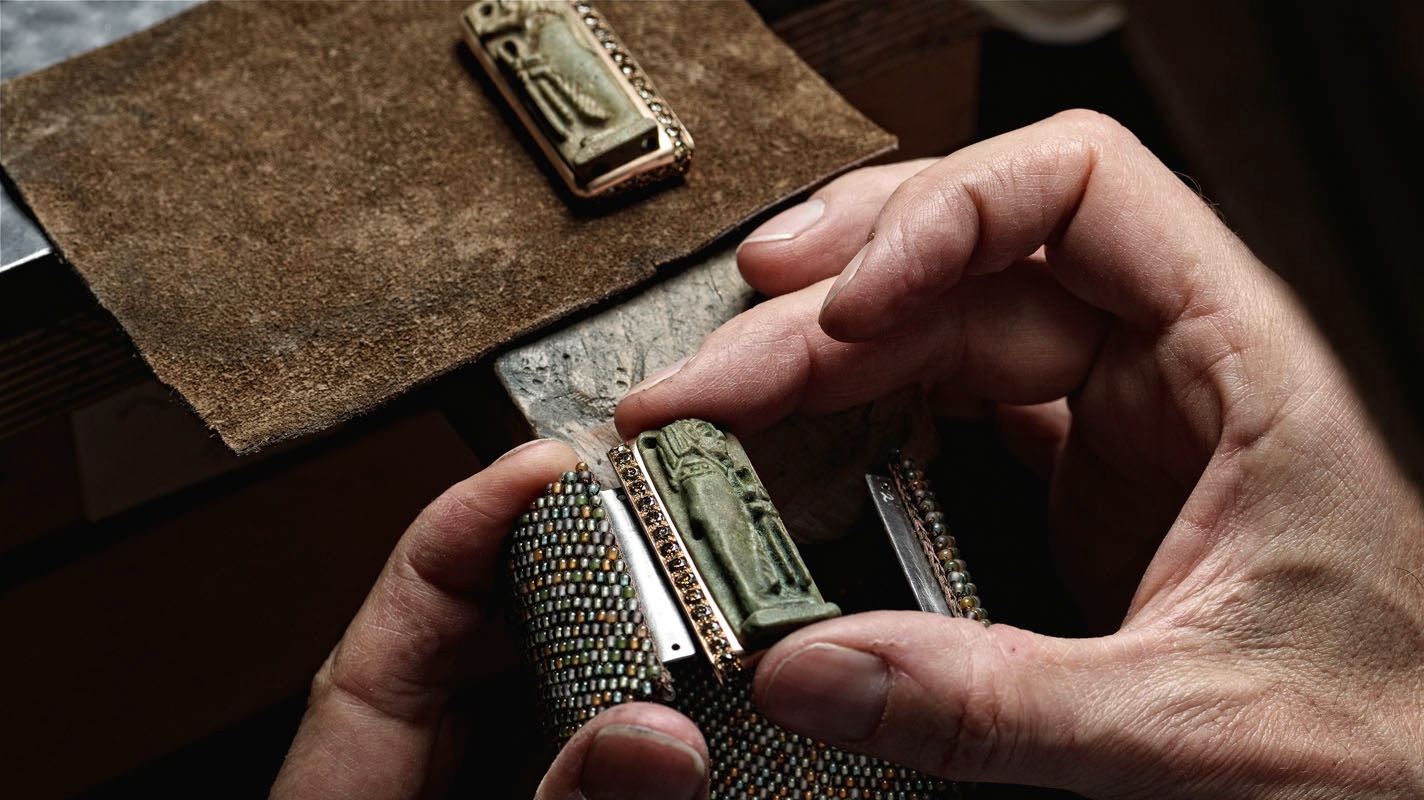
Hemmerle’s official workshop photograph shows hands working around one of the project’s framed elements. It brings the meeting of old and new down to a physical scale: a border, a support and the small decisions that let the complete object exist. The image supports a reading of construction, without establishing every intervention performed on the piece.
The house describes making its jewellery in a single atelier, with research spanning techniques such as patina development and stone setting. Its philosophy gives materials and experimentation a central place in the design process. For this project, those capabilities are relevant because a reused element asks the maker to respond to a particular form, rather than impose a standard outline upon it.
There is a useful distinction between admiring that capability and understanding an individual jewel. An image of the workshop explains a kind of work; the completed piece and its own account explain what was done in that case. A prospective owner should be able to move between the two without having to infer the second entirely from the first.
Different kinds of continuity
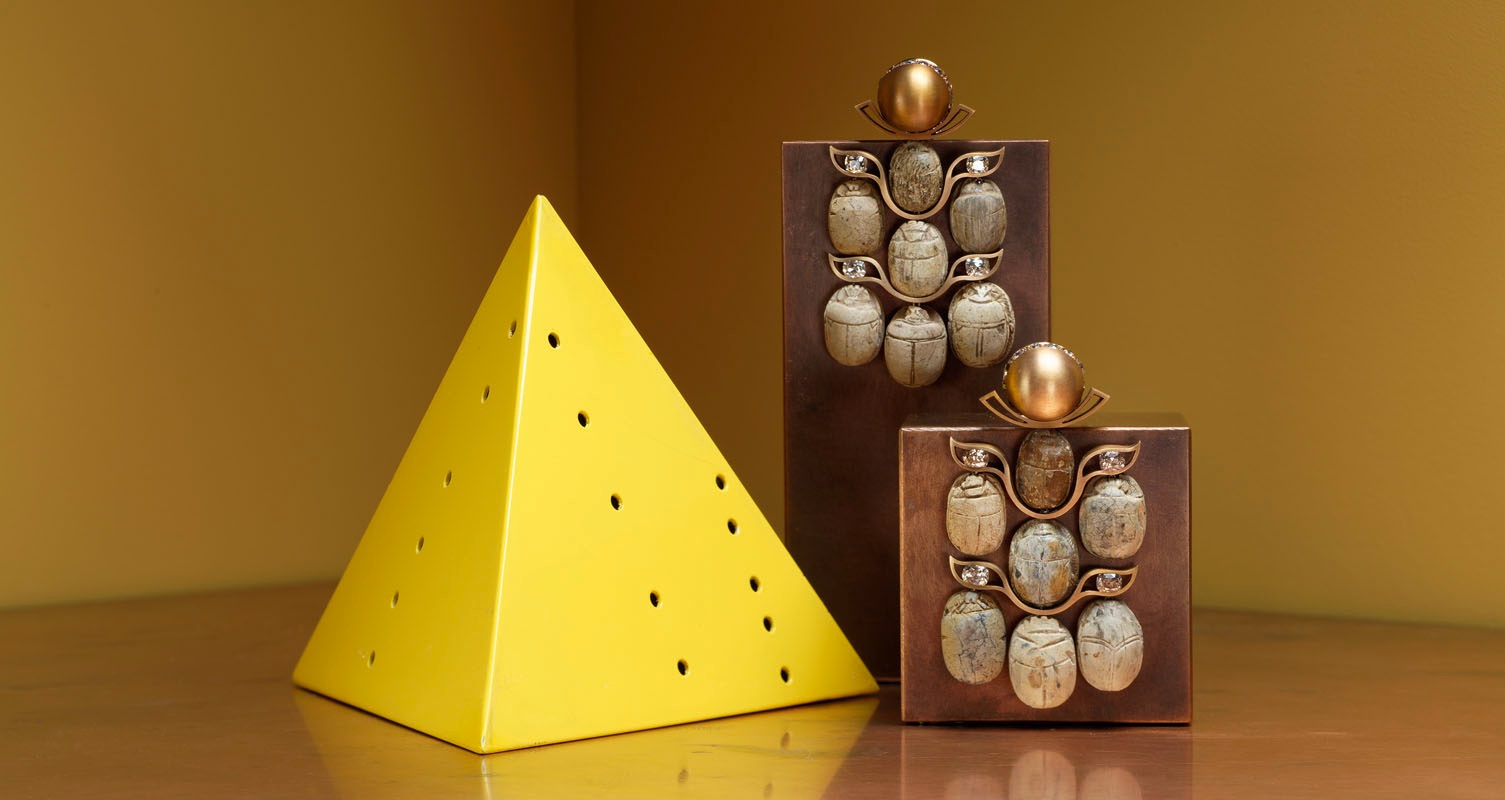
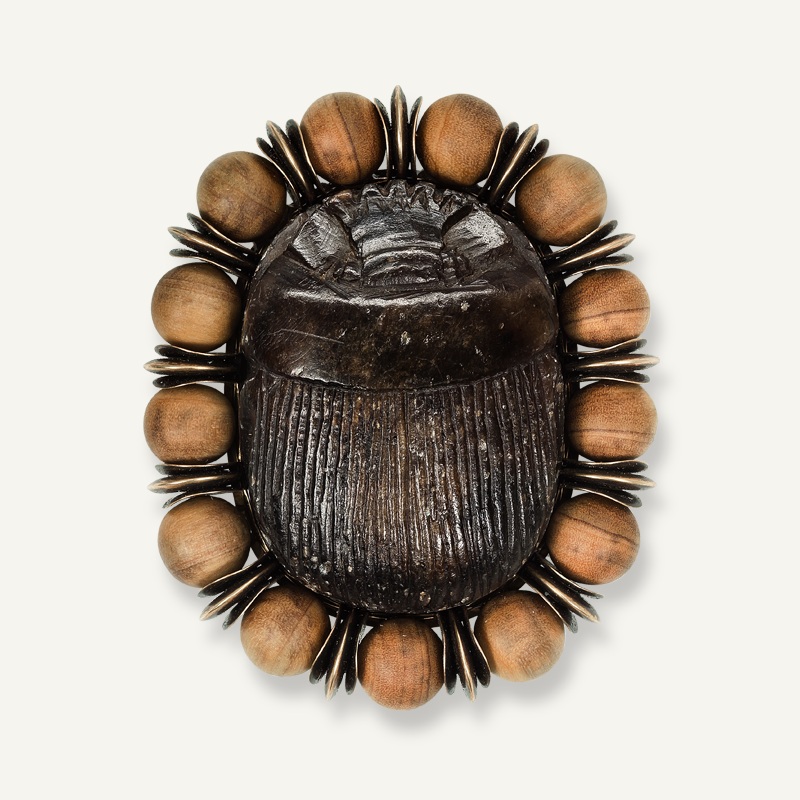
The scarab provides another route through Revived Treasures. Hemmerle’s project includes earrings incorporating scarabs, as well as a brooch whose stated materials include olive wood, bronze and white gold. These are different design propositions: an earlier carved element can be given a new surrounding structure, while a familiar historical form can also be interpreted through a newly composed object.
That distinction makes the project more interesting than a single label such as “Egyptian inspired”. Inspiration, the reuse of an element and the construction of a new jewel describe different relationships with the past. A clear description lets a reader appreciate the design without requiring every object to tell the same kind of historical story.
The paired complete views make these differences available to the eye. Look at the relative scale of the central form and the surrounding metal, the treatment of edges and the direction of the complete silhouette. The materials named by the maker help describe what is there; the design becomes persuasive through the way those parts relate.
A drawing carries the idea forward
The published drawing of the necklace connects its central floral element to a descending arrangement of coloured stones. In the final photograph, the same broad idea has a physical presence: colour, outline and hanging forms continue the composition beyond its centre. The drawing is worth looking at as an account of intention, alongside the object that interprets it.
A drawing and a finished jewel need not be visually identical to be informative together. They allow the viewer to ask what was essential to the original idea. Was it the continuation of a colour, the direction of a pendant or the relationship between the central image and the line around the neck? Those questions reveal more than treating the drawing as decorative background.
Before an object becomes an acquisition
For an interested collector, the project’s appeal should lead towards a specific description of the actual jewel. Establish which elements the maker identifies as earlier, what is contemporary and what documentation accompanies that account. An attractive general story and an individual object’s recorded history are complementary pieces of information.
| What draws your attention | What to examine | What to ask about the individual jewel |
|---|---|---|
| An earlier element | Surface, relief and complete shape | How the element is identified in the supplied account |
| A new border | Structure and the space around the centre | Which materials and components belong to the setting |
| A historical motif | The form of the complete object | Whether the work interprets a motif or incorporates an earlier element |
| A workshop image | The type of construction illustrated | What work is documented for this example |
| A design drawing | The relationship to the finished piece | Which accompanying records are available |
The resulting conversation can deepen the pleasure of looking. A clear account leaves the jewel free to be admired for the design choices it actually contains, while giving its historical elements the attention their descriptions deserve. The new setting becomes a considered response to an existing object, carrying the relationship into another chapter.
Sources & credits
Methodology and sources
An editorial reading of Hemmerle’s published 2018 project. Historical identifications are attributed to the house; this article does not independently authenticate, date or establish the ownership or export history of individual antiquities. No handling, atelier visit or acquisition was undertaken. Official drawings, workshop and object photographs retain their distinct roles.