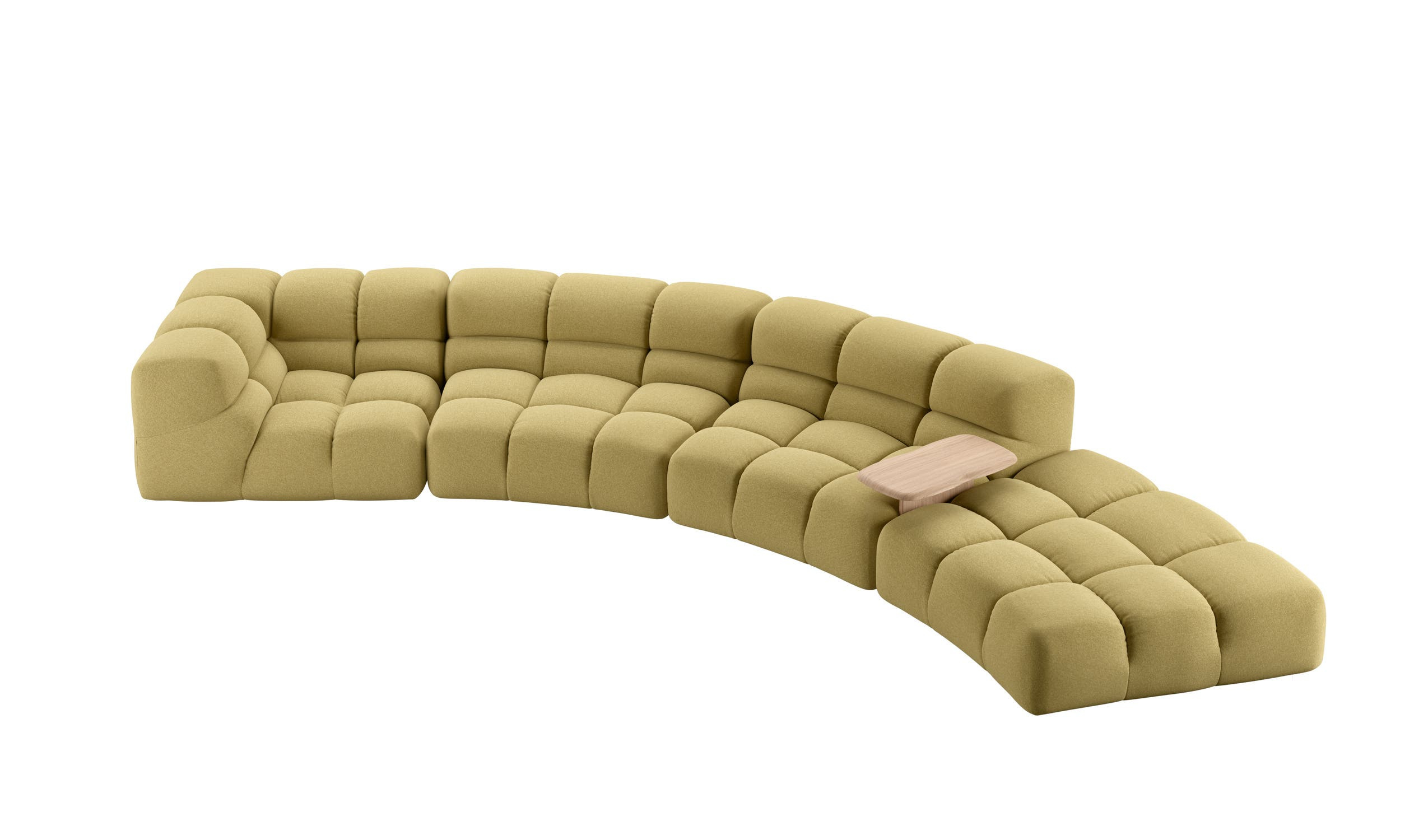
A sofa changes a room before anyone sits down. Its outline directs the approach, determines the space left between people and decides whether the centre feels occupied or open. Tufty-Time 20 makes those decisions unusually legible: soft squares remain its building blocks, but the composition can now turn rather than simply extend.
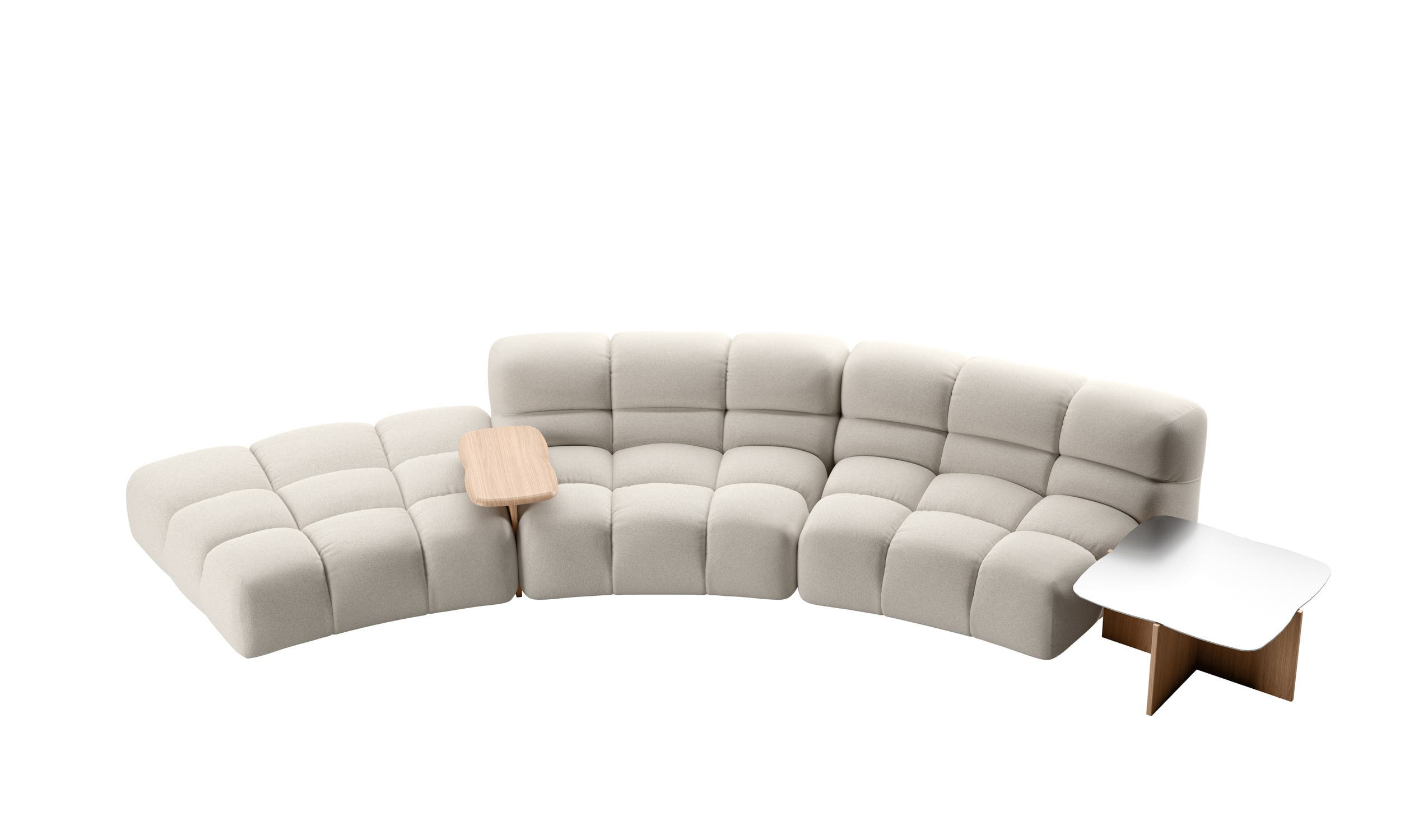
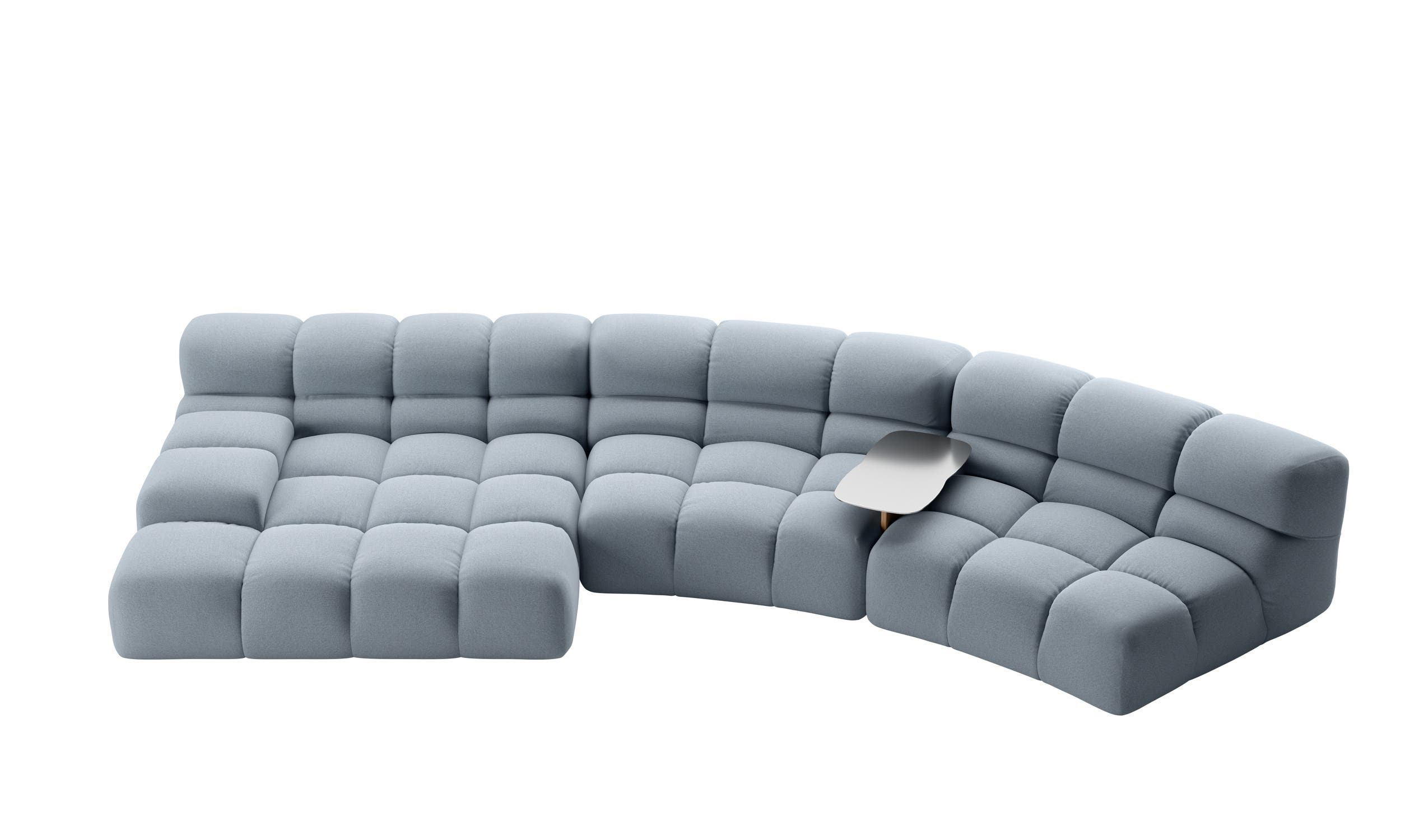
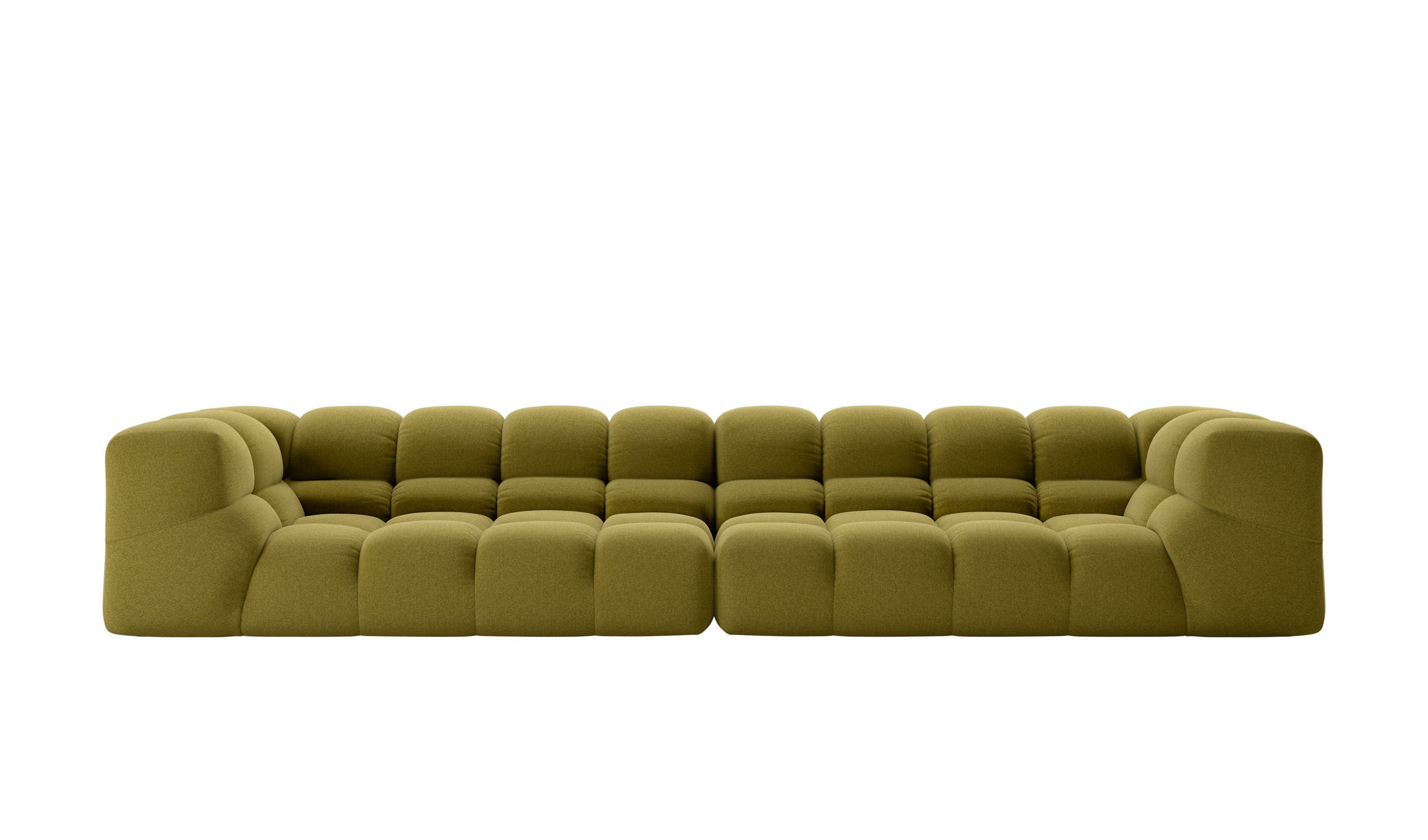
A grid that can change direction
Patricia Urquiola’s Tufty-Time dates from 2005; B&B Italia identifies Tufty-Time 20 as its 2025 evolution. This is a reading of that documented system, rather than a claim that a new collection has just launched. The photographs and isolated product views show how a familiar quilted surface can support quite different room geometries.
The interesting change is the curved module. In the manufacturer’s presentation, it broadens the possible arrangements beyond the straight run and conventional corner. Seen from above, a curved composition opens a shallow bowl towards the centre of the room. A chaise at one end then creates a second direction, allowing the same group to face both the conversation and the space beyond it.
There is a useful distinction between the softness of the surface and the clarity of the plan. The upholstery dissolves sharp edges; the footprint still has to respect doors, walking routes and the reach to a table. A generous arrangement earns its place when people can move around it without treating the cushions as a shortcut.
Read the whole before choosing the modules
The isolated views are valuable because they remove the seduction of architecture. Without a landscaped courtyard or a high ceiling, the difference between a long low composition and a compact curve becomes easier to see. Neither shape is intrinsically more luxurious. The useful question is which one makes the intended room work with less negotiation.
Begin with the occupied space, including the person sitting at the edge, a table pulled towards a seat and a visitor passing behind. This is a more revealing drawing than a tight outline of the furniture. In a long room, a straight composition may make the space feel calm and continuous. Where people gather from several directions, a curve can make arrival feel less like an interruption.
The maker states that padding, volumes and seat height were reconsidered for Tufty-Time 20. Those are documented design changes, but a photograph cannot tell a reader whether the resulting seat suits their own posture. A showroom visit should therefore use the actual intended arrangement: an end seat can produce a different experience from the centre of a long bank.
The surface makes the scale
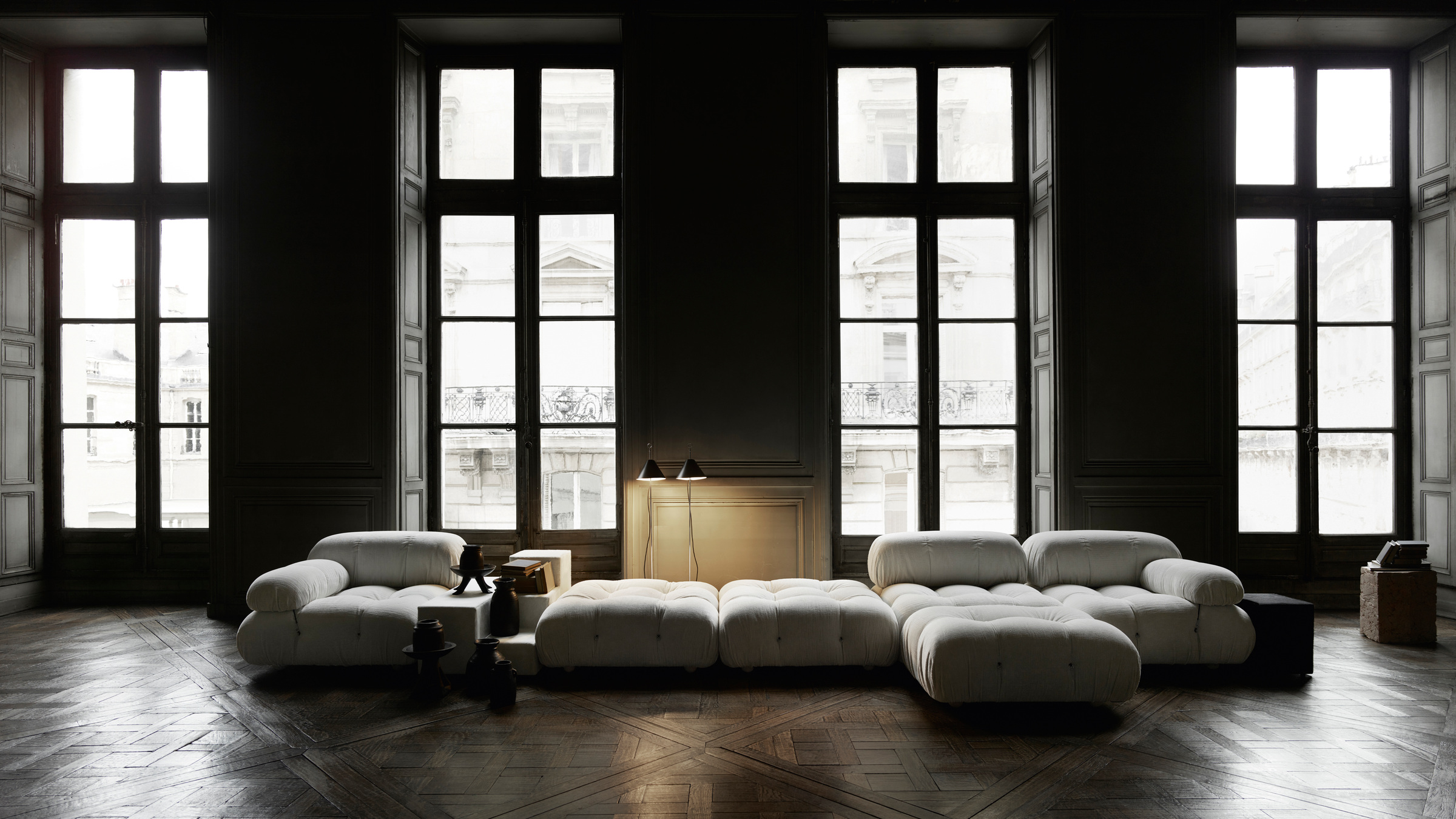
Tufting gives this large object a smaller visual unit. Instead of one uninterrupted upholstered mass, the eye meets a repeated series of soft squares. At room scale the repetition gives order; close up, the rounded edges and seams introduce a quieter rhythm. The product is recognisable without needing an elaborate frame or visible legs to carry its identity.
Colour changes how that rhythm reads. In the official isolated views, muted green brings the shape forward as one continuous object. Pale upholstery makes the valleys between cushions more prominent. Warm brown gives the same geometry a denser, more grounded presence. These are observations about the images, not statements that the pictured finish will look identical under every room’s daylight.
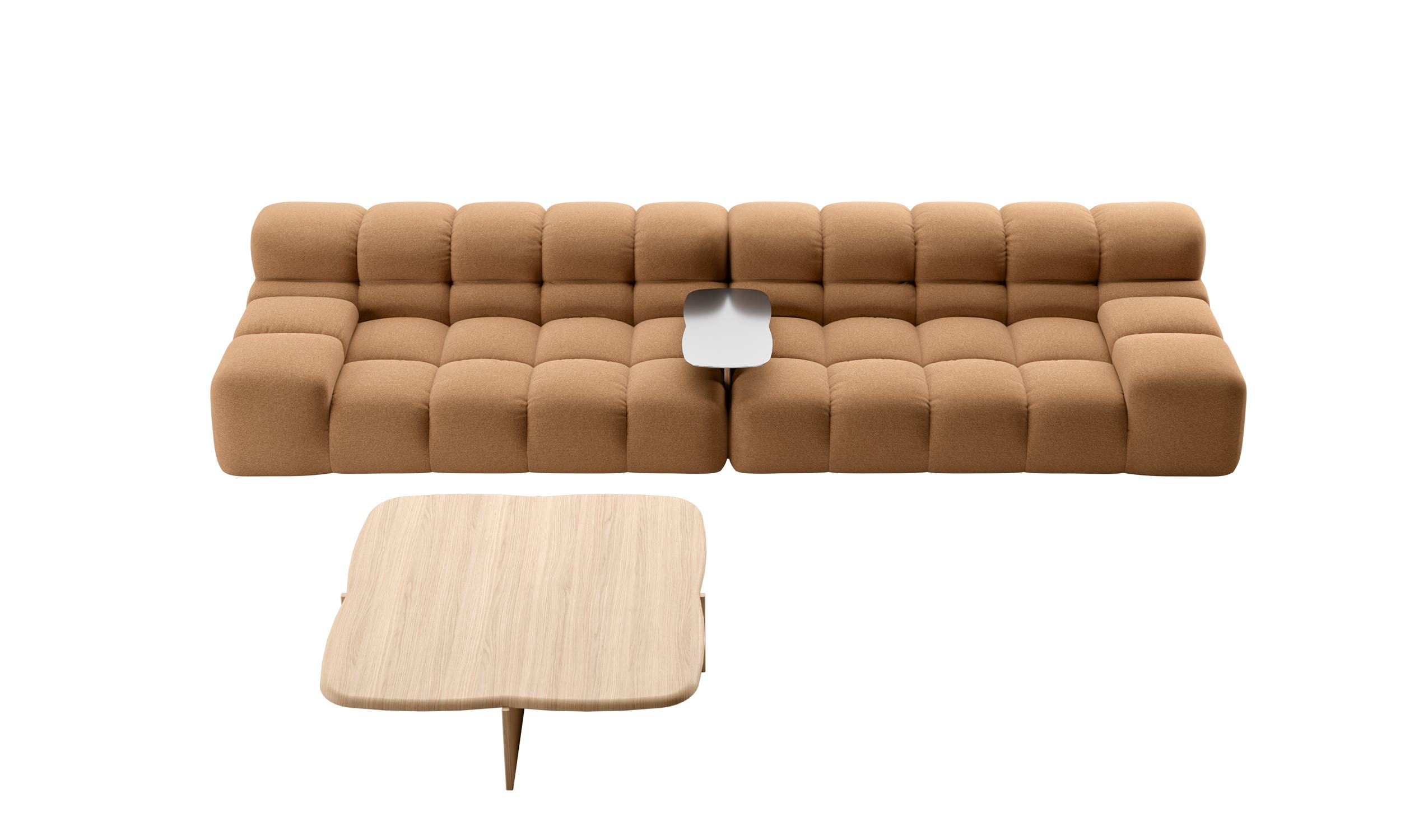
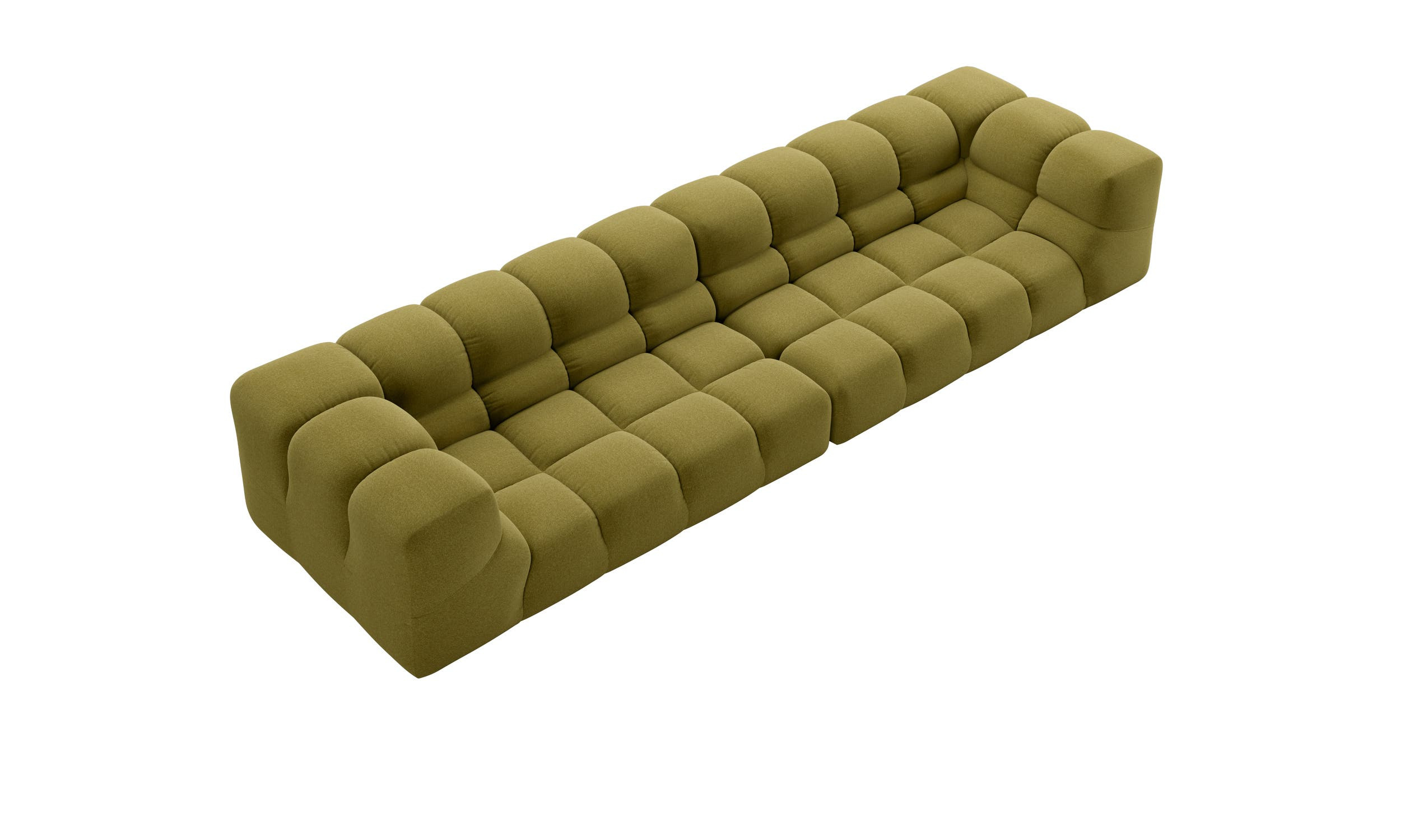
When choosing upholstery, place the sample beside the actual floor and the other large surfaces. The colour that looks restrained on a bright screen may become the room’s strongest element in a darker setting. Keep the sample large enough to see the weave and the direction of the light; a tiny swatch is a poor substitute for the visual weight of several metres of fabric.
Give the centre room to breathe
A curved sofa creates a centre of gravity. Filling that centre with one oversized table can undo the openness that made the composition attractive. Several smaller elements may offer more precise places for drinks or books, but their spacing must still leave a practical route. The right table arrangement follows the seats rather than merely echoing the sofa’s outline.
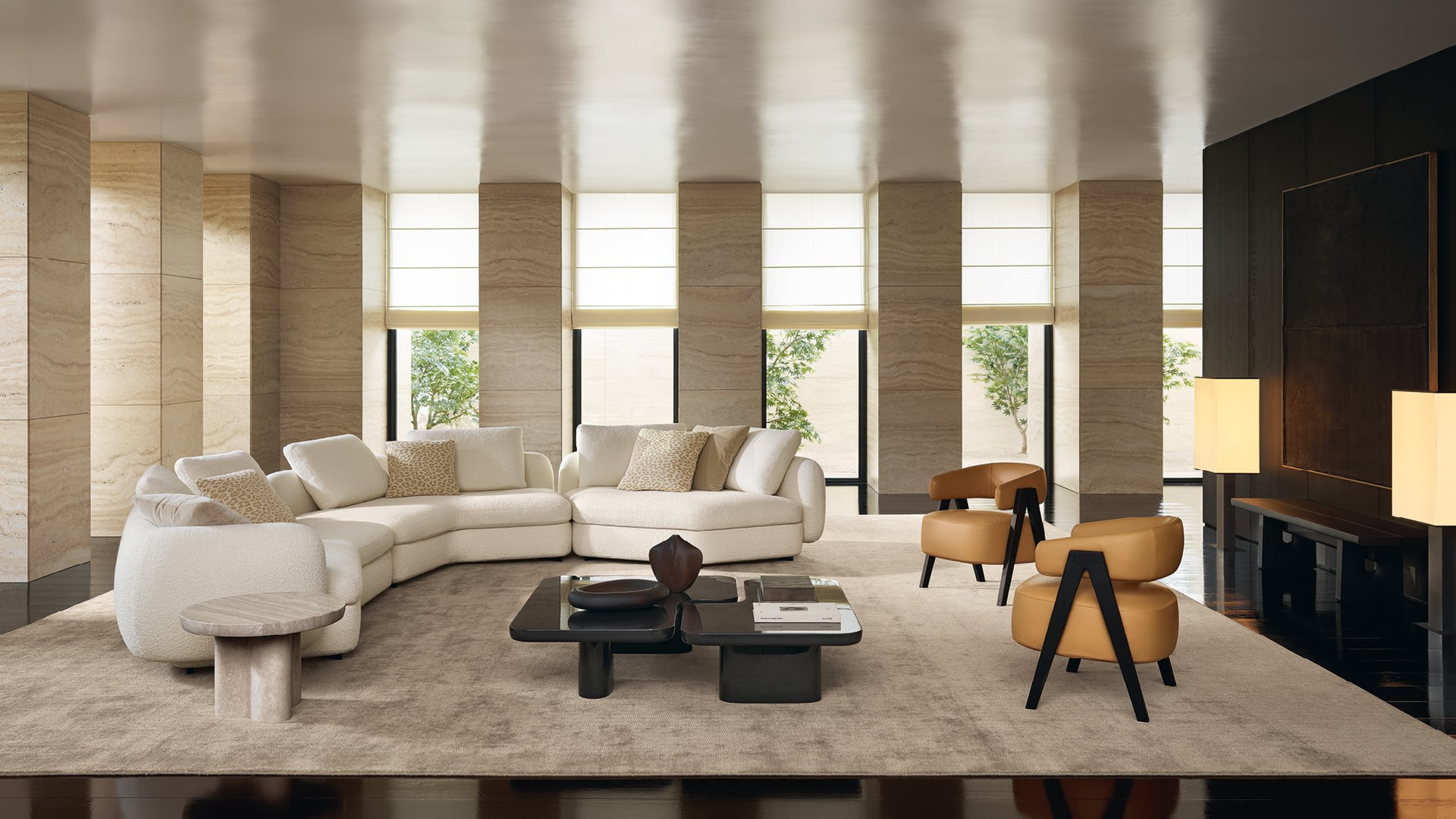
The official room imagery gives a second reading of the system, with broad architectural planes setting off the cushions. It is a useful composition lesson: the furniture becomes more expressive when the surrounding materials are allowed to remain simple. The atmosphere shown belongs to the manufacturer’s presentation; the article does not identify that setting as a bookable house or a documented private commission.
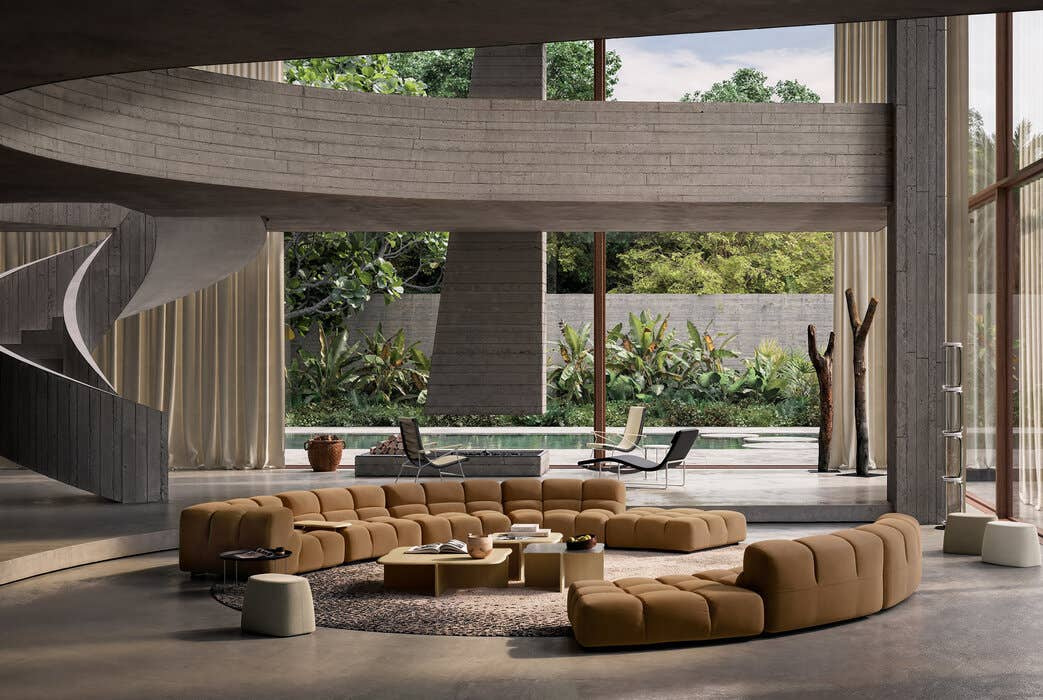
An adjacent chair can add another scale without creating a competing upholstered landscape. Consider its view towards the sofa and whether somebody using it becomes part of the same conversation. A successful room is not necessarily a perfectly matching collection. It is a set of places from which people can comfortably acknowledge one another.
A brief for the living room
| Decision | What to establish | Why it matters |
|---|---|---|
| Composition | Draw doors, circulation and occupied seats | The sofa must leave usable routes |
| Curve | Compare the open side with the arrival direction | The plan determines how people join the group |
| Upholstery | Review a real sample beside floor and daylight | A screen cannot establish colour or texture |
| Tables | Test reach from each intended seat | The centre must remain useful rather than crowded |
| Comfort | Try the intended module and end position | A system view does not establish personal fit |
| Service | Request care and component information for the order | Maintenance starts with the exact specification |
Disassembly is a practical question
B&B Italia describes Tufty-Time 20 as fully disassemblable. That is a meaningful design statement, but it does not by itself establish local recycling infrastructure, replacement-part availability or a lifetime environmental result. The owner-facing question is how the chosen composition can be serviced when one component needs attention.
Ask for the relevant care information and retain the order specification. If a room changes, accurate module records are more useful than a remembered collection name. The same discipline makes a later upholstery or service enquiry more precise: identify the particular item and finish rather than treating every member of the system as interchangeable.
The Luxe Digital view
Tufty-Time 20 is most persuasive when its soft grid creates a clear social plan. The curve is valuable because it offers another way to organise a group, not because it makes every composition automatically better. Its strongest room leaves enough space around the furniture for the architecture, the light and the people to complete the picture.
Tufty-Time 20 is most persuasive when its soft grid creates a clear social plan.
Sources & credits
Sources and methodology
Independent editorial analysis of the documented product and official source imagery, checked on 14 October 2026. Visual interpretation is distinguished from manufacturer specifications. No handling, driving or acoustic test is implied; exact references and archival dates are retained.
- B&B Italia — source 1: Current product, designer, 2025 identity, curved module and documented disassembly.
- B&B Italia — source 2: Official technical description and changes to volumes, padding and seat height.
- B&B Italia — source 3: Official campaign context, separate from an identified residential commission.