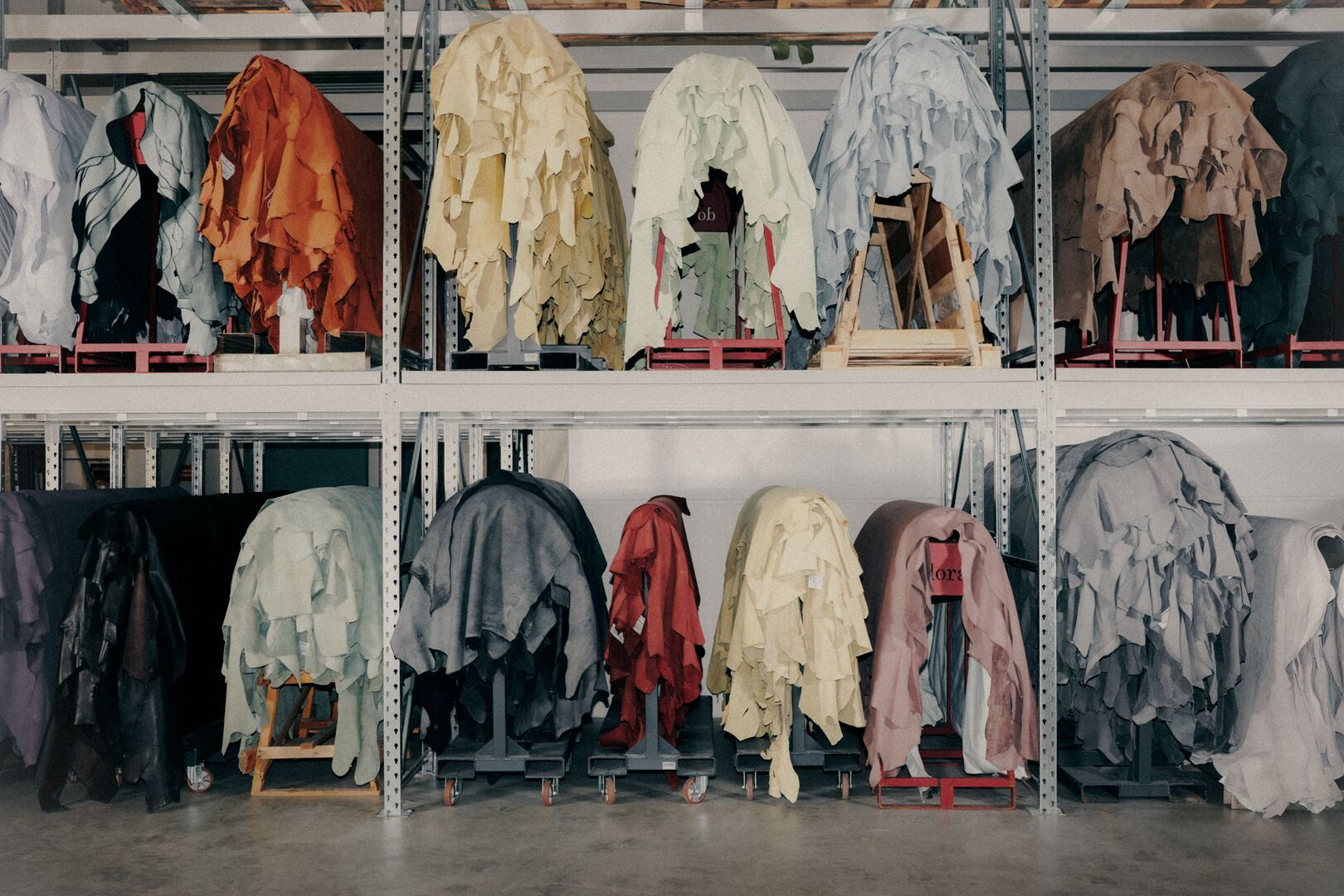
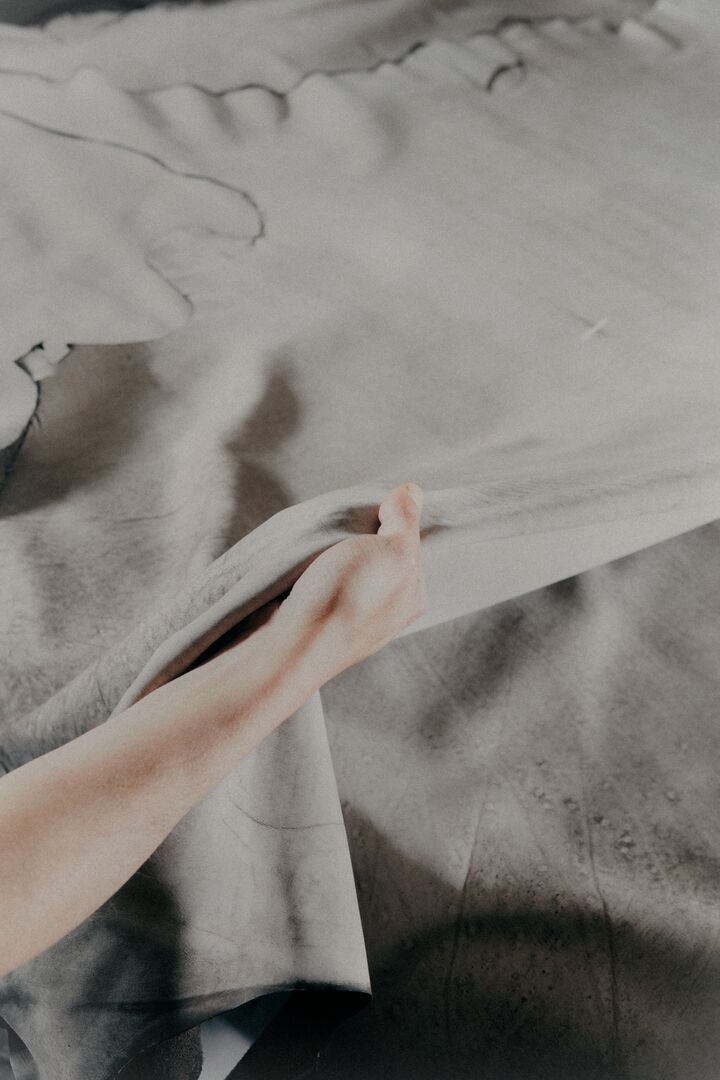
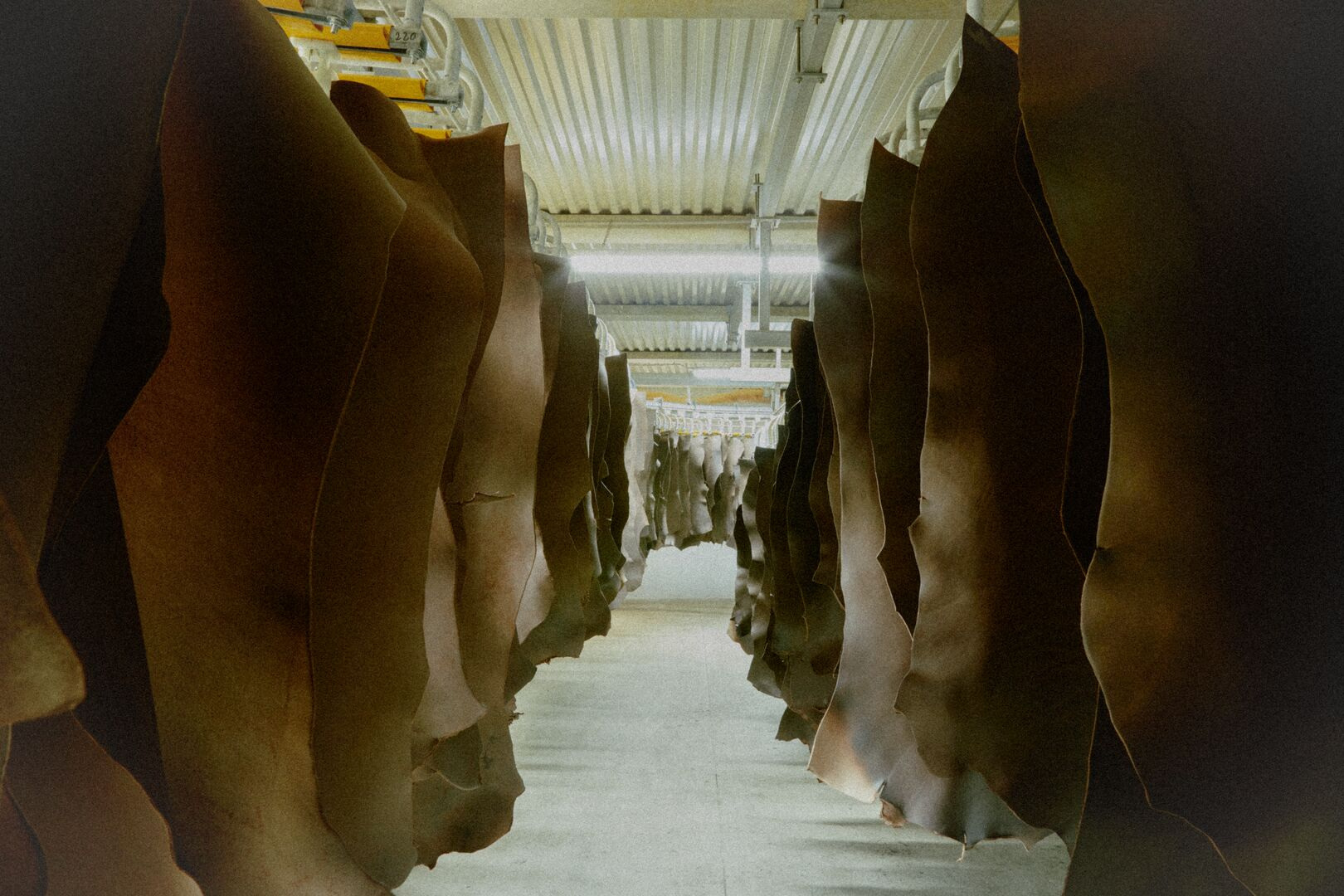
The most revealing image in Baxter’s published production sequence is a rack of hides. Colours hang together in a working space, their irregular outlines still visible. Before leather becomes the continuous surface of an upholstered piece, it is a material to be examined, selected and worked. The finished object contains decisions that its silhouette alone cannot explain.
Before leather becomes a sofa
Baxter’s official leather account and Thomas Pagani’s credited production photographs form the basis of this study. The company’s history places its founding in 1990. The interest here is the making of an upholstered surface, rather than a factory visit or a recommendation of one finish for every home. Different leathers have different specifications and care requirements; the exact material remains part of the purchasing decision.
Selection is already a design act
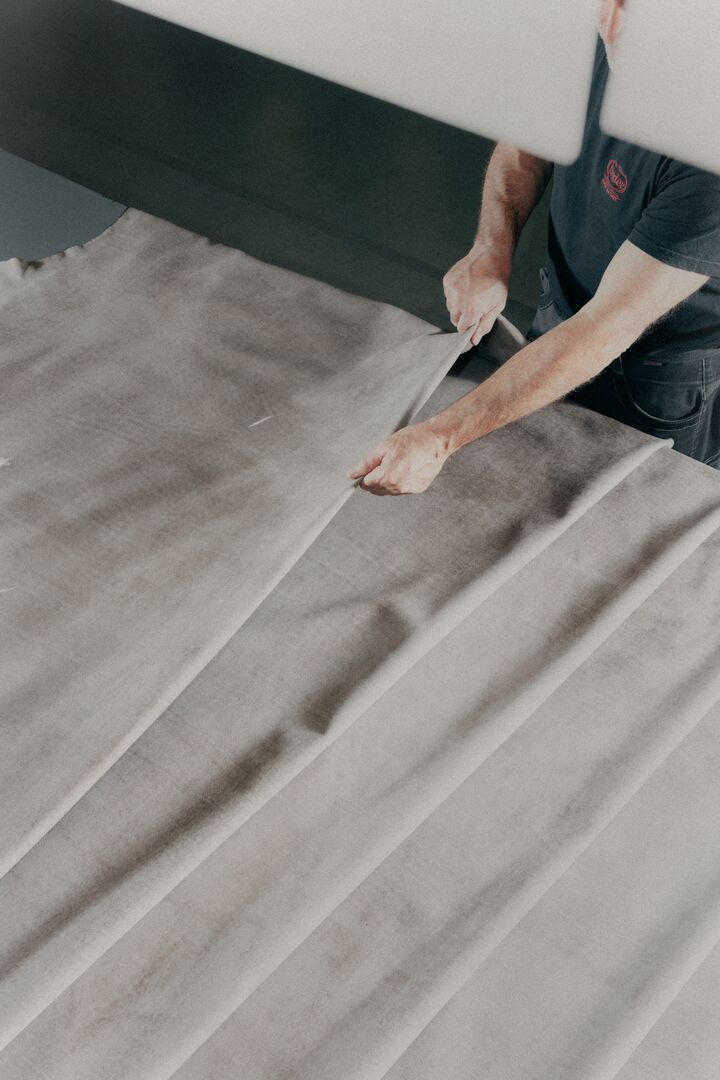
The rack and worktable photographs offer two different distances from the material. From further away, colour appears as a set of possibilities. At the table, the hand brings attention to a particular area of a hide. The sequence makes a basic point visible: selecting leather is more specific than choosing a colour name.
For an owner, that specificity matters when discussing a substantial commission. A small sample can introduce a material, while a larger view helps explain how variation may be distributed across an upholstered piece. Ask the supplier what differences are expected within the chosen leather and how those differences are considered in production. An answer tied to the actual finish is more useful than a general promise about natural materials.
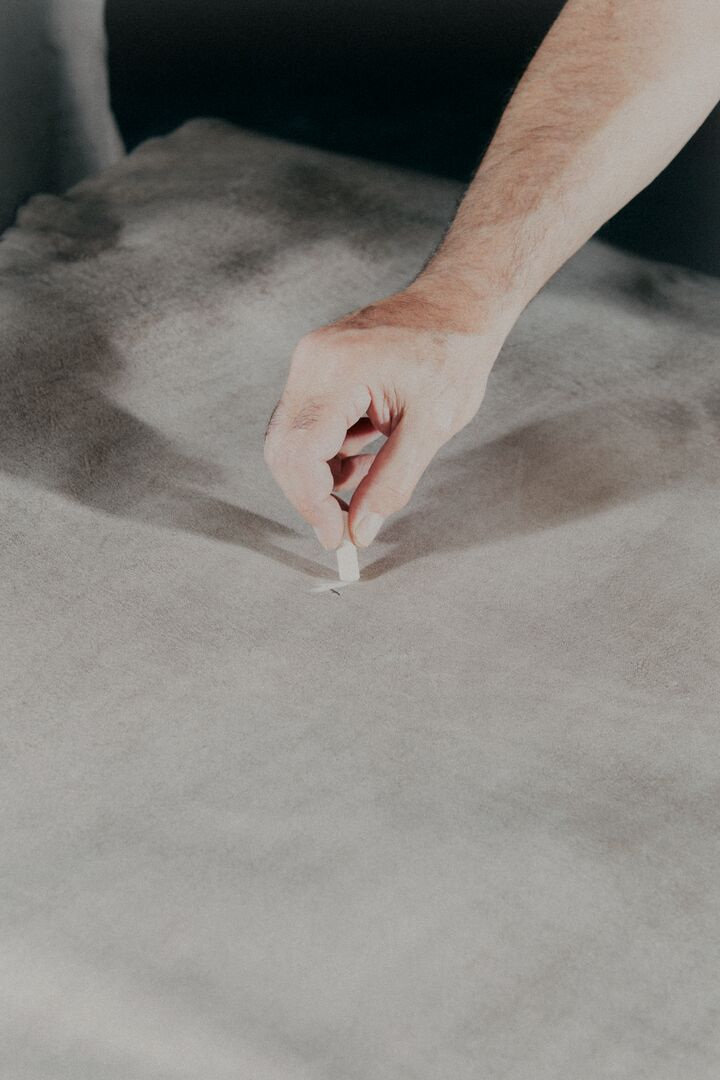
The photographs do not let us grade an individual hide or assess the finished product’s service life. They show a working process. Keeping those two forms of evidence separate makes the account more useful: a visible act of selection demonstrates attention at that stage, while performance and suitability require the relevant product and material documentation.
A seam has a direction
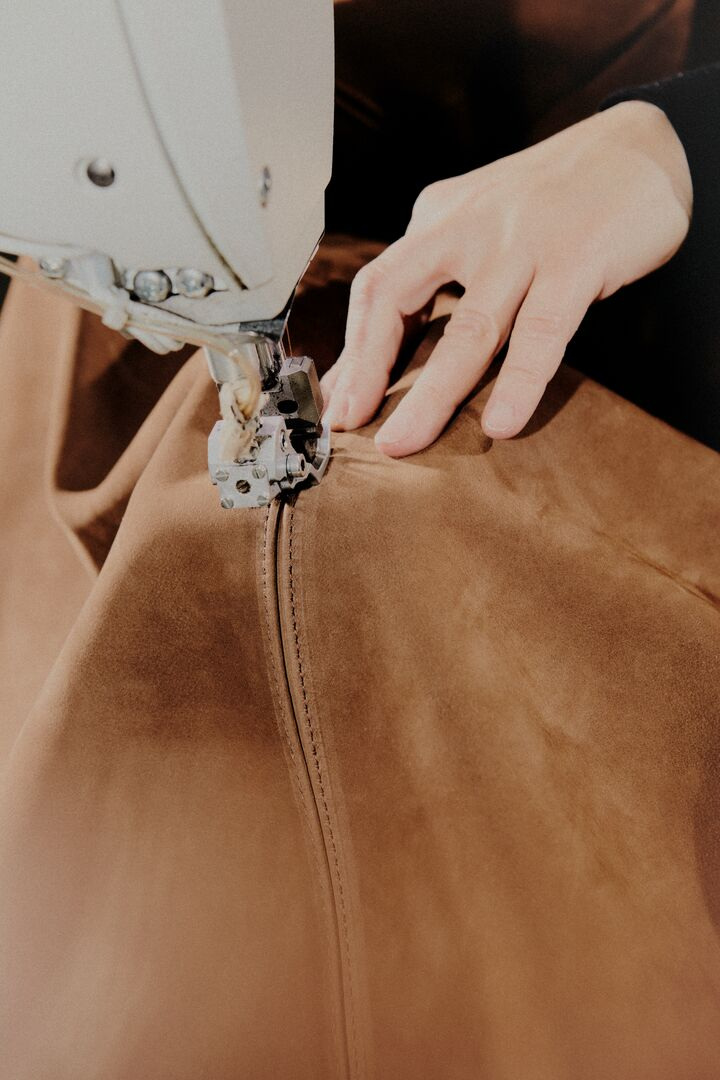
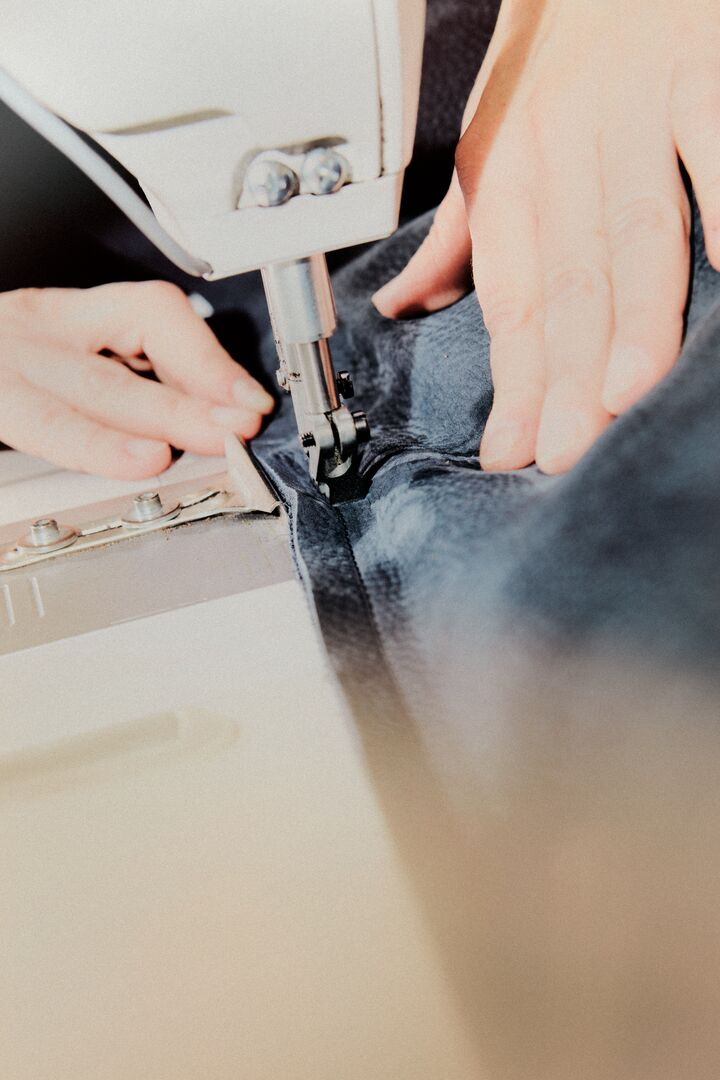
In the sewing photographs, the leather moves through a machine under the guidance of a hand. The frame is close enough to make the seam the principal subject. It reveals a different way to read upholstery: the edge is a designed feature, with its own line, thickness and relation to the surrounding surface.
On a finished object, a seam can articulate a curve, mark a boundary or emphasise how separate pieces meet. Its effect depends on the leather and the shape it follows. A reader considering an upholstered piece can look at where those lines become prominent and where they are allowed to recede. The same attention can be applied to the back and sides, especially when the object will stand away from a wall.
This is a useful argument for viewing a piece from more than its catalogue angle. A sofa seen in the centre of a room has a rear elevation; an armchair has an approach from behind. Ask for those views and for the precise finish being ordered. The seam belongs to the object’s complete presentation, rather than being a detail discovered only after delivery.
Softness changes the reading of form
The handling photographs show leather bending around a shape and being worked across a surface. They do not provide a comfort test. What they make legible is the relationship between a flexible covering and the form beneath it. A broad upholstered volume and a tightly defined edge ask the material to describe different things.
A photograph of a finished seat often compresses that distinction into a general impression of softness. The production sequence gives the reader a reason to be more exact. Which parts are meant to hold a strong outline? Where does the material gather or move? How are those differences represented in the specific version being considered?
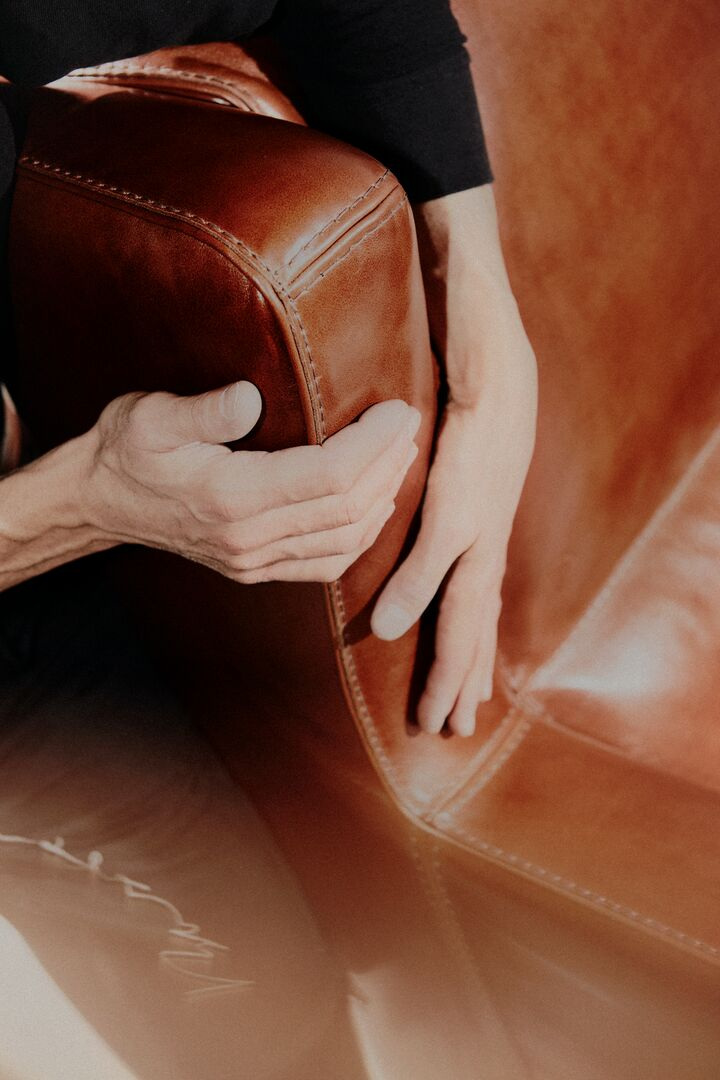
Those questions should be taken to the actual piece or to a properly documented sample. An image cannot tell a reader how a seat feels after an hour, whether its depth suits them or how a particular cover behaves in their room. A responsible presentation can make construction and appearance clearer while leaving bodily experience to an encounter that has actually happened.
Material names have consequences
Baxter’s Hydro record illustrates why leather cannot be treated as one specification. It describes a particular full-grain material, its processing and its intended use, then gives material-specific maintenance guidance. That record belongs to Hydro. It should not be applied automatically to the leathers visible elsewhere in the production photographs or to every upholstered Baxter product.
The broader buying lesson is straightforward. Retain the material name and code with the order, request the current care information and clarify what changes in appearance the supplier considers characteristic. An appealing sample is the beginning of that record. It should lead to a written specification that can be referred to when the piece is delivered and later maintained.
The same discipline helps with repairs or a future companion piece. A colour seen on a screen is an uncertain reference, and the appearance of a used surface may have changed. The original order and finish information give the supplier a firmer starting point. No general cleaning method is prescribed here: treatment should follow the exact material’s current instructions.
What to establish before ordering upholstery
| Decision | Evidence worth requesting | Why it matters |
|---|---|---|
| Leather selection | Exact name, code and a representative sample | Keeps the order tied to a defined material |
| Visible construction | Front, side and rear views of the chosen version | Shows seams and edges beyond the catalogue angle |
| Expected variation | The supplier’s description for that leather | Sets a clear discussion about appearance |
| Care and future work | Current instructions and retained order details | Gives maintenance or repair a documented starting point |
These requests do not turn a client into a production specialist. They create a useful record of the decisions that matter to the finished piece. They also give craftsmanship a practical place in the conversation: how the object is made, what has been selected and what the owner should retain.
The Luxe Digital view
Baxter’s production images are compelling because they move the discussion behind the finished silhouette. Hides, hands, machines and partly resolved surfaces reveal a sequence of decisions. The material is seen being directed towards an object, rather than presented as a decorative label attached to it afterwards.
For a reader, the most durable response is to ask more precise questions of the piece being considered. Follow a seam around the object. View the rear. Keep the leather specification. Establish the care information before there is a problem to solve. A strong presentation of craftsmanship makes those questions easier to ask, while respecting the difference between a photographed process and a claim about the performance of an individual purchase.
Baxter’s production images are compelling because they move the discussion behind the finished silhouette.
Sources & credits
Sources and methodology
Independent design and reference analysis of the named official records and imagery, checked on 15 October 2026. Launch specifications and later product records retain their own dates and references. Images show the identified configurations. Original visual and commissioning analysis of the exact official product/project records and identified images. No visit, interview, comfort test or performance measurement claimed. Existing projects retain their dates; product versions, showroom photographs, sample images and official visualisations are identified separately.