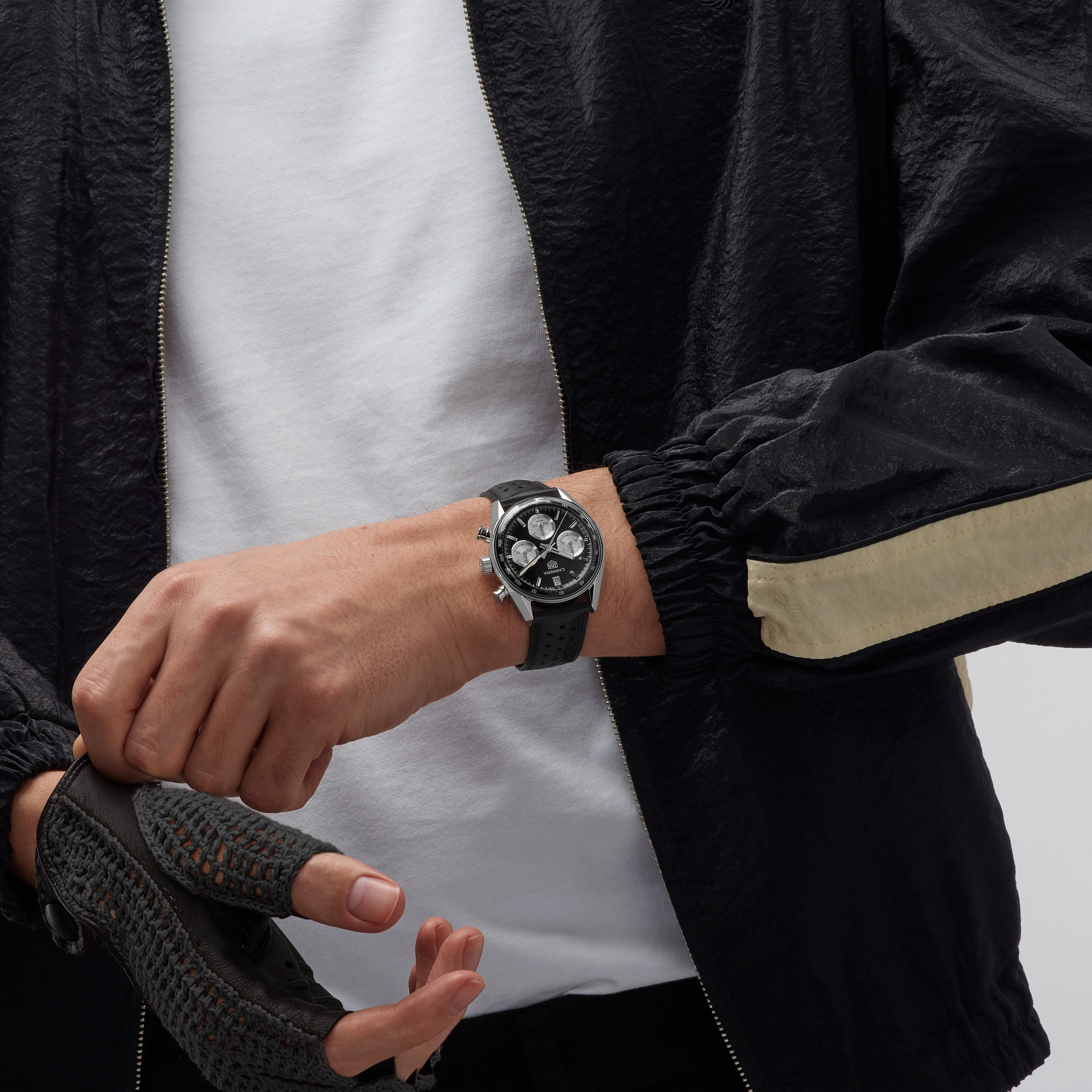
The Carrera Glassbox gives the dial’s outer edge another dimension. Beneath the domed crystal, the scale rises towards the perimeter, making the face something more spatial than a flat circle behind a window. On the black 39 mm reference CBS2210.FC6534, that raised boundary sits around three contrasting registers and a date placed high on the dial.
A face with a working perimeter
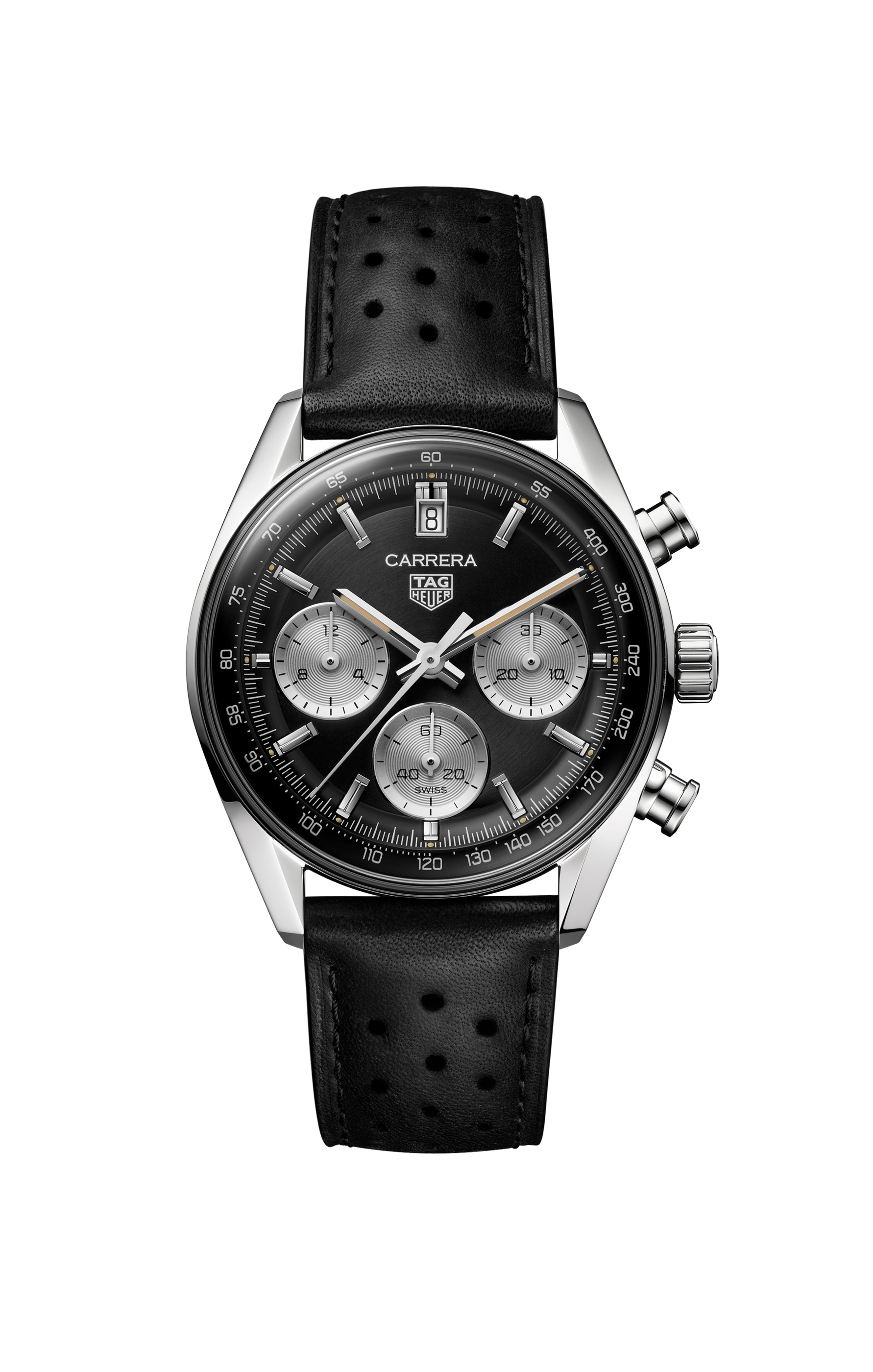
The complete front view establishes a recognisable chronograph arrangement. Three pale registers stand against the black dial, with the main hands passing through the centre. The date at twelve o’clock adds another small element within an already active face.
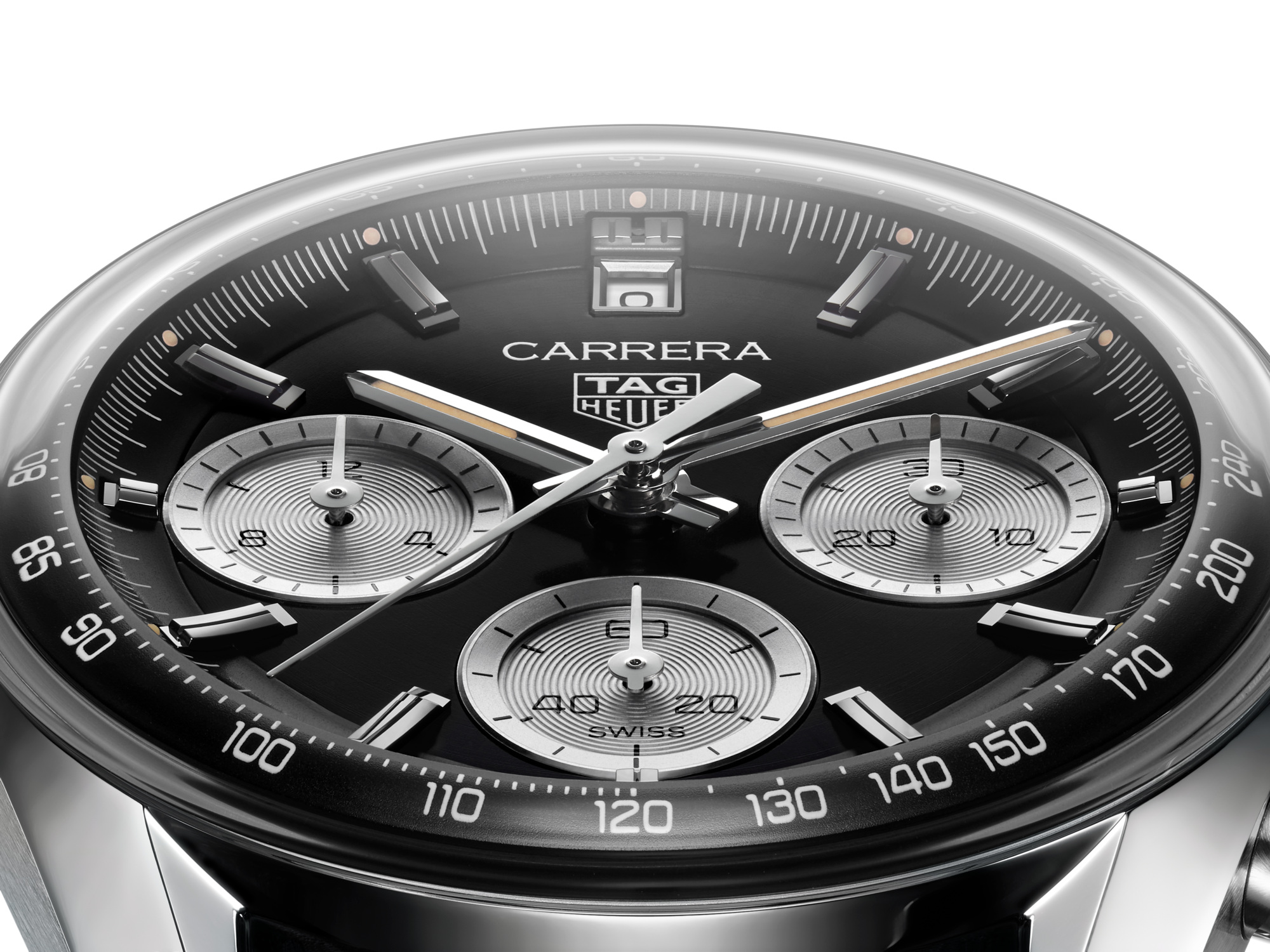
The outer scale changes how that arrangement is contained. In the angled official view, it rises beneath the glass instead of appearing as a flat printed ring. The crystal and dial perimeter are therefore part of one spatial account, giving the edge a substantial role in the watch’s identity.
That is the point of moving between frontal and oblique views. One explains where the information sits; the other reveals the shape through which it is presented. The Glassbox becomes more interesting when the reader can connect those two accounts rather than treating its crystal as a name detached from the object.
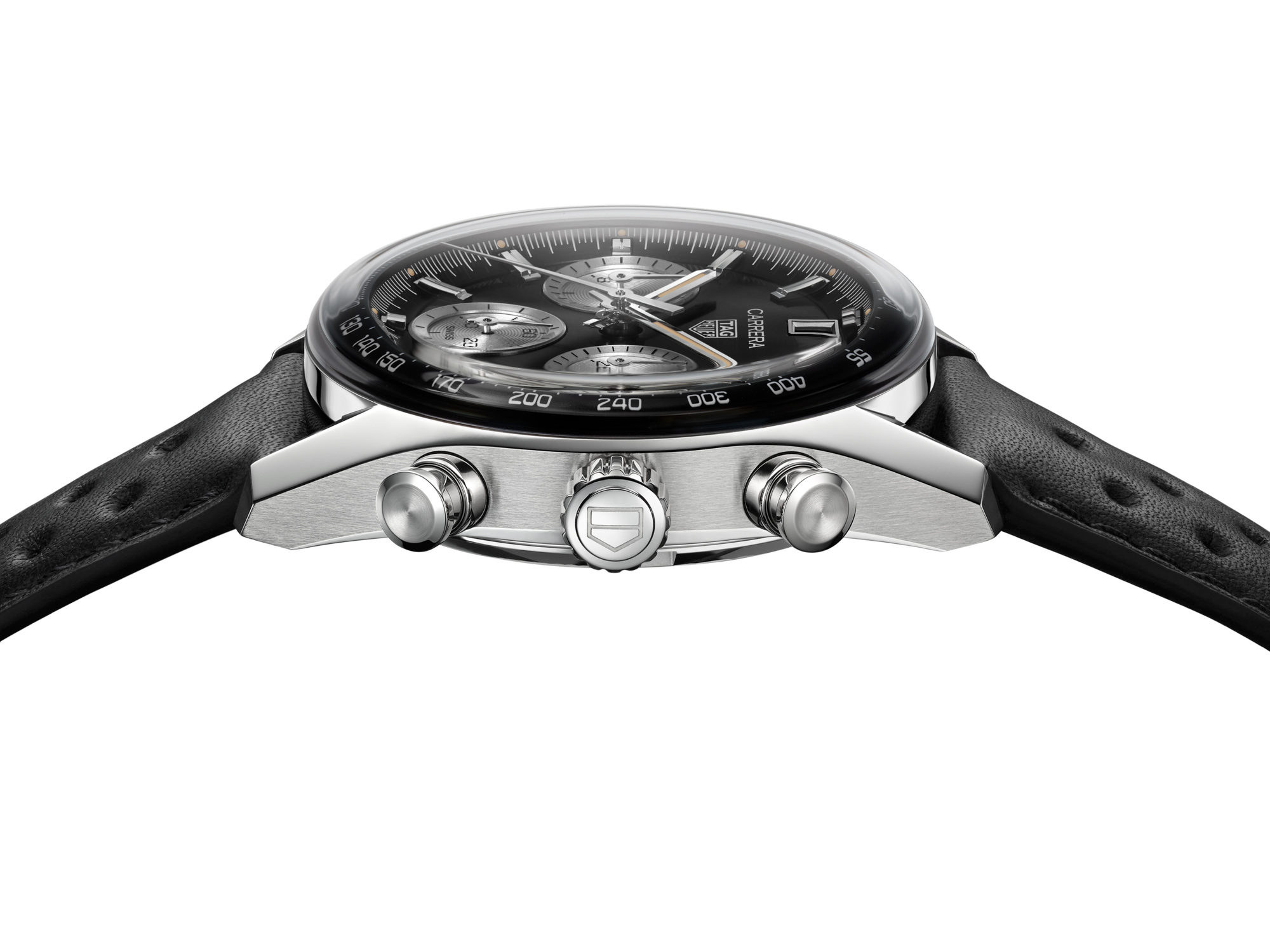
The side profile explains the title
The official profile image gives the crystal its own visible volume above the steel case. The pushers and crown establish a second group of forms along the side, making the watch’s controls legible separately from the rising glass.
The case has to hold those elements together. From the wrist, the complete object is encountered through a combination of height, width and the direction in which the lugs and strap leave the head. The 39 mm diameter describes only one part of that physical arrangement.
TAG Heuer’s specification also identifies fine-brushed and polished steel finishing. Those treatments give adjacent areas different levels of reflection, helping the case retain definition around the more conspicuous crystal. They are small material decisions, but they become easier to appreciate from the profile than from a brightly lit frontal portrait.
A prospective owner should therefore look at the profile as carefully as the dial. The official current specification gives a thickness of 13.9 mm for this reference. That figure and the curved crystal explain why a frontal portrait alone cannot establish the watch’s presence beneath a cuff or during ordinary movement.
The registers remain separate centres of attention
The reverse-panda arrangement gives each register a clearly contrasting field. Their pale surfaces introduce three smaller circles within the larger black face, while the central hands and outer scale retain other kinds of information.
The useful design question is how the eye changes focus. A quick reading of the main time should remain distinguishable from a more deliberate look at the chronograph indications. The contrasting registers establish positions, but actual ease of reading depends on distance, light and the person using the watch.
The date at twelve adds another challenge. It occupies a prominent place near the upper part of the composition, so its frame has to coexist with the surrounding markers and text. The official detail view is valuable here because it shows the density of the arrangement without making every element appear equally large.
Movement, back and clasp complete the object
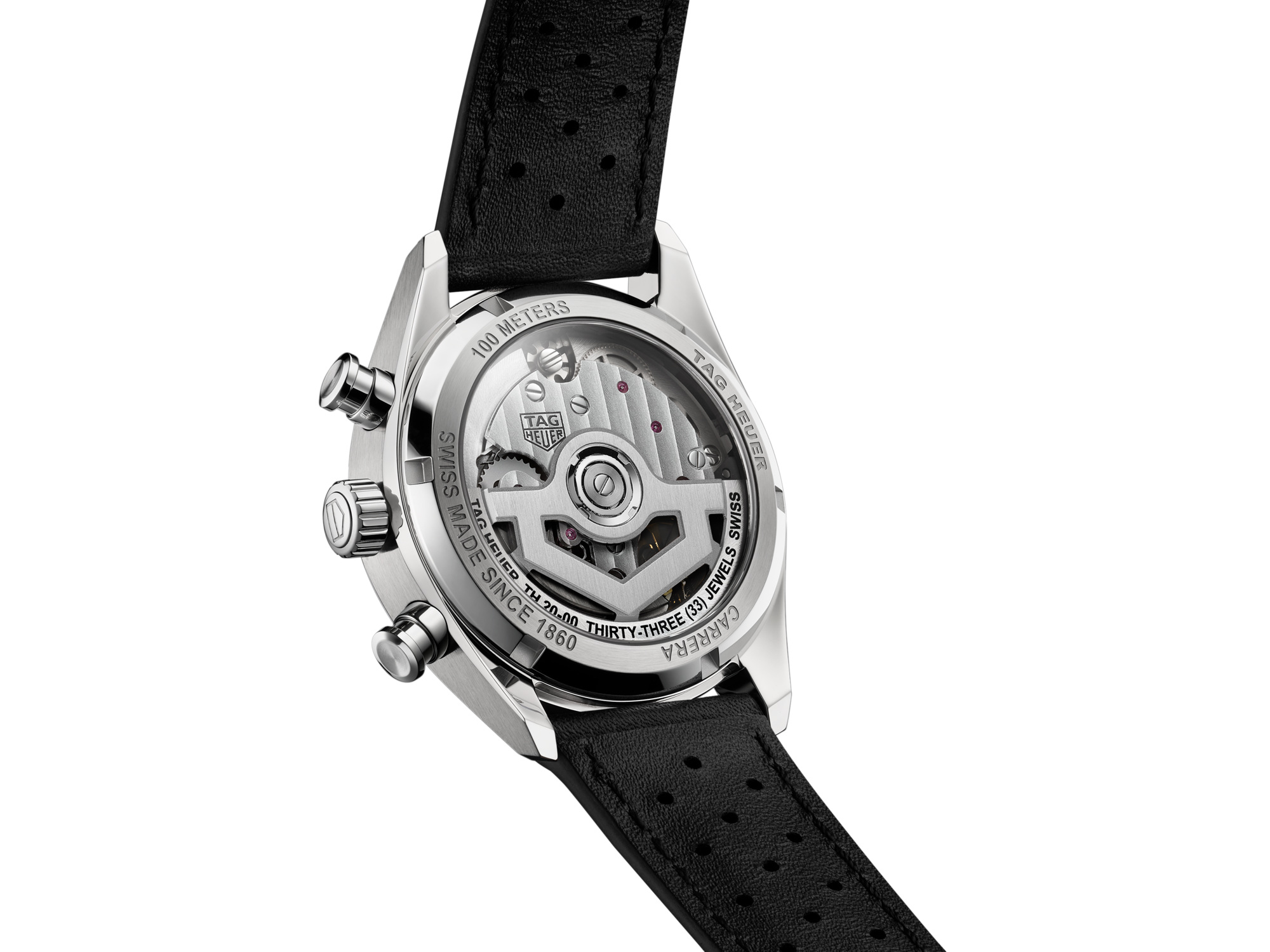
TAG Heuer names the automatic movement TH20-00 and states an 80-hour power reserve. The sapphire-back photograph makes that mechanism part of the visible watch, while keeping it on a different side from the chronograph display encountered most often.
The back and the front reward different attention. One presents the user with indications to read and controls to operate; the other allows a slower inspection of the mechanism. The relationship is more useful than assuming an exposed movement is required to make the watch mechanically interesting.
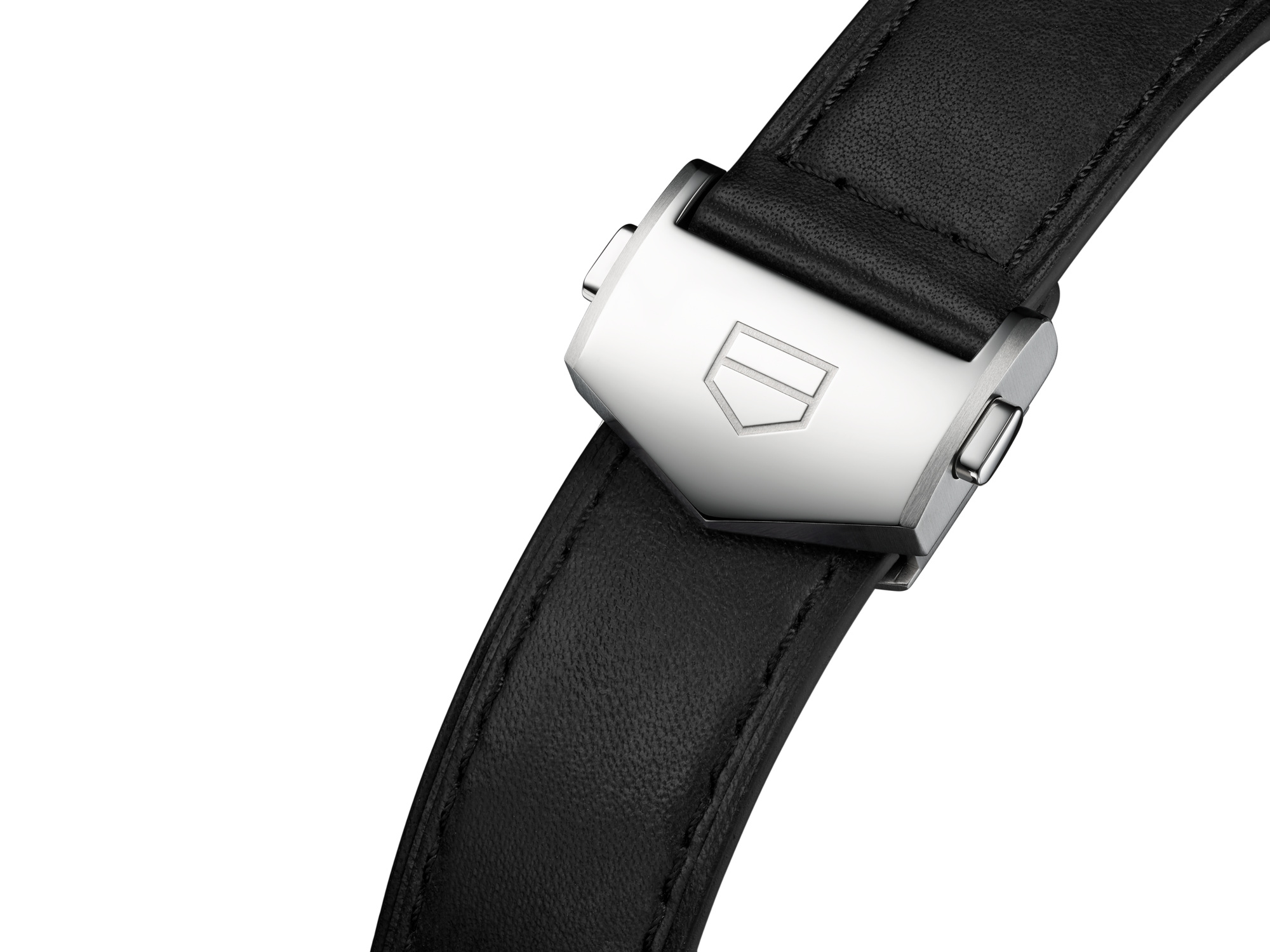
The clasp image supplies an equally practical final detail. Reference CBS2210.FC6534 is shown on perforated black leather with a folding clasp. The strap’s surface and fastening belong to the wearing experience, and they should remain part of the reference identity rather than being silently exchanged for the bracelet configuration seen elsewhere in the family.
The reference before the family name
The current product record and the official Glassbox introduction provide the basis for this account. Similar Carrera names cover other dials, straps and references, so the complete identifier remains useful even in a story principally concerned with design.
| Element | CBS2210.FC6534 record | What to examine in person |
|---|---|---|
| Case | Steel, 39 mm diameter | Overall footprint and the direction of the lugs |
| Thickness | 13.9 mm | The relationship between case, crystal and cuff |
| Movement | Automatic TH20-00 | Setting and chronograph operation for this reference |
| Reserve | 80 hours, stated by TAG Heuer | How the watch fits the intended wearing routine |
| Strap | Perforated black leather | Fit, fastening and the position of the folding clasp |
| Dial | Black with contrasting registers | Main-time and chronograph readability at ordinary distance |
This puts the technical record to work without pretending that specification alone supplies a wearing verdict. The design can be understood in detail from the official material, then tested against the individual wrist and the conditions in which it will actually be used.
The Luxe Digital view
The Carrera Glassbox is strongest where the perimeter becomes an active part of the design. The rising scale and domed crystal give depth to an already information-rich face, making the angle of view a meaningful part of how the watch is understood.
Reference CBS2210.FC6534 keeps that spatial idea tied to a clear graphic one. Black and pale registers divide the information, while steel, leather and glass establish the object’s different physical boundaries. Each material has a distinct role in the complete watch.
Its most useful presentation therefore moves from face to edge to wrist, then towards the back and clasp. The sequence reveals a chronograph whose appeal depends on more than a frontal arrangement of counters: it is a three-dimensional instrument, with a particularly deliberate boundary between dial and surrounding world.
The Carrera Glassbox is strongest where the perimeter becomes an active part of the design.
Sources & credits
Sources and methodology
Independent design and reference analysis of the named official records and imagery, checked on 15 October 2026. Launch specifications and later product records retain their own dates and references. Images show the identified configurations. No independent handling or timing test is implied.