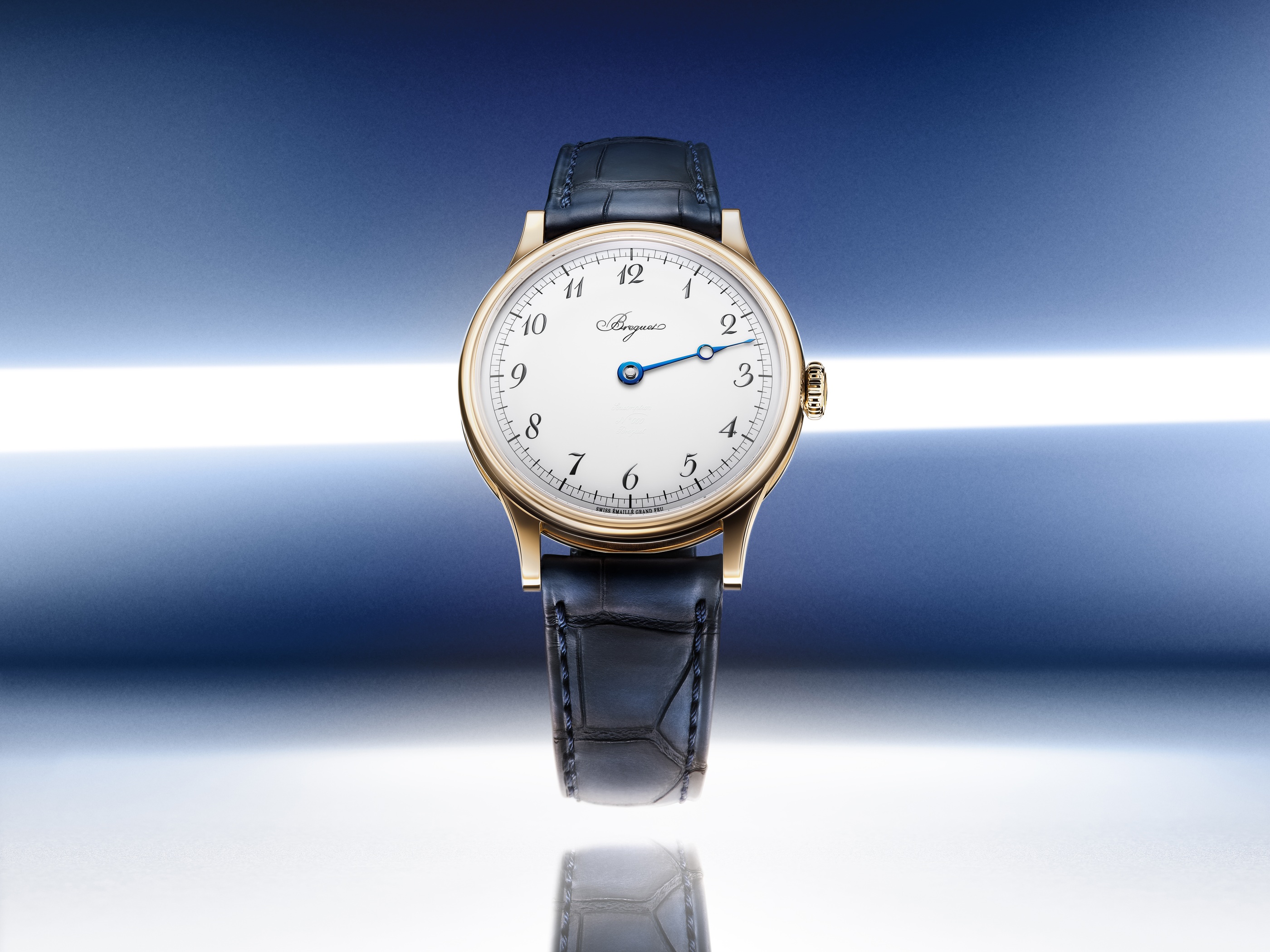
One hand changes the balance of a watch. In Breguet’s Classique Souscription 2025, the white dial becomes a broad field of enamel, the blue pointer a single deliberate gesture. Turn it over and that visual economy gives way to a movement arranged around a conspicuous central barrel. The two views belong to the same idea, expressed in different materials.
Begin with the space around the hand
The first impression is not the number of indications but the amount of dial left available around them. Sloping Arabic numerals sit away from the centre, with a finely divided track at the perimeter. The long pointer reaches towards that outer reading area. Without a second large hand crossing it, the direction of the blue line becomes exceptionally easy to follow in the official front photograph.
This does not turn the watch into an instrument for reading a separate minute counter. The single hand must be read against its surrounding divisions. A buyer accustomed to two hands should spend time with that different rhythm, returning to the display after a few minutes rather than treating its first impression as a complete answer. Visual simplicity and an immediately familiar reading method are separate qualities.
The dial makes a persuasive case for restraint because its details have different levels of visibility. Numerals and pointer establish the time; smaller inscriptions become discoveries made at closer range. The result invites two distances of attention. From across a table it is a clear, light-coloured watch. Close to the wrist it becomes a surface with subtler marks and a carefully organised border.
White enamel, considered as a material
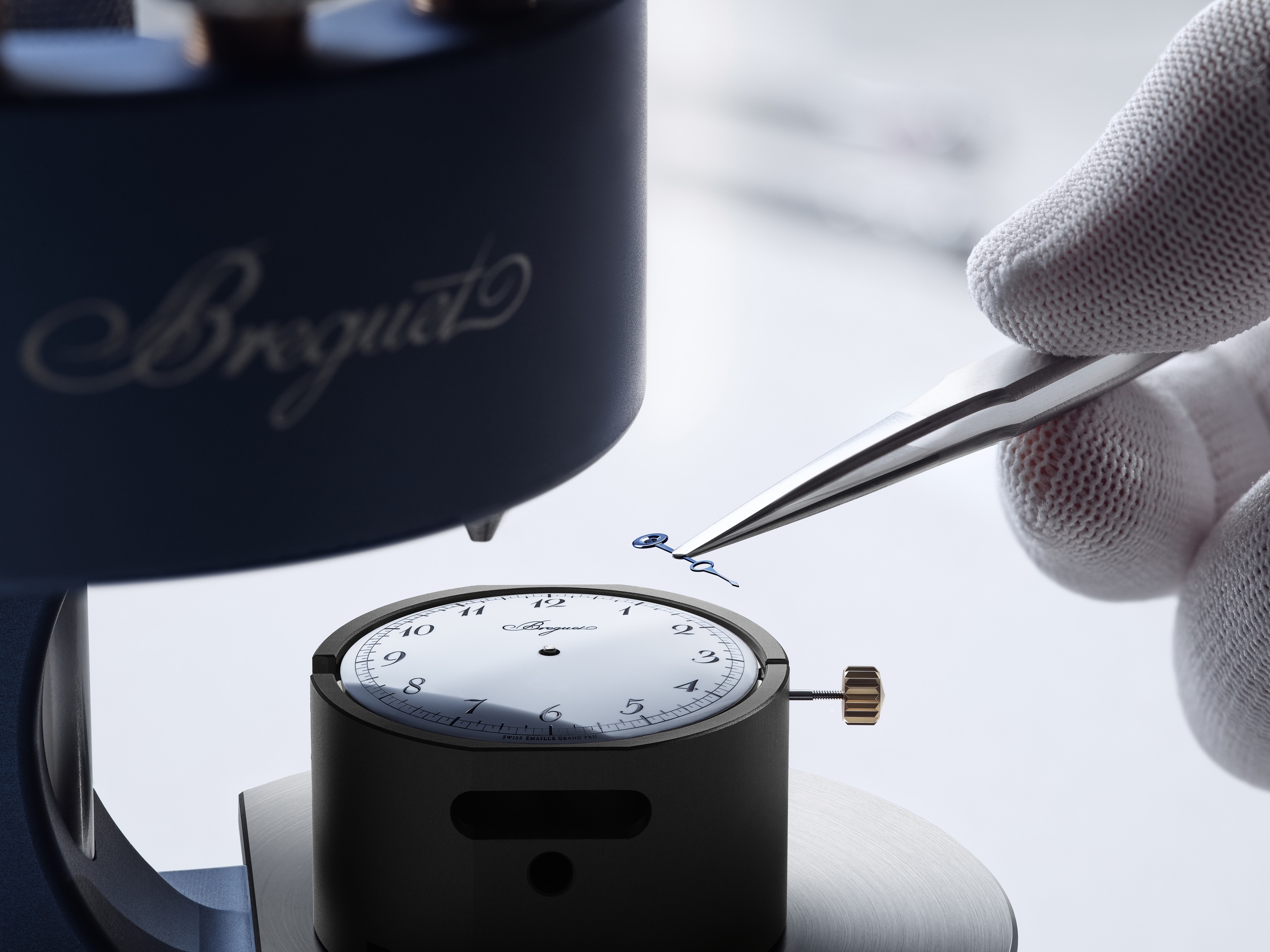
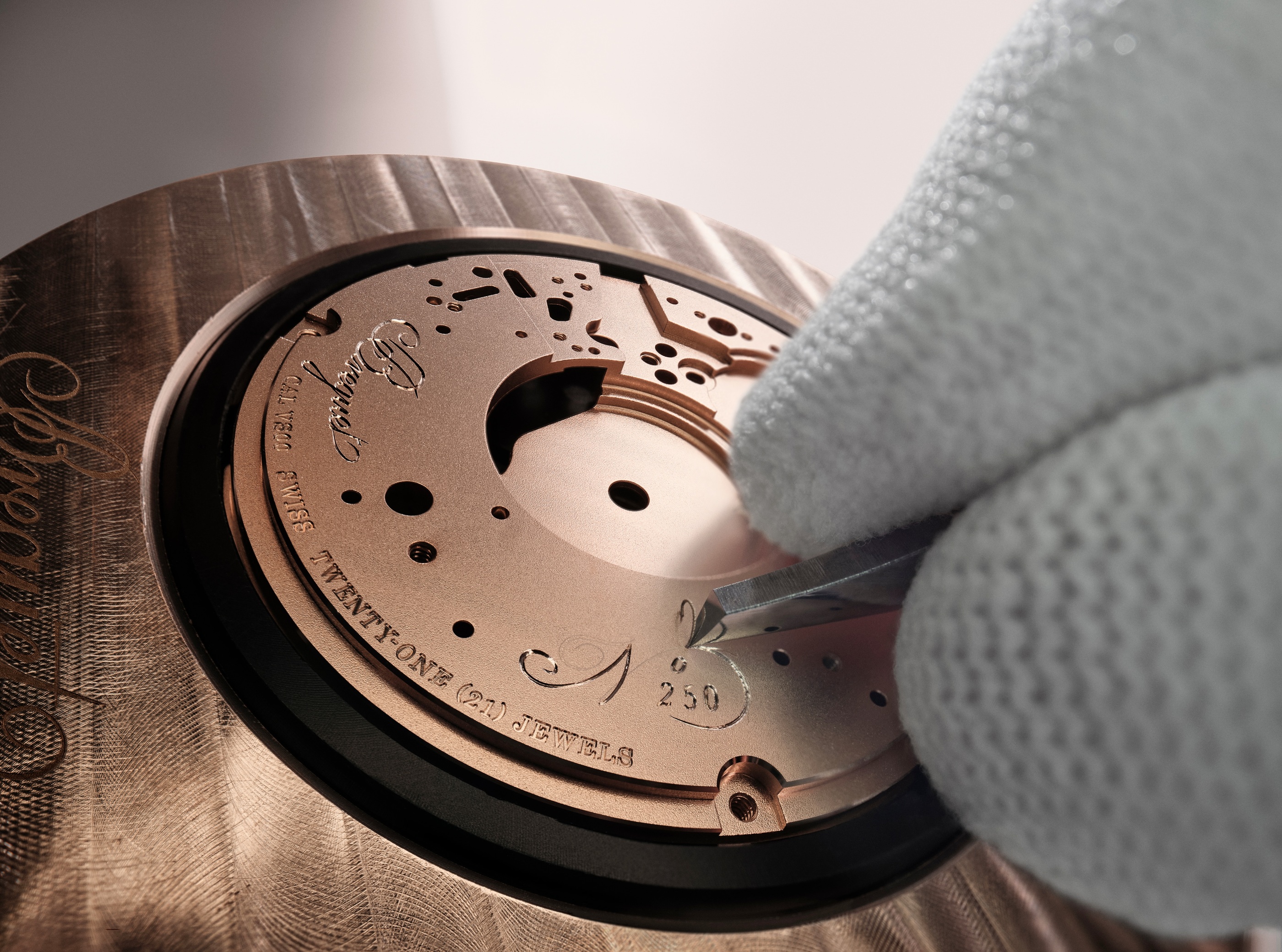
Breguet identifies the dial as grand feu enamel. In the workshop images, the surface is handled as a physical component, with the hand and surrounding case still separate from the finished object. That sequence is valuable because a white dial in a small product image can look almost immaterial. Seen through the process photographs, its apparent ease becomes a result that has to be achieved.
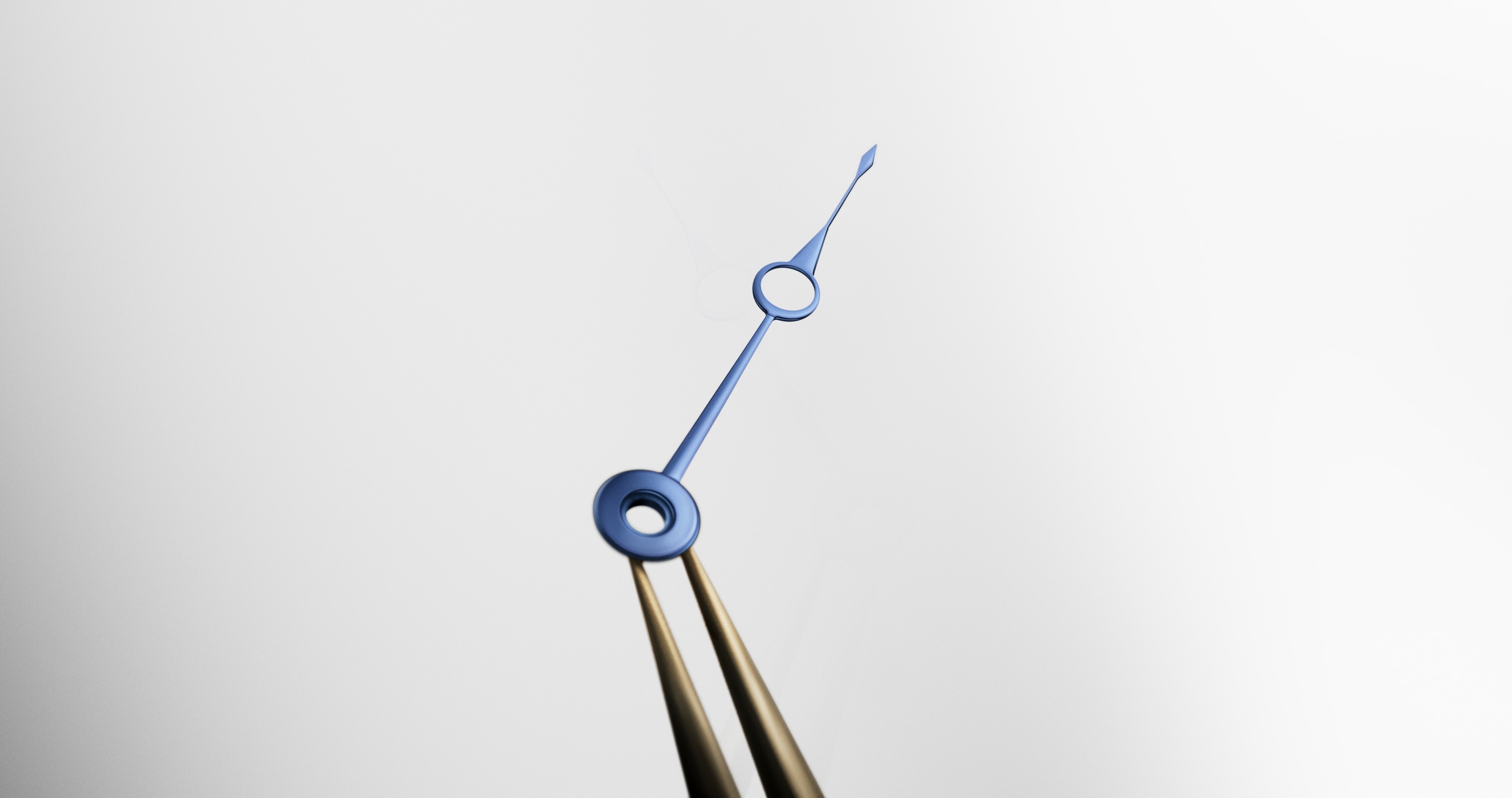
The official photograph of the blue hand held in a tool provides a particularly effective counterpoint. Removed from the dial, the pointer has its own silhouette and changing width. Put back into the composition, it becomes the point at which a broad, pale surface is given direction. The colour contrast is strong, but the way the hand narrows towards the track is equally important to the visual result.
An enamel dial also deserves to be seen under more than one light. At an appointment, move between a direct view and a slightly oblique angle. Look at the numerals, the track and the way the pointer remains distinguishable from the surface. The question is how the different elements work together, rather than whether a macro photograph makes every detail appear equally prominent.
The reverse has a different centre of gravity
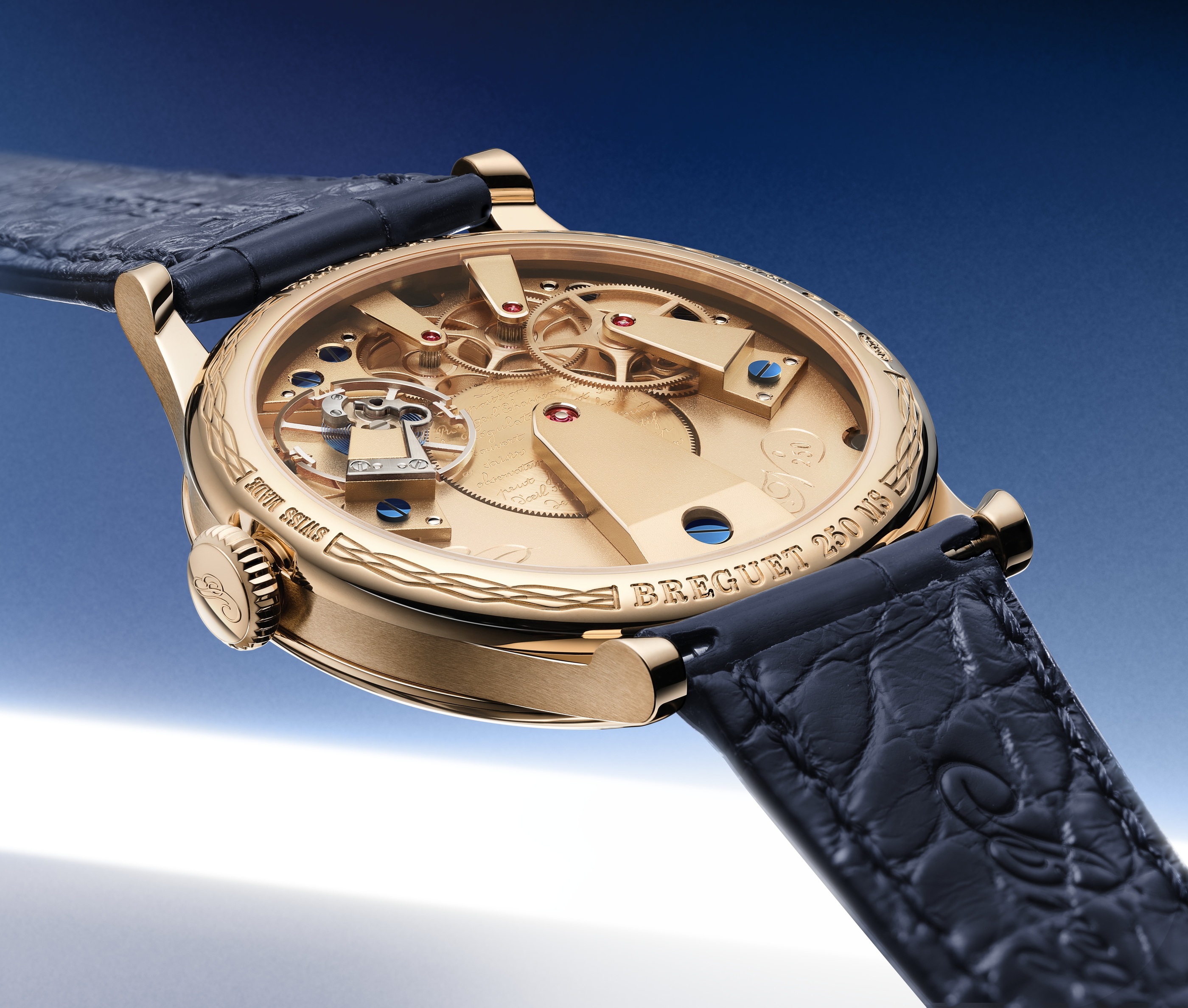
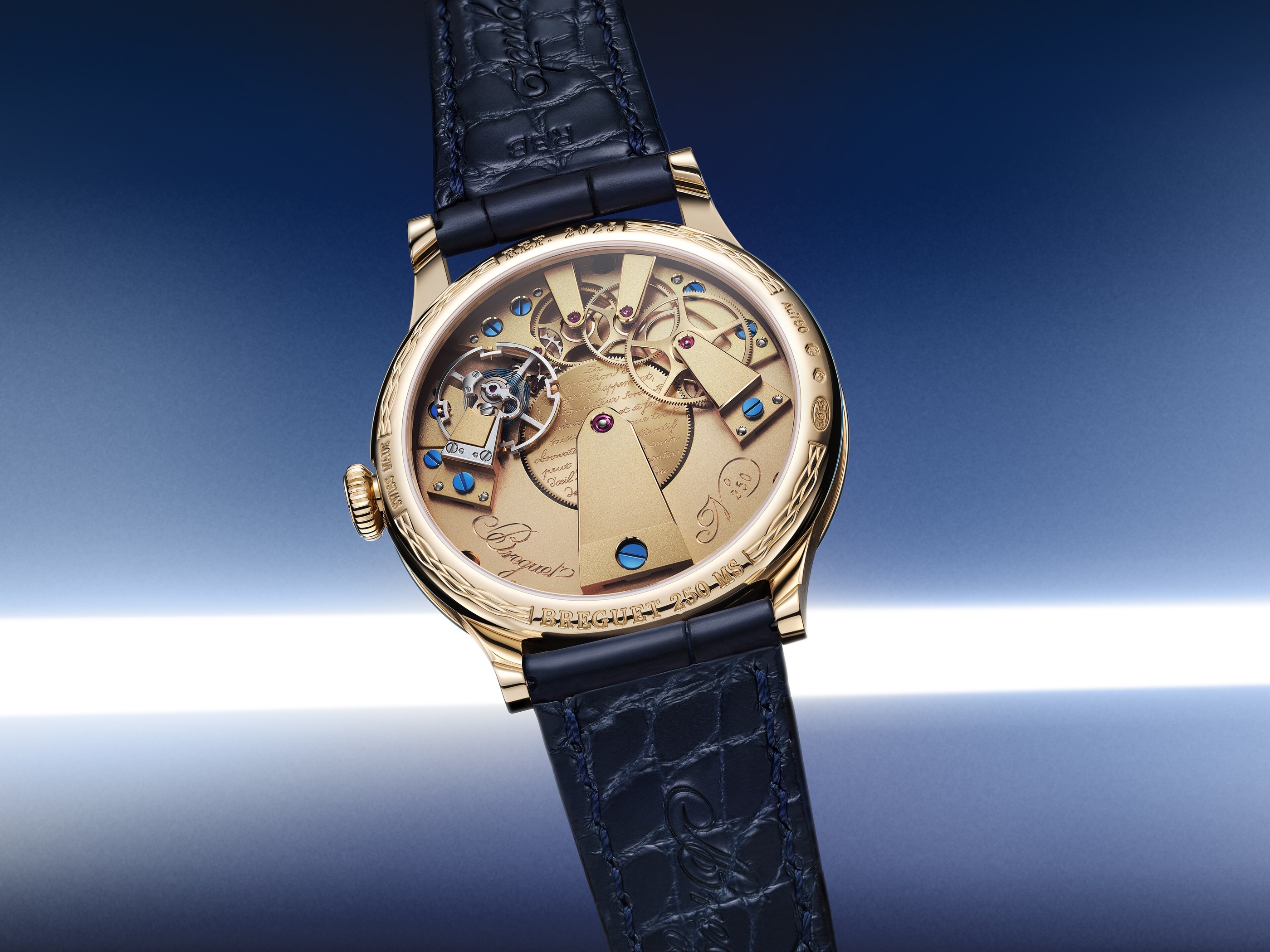
The movement side changes the composition completely. The central barrel is a large, easily recognised form, with other components arranged around it rather than hidden beneath a fully covering plate. The official caseback photograph lets the eye move between the large circular element, the smaller wheels, the balance and the changing outlines of the bridges. It is a view that benefits from remaining beside the explanation, rather than appearing as a brief interruption between paragraphs.
Breguet calls the manually wound movement VS00 and quotes a 96-hour power reserve. Those facts establish the mechanism’s basic proposition, but they do not explain the photograph by themselves. Visually, the interest lies in differences of scale. A large circular form gives the composition a centre; smaller parts create intervals and changes of direction around it. The dial side removes competing large hands, while the reverse makes the organisation of the machinery available to the eye.
The sapphire caseback is therefore more than another transparent window in a specification list. It offers a second way to understand the object. The reader can compare how much is withheld on the front with how much is presented on the back, without assuming that every visible part must be identified to enjoy the arrangement. At a boutique, an explanation of the visible components should help the view become clearer, rather than replace the experience of looking at it.
Gold as a warm boundary
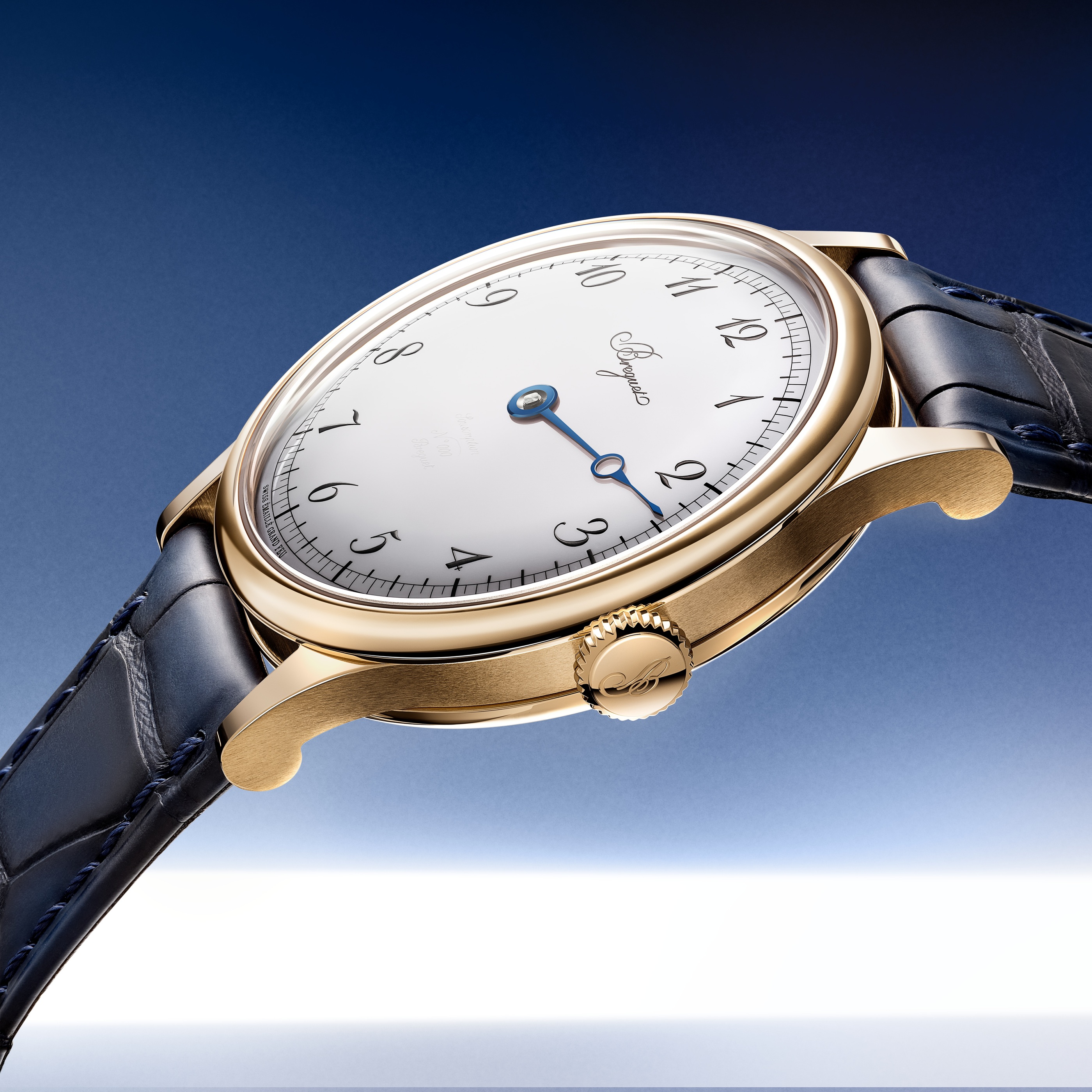
The case uses the manufacture’s 18K Breguet gold. Against the white dial, the metal supplies a warmer boundary; against the dark blue strap, it becomes a brighter transition. In the side photograph, the outline of the case and its attachment to the leather are more informative than a frontal view of the dial alone. They show where the watch acquires physical depth.
The published diameter is 40mm and the thickness 10.8mm. Neither measurement should be treated as a full description of its presence. The broad dial, the treatment of the perimeter, the lugs and the strap all contribute to how the circle is framed on the wrist. The official campaign shows the watch with different wearers and clothing; these images offer contexts to consider, rather than proof that one proportion suits every wrist.
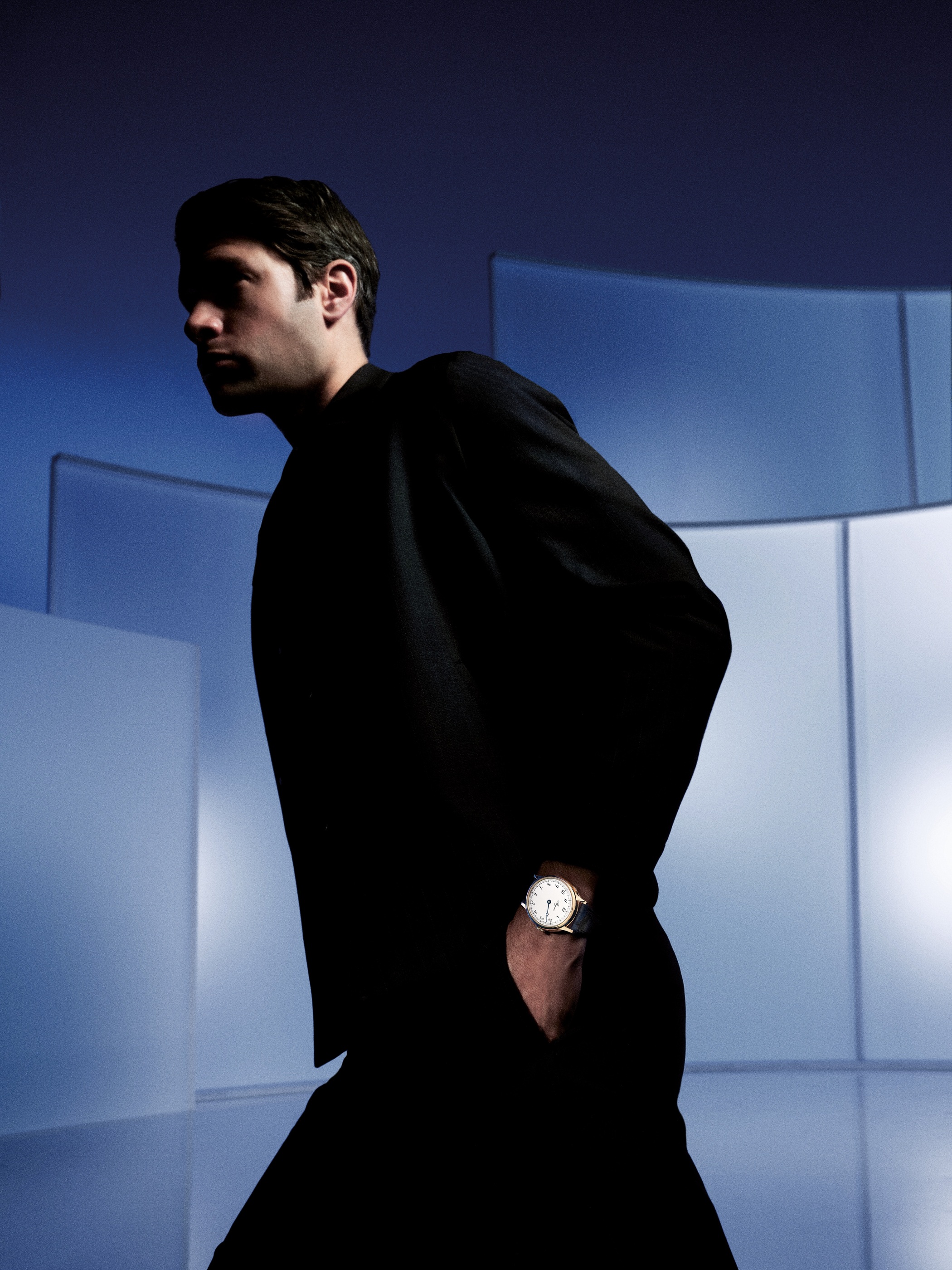
Dark blue is an especially useful partner in the photographic sequence. It connects the strap with the hand without turning the rest of the watch into a colour-matching exercise. A pale dial, warm case and dark strap each retain their own territory. That separation gives the design clarity even when the wrist is seen at a distance or partially framed by a sleeve.
A making sequence worth slowing down for
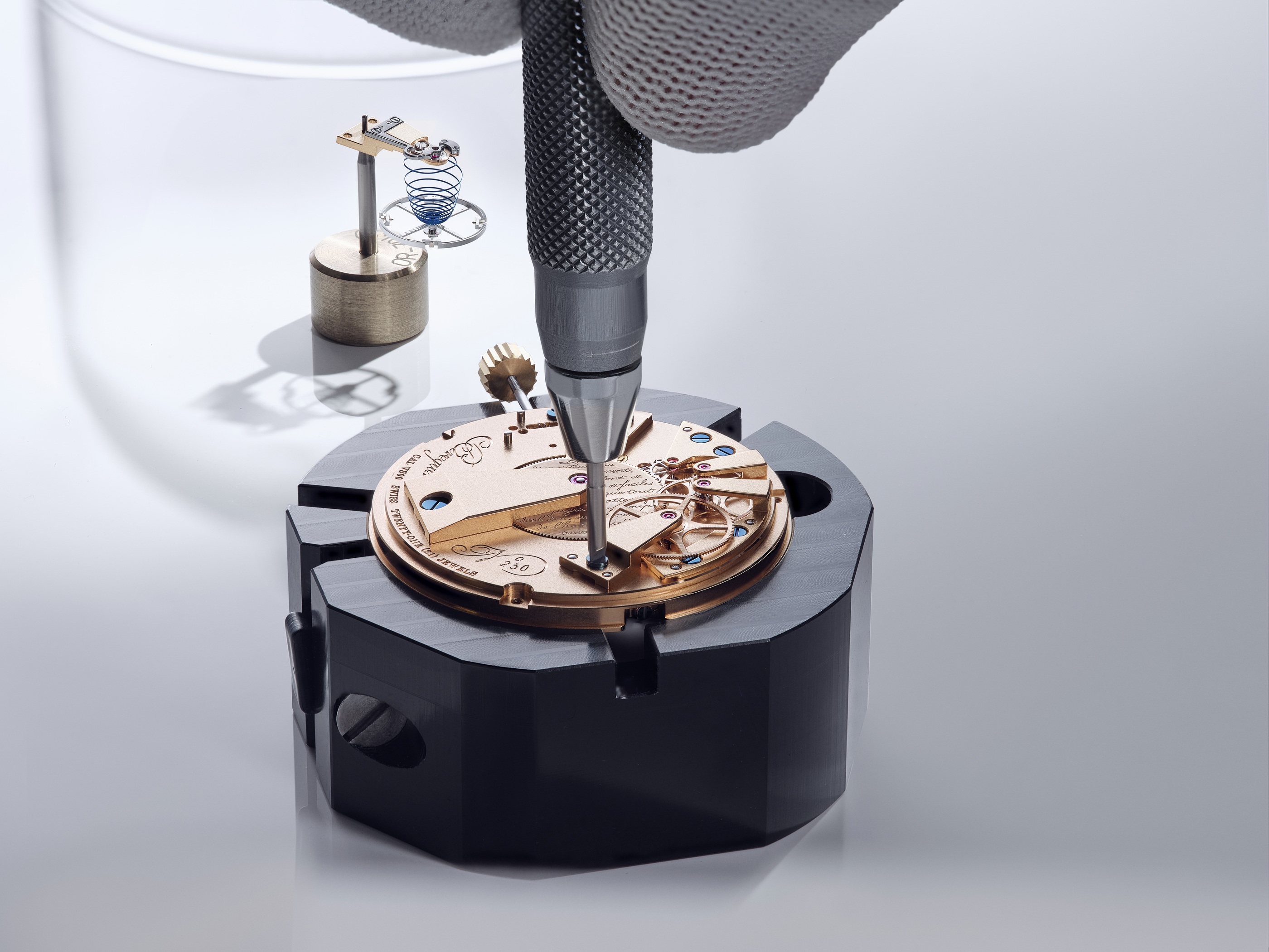
The workshop photographs offer several different kinds of evidence. A movement being worked on, a hand held separately and a dial approached with a fine tool are not interchangeable images of craft. Each brings a different part of the finished watch into focus. Showing them at a useful scale lets the reader connect the clean result with the small physical objects that produce it.
It is also worth keeping the finished-object images in the sequence. Process photography can become a language of its own, full of tools and gloved hands but detached from the watch a reader is trying to understand. Returning to the complete Souscription after a close detail restores the relationship between making and use. The pointer has to work against the dial; the case has to carry both the display and the visible mechanism.
A short specification, a longer look
| Element | Breguet’s published specification | What it contributes to the reading |
|---|---|---|
| Reference | 2025BH/28/9W6 | Identifies the white-enamel Souscription discussed here |
| Display | Single hand; grand feu enamel dial | Concentrates attention on the pointer and outer track |
| Case | 18K Breguet gold; 40mm diameter | Frames the pale dial with a warm perimeter |
| Thickness | 10.8mm | One part of the complete wearing proportion |
| Movement | Manual-winding VS00 | Makes winding part of the relationship with the watch |
| Power reserve | Manufacturer quotation: 96 hours | An operating figure, rather than an independent test result |
Introduced for Breguet’s 250th anniversary in 2025, the Souscription is best approached here as a continuing design proposition. Its value to the reader is not dependent on presenting an anniversary launch as breaking news. It asks how little a dial can show while still remaining a richly considered object, and how a second view can deepen that first impression without contradicting it.
The most satisfying way to look at it is consequently a small circuit: the entire watch, the tip of the hand, the edge of the case, the reverse, and the entire watch again. The final return matters. It is where the visible details either gather into a coherent object or remain a collection of attractive close-ups. In this Souscription, the single blue line gives that circuit a particularly clear starting point.
Sources & credits
Methodology and sources
Independent visual and ownership-context analysis of Classique Souscription 2025 reference 2025BH/28/9W6. The official product page and anniversary article were checked on 4 November 2026. The 2025 name and launch context are retained; this is not presented as a new 2026 release. Photographs distinguish finished watch, movement and workshop views. No wearing trial, timing result, price, allocation or resale prediction is asserted.