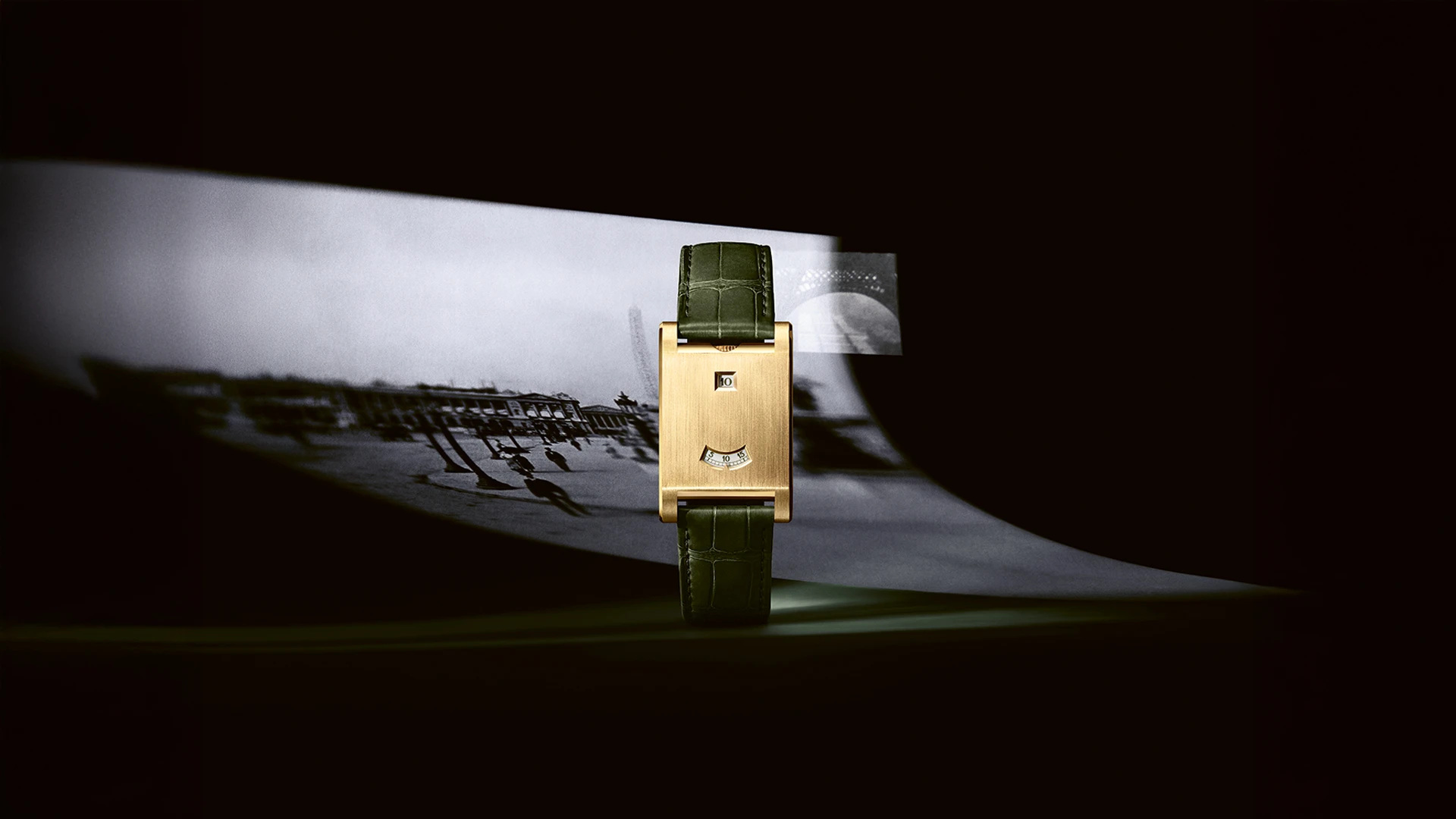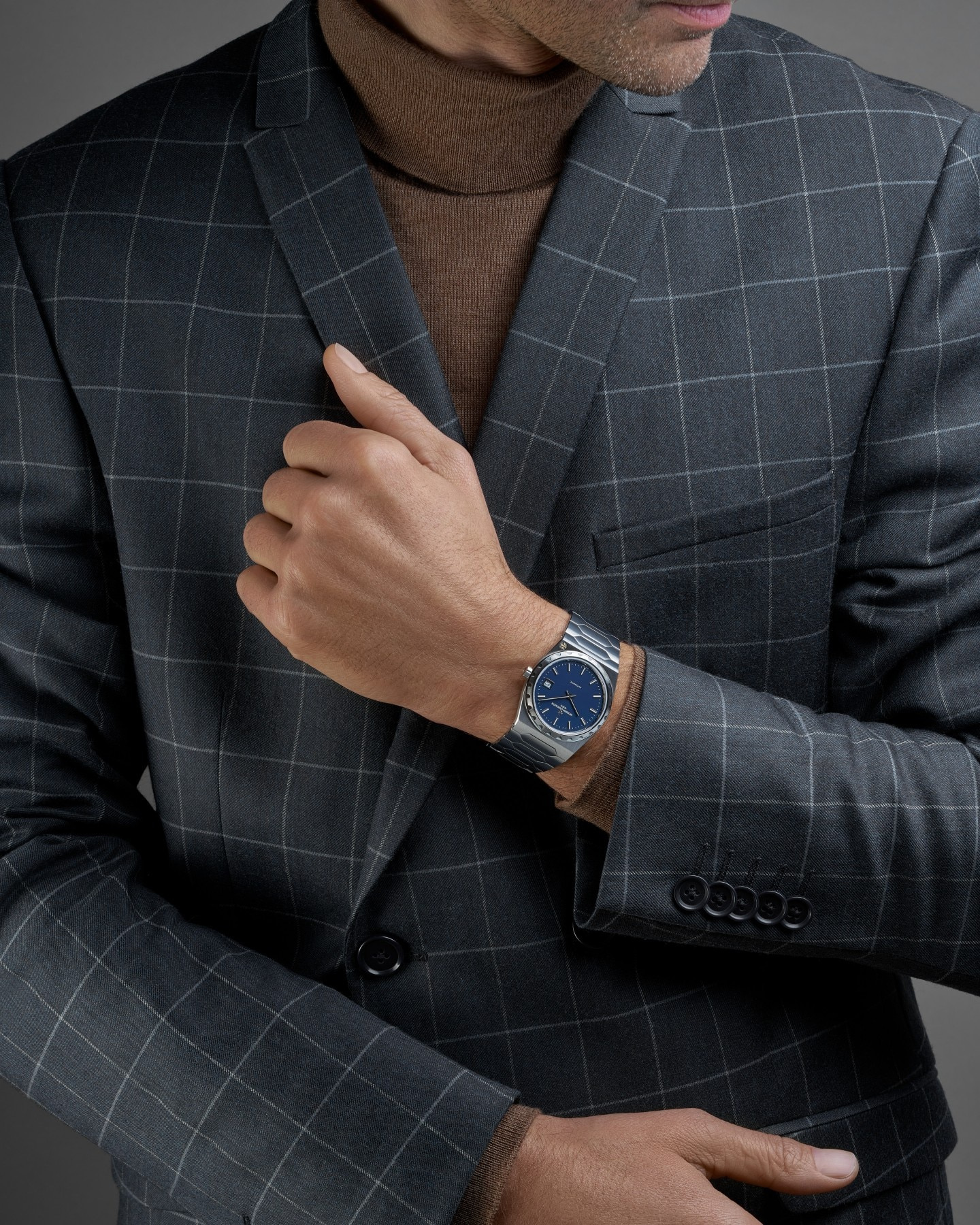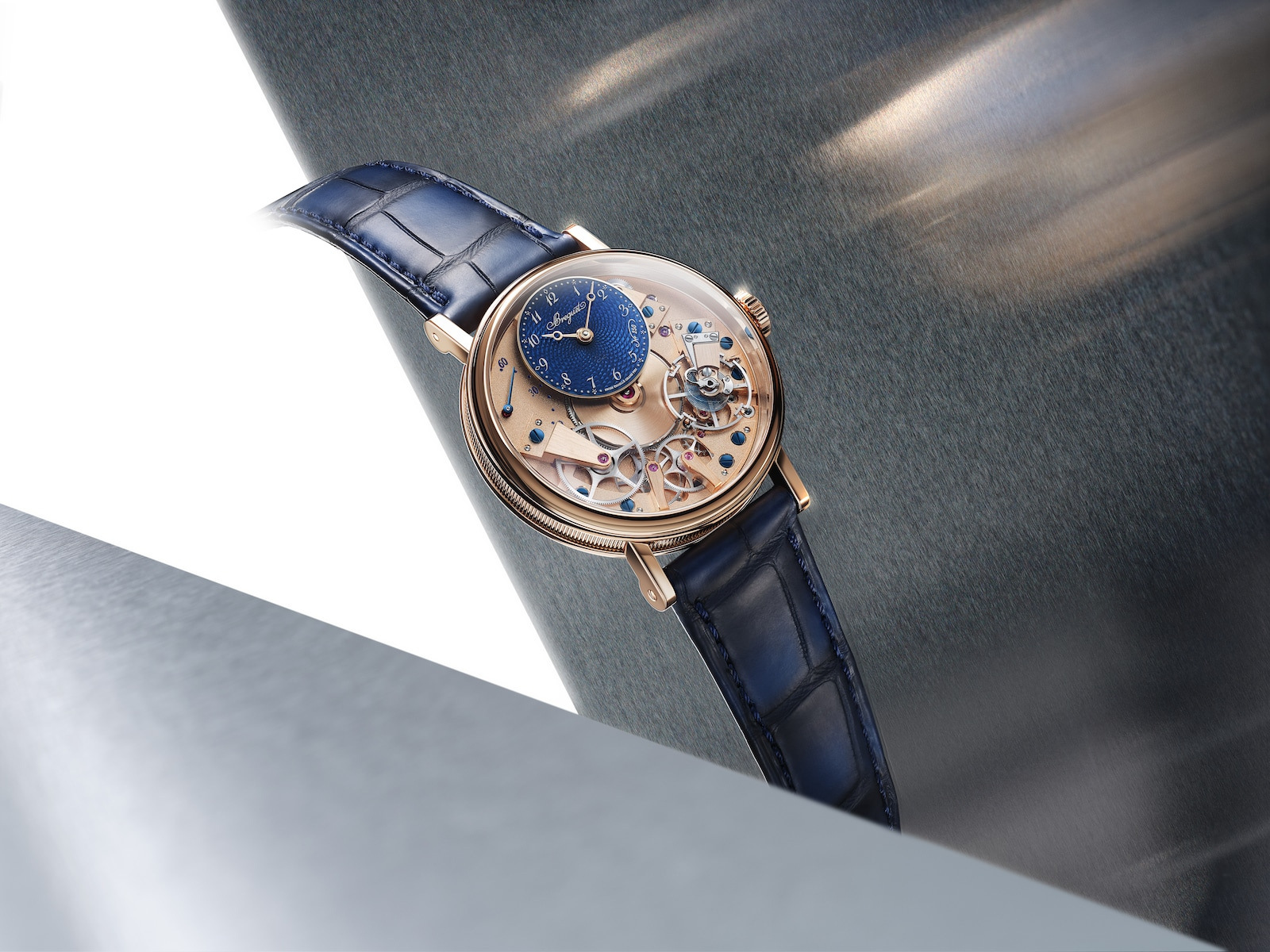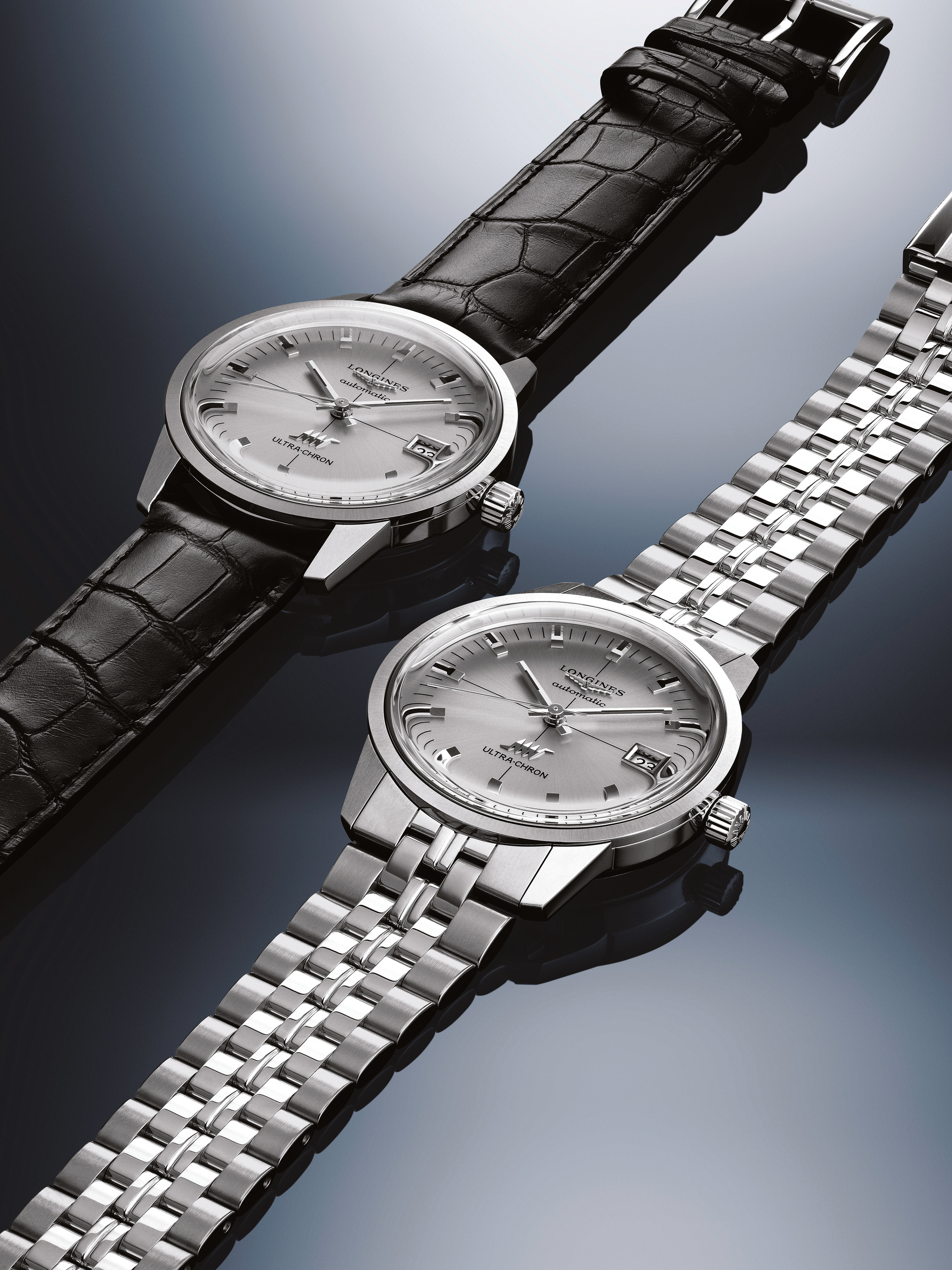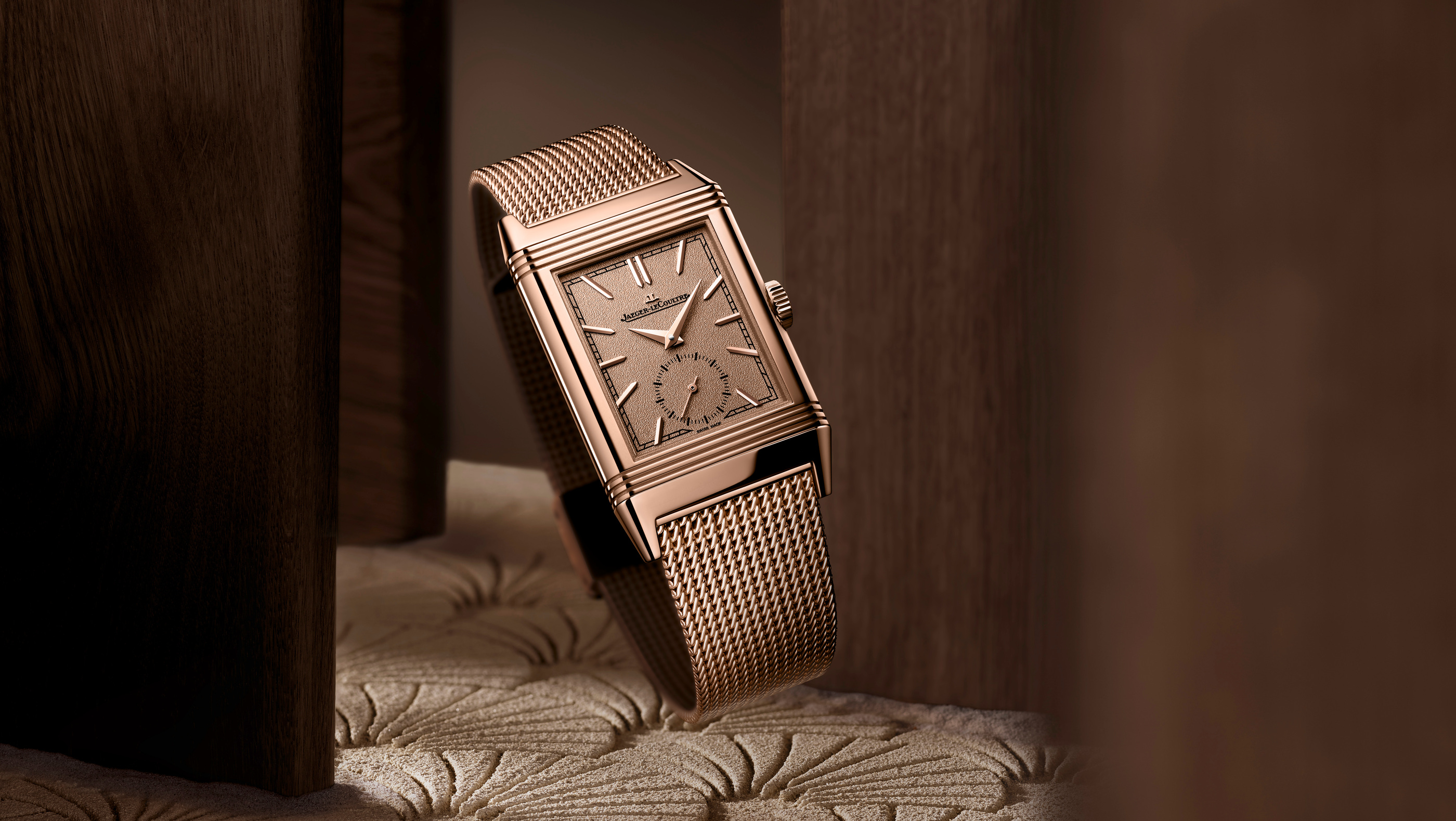
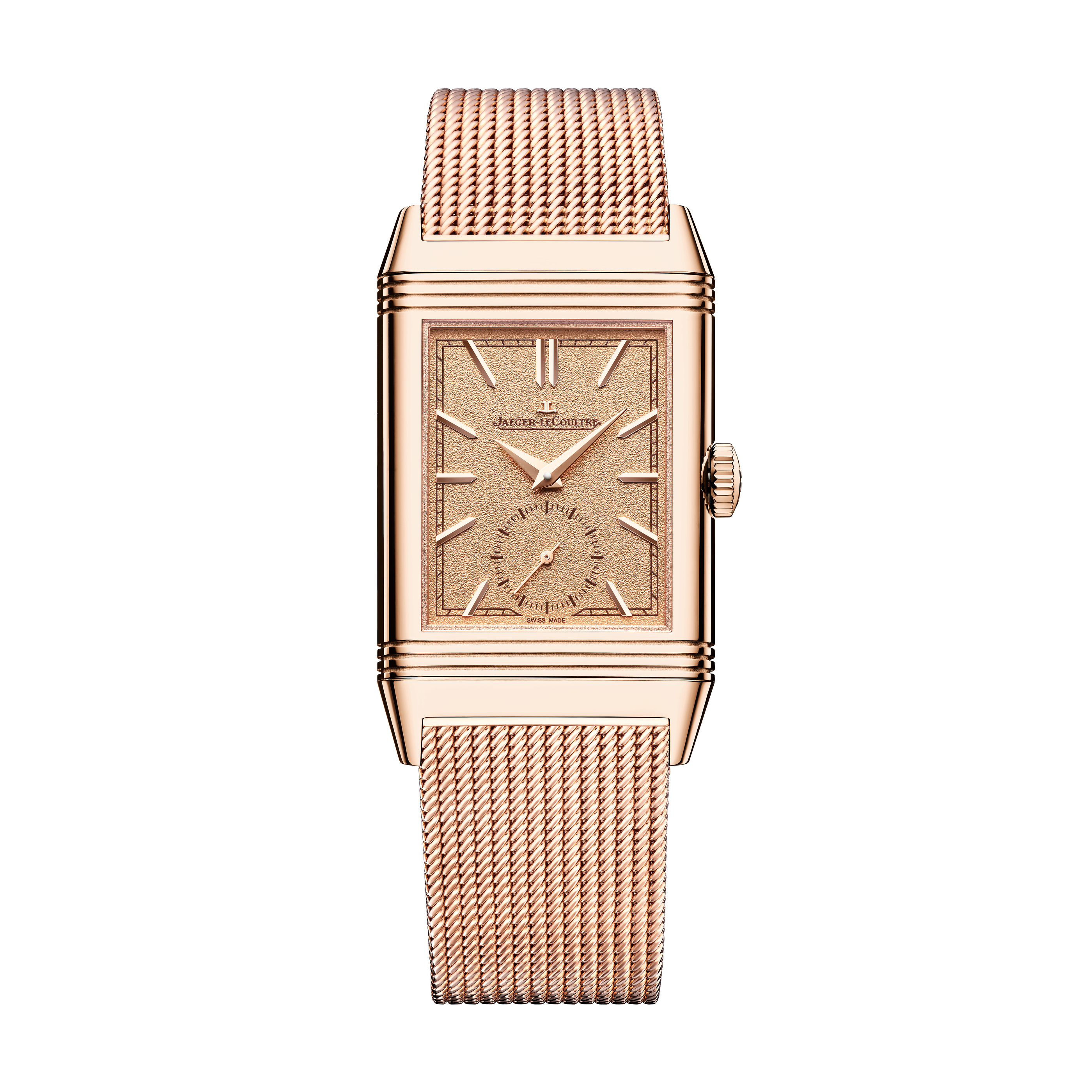
The pink-gold Reverso Tribute Monoface Small Seconds changes character before its case is turned. A Milanese bracelet carries the metal colour beyond the rectangle, while a grained dial stops the face from becoming one continuous polished reflection. Reference Q713216J, introduced in 2025, is an especially clear study of what happens when a familiar watch is redesigned through the relationship between its surfaces rather than through a new outline.
One colour, several surfaces
Jaeger-LeCoultre identifies an 18-carat pink-gold case and Milanese bracelet, paired with a golden-coloured grained dial. The descriptions are worth keeping separate. A dial that matches the visual palette is not automatically made of the same material as the case. Colour supplies continuity; the actual materials and finishes give that continuity its structure.
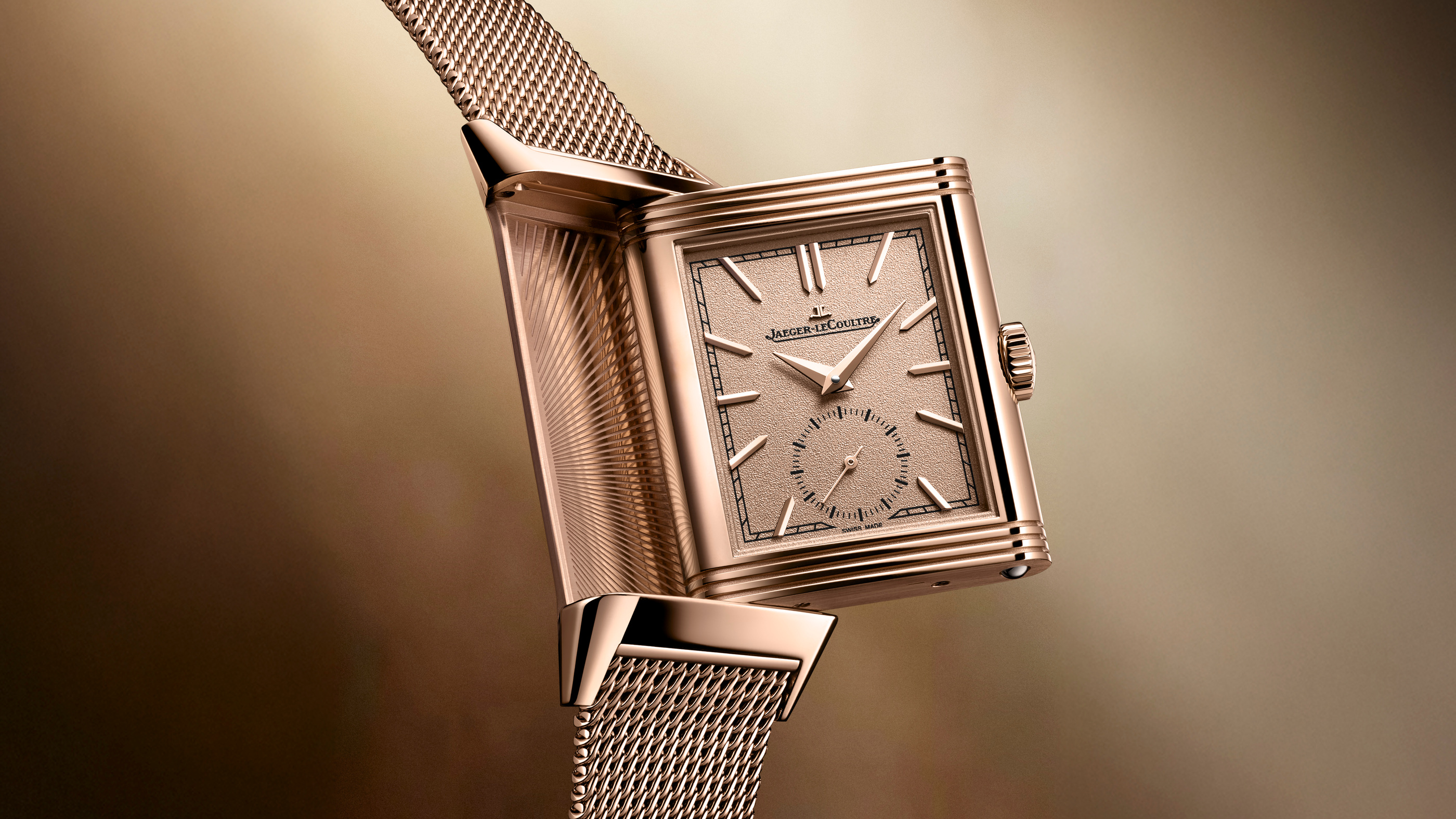
In the official close photographs, the bracelet forms a fine repeated texture, the case edges produce brighter lines and the dial provides a quieter central field. The hands and applied markers then introduce another scale of reflection. This is why the composition does not read as a solid block of gold. Differences in surface activity allow the rectangle to remain legible within the larger metal object.
The small-seconds circle is equally important. Positioned at six, it offers a curved counterpoint to the case’s horizontal grooves and long sides. It is a functional indication, but it also gives the lower part of the dial a centre of gravity. Removing that circle would change the composition even if every colour and material remained the same.
The bracelet draws a longer line
The manufacture describes its Milanese construction as a dense weave formed from intertwined metal threads. Its account discusses making, stamping and hand-soldering the links. Those are statements about the bracelet’s construction, rather than a substitute for an independently tested judgement about comfort, longevity or the ease of fitting a particular wrist.
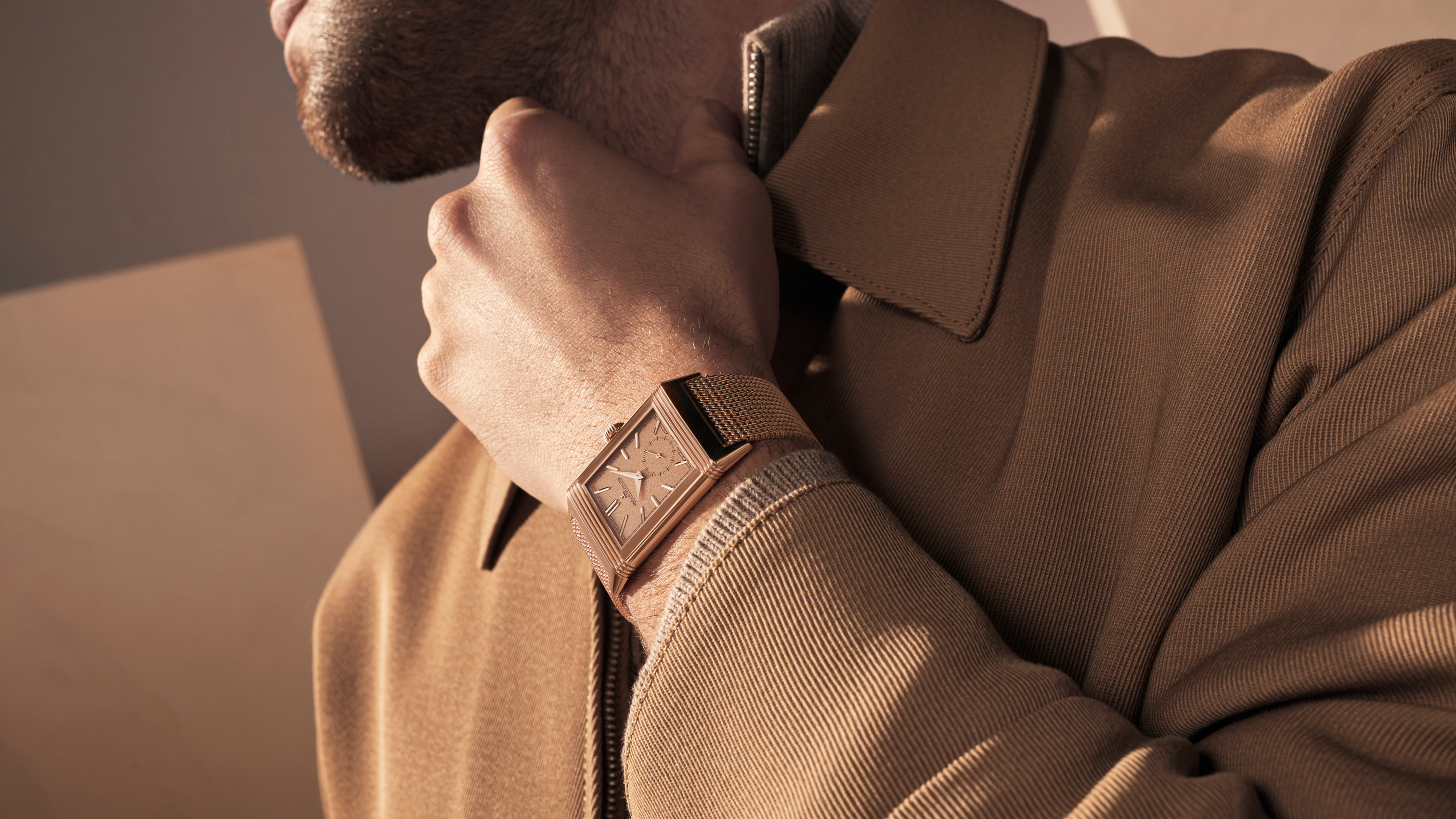
The visual consequence is easier to establish from the published imagery. The bracelet continues the watch’s narrow direction along the arm instead of ending the metal at the case and beginning a contrasting strap. On the official wrist image, the resulting object feels like one extended composition. A sleeve edge becomes another boundary within that composition, rather than merely a background.
Fit therefore deserves more than a circumference check. Ask to see the clasp operation, adjustment range and the way the bracelet meets the wrist below the case. Inspect it while the hand is relaxed and while the arm moves through an ordinary gesture. A mesh-like surface may suggest fluidity in a photograph; only the actual watch can answer whether its articulation and contact suit the person who will wear it.
The second surface is a choice
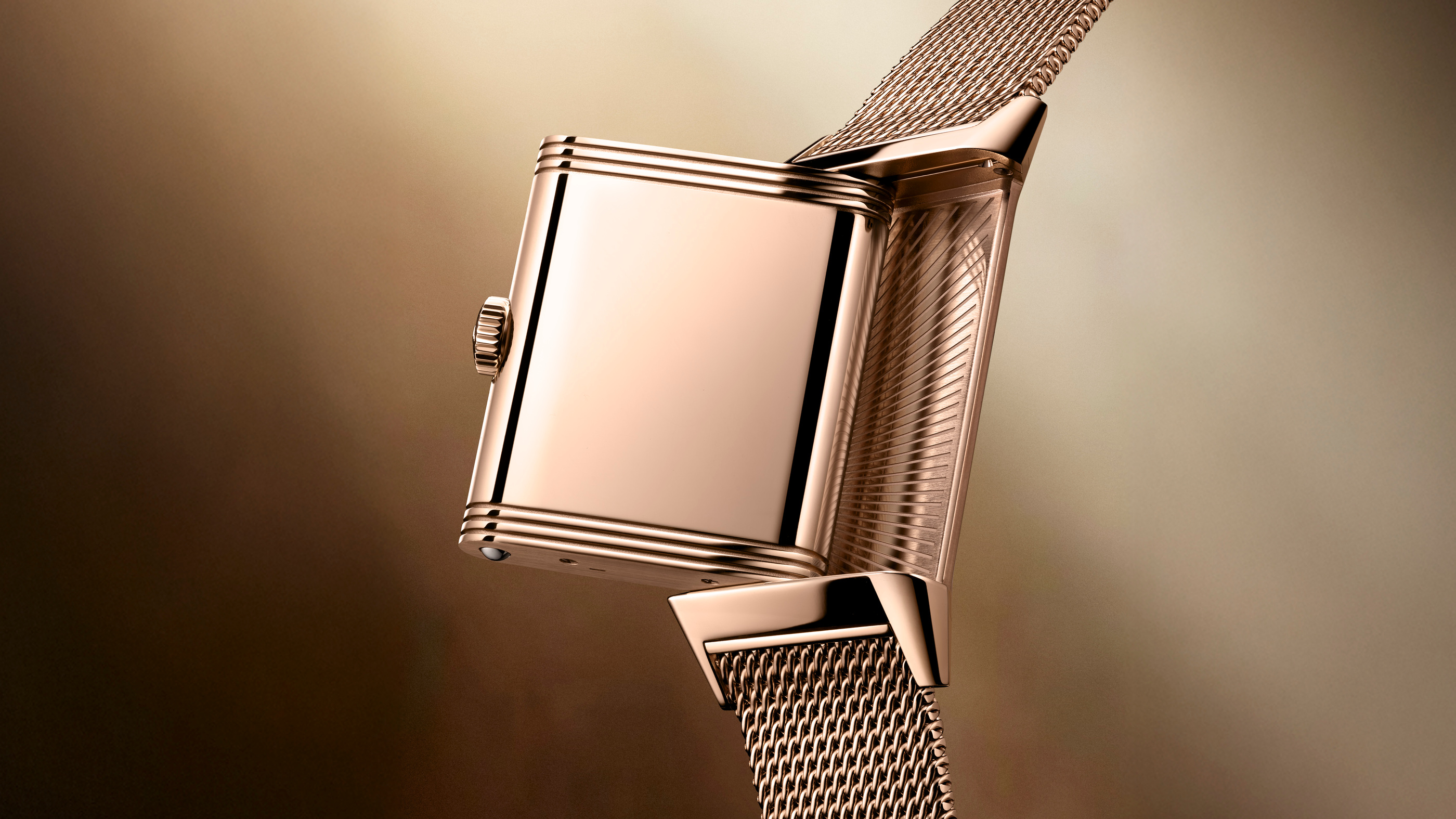
Monoface identifies this as a single-dial Reverso. Turning the case reveals a metal reverse rather than a second time-zone display. The official front and back views make that distinction particularly clear. This is not the Duoface architecture, and the presence of a swivelling case should not be used to imply functions the reference does not have.
The reverse changes how the watch can be seen as an object. One side is organised around reading: markers, hands and small seconds. The other concentrates attention on the metal plane and its frame. The bracelet remains the same, so the case’s visual emphasis can change within an otherwise continuous composition. That is a different kind of variation from changing a strap.
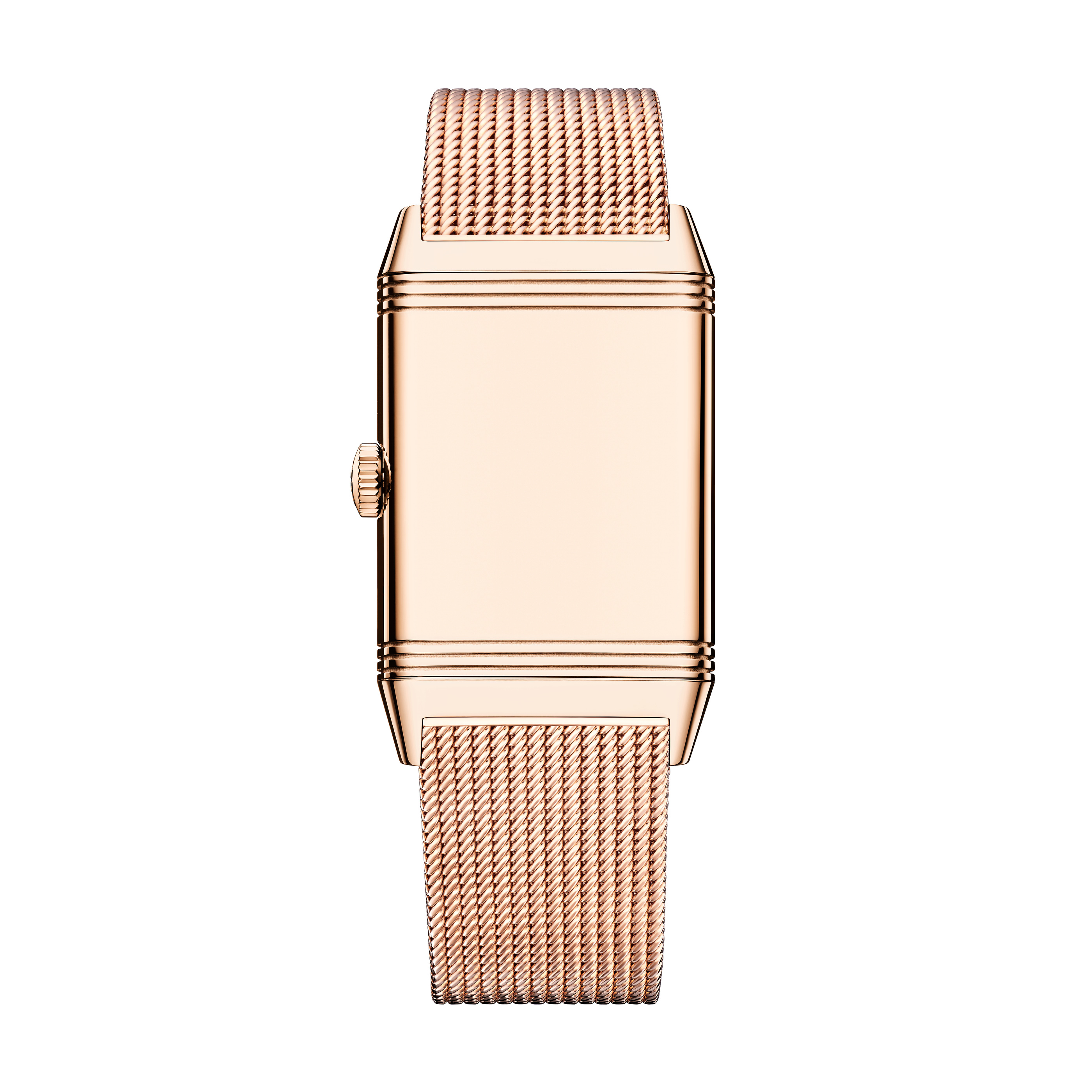
Any personalisation should be discussed for the actual reference and proposed work. A plain reverse in an official photograph does not establish that every engraving or intervention is possible, included or reversible. The more interesting starting question is what the owner wants that second surface to mean. Leaving it untouched is also a considered choice, rather than a failure to use an available space.
Construction without a spectacle
The 2025 release identifies the hand-wound Calibre 822, a stated power reserve of 42 hours and a case measuring 45.6 by 27.4 millimetres, 7.56 millimetres thick. The movement is described as shaped to echo the rectangular case. These specifications establish the reference’s architecture; they do not establish measured running performance for a delivered example.
Hand winding also belongs to the watch’s daily relationship with its owner. Someone accustomed to an automatic watch should consider whether they want that repeated interaction. The question is about use, not which system is inherently more authentic. The published reserve provides a technical reference point, while actual setting and winding procedures belong to the manufacturer’s instructions for the watch.
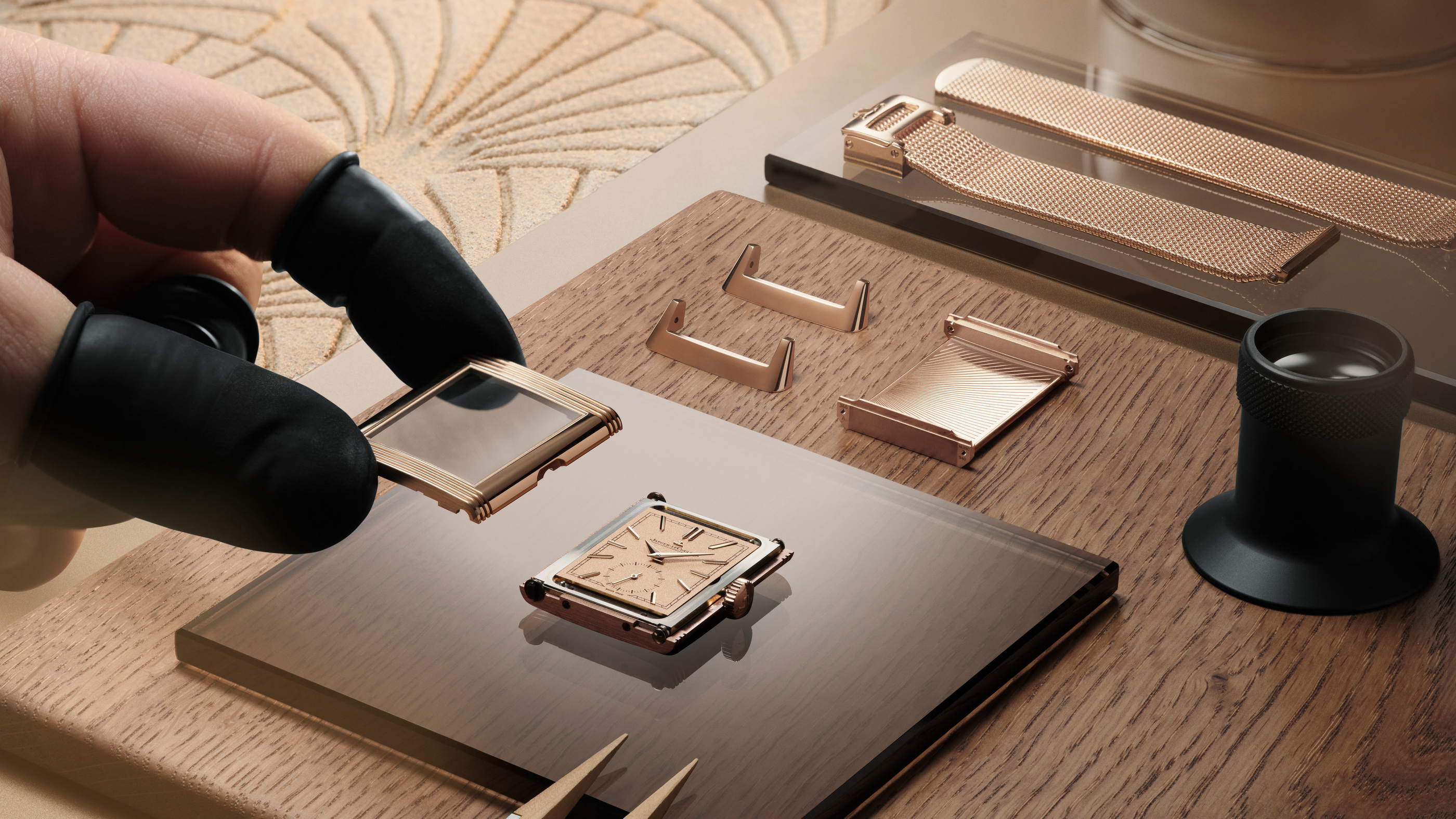
The official making photograph shows components and a gloved hand at a work surface. It helps connect the complete watch to the scale of assembly without pretending to document every stage of the bracelet or movement. A manufacturing image is most useful when it explains something specific. Here, it draws attention back to the fact that the apparently effortless rectangle is assembled from separate, carefully related parts.
The fitting notebook
Keep the exact reference with any boutique conversation. Jaeger-LeCoultre’s later Or Deco announcement expands the broader expression into other variants; this article concerns the 2025 pink-gold Q713216J. Images and specifications from that reference should not be transferred to a later colour or gem-set version.
| Consideration | Official Q713216J record | What to establish in person |
|---|---|---|
| Metal palette | Pink-gold case and bracelet; golden-coloured grained dial | How the finishes respond at ordinary viewing distance |
| Case | 45.6 × 27.4 × 7.56 mm | How the rectangle sits across the wrist |
| Bracelet | Milanese link with integrated sliding clasp | Adjustment, clasp operation and contact with the wrist |
| Display | Hours, minutes and small seconds on one dial | Readability without posing the watch towards the eye |
| Reverse | Metal back of a swivelling case | Whether to leave it plain or discuss appropriate personalisation |
| Movement | Hand-wound Calibre 822; stated 42-hour reserve | Correct winding and setting instructions |
A successful fitting should explain the complete object, not only the dial viewed straight on. Spend time with the bracelet, the side of the case and the closed reverse. Those relationships are the reason to consider this version, so they deserve as much attention as the more familiar front view.
The Luxe Digital view
This Reverso’s strongest idea is continuity interrupted by texture. Case, dial and bracelet share a colour family while retaining distinct visual jobs. The result gives a well-known rectangular design another way to occupy the wrist without disguising what made it recognisable.
The useful choice is whether that extended metal composition suits the owner’s habits and eye. Establish the fit and the exact reference, then look beyond the watch’s most flattering close-up. The relationship between a small grained field, a clear metal reverse and a woven-looking bracelet is sufficiently rich to reward ordinary, repeated attention.
This Reverso’s strongest idea is continuity interrupted by texture.
Sources & credits
Sources and methodology
Independent watch design and reference analysis of the named official records and imagery, checked on 15 October 2026. Original introduction dates and reference-specific specifications are retained. Images show the identified configurations. Independent visual and reference analysis of official material. No hands-on wearing, accuracy or water-use test, workshop visit, interview or specimen inspection claimed. Launch, current regional records, studio visuals, campaign compositions and assembly photographs are identified separately. Availability, individual condition, fitting and care require exact-reference confirmation.