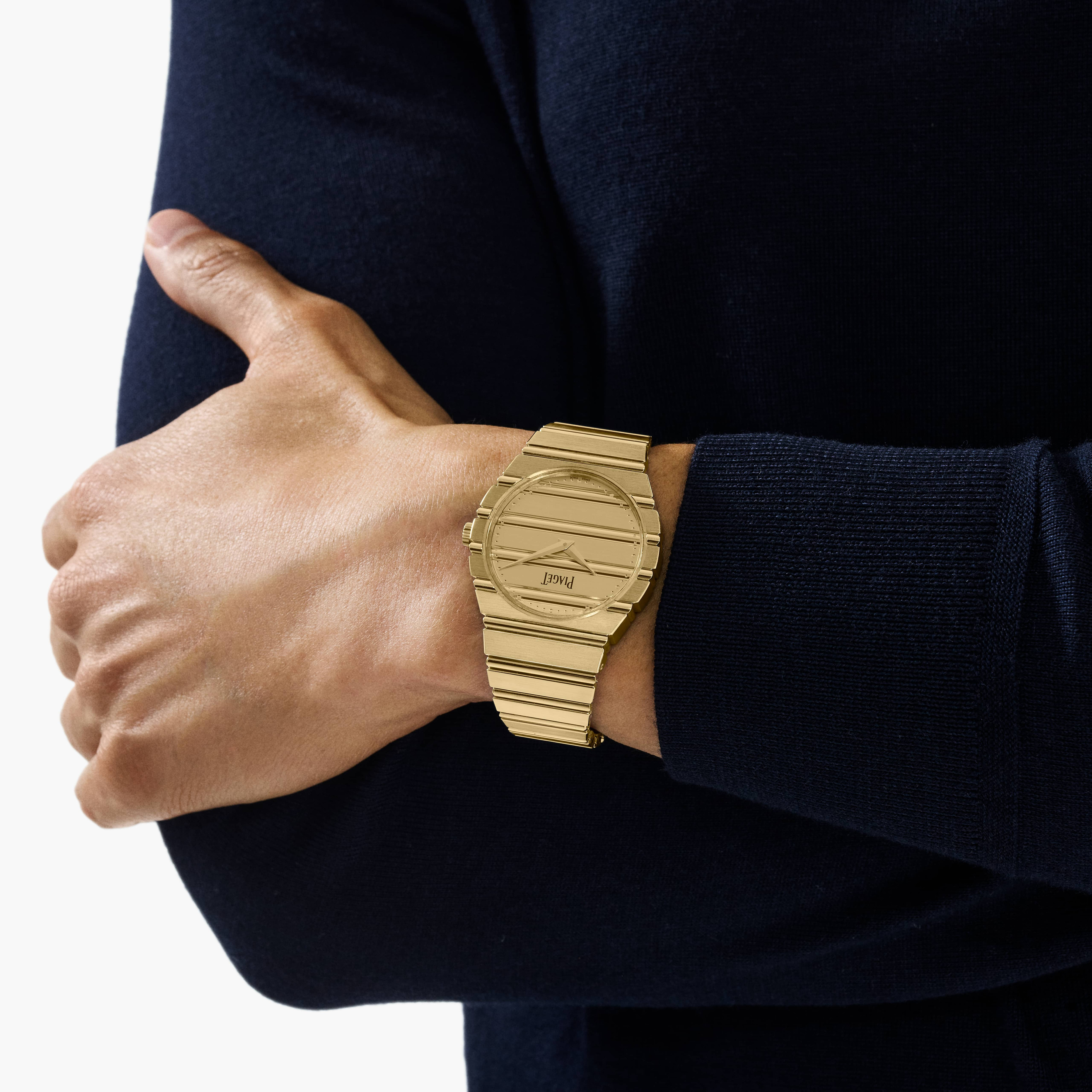
On the yellow-gold Piaget Polo 79, the bracelet appears to continue across the face. Horizontal gadroons move from link to case to dial, making the watch read as one surface before its separate components become apparent. The design’s coherence depends on that continuity, while the official making imagery reveals how many individual operations are required to sustain it.
The line passes through the watch
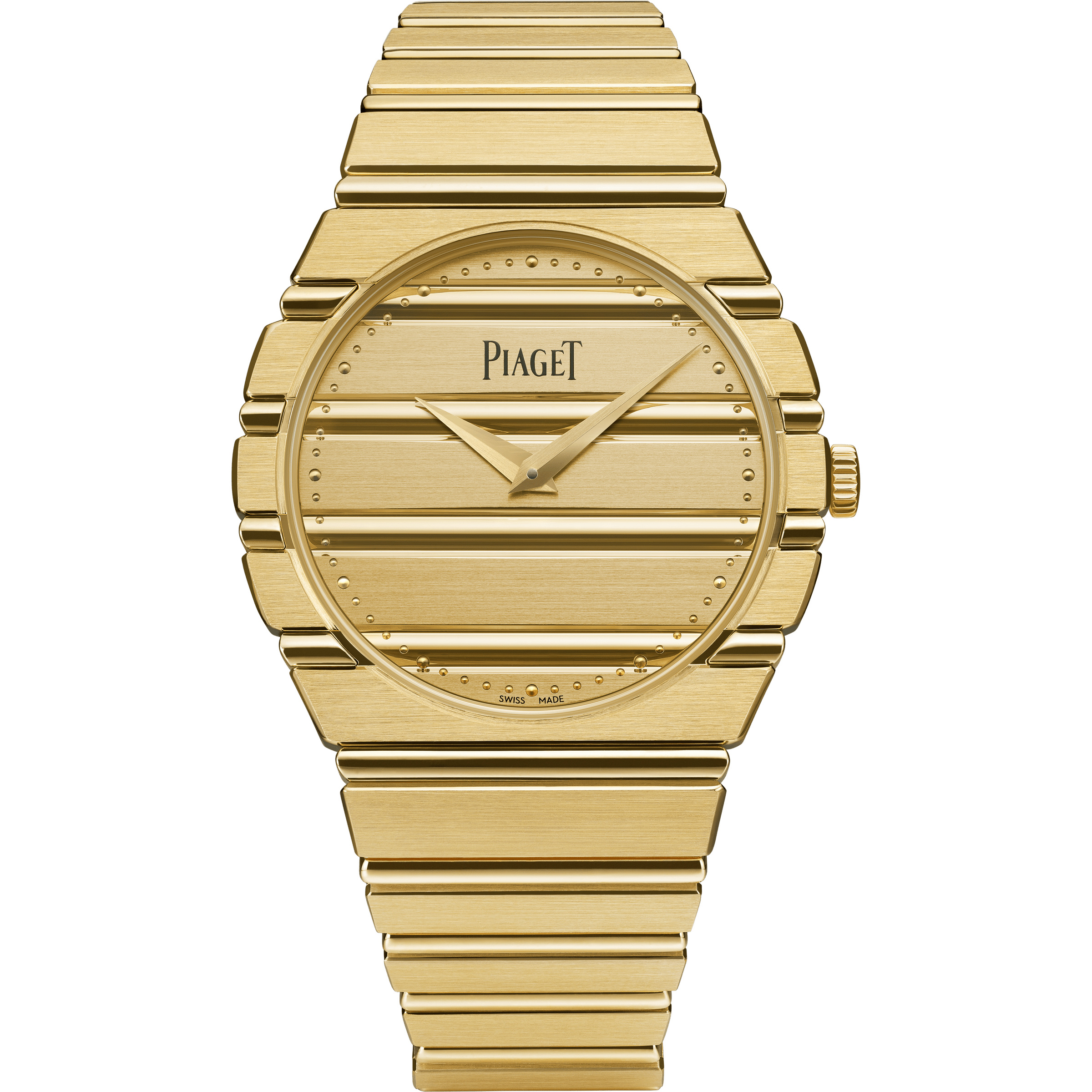
The frontal view of reference G0A49150 gives the eye very little reason to stop at the edge of the case. The broad horizontal elements continue into the bracelet, while the dial carries a related rhythm across its centre. Hands and markers occupy that surface rather than sitting within a strongly separated visual compartment.
That is a particular way to organise a watch. The case remains a distinct physical object, but the composition reduces the apparent break between head and bracelet. The result can be understood as a larger piece of metalwork that also tells the time.
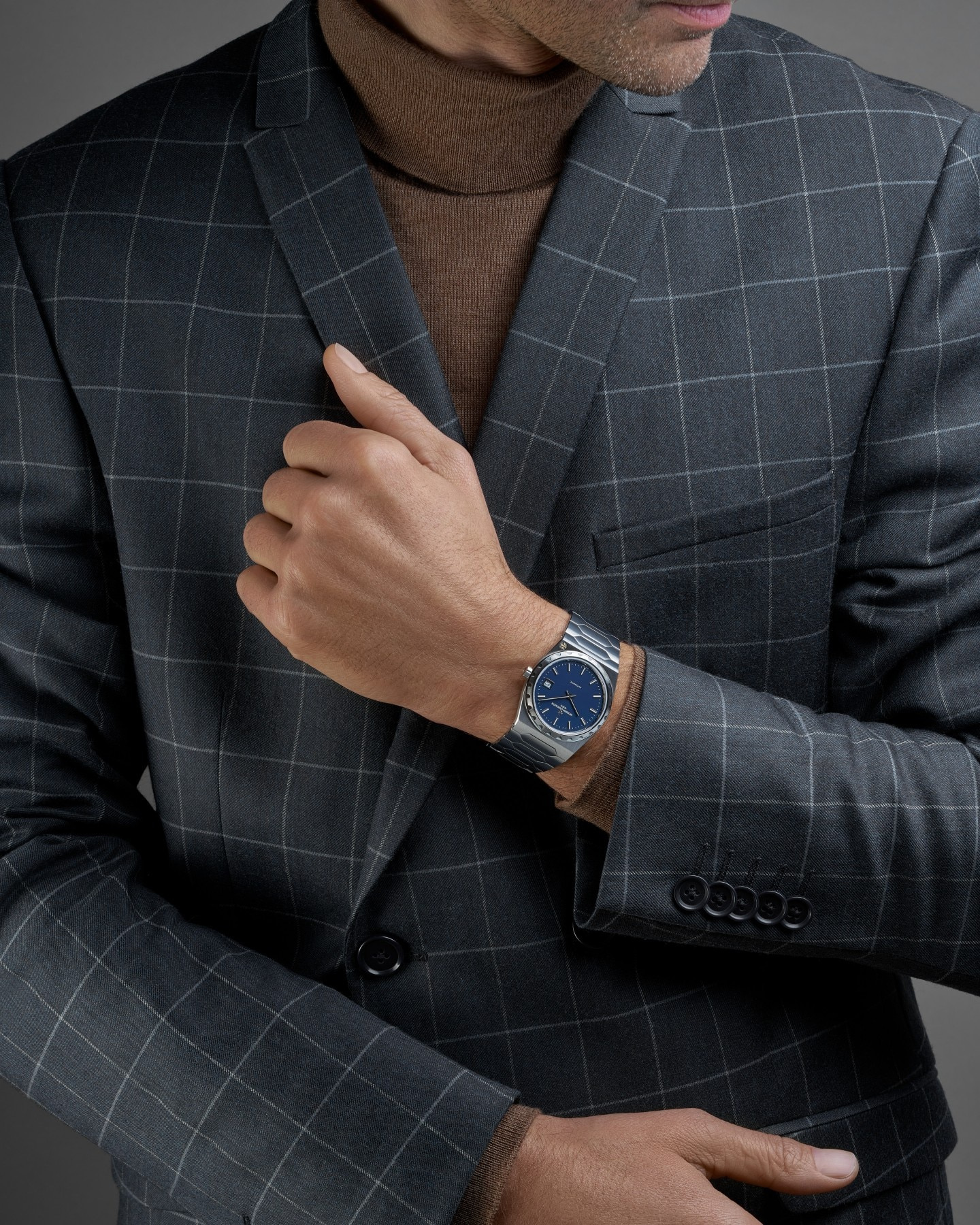
The wrist photograph supplies an essential counterpart. Once the bracelet curves around a person, the repeated lines have to change direction while retaining their relationship with the face. The design’s success is therefore connected to articulation and fit, not simply to the appearance of a perfectly flat studio portrait.
One metal, several surface behaviours
Piaget specifies an 18K yellow-gold case, dial and bracelet for G0A49150. Within that common material, the distinction between satin-finished elements and polished gadroons gives the watch much of its visual structure.
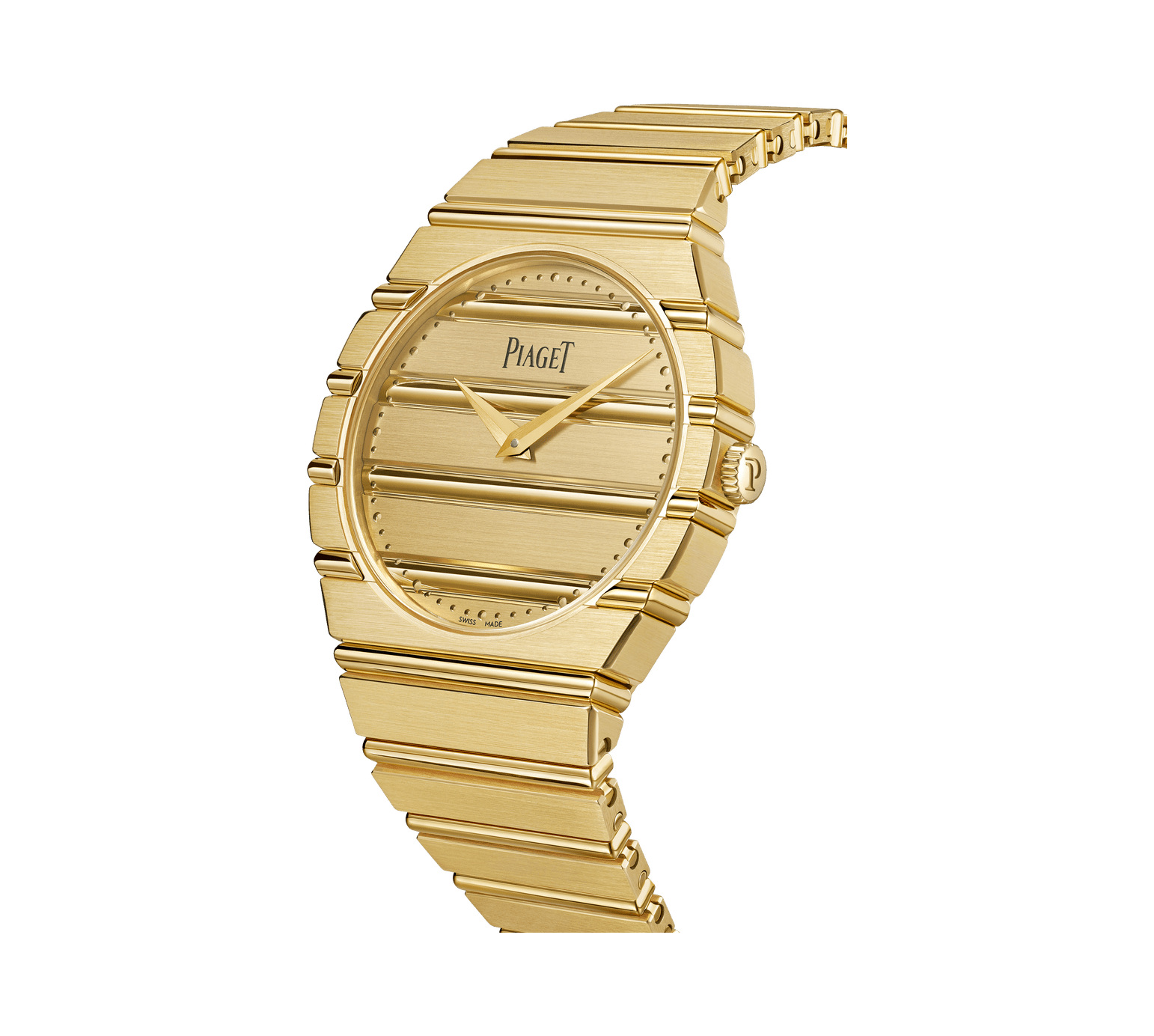
The different finishes respond to light in different ways. A broad satin area holds a relatively quiet tone, while a polished edge can establish a sharper line. Alternating those behaviours makes the horizontal rhythm legible without needing a strong change of colour between components.
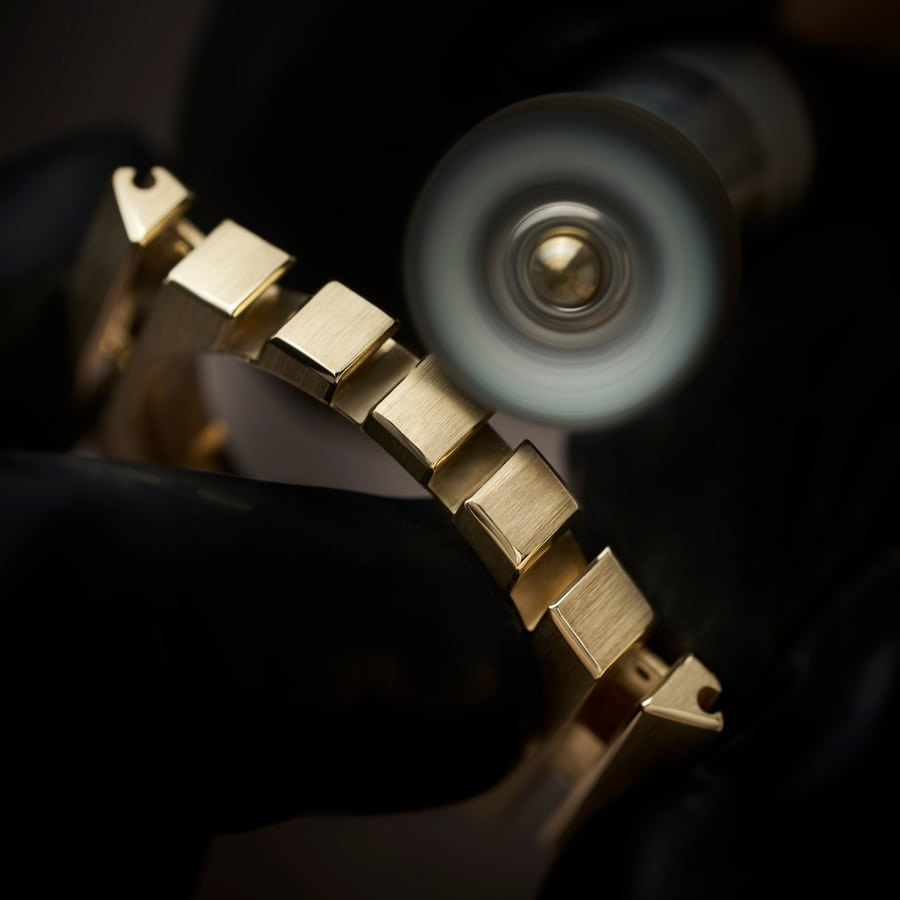
This is where the angled product view becomes especially useful. It introduces reflections that a frontal image can suppress, showing the surfaces as three-dimensional forms. The watch’s apparent simplicity depends on controlling those transitions, so that the line remains readable as the object moves.
The making sequence exposes the separate parts
The official workshop imagery shows bracelet finishing, case work and a dial-side operation. Each photograph isolates a component that the complete watch encourages the eye to read as part of one surface.
That change of scale explains a substantial part of the design. Continuity is an outcome assembled from separate pieces, each with its own edge and finish. A bracelet link has to participate in the same visual rhythm as the adjoining element, while the case and dial need to carry that rhythm through different geometries.
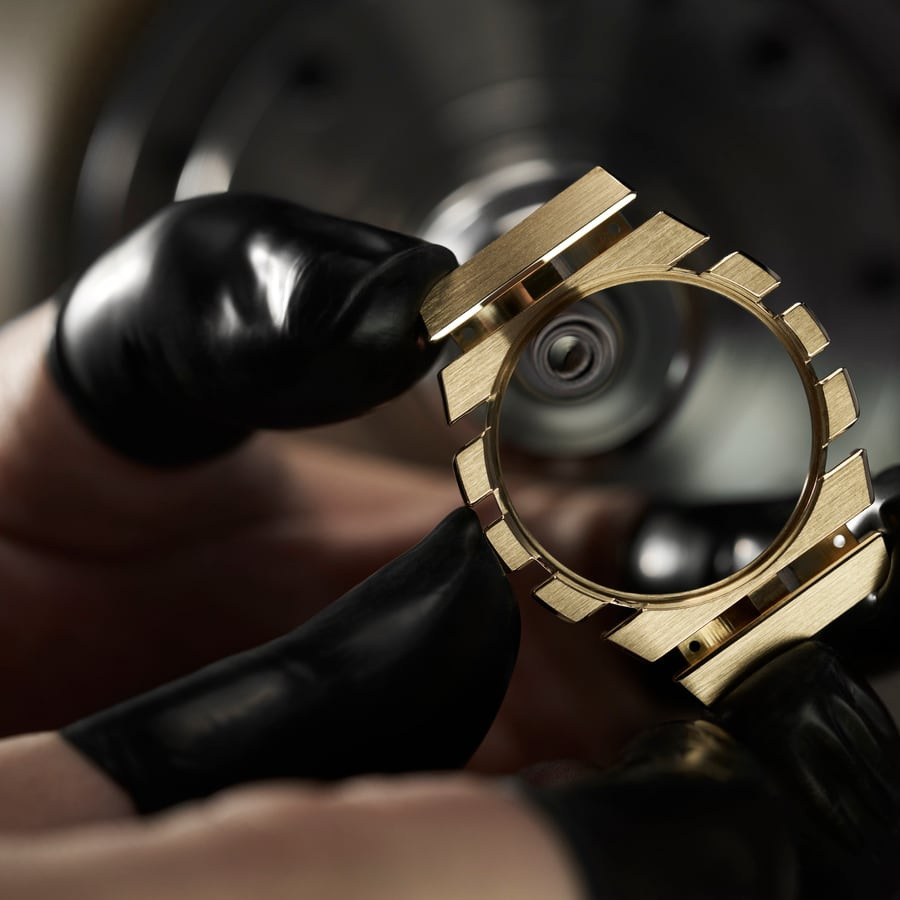
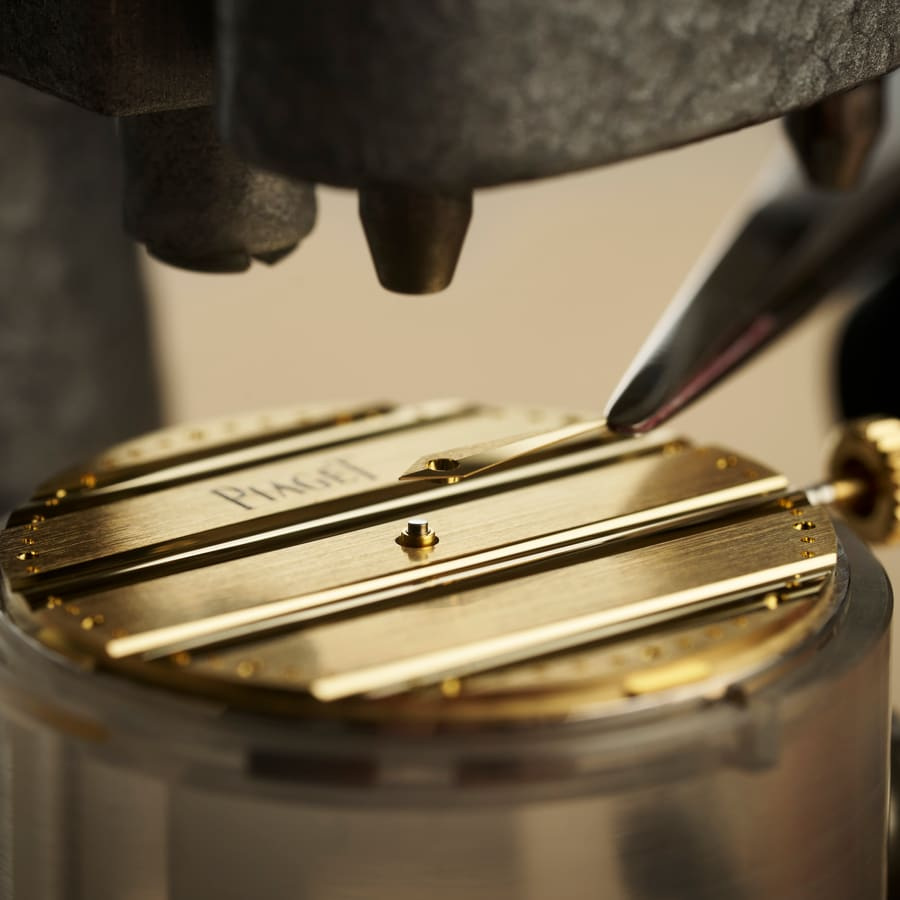
The images should be read as the maker’s documented process sequence. They reveal the relationship between component and whole without establishing a labour-hour figure or suggesting that every operation on a delivered watch has been witnessed independently. Their value is concrete enough without adding those unsupported claims.
The automatic movement gives the back another centre
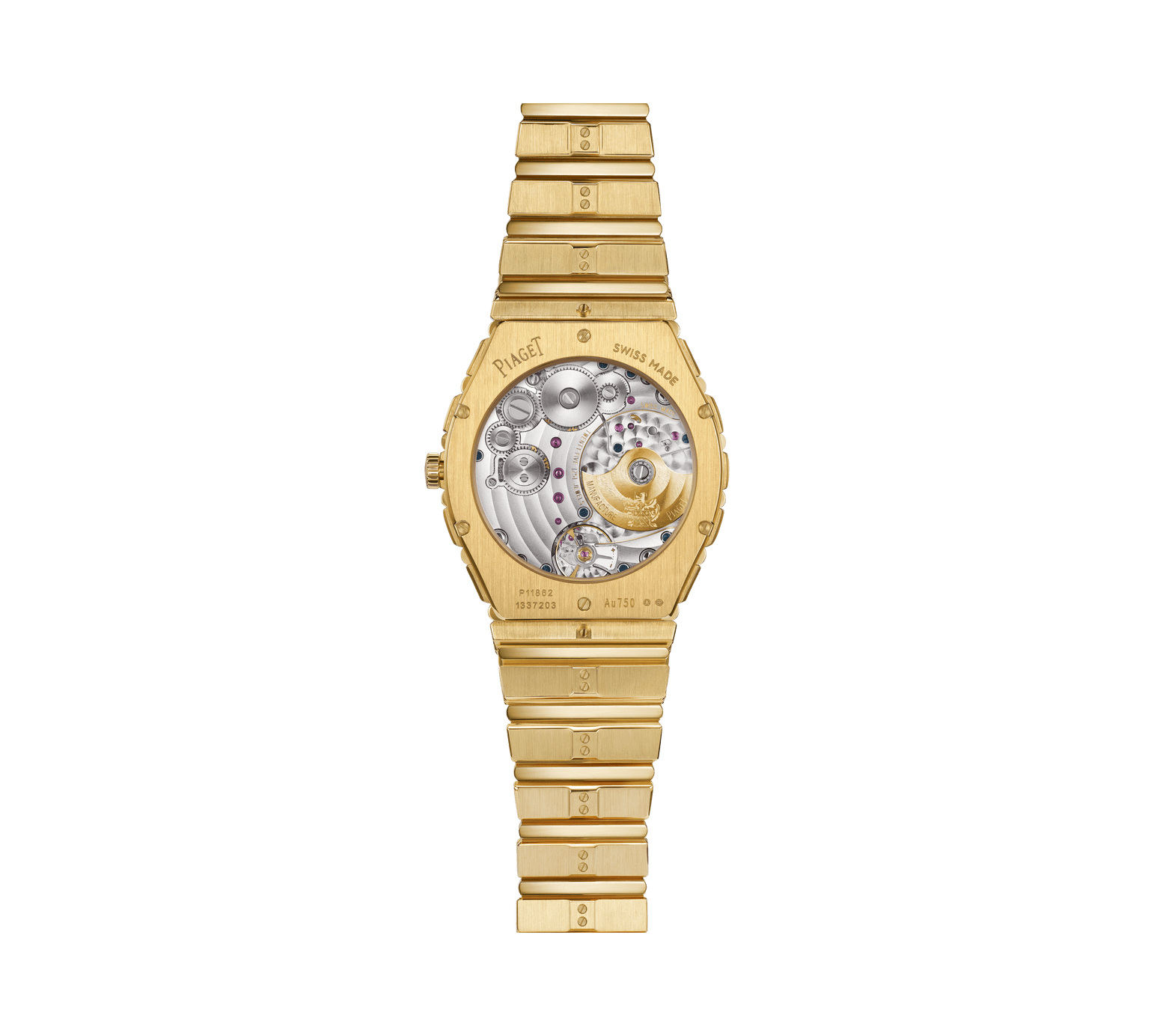
Reference G0A49150 uses Piaget’s self-winding 1200P1 movement, with an 18K yellow-gold oscillating weight. The display-back image gives this side of the watch a different organisation from the horizontal face.
Here, the interest moves towards mechanical components and their positions within the case. The back does not repeat the dial’s broad graphic gesture. It offers another scale of workmanship, with the complete bracelet reminding the viewer that the mechanism remains inside the same continuous exterior object.
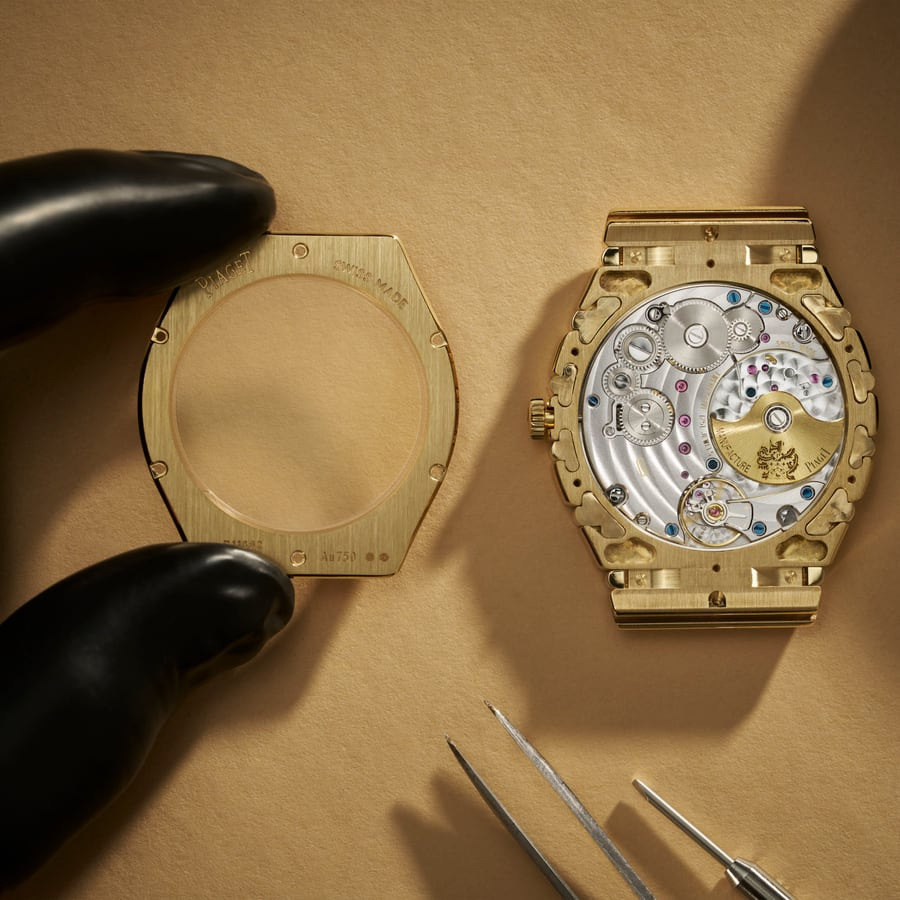
The contrast is useful for an owner. The front is encountered repeatedly at a glance; the back invites a slower inspection. Both can be integral to the appeal of the watch without competing for the same kind of attention or requiring the dial to expose the machinery below.
Thinness belongs beside the bracelet
The current reference measures 38 mm across and 7.45 mm in thickness. Those figures help establish the case, while the integrated bracelet makes the total footprint a broader question. Diameter does not describe how the first links leave the case or how the complete object settles around a particular wrist.
The bracelet also changes how the polished lines meet one another when the watch curves. A flat front view gives them an almost continuous direction; on the wrist, their reflections divide into smaller intervals. That movement is part of the design’s character. It makes a fitting useful for understanding the appearance as well as for establishing the correct length.
| Element | G0A49150 record | Design consequence |
|---|---|---|
| Metal | 18K yellow gold for case, dial and bracelet | Gives the object a common material language |
| Diameter | 38 mm | Defines one dimension of the watch head |
| Thickness | 7.45 mm | Establishes a separate part of the side profile |
| Movement | Self-winding 1200P1 | Supplies the automatic mechanical architecture |
| Oscillating weight | 18K yellow gold | A specific feature visible from the back |
| Water resistance | 5 bar | A rating to consider with the current care instructions |
The best fitting therefore includes the bracelet as part of the design, rather than a final adjustment after the head has been chosen. The angle of its first links, the clasp and the length around the wrist all affect how the continuous horizontal idea is actually experienced.
The Luxe Digital view
The Polo 79’s most persuasive quality is the way it makes separate components appear to belong to one uninterrupted piece of design. Its horizontal rhythm is immediately recognisable, but the workshop views reveal how much coordination is needed to make that rhythm travel across different parts.
The all-gold construction supports the idea through surface rather than colour contrast. Satin areas and polished gadroons give the eye enough distinction to follow the form, while the bracelet carries the composition beyond the case and around the wrist.
Reference G0A49150 is therefore worth considering as an articulated object, with time display and movement inside a larger material arrangement. The complete watch supplies the first impression. Its making, back and fit then turn that impression into a more substantial understanding of how the design has been achieved.
The Polo 79’s most persuasive quality is the way it makes separate components appear to belong to one uninterrupted piece of design.
Sources & credits
Sources and methodology
Independent design and reference analysis of the named official records and imagery, checked on 15 October 2026. Launch specifications and later product records retain their own dates and references. Images show the identified configurations. No independent handling or timing test is implied.