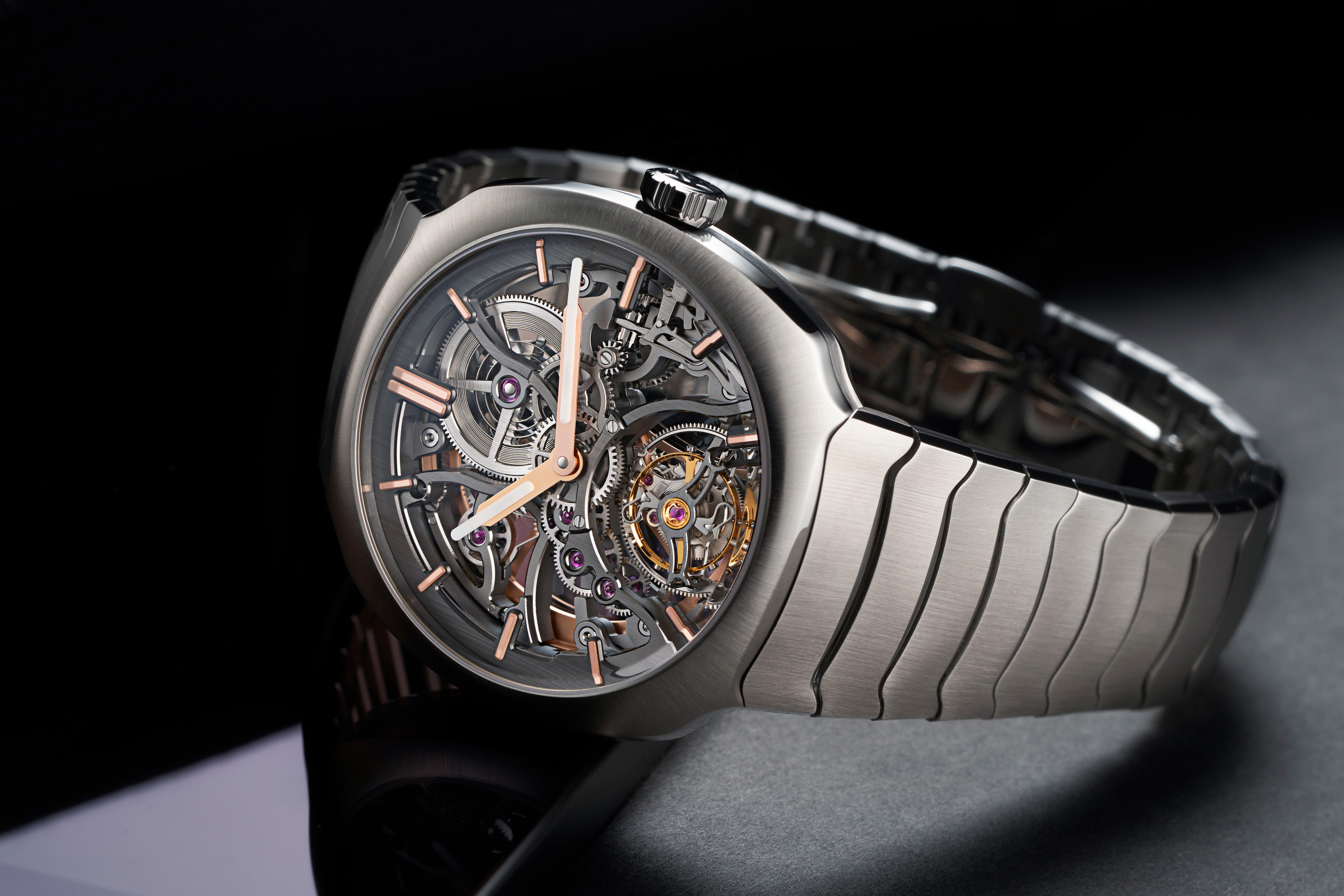
The H. Moser & Cie. Streamliner Tourbillon Skeleton presents its movement as the face of the watch. Bridges, openings and the tourbillon create the composition through which the hands move. Around that intricate centre, the rounded steel case and flowing bracelet establish a calmer outline: complexity is held within a remarkably continuous object.
An outline before a mechanism
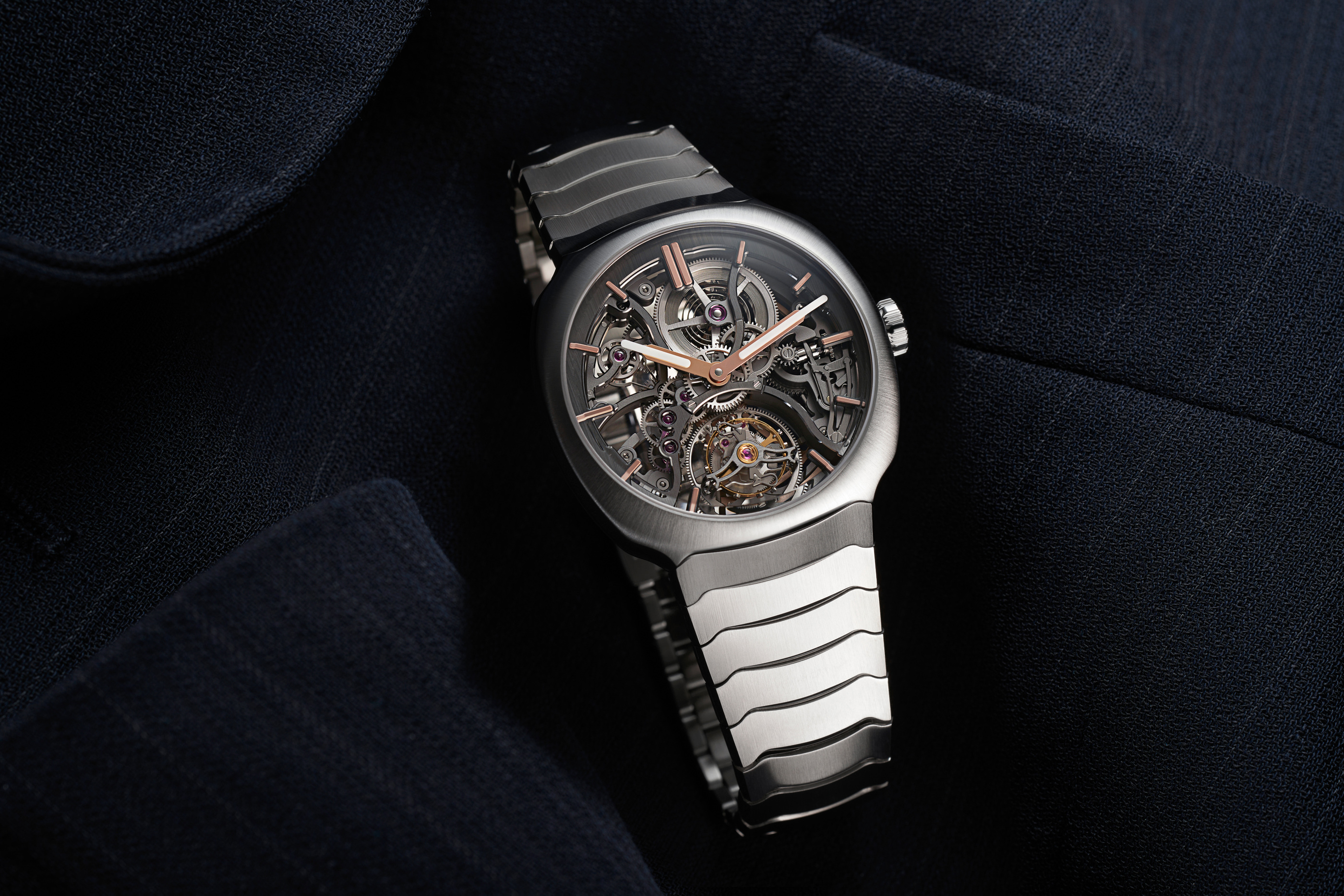
The reference shown here is the steel Streamliner Tourbillon Skeleton 6814-1200. The manufacturer gives its diameter as 40 mm. Its integrated bracelet and rounded case can be read together in the official studio photographs, before any attempt is made to follow the movement’s individual components.
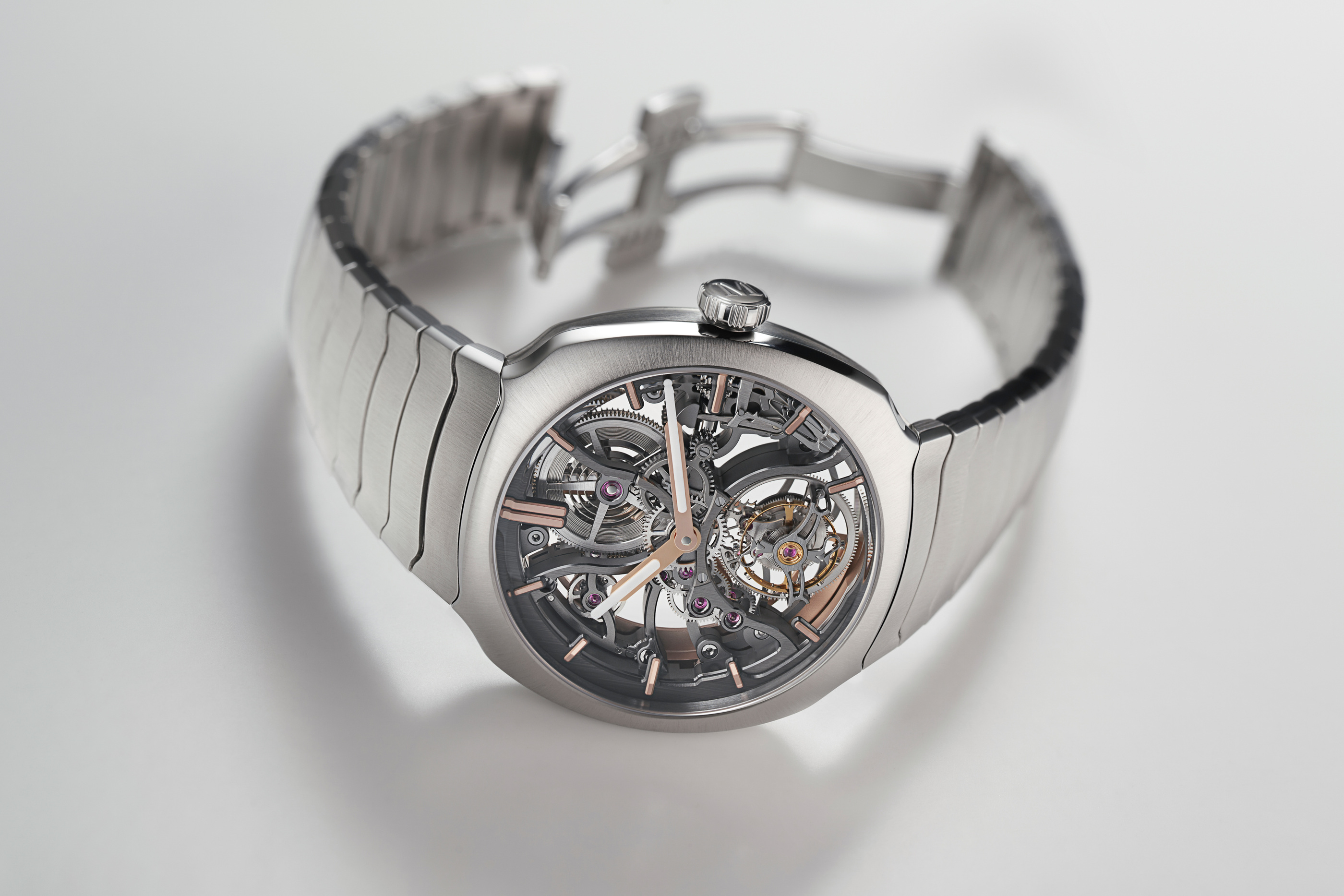
That order of looking is useful. In the three-quarter view, the bracelet is an important part of the composition rather than a secondary attachment. Its articulated surfaces continue the visual movement of the case, while the open dial provides a different density at the centre. The eye encounters a continuous outline and then a more elaborate interior.
The photographs chosen for this study alternate an isolated object, a closer movement view and the watch on the wrist. Each answers a different question about proportion. None can establish comfort or fit for another wearer. Those remain matters for a direct fitting, especially with an integrated bracelet whose sizing is part of the ownership experience.
Skeletonisation creates a field of depth
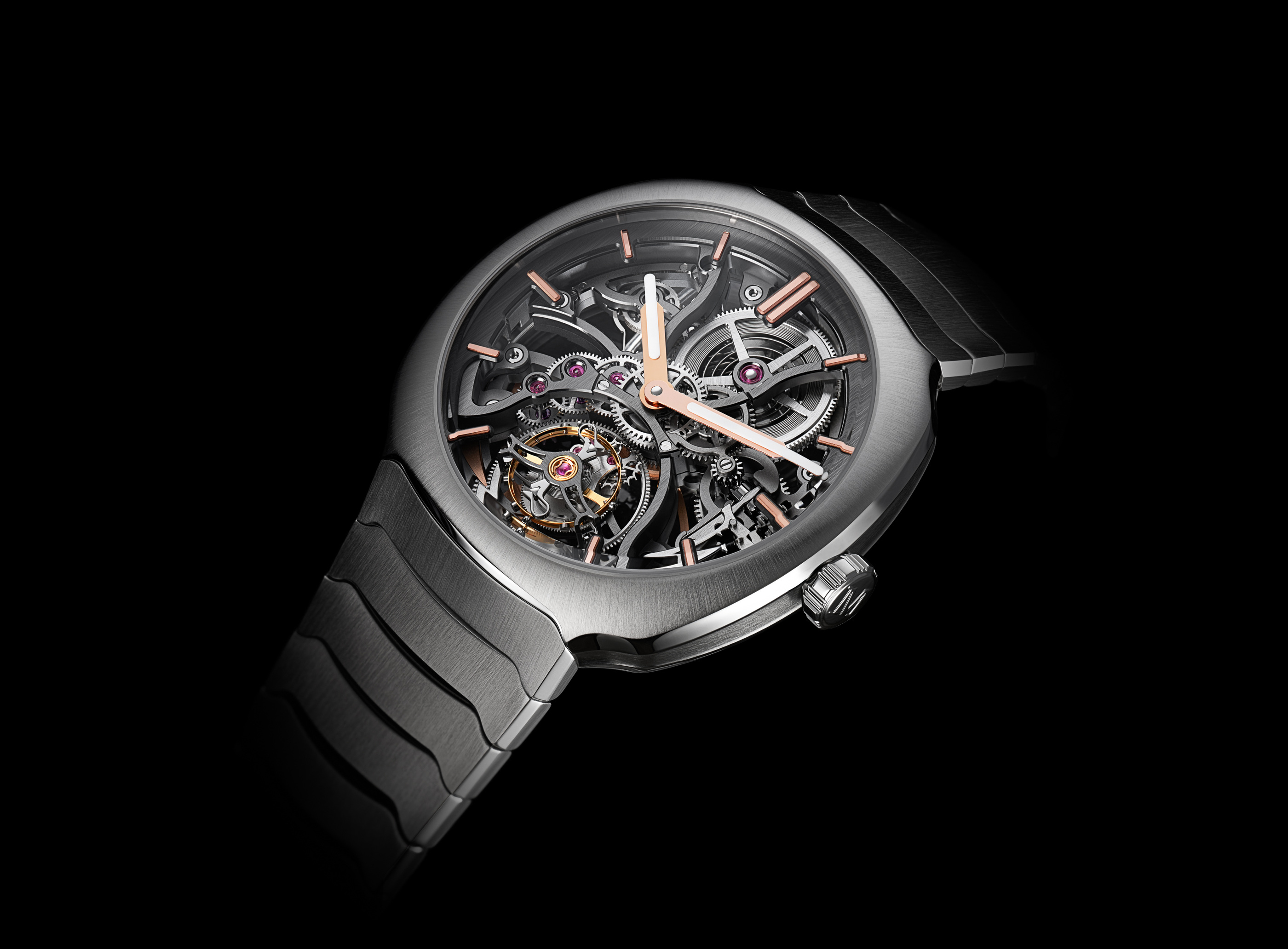
An open movement can be presented as an inventory of visible parts, but the more interesting question is how those parts form an intelligible face. Here, dark bridges sit against lighter mechanical elements, with the hands crossing above them. The contrast helps create depth while preserving a recognisable overall shape.
The manufacturer identifies the automatic movement as HMC 814 and describes anthracite-treated bridges and mainplate. That documented treatment has a visible role in the design. Darker structural elements provide a background against which the moving display can register, rather than asking every component to compete with the hands at the same brightness.
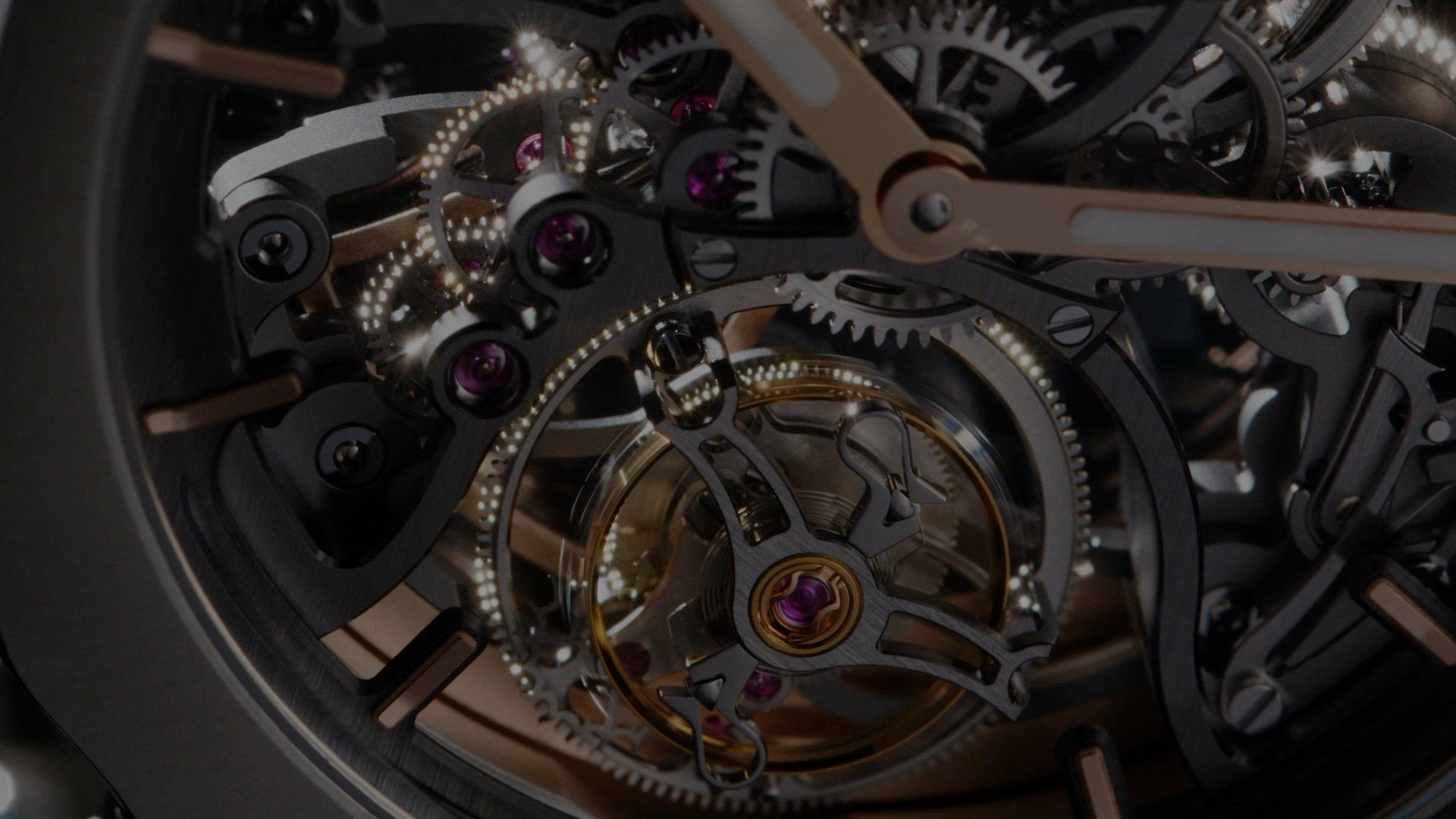
The close photograph is therefore placed beside the broader studio view. It lets the reader examine the arrangement without losing the context of the case. Following the mechanism in motion would require a different form of evidence. A still photograph shows its construction and visual hierarchy, not its rate performance or the ease with which time is read in every lighting condition.
The tourbillon is part of the face
Moser describes a one-minute flying tourbillon with a double hairspring. In the photograph, the assembly occupies a distinct position within the open movement. Its presence changes the face from a flat surface into a set of elements at different depths, with the hands and surrounding structures providing a framework around it.
The design question is how much attention that assembly should command. A macro image gives it scale and detail; an overall view tests whether it remains part of a coherent watch. The combination is more informative than using the tourbillon as a standalone emblem of value. It shows why the mechanism belongs in this particular composition.
Any claim about improved real-world timekeeping would need its own measurement and comparison. The manufacturer’s description establishes the construction being offered. This feature concentrates on the visible relationship between that construction, the hands and the case, leaving performance evaluation to evidence gathered for that purpose.
Steel changes the light around the movement
The bracelet photographs show how polished and darker-looking surfaces can appear across the same object as the angle changes. Against fabric, the watch takes on a quieter outline; against a lighter studio setting, the bracelet’s repeated shapes become more explicit. These are complementary views, not contradictory descriptions of its finish.
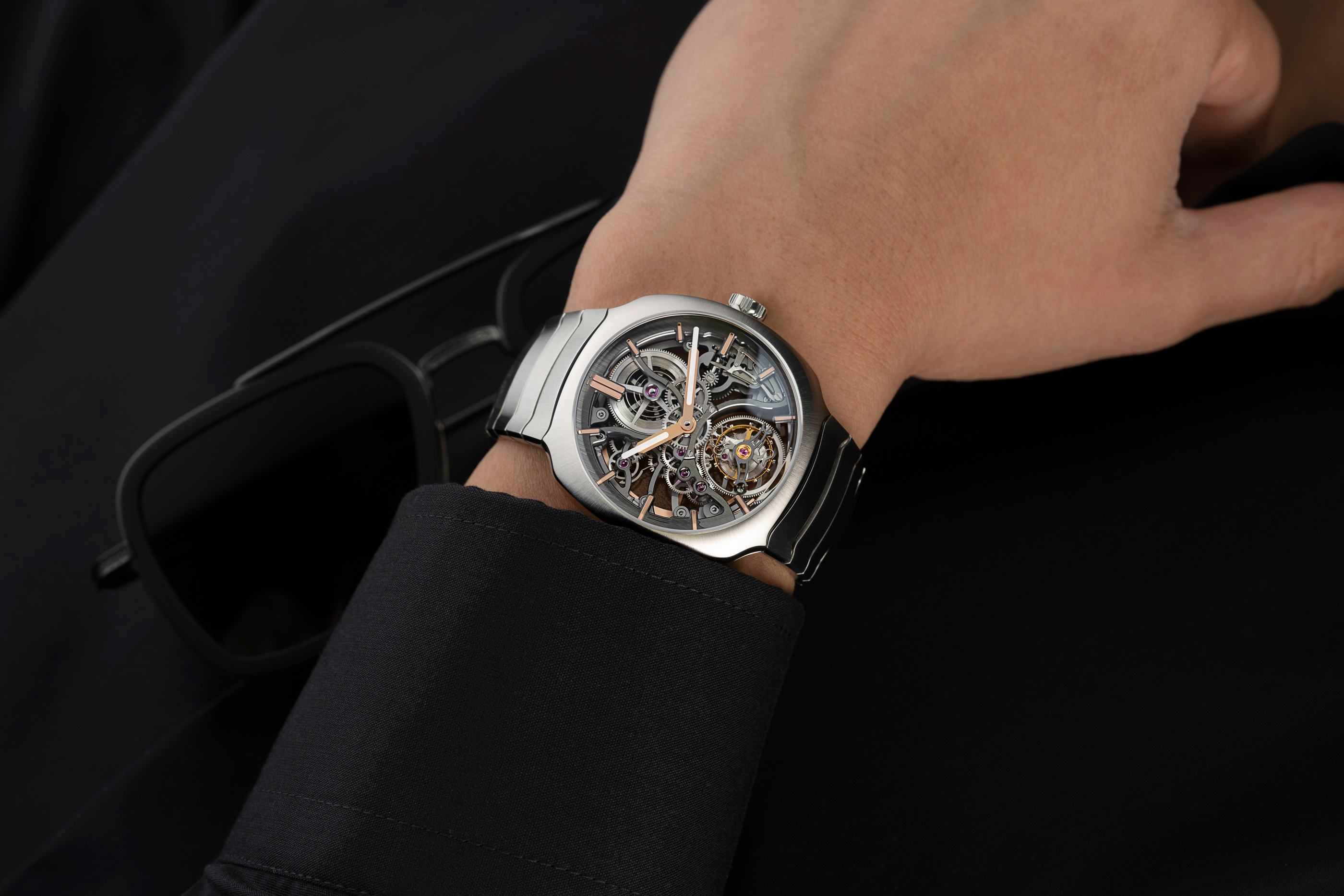
The wrist image is valuable because it returns the watch to a human scale. The open movement can look enormous in a close photograph, yet the complete object has to operate within the dimensions of a wristwatch. Placing the macro and wrist views in different chapters restores that relationship and avoids presenting detail as the whole experience.
For someone considering the reference, the sensible questions concern legibility in ordinary light, bracelet adjustment and the view from the caseback. The official images make those questions more specific. They do not supply a substitute for handling the watch or inspecting the individual piece being offered.
A reference for the exact steel model
The details below apply to 6814-1200, rather than every member of the Streamliner family. Keeping the reference visible prevents photographs or specifications from other materials and variants being folded into one generic description.
| Element | Manufacturer’s reference | Why it matters here |
|---|---|---|
| Model reference | 6814-1200 | Identifies the steel watch pictured |
| Case | Steel, 40 mm diameter | Establishes the object’s outer scale |
| Movement | Automatic HMC 814 | The movement also supplies the visual face |
| Power reserve | 72 hours | A published operating specification |
| Tourbillon | One-minute flying construction | A distinct element within the open display |
| Bracelet | Integrated steel | Continues the case’s overall composition |
Moser’s specifications also state water resistance of 12 ATM. That rating should be read alongside the maker’s use and care guidance; it is not a basis for inventing a diving capability or promising resistance under every practical condition.
Complexity within a quiet boundary
The most persuasive aspect of this Streamliner is the contrast between its boundary and its centre. The case and bracelet establish continuity, while the skeletonised movement introduces openings, intersections and depth. Neither needs to imitate the other for the watch to feel coherent.
It is a design that benefits from being shown at several scales. The full object explains the outline; the close view reveals construction; the wrist image supplies proportion. Taken together, they allow a reader to examine how an intricate mechanism becomes a wearable composition, while keeping the questions that require direct handling clearly in view.
The most persuasive aspect of this Streamliner is the contrast between its boundary and its centre.
Sources & credits
Methodology and sources
This is a visual design feature about reference 6814-1200, based on Moser’s current product and collection presentations. It is not a hands-on review, accuracy test or valuation. Specifications are maker-stated. All images are official photographs of the identified model; visual interpretation is LuxeDigital’s own.