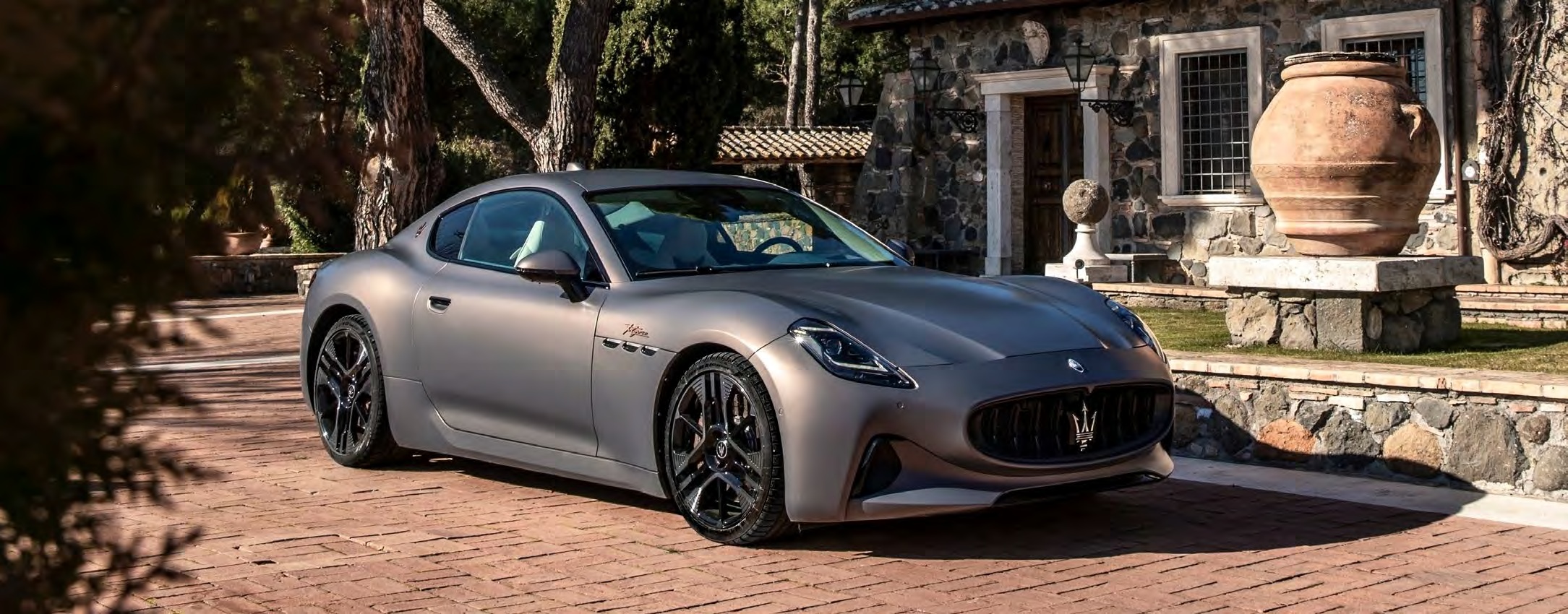
The most revealing detail of the GranTurismo Folgore is not visible in a passing photograph. Its battery layout was designed to preserve the low seating position and silhouette of a grand-touring coupé. Read through that decision, the electric Maserati becomes an argument about proportion: how much of a familiar way of travelling can be retained when the machinery changes almost completely.
The journey begins with the shape
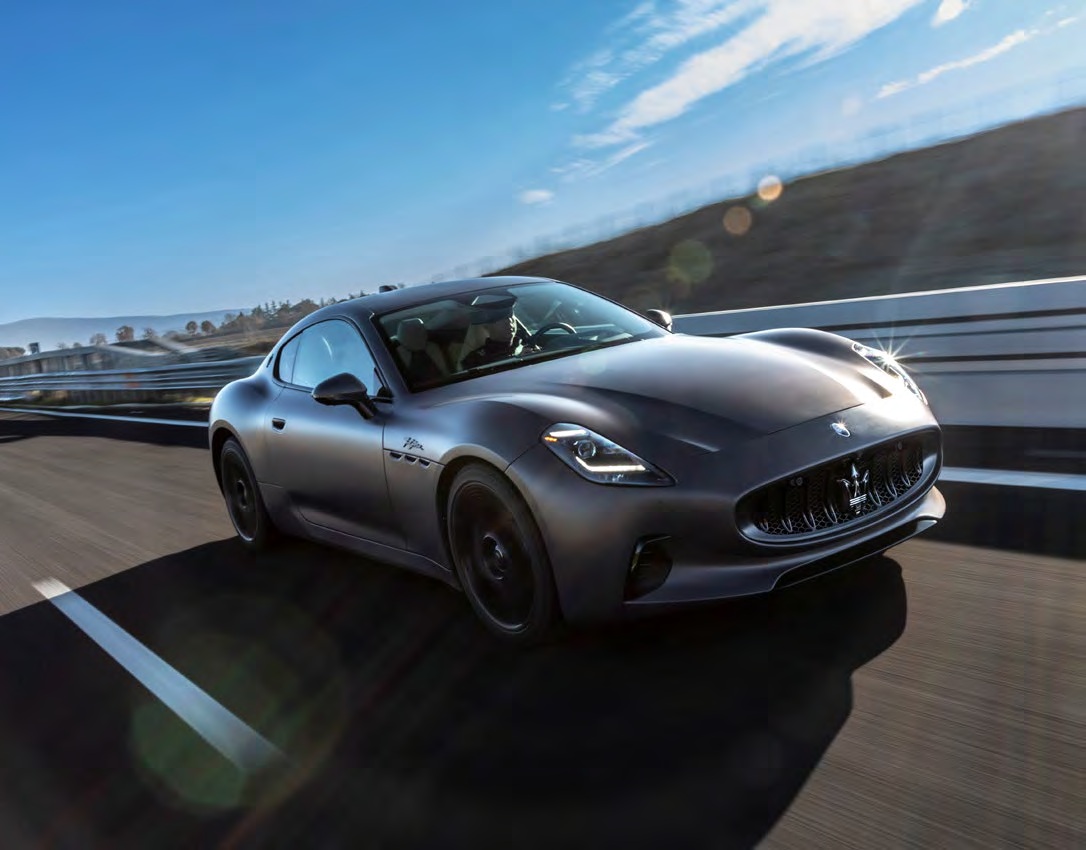
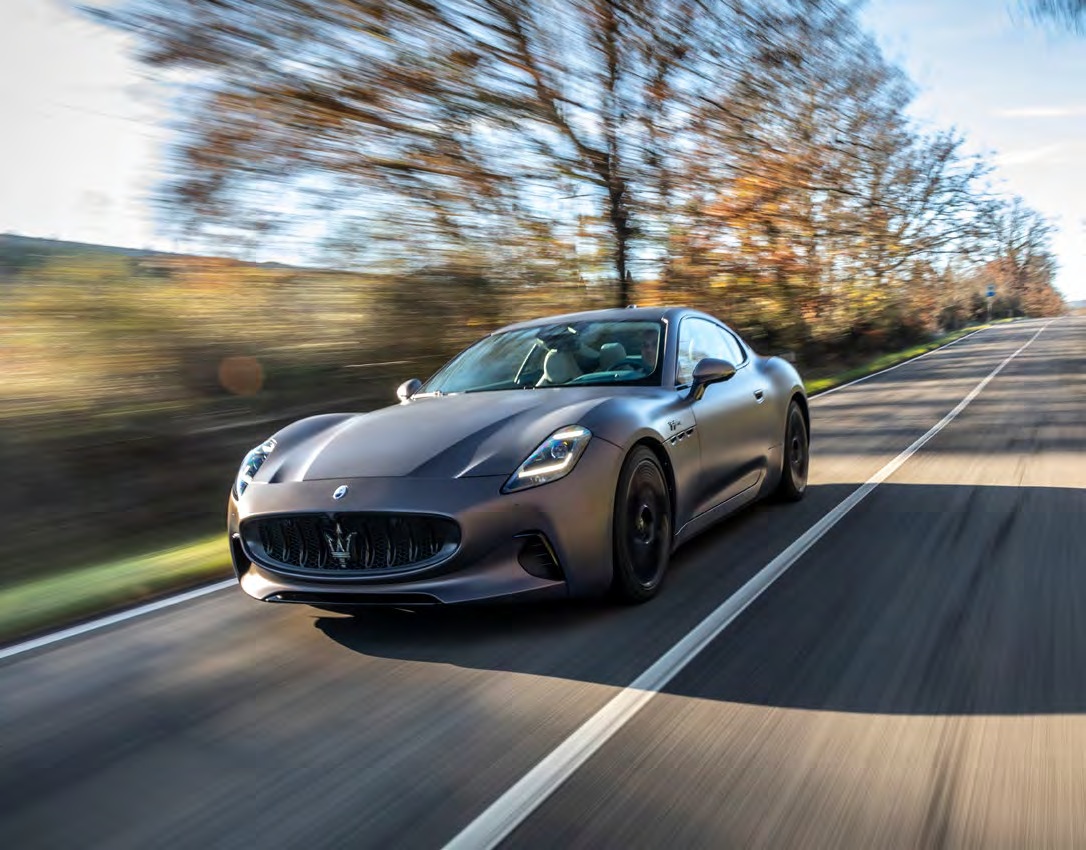
In Maserati’s official catalogue sequence, the Folgore appears on the road, outside a stone house and under tightly controlled studio light. The settings change, but the outline remains the point of continuity. A long bonnet leads into a compact-looking glasshouse; the roof descends towards the rear, while the wheel arches give the body its weight and stance.
That is an interesting choice for an electric car. The absence of a combustion engine does not automatically require a designer to abandon the bonnet as a visual element. Maserati uses it to maintain the rhythm of the GranTurismo: a car whose identity is bound to the relationship between the forward body, the cabin and the rear haunches.
The Folgore is therefore best understood as a specific interpretation of the coupé, not simply a generic electric platform dressed in familiar badges. The official launch documentation places its electrical architecture alongside the petrol versions within the same broader design programme. What the eye recognises and what powers the car are deliberately allowed to follow different histories.
A battery arranged around the occupants
Maserati’s original technical presentation describes the Folgore’s battery as a T-bone arrangement, concentrating modules around the central tunnel rather than stacking a conventional flat pack beneath the seats. The stated purpose includes retaining a low seating position. It is a structural decision with a direct consequence for the shape of the inhabited car.
This is more useful than treating battery capacity as an isolated number. Where the mass sits affects what can happen above it: the position of the seats, the height of the roof and the relationship between the occupant and the window line. A grand tourer is partly a composition of those relationships, particularly when it is expected to remain a low, two-door car with four seats.
The original documentation also describes an 800-volt system with three electric motors. Those facts establish the architecture. They do not, on their own, tell us how the steering feels or how comfortably the car crosses an imperfect road. That distinction leaves room for a more interesting design reading: the hardware supports a recognisable kind of automobile without requiring the article to manufacture a driving impression.
The cabin keeps its own hierarchy
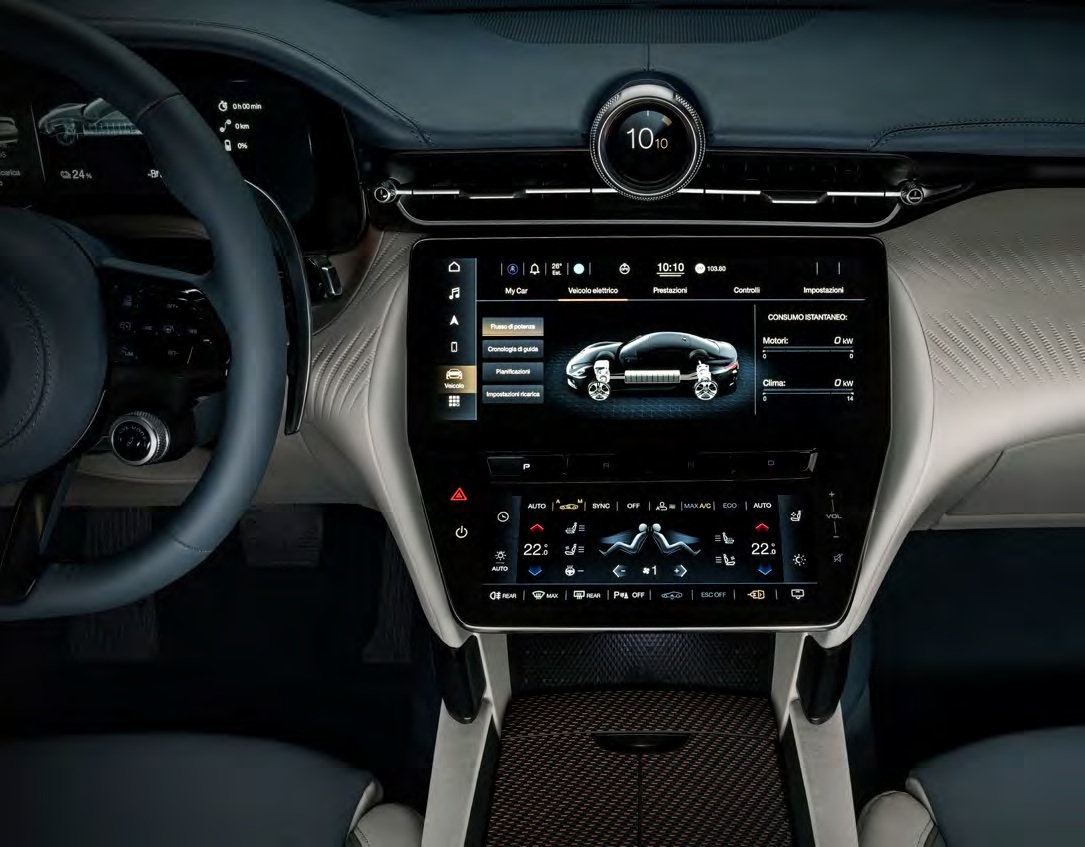
Inside, the Folgore does not ask one screen to become the entire dashboard. The official cabin view shows instruments behind the wheel, a central display and a lower control surface, with the clock occupying a separate position above them. Their arrangement matters because the eye encounters them at different moments.
The steering wheel remains an especially concentrated piece of design. In Maserati’s launch description, start/stop and driving-mode controls sit within its central area. The arrangement connects a change of operating character to the object already held by the driver. Whether that placement suits an individual hand is a question for a physical appointment; its intended relationship to the driver is nevertheless legible.
The wide central tunnel is also a useful reminder that the cabin has a plan, not merely a dashboard. It separates the front positions and carries surfaces and storage between them. When considering a four-seat coupé, it is worth examining the rear places with the front seats set for their intended occupants. The photograph establishes the design language; actual access and accommodation require that more personal test.
A material with a different starting point
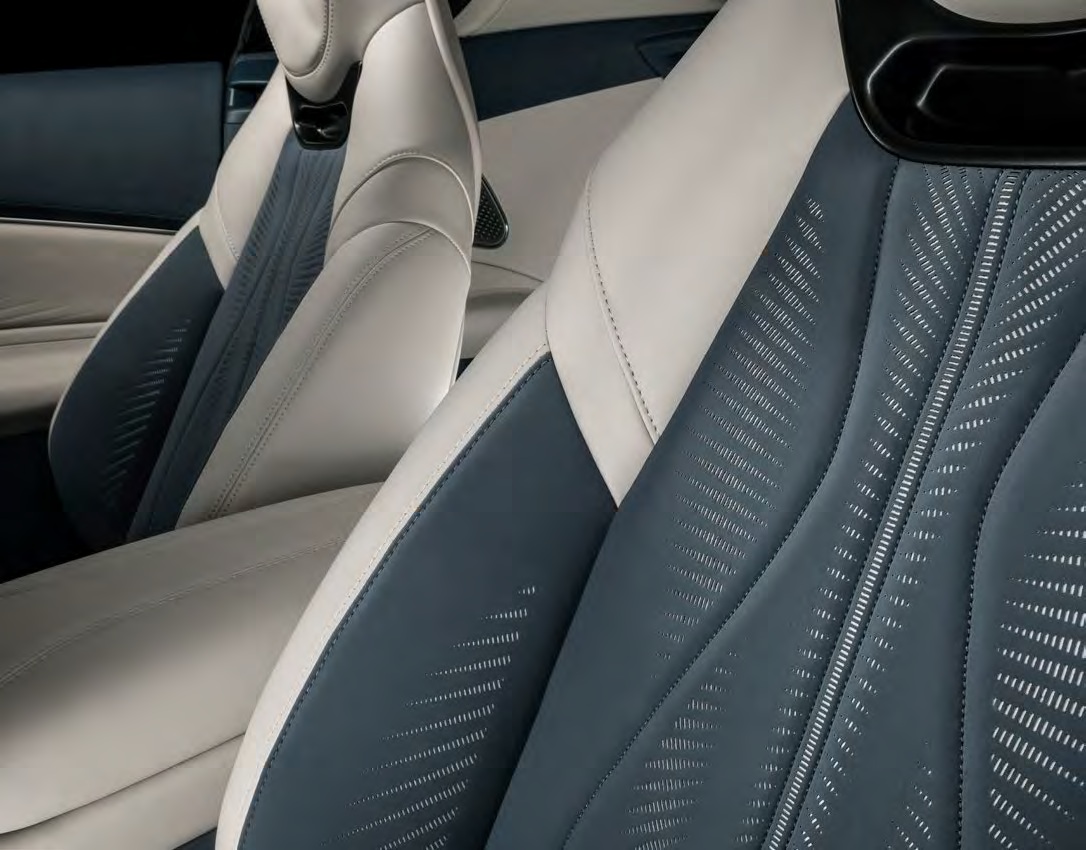
The catalogue’s Folgore chapter introduces ECONYL regenerated nylon as a cabin material, including its use across upholstered surfaces. Its close-up of the seat makes the subject tangible: a patterned, matte surface, shaped panels and a clear difference between the main upholstery and its surrounding trim.
The interesting point is not simply that an unconventional fibre appears in a luxury car. It is whether that fibre can carry a complete interior language. Texture, colour and the way the material meets an edge have to work at the scale of a seat, a pillar and a larger expanse of cabin. The official image gives the pattern enough room to be read as part of the form rather than as a tiny decorative sample.
Regenerated content should not be inflated into a claim about the environmental impact of the whole automobile. Here it is a documented material choice with a visible consequence. For an owner, the useful next questions concern the precise upholstery fitted to a particular car, its care requirements and how it looks beside the other surfaces in daylight.
Aerodynamics without abandoning the coupé
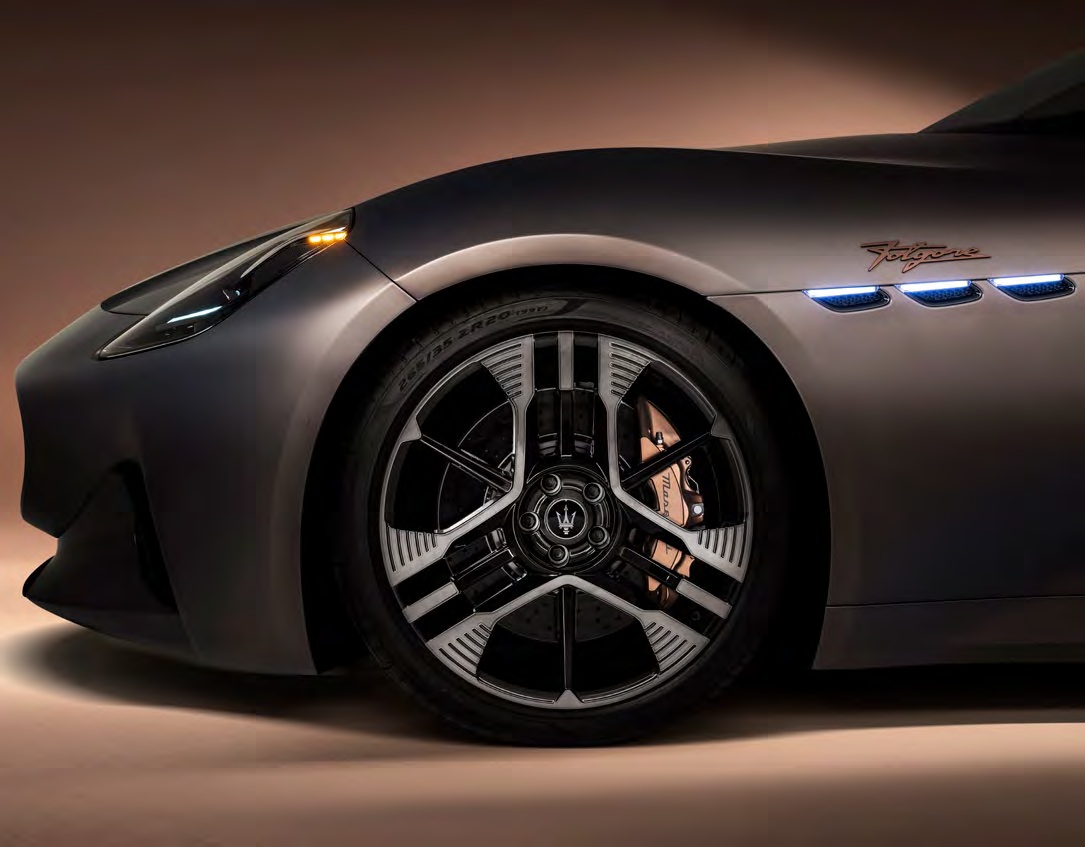
The Folgore’s specific aerodynamic treatment is described in the catalogue through its front splitter, diffuser and wheel design. The studio view of the front quarter is valuable because it gives these elements a common frame. The wheel, the lower opening and the body surface can be assessed together, rather than as isolated technical illustrations.
At the rear, the charging connection introduces a new ritual into a familiar outline. The official photograph places it below the illuminated rear lamp, making its position easy to understand. For a grand tourer, this is where the design discussion naturally reaches the itinerary: where the car is parked, how it is connected and what the next morning requires.
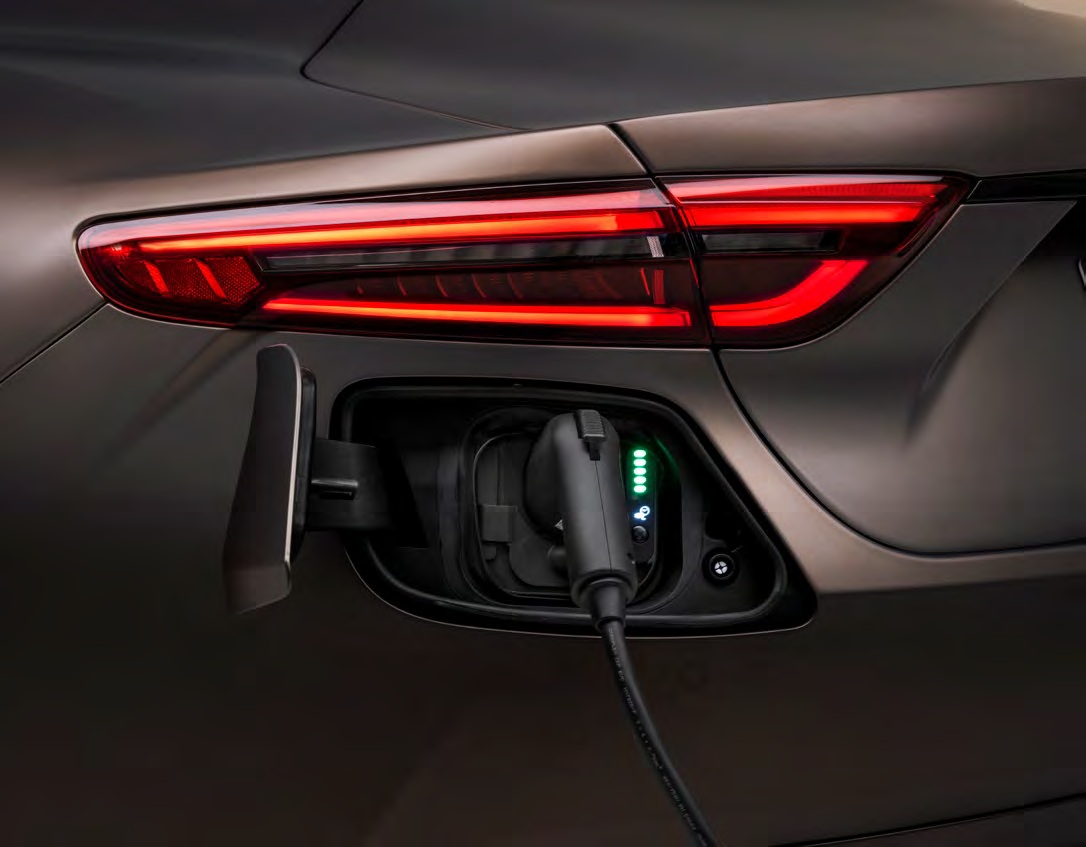
There is little value in turning that into a universal promise about distance or charging speed. The relevant model year, conditions and charging equipment matter. A considered journey begins with those details confirmed, leaving the car’s design to be appreciated without an implausibly effortless travel story being attached to it.
A notebook for the electric grand tour
| Part of the journey | What the design establishes | What to confirm for the actual car |
|---|---|---|
| Taking your place | Low coupé architecture and individual seating positions | Seat adjustment, visibility and rear access |
| Packing | A distinct luggage compartment within a four-seat GT | The fit of the bags you actually use |
| Setting out | Separate instrument and central-display zones | Navigation, controls and preferred drive settings |
| Arriving | A charging connection integrated at the rear | Connector access and the hotel’s charging arrangement |
| Travelling again | Electric propulsion within a familiar silhouette | Model-year range information and the next charging stop |
| Living with the interior | A defined palette and documented textile choices | The fitted materials, maintenance and care instructions |
This checklist is deliberately tied to the use of the car. A beautiful arrival photograph cannot answer any of these practical questions. Conversely, a technical specification alone cannot explain why someone would choose this particular shape for the journey.
The familiar outline earns its place
The strongest reading of the Folgore is that electrification becomes a problem to be designed through, rather than a visual theme that must dominate every surface. The low roof, the long forward body and the arrangement of the cabin continue to describe a Maserati grand tourer. Beneath them, a different propulsion architecture does the work.
That tension gives the car its editorial interest. Continuity is convincing when it is supported by decisions about packaging, materials and use. In the Folgore, the battery layout makes the point most clearly: the important innovation can be the one that allows the silhouette to remain familiar.
Sources & credits
Methodology and sources
This feature examines the Folgore design documented in Maserati’s 2025 catalogue, with architectural context from the 3 October 2022 launch presentation. All nine selected images come from the Folgore chapter of that catalogue; they are not presented as photographs of the revised 2027 model. No current price, order availability, measured range, charging result or road-test impression is asserted. PDF page numbers and image identities are retained in the media record.