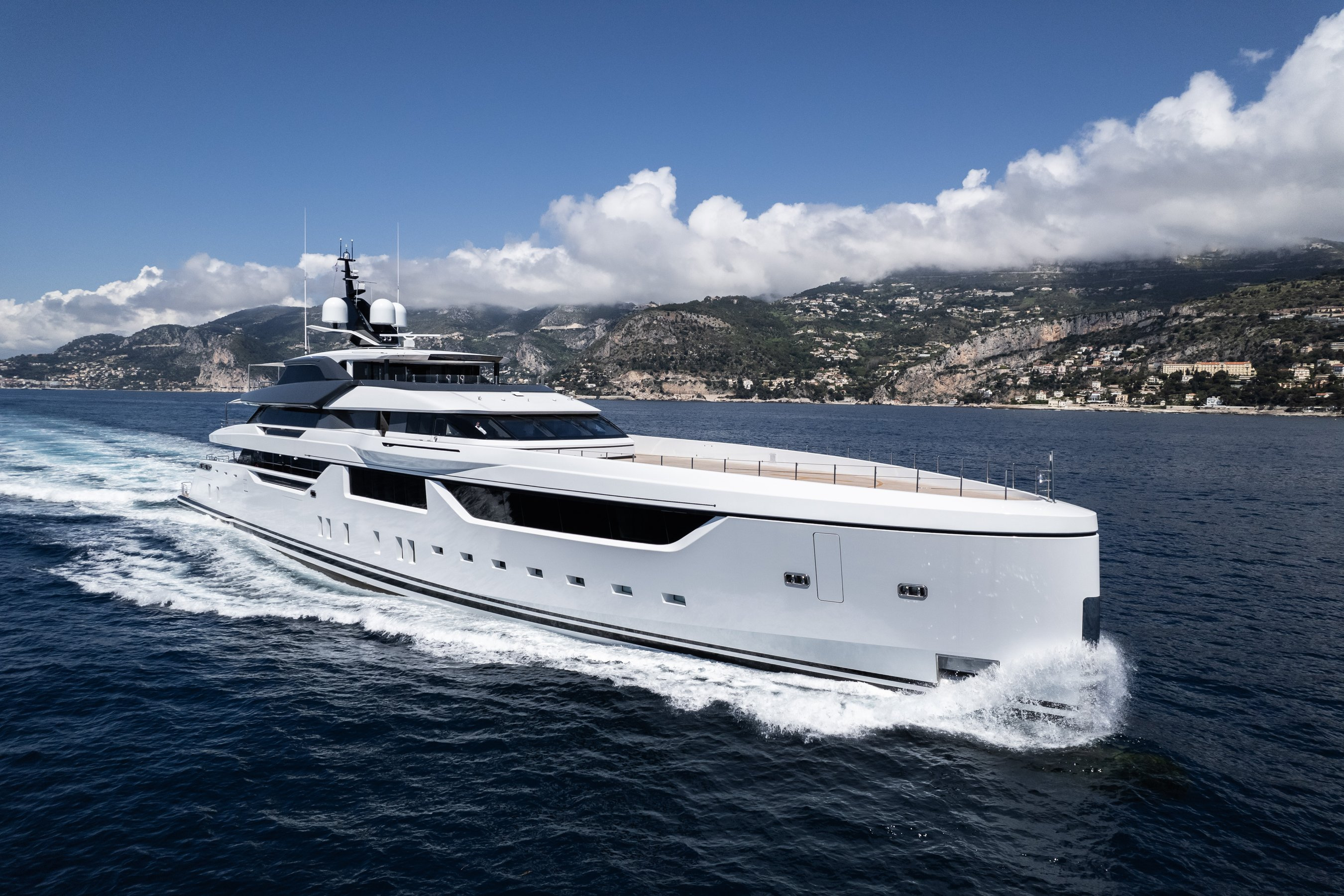
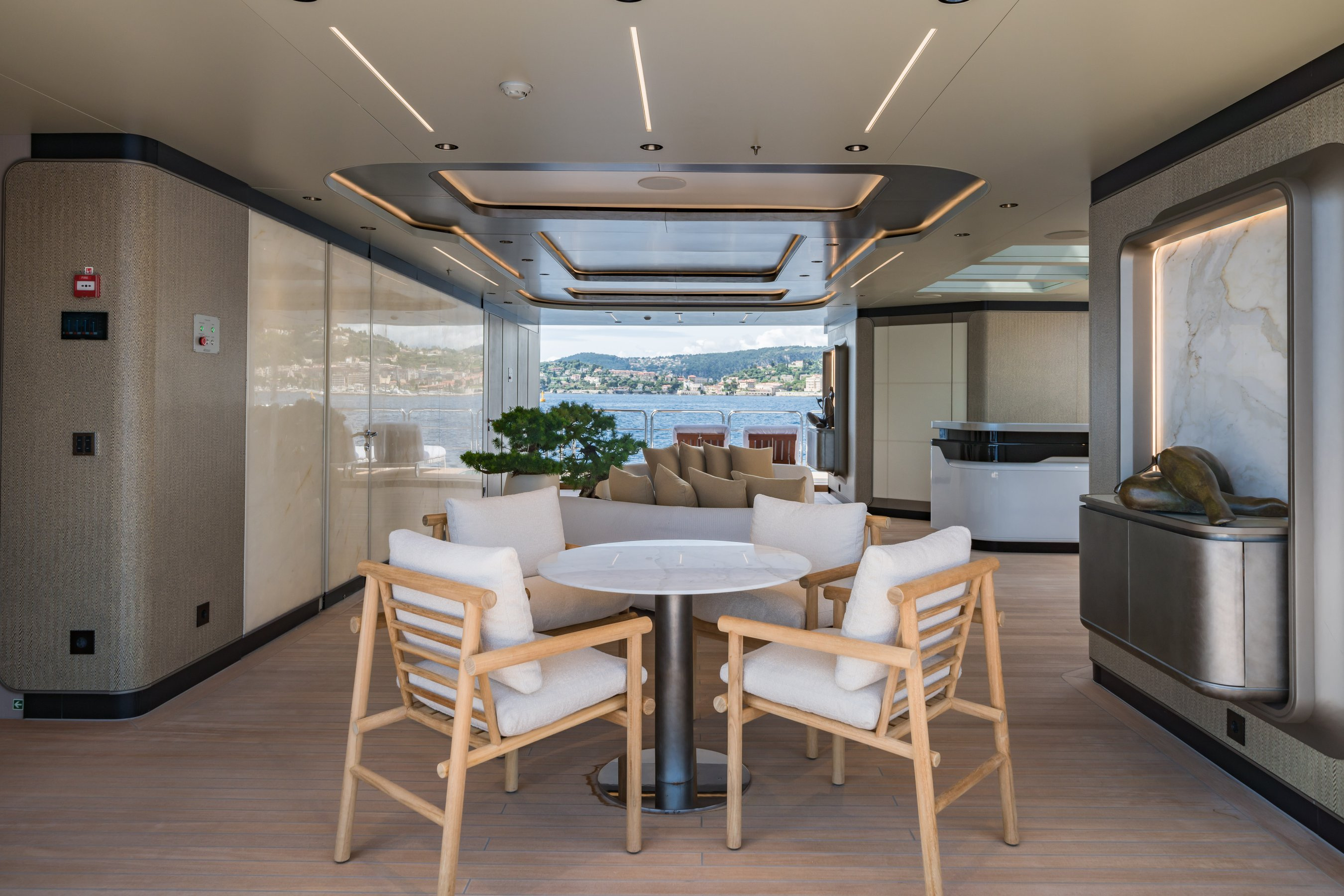
MALIA’s most persuasive image is not necessarily the long white profile. It is the view from the beach club towards the water: a low, sheltered room where the horizon seems to begin at the edge of the furniture. Read alongside the terraces above, it suggests a useful way to judge a large charter yacht. The question is how many different kinds of day its spaces can accommodate.
A profile with several social scales
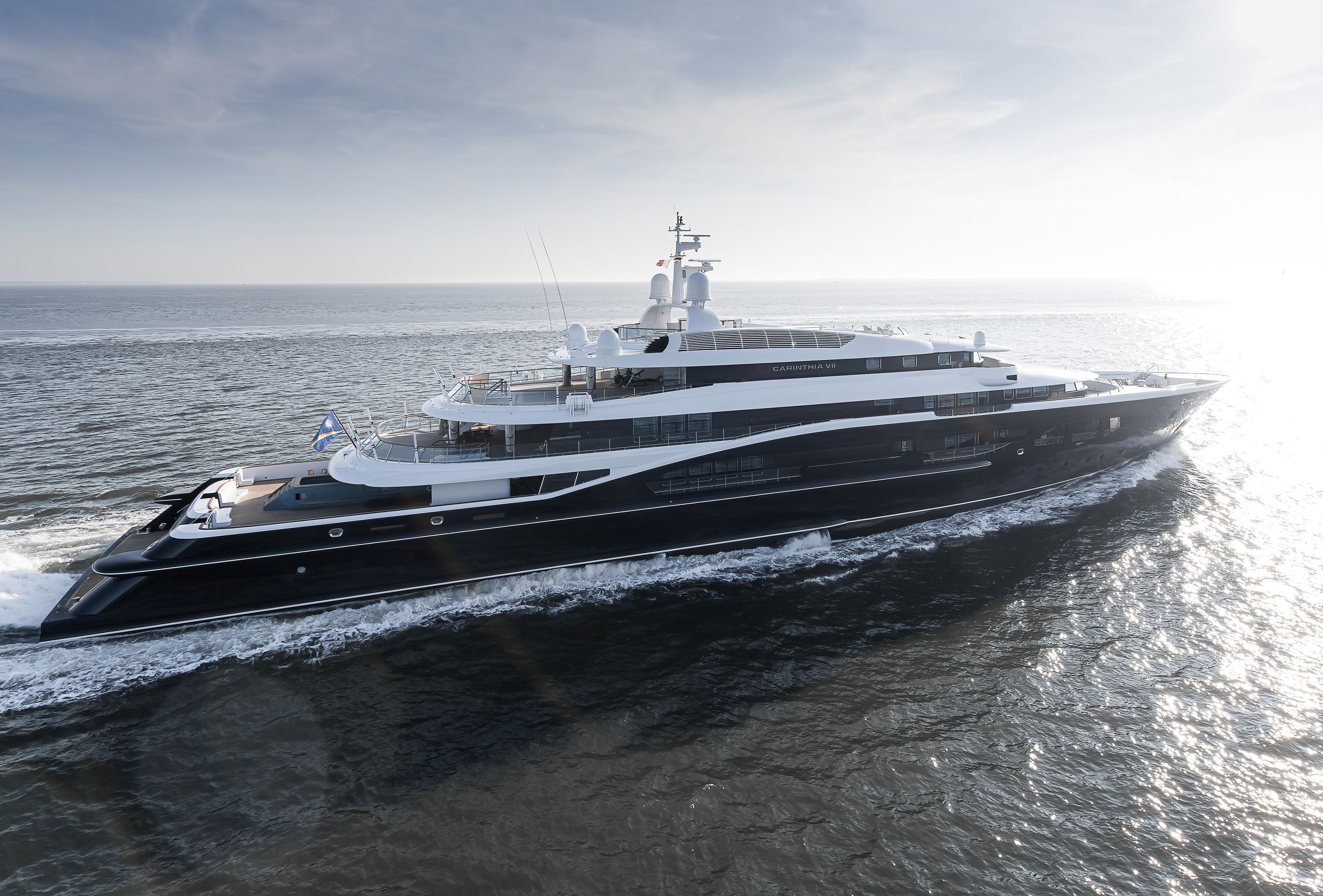
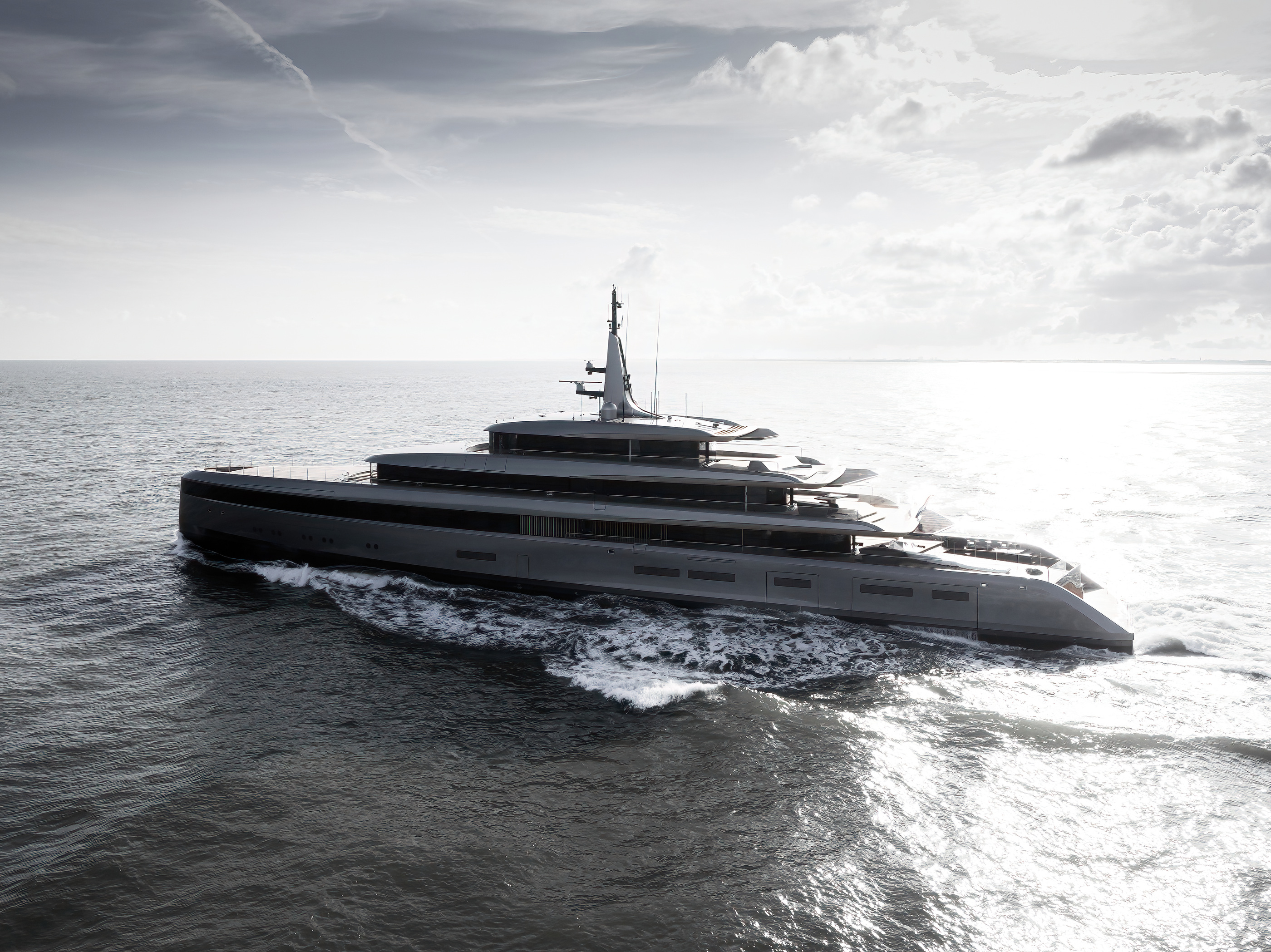
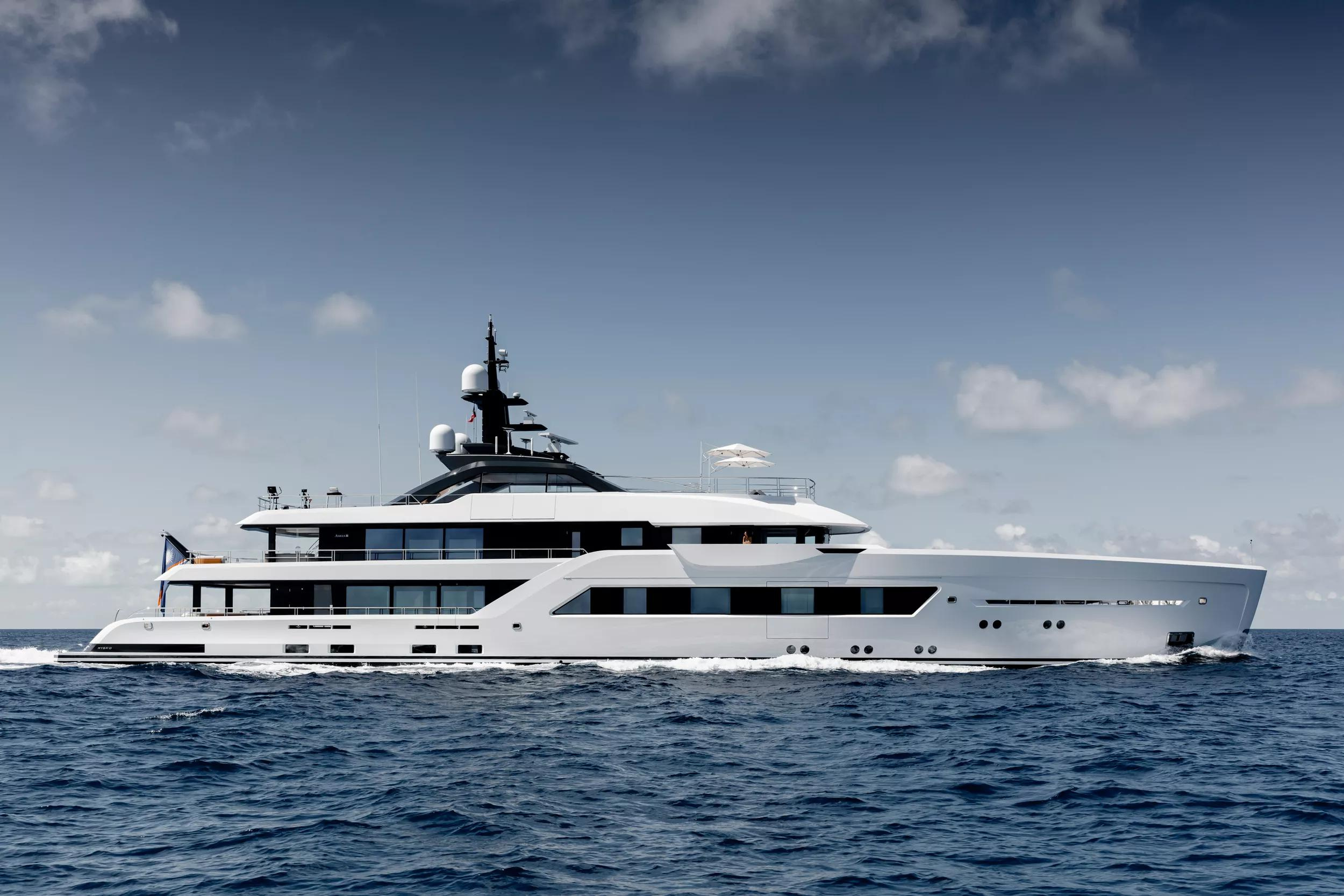
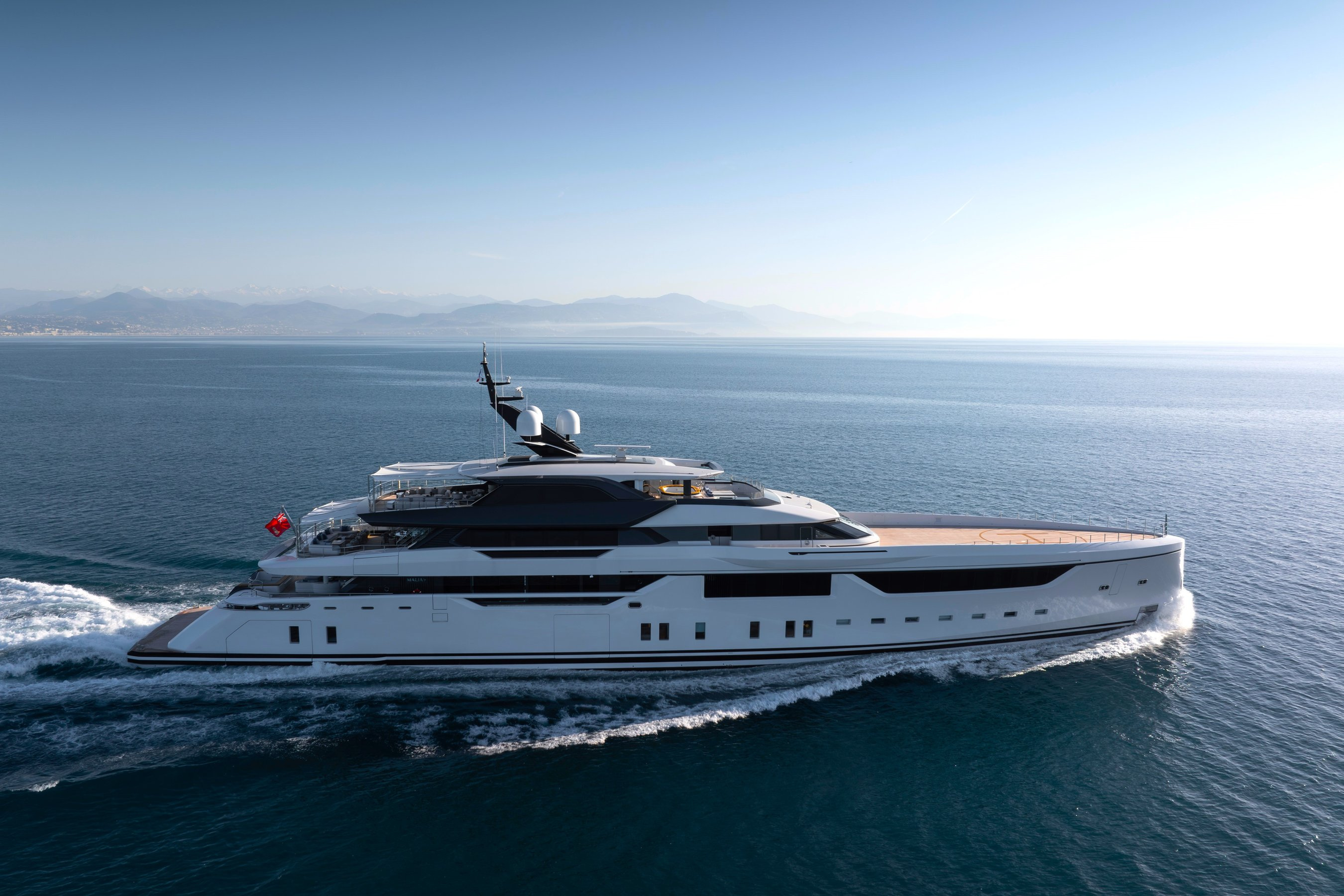
Burgess identifies MALIA as a 77.7-metre motor yacht built by Golden Yachts in Greece in 2023. Those facts establish the physical subject; they do not explain the character of a week aboard. For that, the official photographic sequence is more revealing. Broad outdoor decks alternate with enclosed rooms, and the stern repeatedly opens towards the sea. The architecture offers several possible centres of gravity rather than one overwhelming entertainment space.
That distinction matters when a charter party wants different things at the same time. A conversation in shade, a quiet interval indoors and time close to the water need not be variations of the same activity. In the photographs, the furniture forms recognisable groups, with thresholds and changes of level giving each a particular outlook. This is a reading of the documented arrangement, rather than an account of a LuxeDigital stay or sea trial.
There is also an important difference between space on a specification sheet and space that feels usable. A wide deck gains purpose through shade, access, seating depth and its relationship to the neighbouring room. MALIA’s official images make those relationships visible. The exterior is the introduction; the more interesting story begins at the points where it becomes a place to sit, eat or leave the water behind for a while.
The beach club as a room beside the sea
The broker’s gallery identifies several beach-club views and a beach-club balcony. Together they reveal a room with its own furniture, pale surfaces and a direct visual connection to the surrounding water. It reads as a destination in the yacht, rather than simply the route to a tender. The low viewing position is part of its appeal: a very different relationship with the horizon from the upper terraces.
For a prospective charterer, the worthwhile conversation is about how such a room is used. Ask when the opening areas can operate, how swimming and tender movements are separated, and what restrictions weather or local rules impose. A photograph can explain the design intention. It cannot establish that every platform will be open at every anchorage, or that a particular watersports arrangement will be offered throughout a charter.
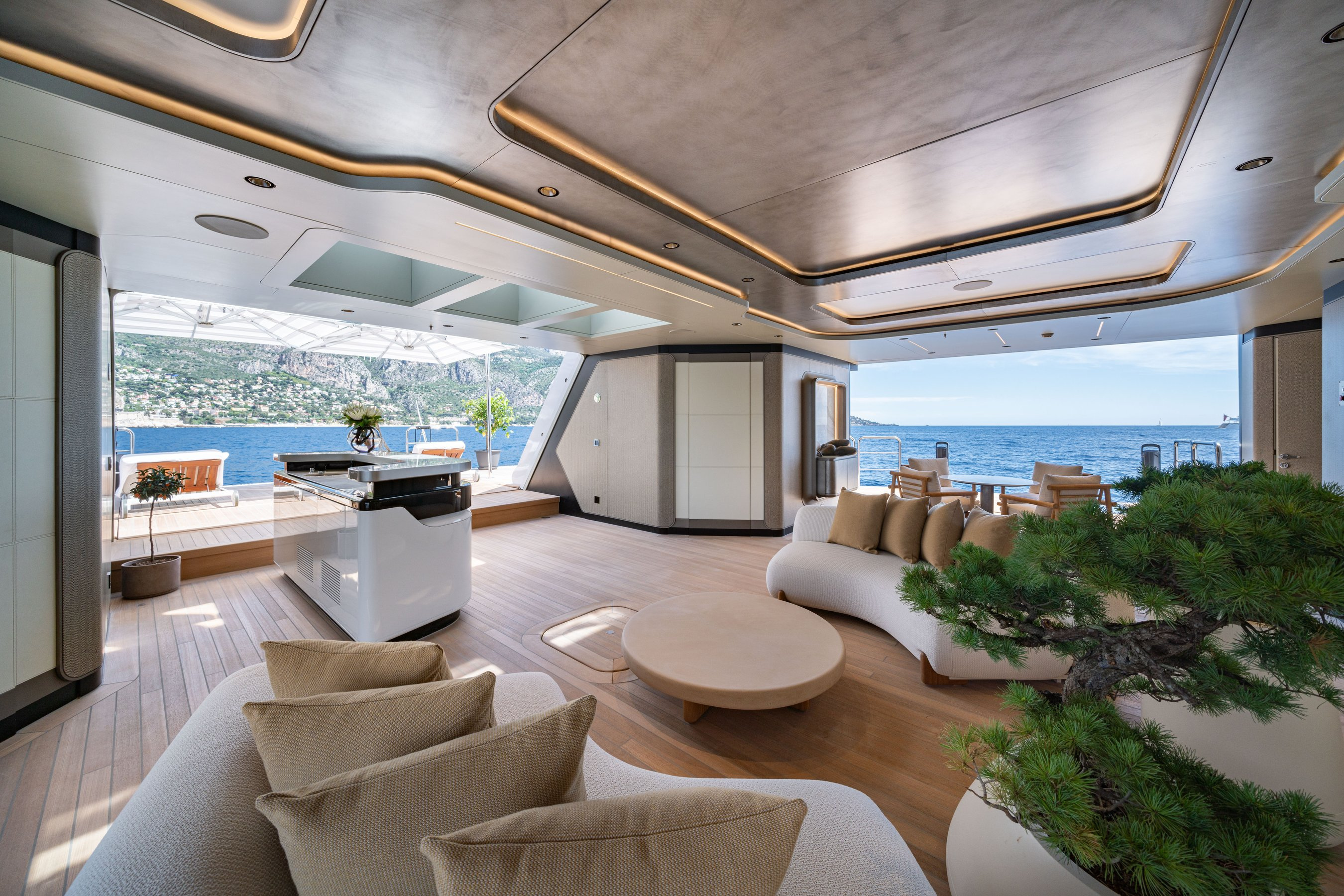
The furnishing adds another layer. Rounded seats and a small table make the sea-facing edge feel domestic, while the surrounding structure retains the sense of a sheltered interior. This is where a large yacht can become intimate. Instead of always celebrating distance above the water, the design gives guests a place to notice its surface, the changing light and the activity around the stern.
Shade, dining and the terrace above
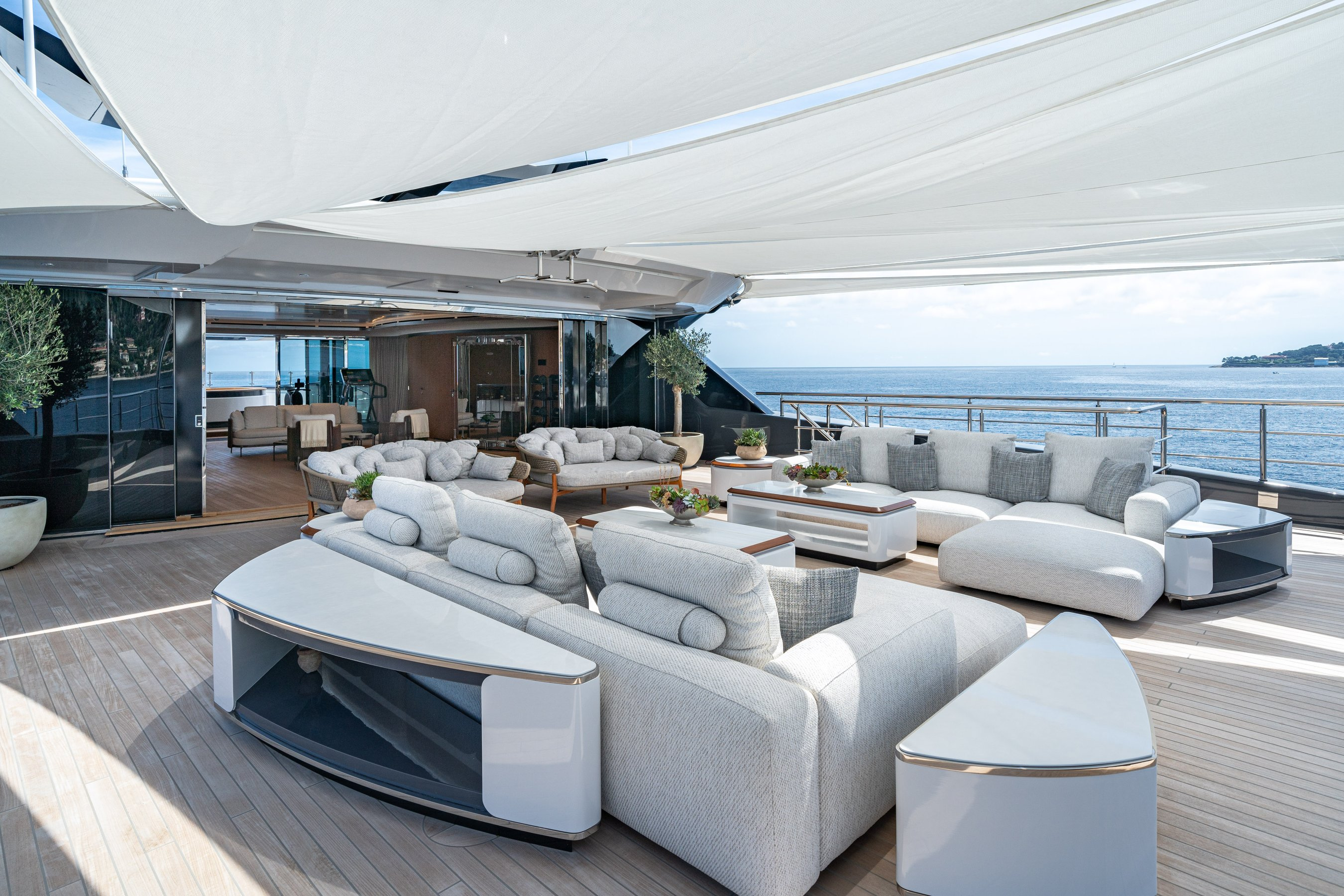
Higher up, the official photographs show outdoor dining and lounge settings beneath substantial overhead structures and stretched shades. The views differ in mood from the beach club: more panoramic, more connected to the yacht’s overall width. Tables, low seating and the edge of the deck organise these spaces without turning them into rows of interchangeable loungers. The furniture helps explain where a group might gather and where a smaller conversation could settle.
The dining setting deserves to be judged as a room, too. Its position relative to shelter, glazing and circulation is more informative than a dressed table alone. When discussing a charter, ask which dining locations are normally used in different conditions, how formal service is arranged and whether the layout suits the party’s actual habits. A long lunch and a late, seated dinner make different demands on the same attractive photograph.
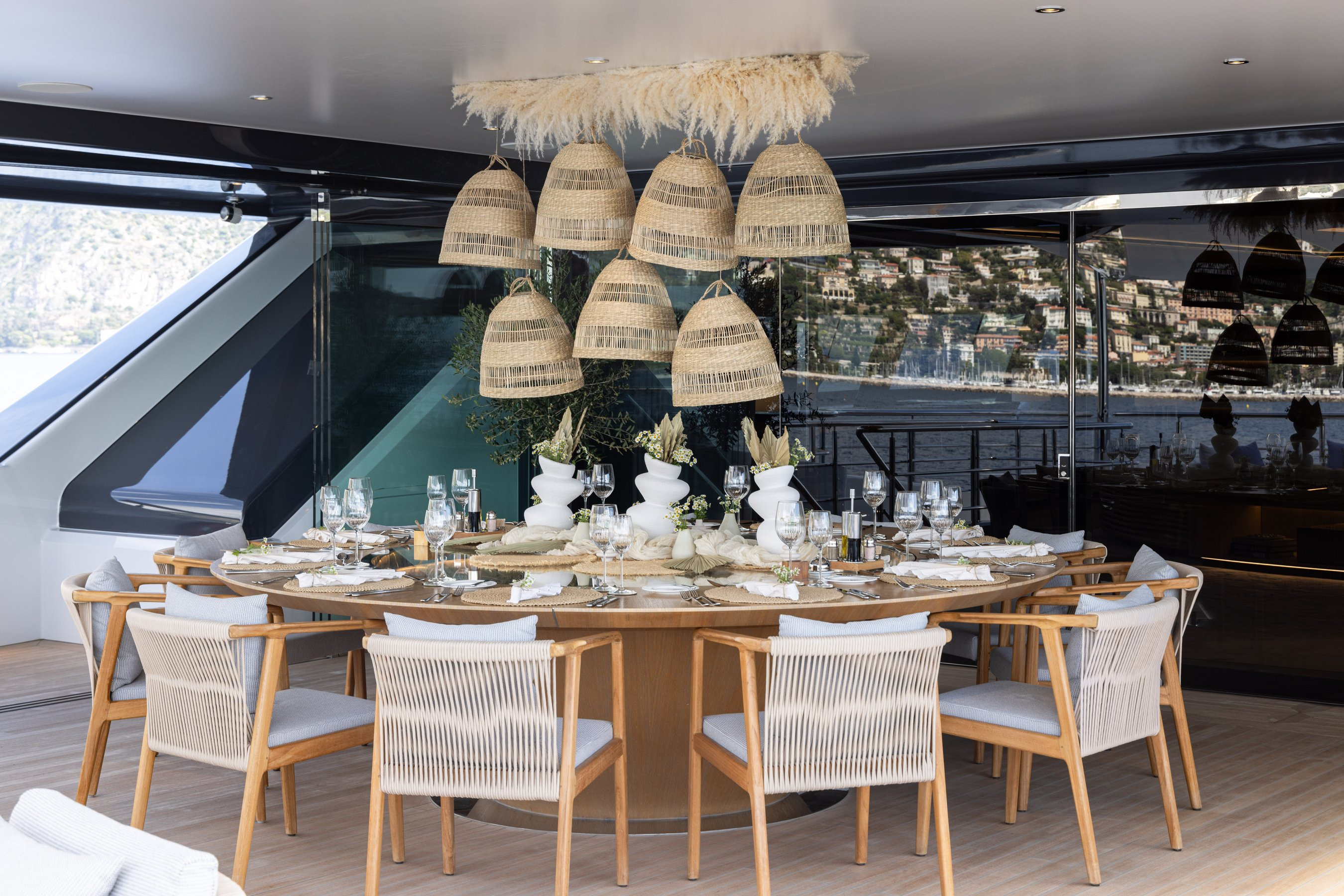
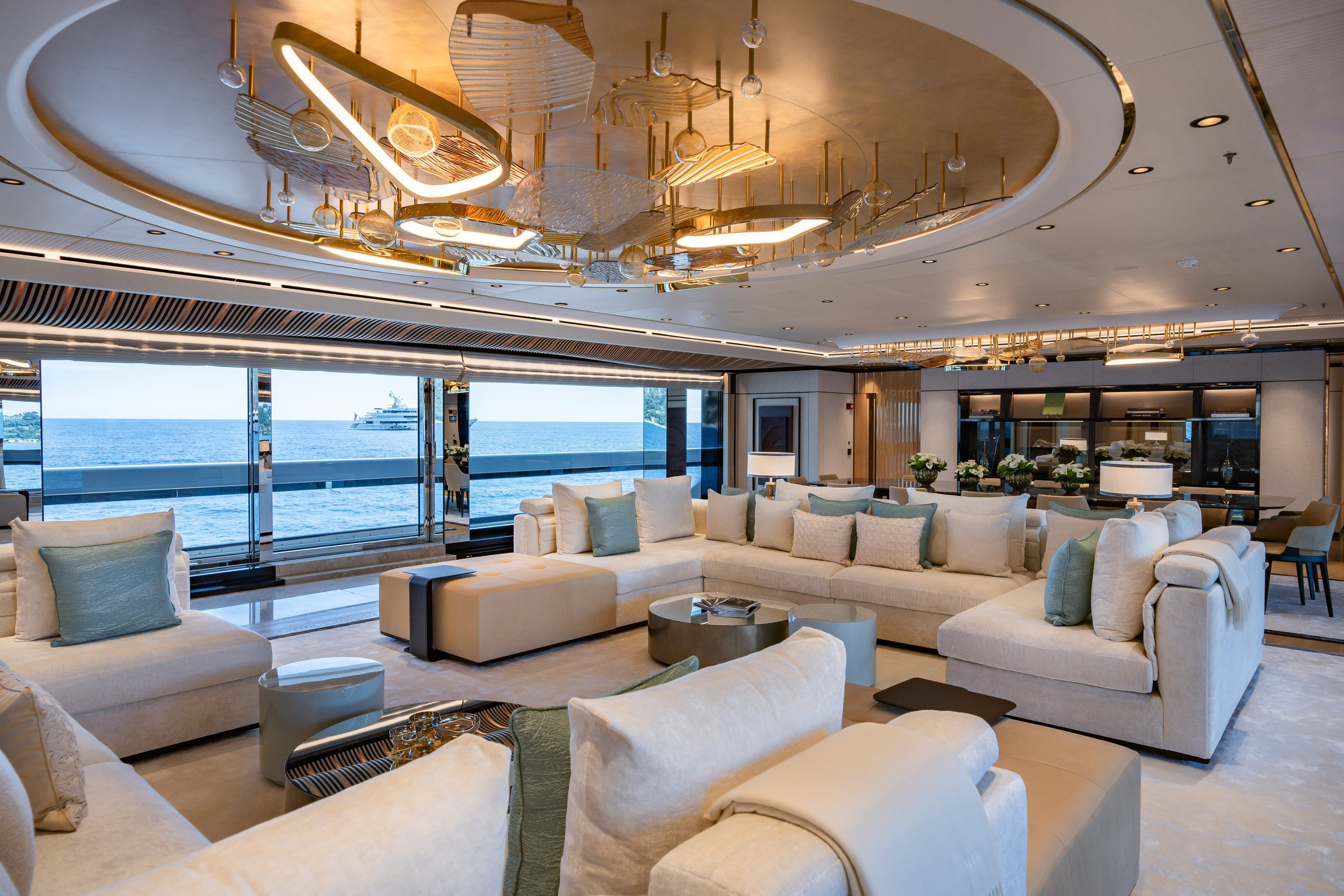
The upper terraces also demonstrate why variety should be assessed across the whole yacht. Repeating the same furniture on several decks would add area without necessarily adding choice. Here, the published sequence moves between more open and more enclosed settings, between a forward outlook and a view over the stern. Their value lies in the differences, and in how comfortably the group can move between them.
Cabins are a configuration, not a headcount shortcut
Burgess currently lists twelve guests in eight cabins. Those two figures should be retained together. Eight cabins do not imply permission to carry sixteen charter guests, nor do they establish that every room has the same status or suitability. The listed master, guest and twin-room photographs show variation, which is the beginning of a useful accommodation discussion rather than its conclusion.
For a family or a mixed group, start with the sleeping arrangement. Which rooms should be near one another? Who needs a particular bed configuration? Are stairs or routes between decks relevant? Have the broker explain the current cabin allocation and any conversion options for the proposed charter. The answer should relate to the specific party and agreed guest limit, not an assumption made from the number of doors on a deck plan.
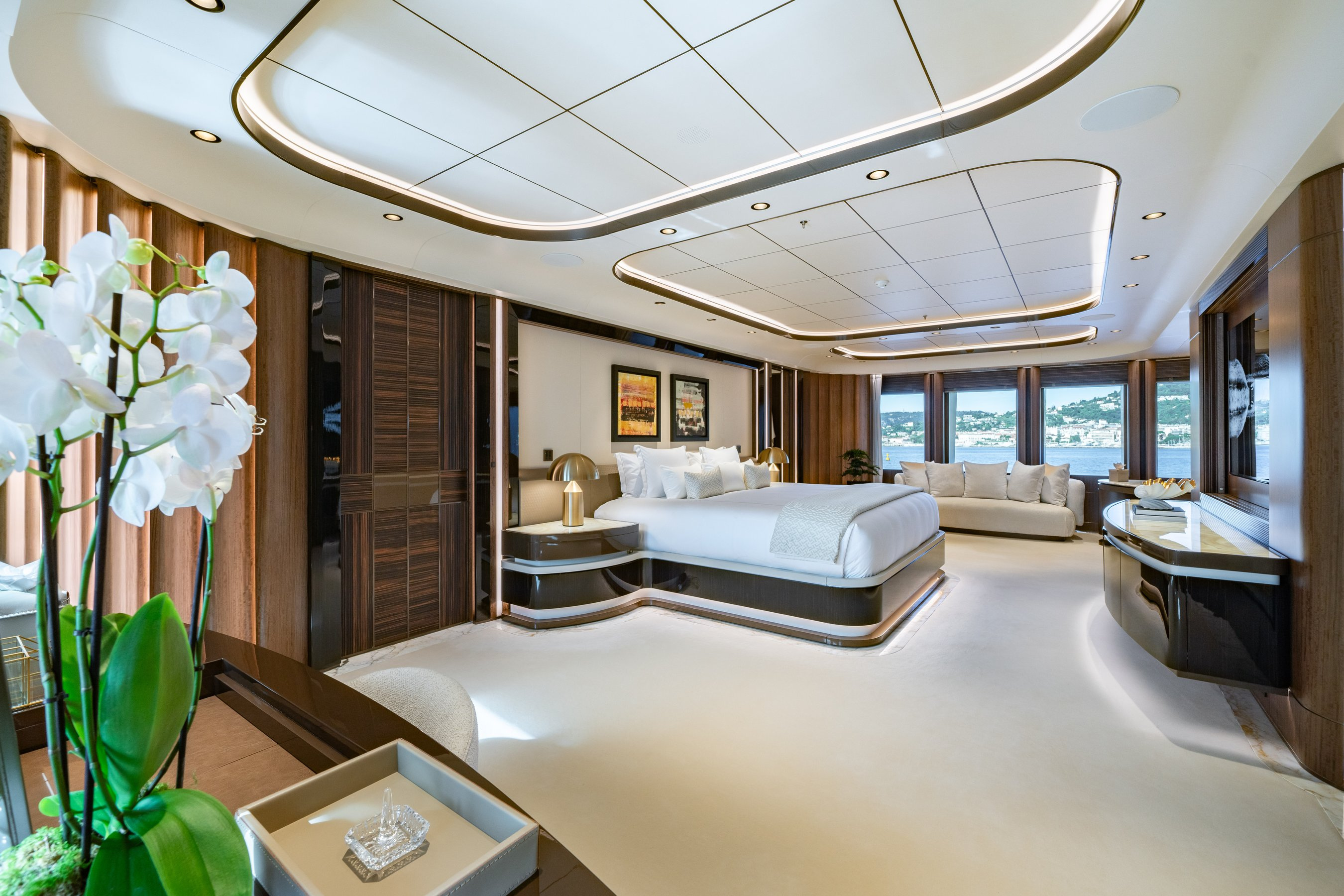
The photographs also suggest how different private rooms can feel. Window placement, the relationship between bed and sitting area, and the treatment of bathroom thresholds contribute as much as decorative finish. A successful selection recognises that some guests value outlook, others proximity or privacy. The best room is therefore not a universal ranking: it depends on who will use it and how the group wants to live together.
Reading the yacht before the enquiry
| Documented element | What it helps you assess | What to ask the broker |
|---|---|---|
| Beach-club room and balcony | A distinct setting close to the water | Opening conditions, supervision and tender arrangements |
| Outdoor dining and lounge areas | Several social settings at different heights | Shade, weather alternatives and usual service arrangements |
| Twelve guests in eight cabins | A flexible-looking accommodation proposition within a stated guest limit | Exact room allocation and the agreed charter capacity |
| Official wellness and equipment descriptions | The range of facilities being presented | The current inventory and any operating restrictions |
This approach turns a visual preference into a better enquiry. Rather than asking only whether MALIA is impressive, describe the days you want: how much time outdoors, how often the group eats together, what privacy means and which activities matter. The current equipment inventory, crew arrangements, itinerary and contract must then be confirmed for the proposed dates. No rate or availability is established by this design reading.
The Luxe Digital view
MALIA is most interesting where a large yacht offers the scale of a smaller room. The beach club, shaded terraces and varied accommodation give the official imagery a coherent argument: size becomes valuable when it creates meaningful choices. A charter enquiry should test those choices against the people who will actually be on board. That is a stronger starting point than length alone, and a more durable way to understand the attraction of the yacht.
MALIA is most interesting where a large yacht offers the scale of a smaller room.
Sources & credits
Sources and methodology
Independent yacht, coastal architecture and hospitality analysis of the named official records and imagery, checked on 16 October 2026. Original build, refit and presentation dates are retained. Photographs are identified by the named yacht, hotel room or destination setting. Independent analysis of official yacht, hotel and marina records and imagery. No visit, stay, sea trial or interview is claimed. Historic refit dates and source identities remain identified. Current availability, access, prices, operational suitability and contractual inclusions are not inferred.