A cut diamond is read through the meeting of planes. Laurence Graff Signature takes that visual language into gold, giving a band, bracelet or chain an identity built around angular surfaces. The collection does not need every object to contain the same gemstone arrangement to remain recognisable. The facet becomes a way of organising the metal itself.
The facet becomes the form
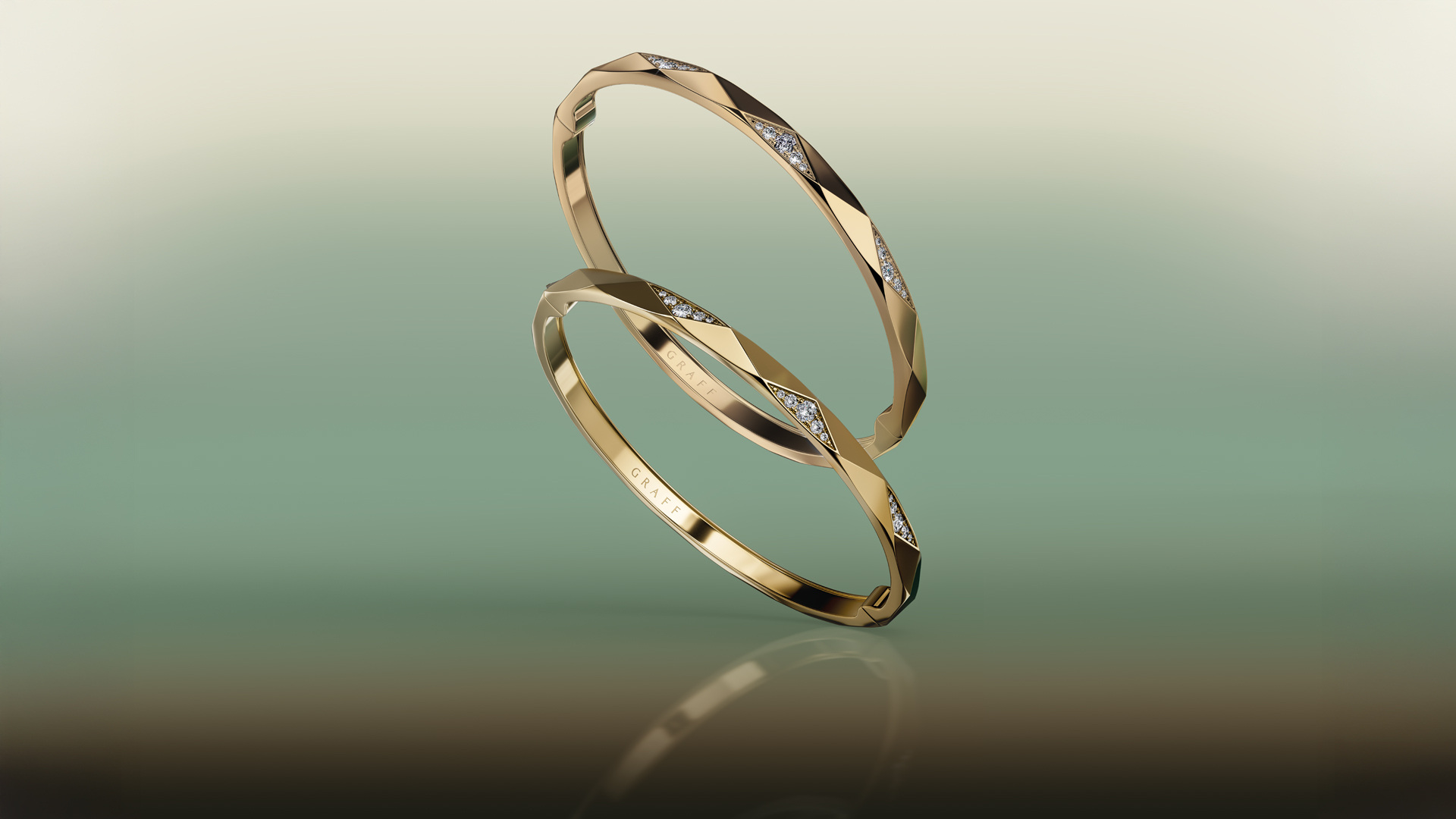
Graff’s current official presentation describes the diamond-cut inspiration and shows the collection across different wearers and object types. The opening portrait gives the jewellery a wider setting; the bangle and band photographs then make the geometry more concentrated. The complete link bracelet and necklace extend the same question along a longer line: how can a succession of planes produce both texture and a clear silhouette?
This is a design study of the current collection, using the maison’s narrative and product presentation. It makes no new-launch claim for October 2026 and does not assign a universal metal or stone specification across the family. The visual connection is the faceted language. The material identity of a particular object remains a matter for its exact product record.
A band makes the plane changes easy to follow
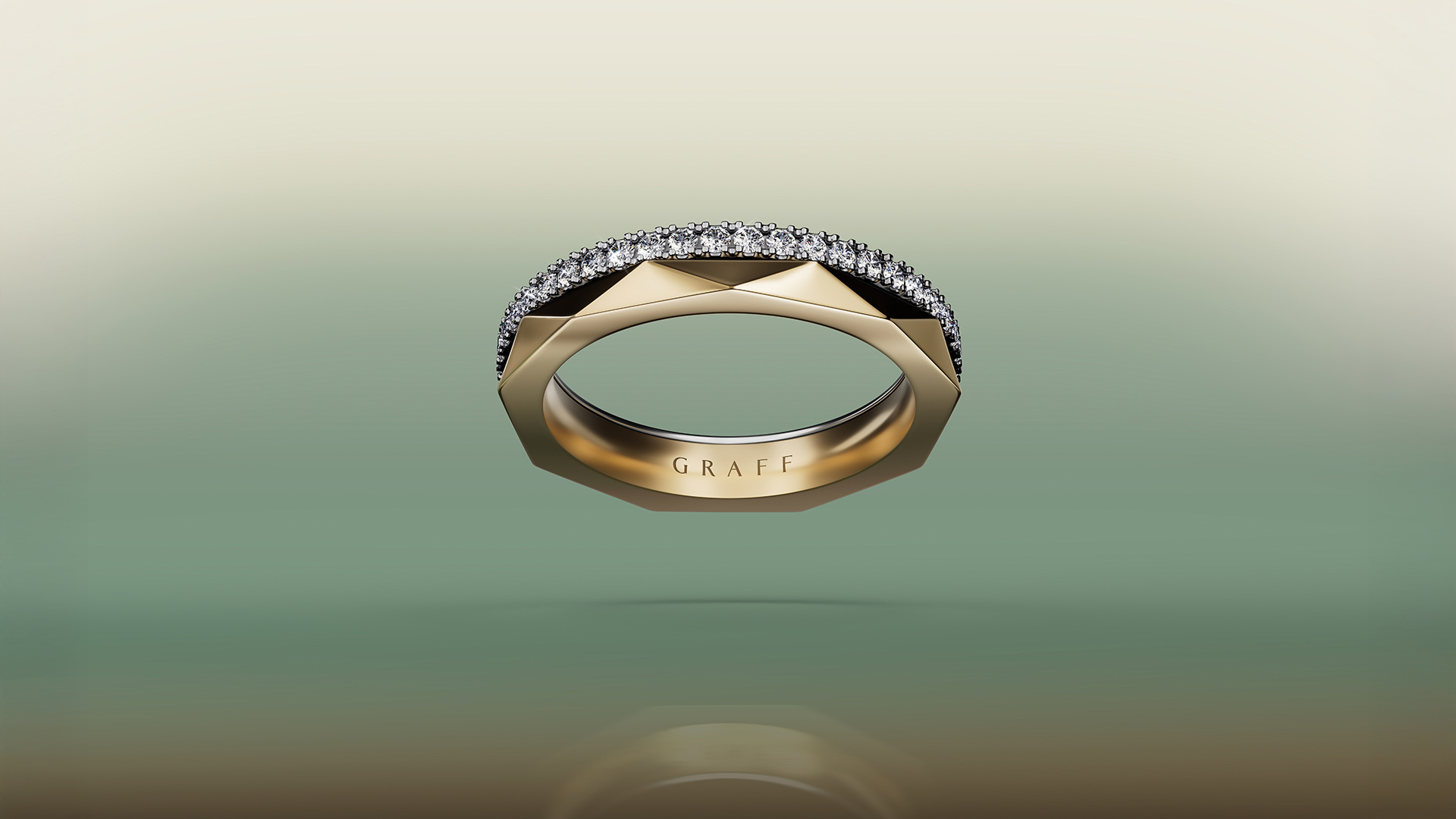
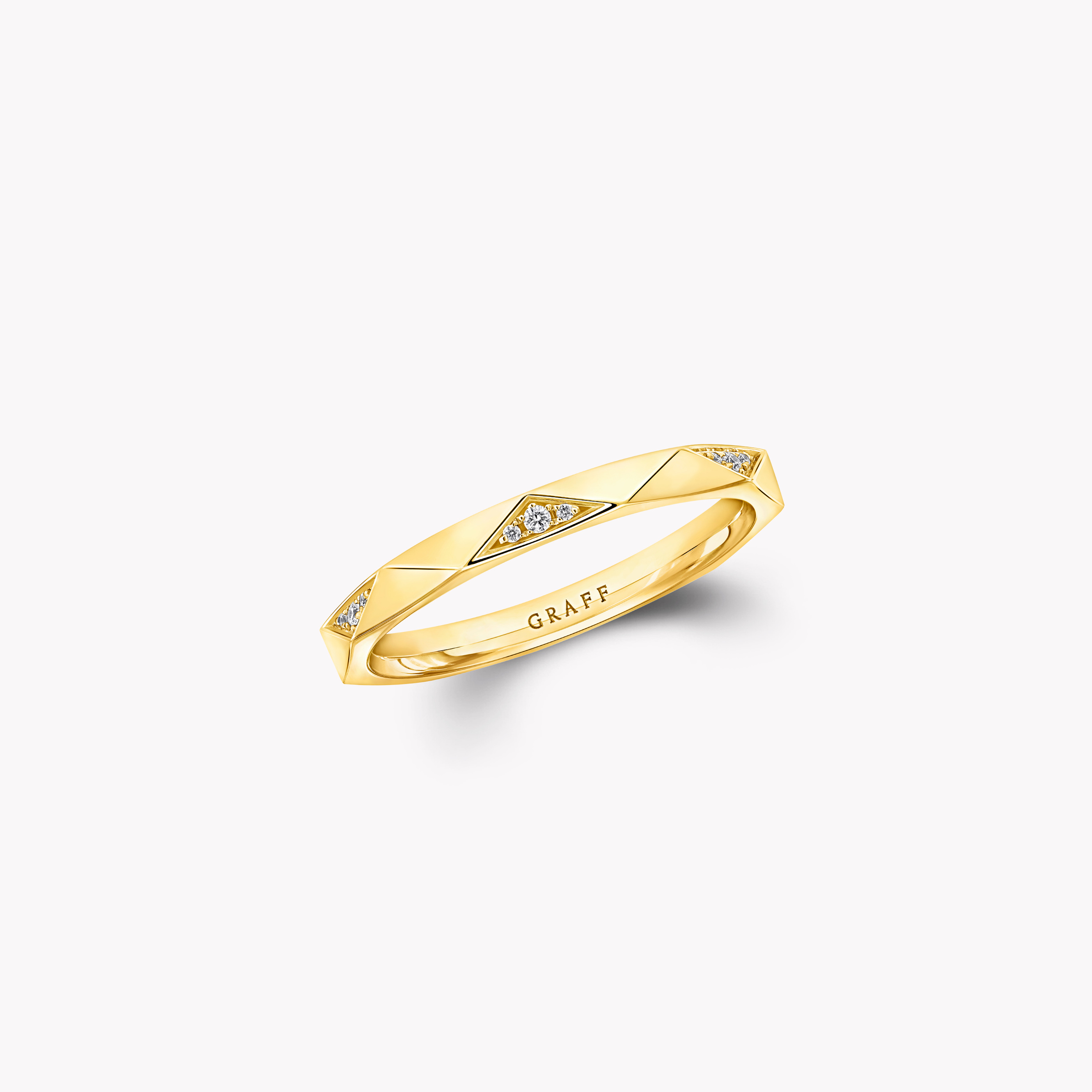
The complete ring photograph is useful because the circumference remains visible. The facet-like surfaces interrupt a conventional smooth band, giving light more than one kind of boundary to encounter. A bright area can sit beside a darker plane even within the same gold-coloured object. The resulting contrast lets the viewer read an angular structure without needing a separate decorative motif attached to the ring.
The wider display view places that band within a more atmospheric field, while the studio image gives it a quieter background. Both have a role. One presents the object as part of the collection’s visual world; the other exposes the complete outline for inspection. Alternating them keeps the article from becoming either an uninterrupted campaign sequence or a bare catalogue of objects detached from their intended presence.

The relationship between facet and circumference is the central design decision. A ring must still offer a continuous route around the finger, but its exterior can change direction through smaller planes. The viewer therefore encounters two geometries at once: the larger circle and the angular rhythm across its surface. That combination explains the collection’s character more clearly than describing the gold as simply bright or sculptural.
The bangle carries the geometry around the wrist
The bangle has a larger route to organise. In the official wide photograph, the angular treatment becomes part of a more extended contour, with the whole curve still legible. The design language survives the change in scale because it is not dependent on one tiny detail. The eye can follow the outer shape and then notice the smaller plane changes along it.
The worn ring portrait gives the collection a further comparison. Against the hand, an object that dominated its studio frame becomes a concentrated accent. The surrounding skin and clothing introduce softer lines, making the metal’s angular character more distinct. This is a visible contrast in the official image, not a claim about the jewel’s weight or how its edges feel during use.
The collection’s portraits also show that a shared form need not be confined to one wearer profile. The geometry remains the point of continuity while the styling changes. That is a more useful reading than imposing a fixed dress code on the objects. A faceted band can meet different clothing and still retain its outline; the exact size, width and chosen reference determine the particular object being considered.
Links turn separate units into a longer line
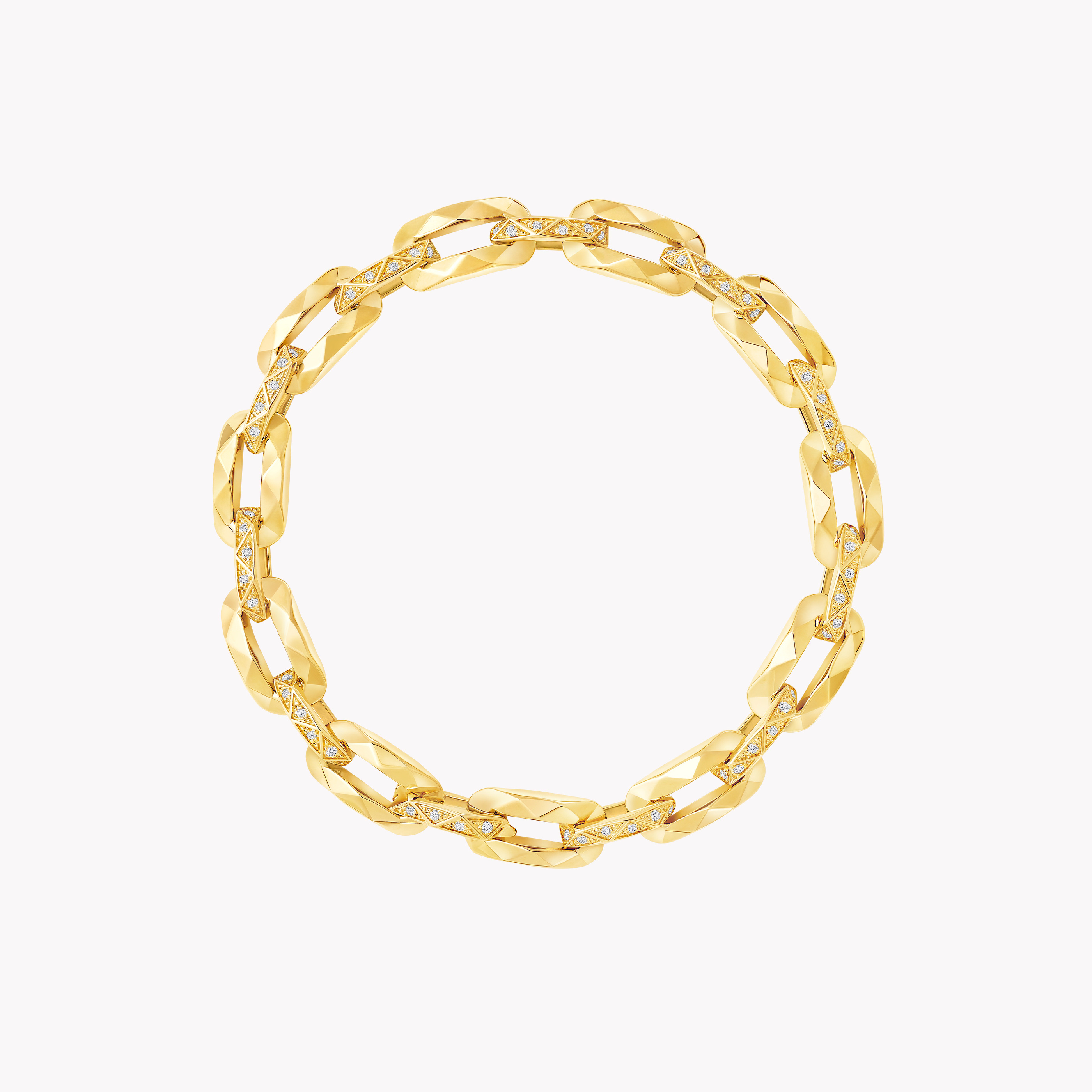
The complete link bracelet changes the organising problem. Instead of following one continuous band, the eye follows a sequence of connected units. The facet-like treatment gives those units a repeated character, while the links create intervals and changes of direction. Seen complete, the object has a rhythm that belongs to its length as well as to the surfaces of its individual parts.
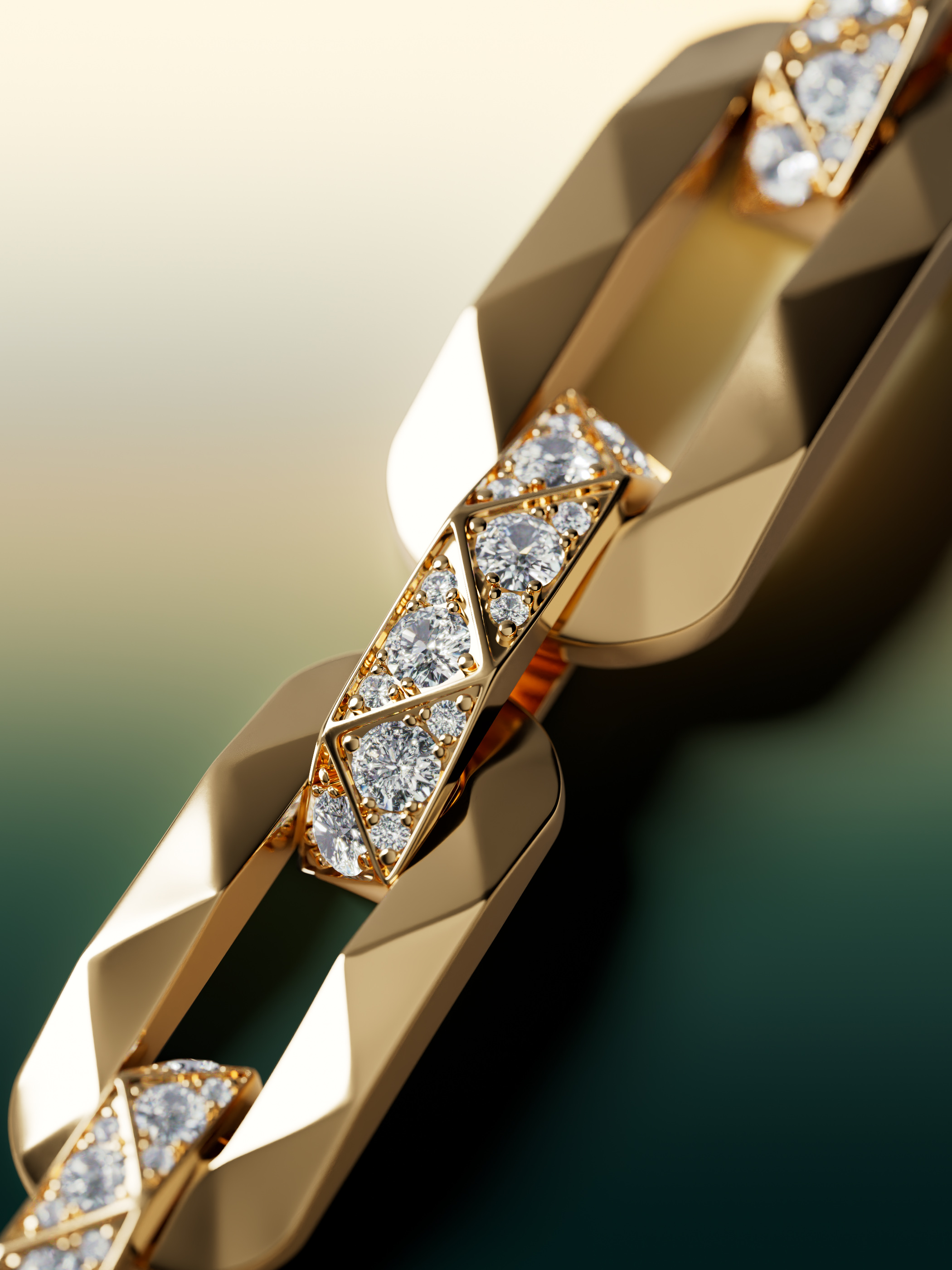
The necklace extends that rhythm further. Its complete product view is important because the overall fall cannot be understood from a macro alone. The closer necklace photograph then makes the surface treatment more apparent, letting the viewer move from line to unit and back again. The two views are complementary: one establishes the composition, the other explains the language that repeats through it.
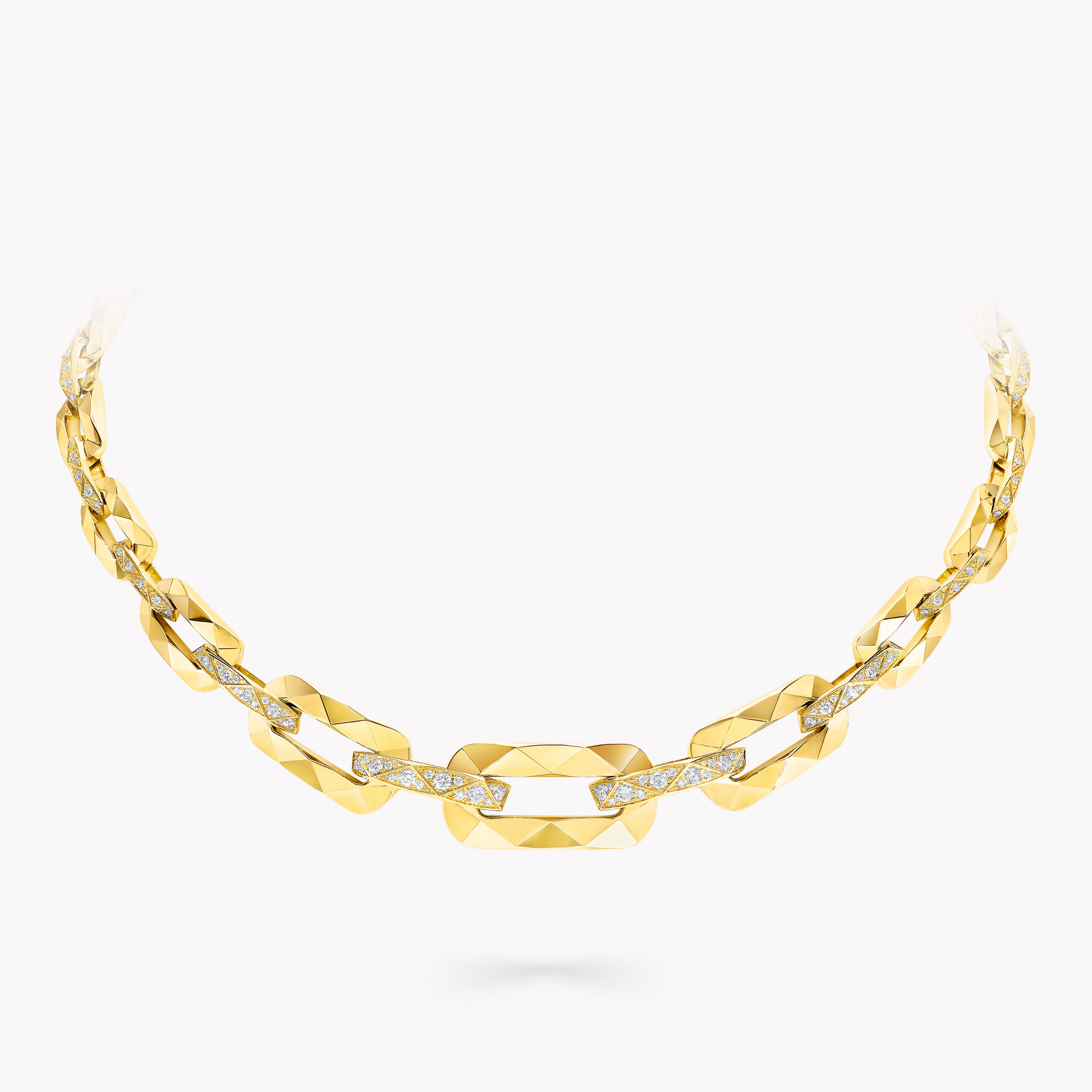
This is where the facet becomes more than a resemblance to a gemstone. It can organise a continuous band or a linked sequence, two structurally different kinds of object. The collection remains coherent because the smaller plane changes are recognisable in both. The design idea is therefore portable, but not mechanically identical across every category. A chain and a bangle retain their own construction, proportions and fastening requirements.
Portrait and product view should answer different questions
The wide collection portrait establishes a visual world: the jewellery’s place against skin, the character of the clothing and the distance from which its form is encountered. A complete product photograph answers a narrower question about shape. A closer view answers another about surface. The article needs all three scales because the faceted language changes its emphasis as the surrounding field changes.
The strongest sequence is not a repeated zoom towards the same object. It moves between contexts. A bangle can follow a portrait, a complete chain can interrupt a surface detail, and a ring can return the eye to a compact circumference. That variation makes the family’s coherence visible across different objects rather than merely stating that the collection has a signature style.
For someone considering a specific piece, the visual reading gives a clear starting point: choose the type of line that is appealing, then confirm the actual reference’s material, size and closure. A motif cannot answer those practical questions on its own. The official images supply a considered presentation of form; they do not replace the physical object or create a valuation from its association with a famous house.
A faceted vocabulary across objects
| Object | Larger geometry | What the facet changes |
|---|---|---|
| Band ring | A compact circumference | The exterior rhythm of planes and light |
| Bangle | A broader curve around the wrist | The angular character along a longer outline |
| Link bracelet | A sequence of connected units | Repeated surface identity across separate parts |
| Necklace | A longer suspended line | A consistent vocabulary within the complete fall |
The table concerns visible design, not shared specifications. Gold colour on screen is not an independent determination of alloy, and a collection image should not supply gemstone weights for a separate reference. The sources and photographs are official Graff material; the observations are an independent editorial reading.
The Luxe Digital view
Laurence Graff Signature is most legible where the facet becomes the form rather than an ornament placed on it. Graff carries that decision from a compact band to a longer linked line, with enough continuity to establish a family and enough variation to keep its objects distinct. The complete photographs make that relationship easier to see.
Laurence Graff Signature is most legible where the facet becomes the form rather than an ornament placed on it.
Sources & credits
Sources and methodology
Independent visual analysis of current official imagery and named product records, checked on 14 October 2026. Historical introductions, manufacturer specifications and visual observations are kept distinct. No visit, interview, independent handling or appraisal is implied.
- Graff — source 1: Current official collection, named designs, dated context and selected image provenance.
- Graff — source 2: Current official collection, named designs, dated context and selected image provenance.