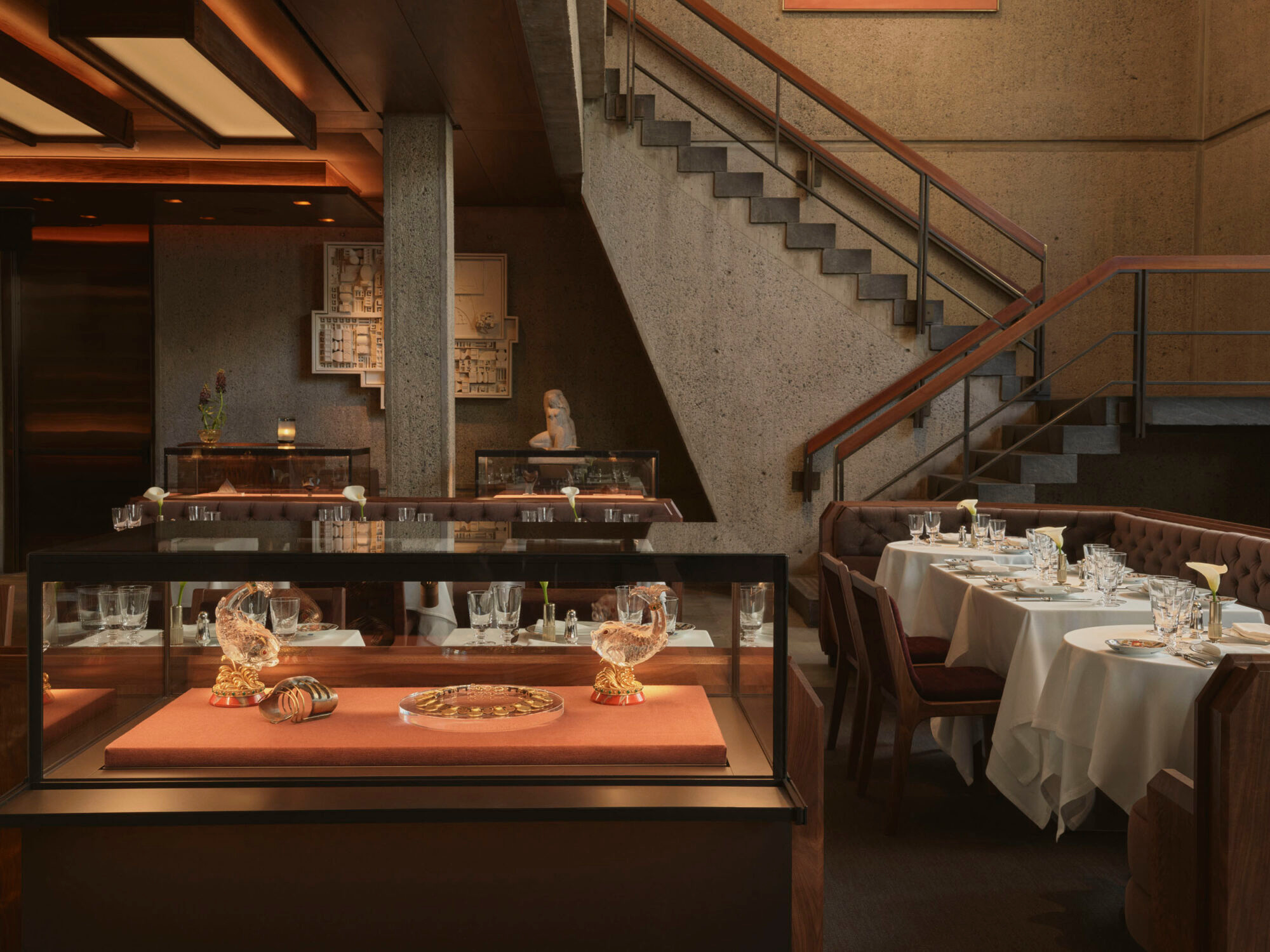
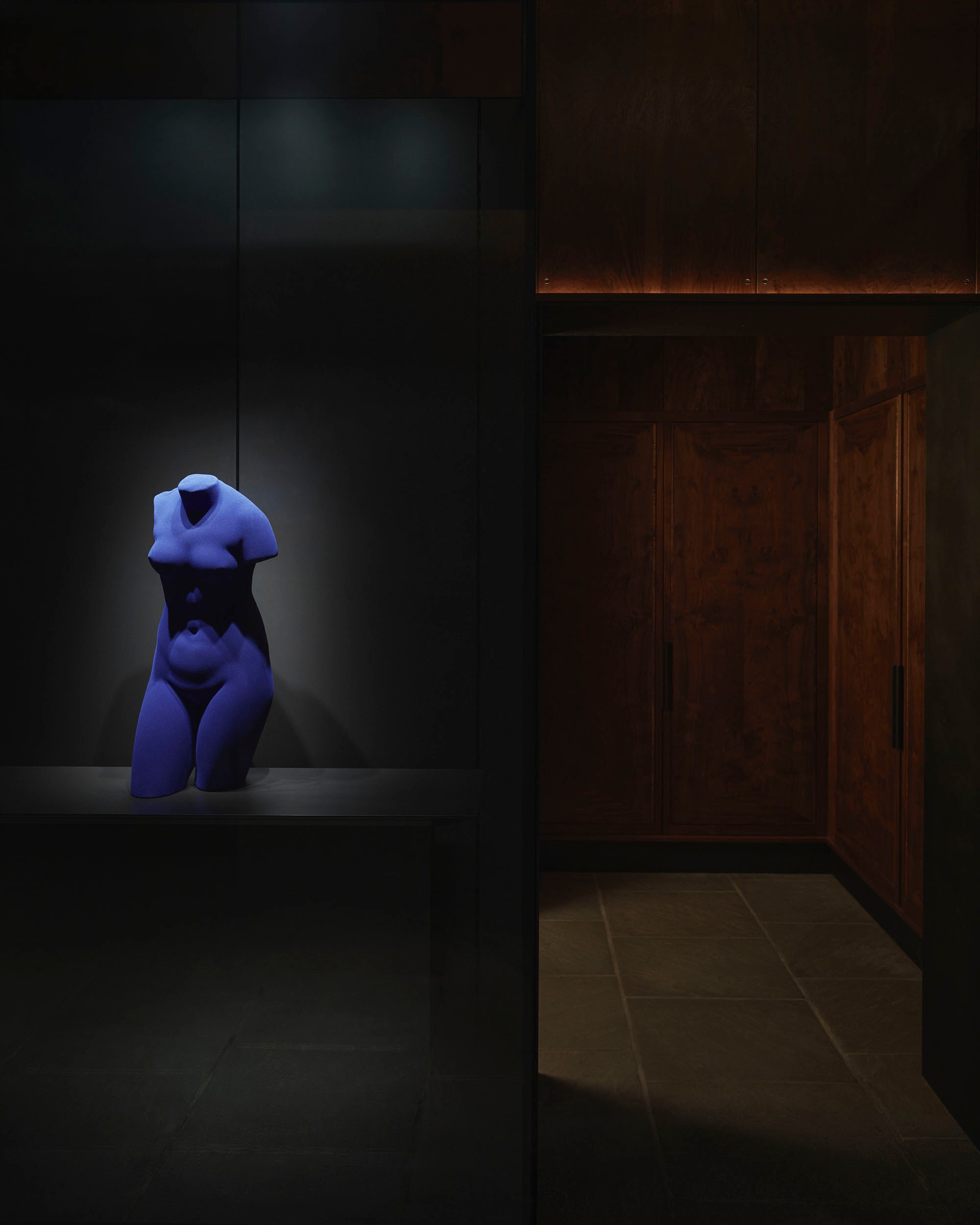
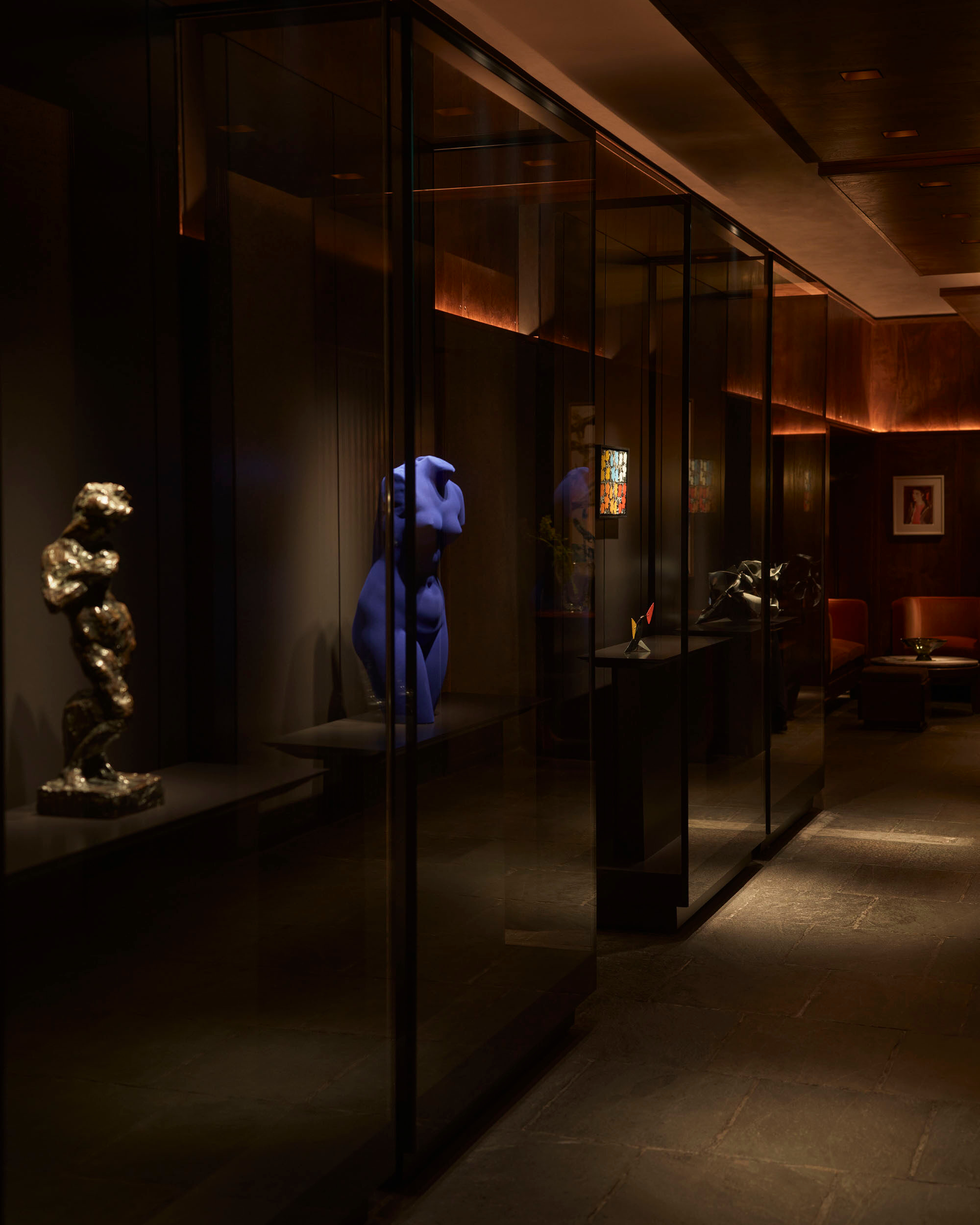
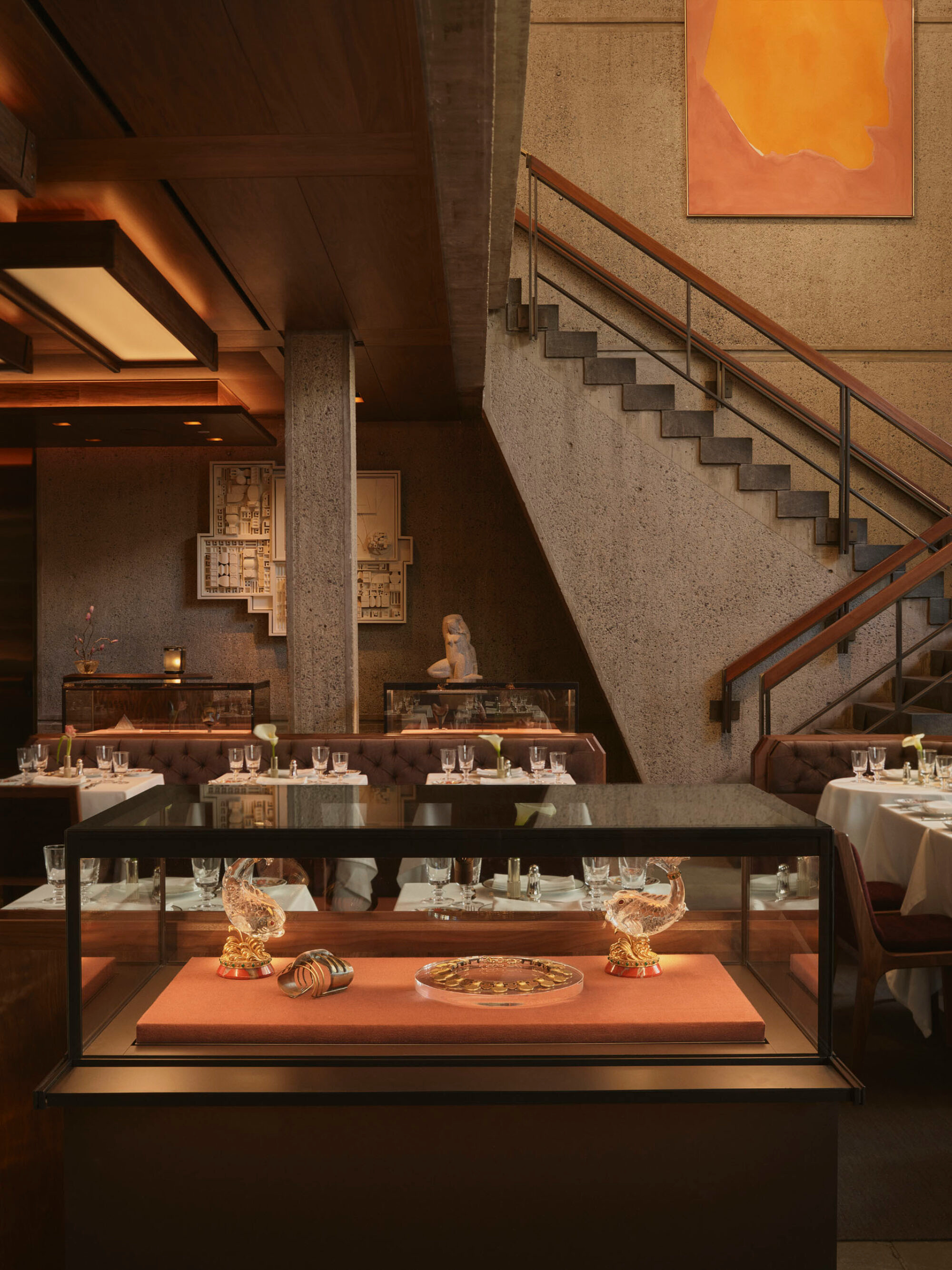
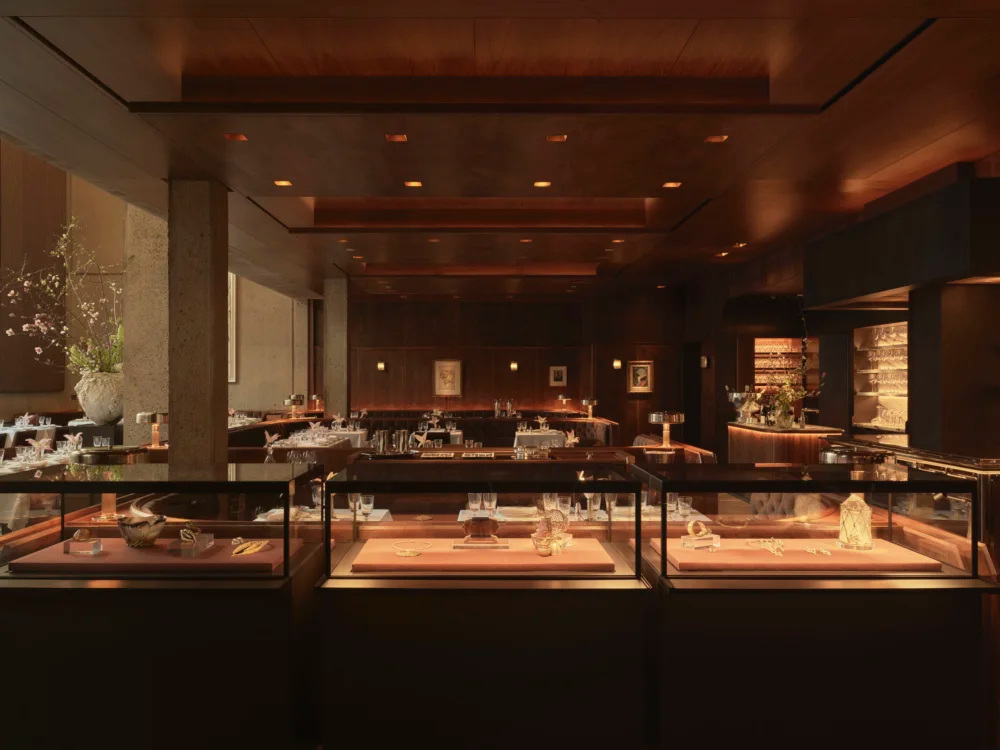
In the photographs of Marcel at Sotheby’s New York, the display case is also part of the room’s furniture. Objects sit among dining tables, beneath the weight of the Breuer Building’s architecture. Goppion’s project account gives this atmosphere a practical counterpart: a case has responsibilities beyond making something look desirable.
Two settings, two display briefs
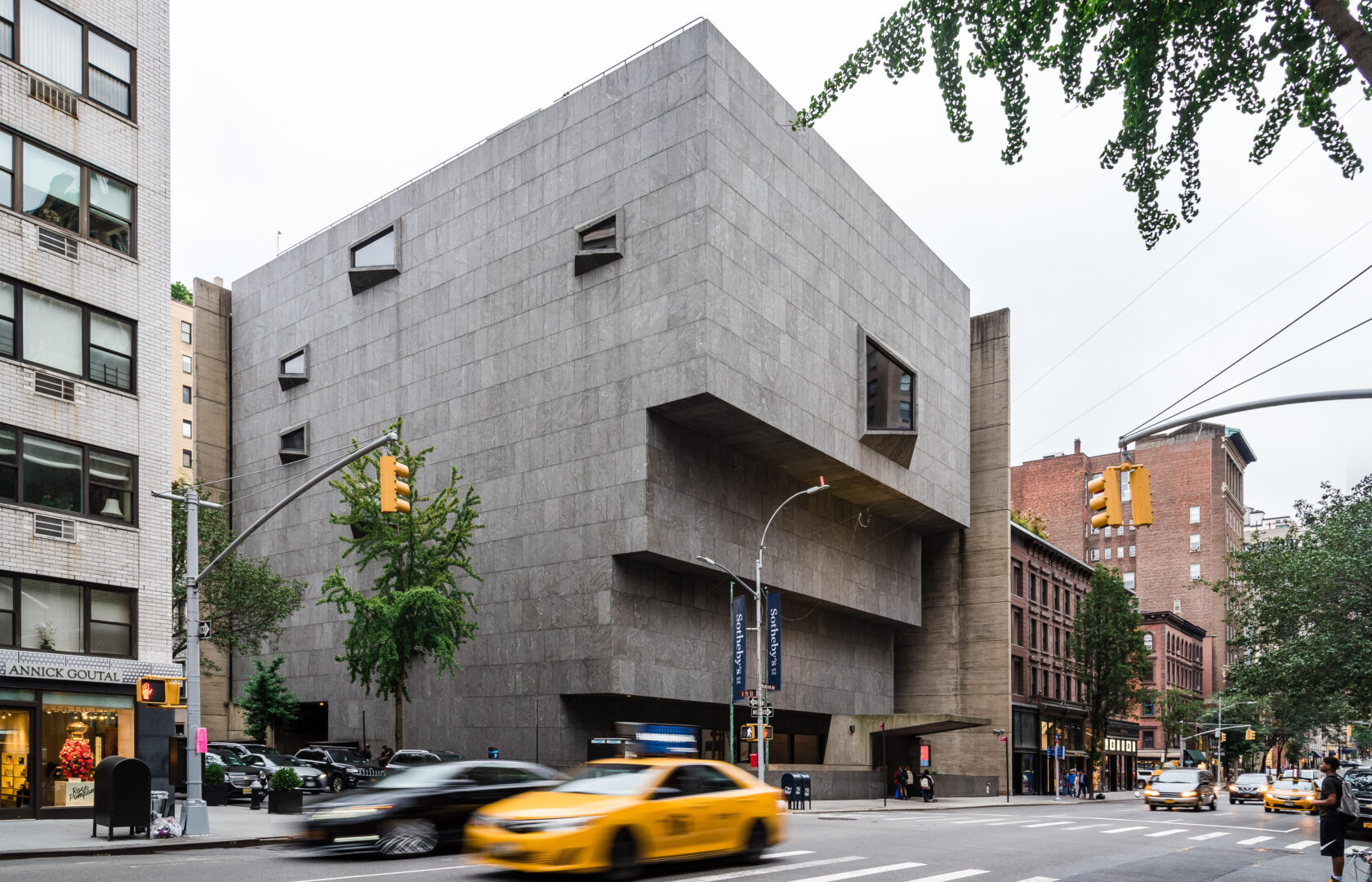
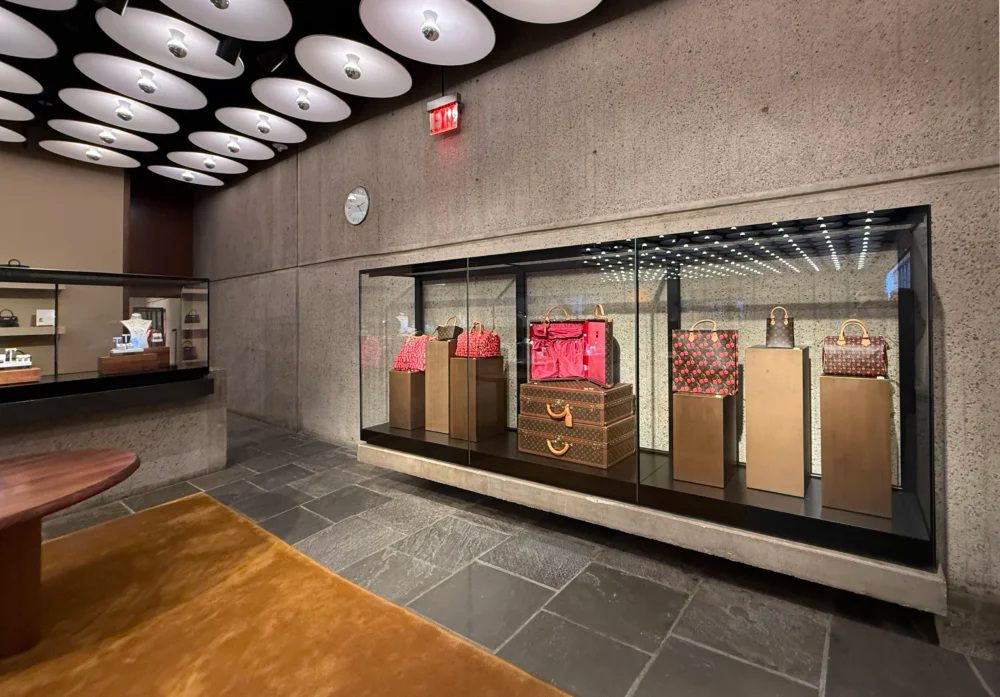
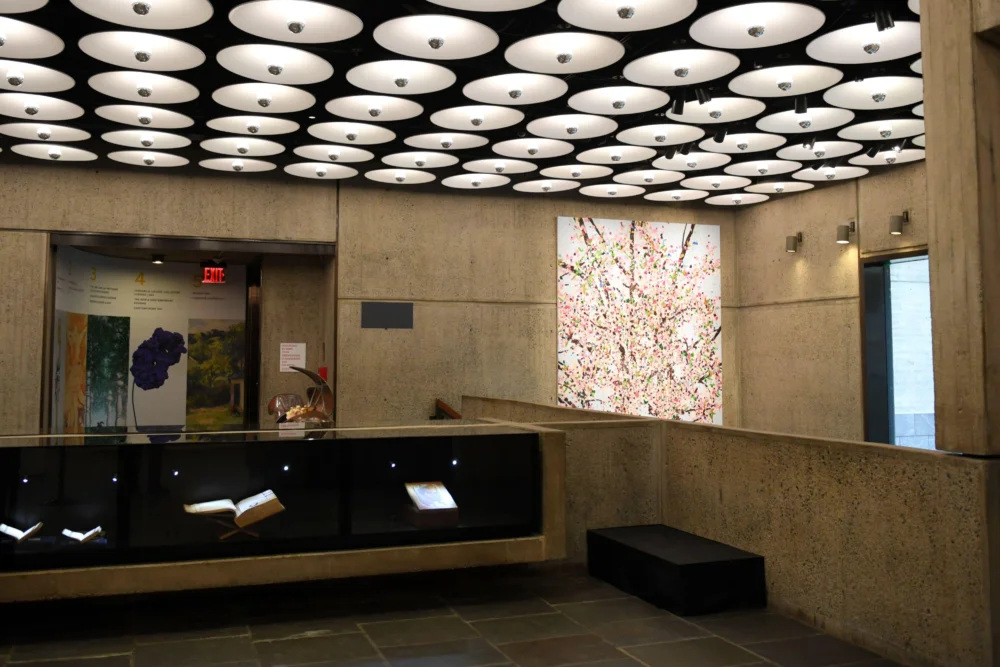
Goppion records a 2025 commission within Sotheby’s New York headquarters and distinguishes the galleries from Marcel, the restaurant that its account says opened in spring 2026. It names Herzog & de Meuron in relation to the galleries and Roman & Williams for Marcel. These are different parts of a documented project, rather than a single undifferentiated design commission.
The manufacturer describes four Q Class showcases for the gallery retail area, followed by sixteen cases and five free-standing pedestals for the restaurant. Those quantities explain the scale and diversity of its contribution. They do not establish that each case has identical technical performance, or that a similar-looking piece would be suitable for a particular private object.
The photographs make the distinction tangible. A gallery display addresses a visitor approaching objects for close consideration. At Marcel, objects share attention with tables, conversation and the movement of a dining room. For a collector thinking about display at home, the productive question is how a case should relate to that room’s activities, rather than how to reproduce the restaurant’s appearance.
Visibility is a design decision
Glass can make an object available to the eye while keeping it physically separate. The degree of visual presence depends on the case, its position, the surrounding materials and the light. In the restaurant sequence, individual objects emerge from dark settings while other displays take their place within a broader tabletop composition.
That is an observation of the published images, not a measurement of illuminance, reflections or viewing performance. It offers a useful commissioning exercise: describe the viewpoints that matter. Should an object be read while seated, approached from several sides or discovered along a route? A case that looks impressive in an isolated product photograph may answer a different question from the one posed by an inhabited room.
Consider the relationship between the object and its support with the same care. A support should make sense of a particular form without competing for attention. The appropriate mounting solution belongs with the relevant specialists. The owner’s role is to communicate the intended experience and ensure that the physical object, rather than a convenient catalogue category, informs the discussion.
Protection needs an object-specific account
Goppion’s conservation material discusses airtightness, climate, offgassing and vibration as areas to consider when creating a display environment. Its lighting account addresses the relationship between visibility and preventive conservation. These are statements about the company’s expertise; they should not be turned into unverified specifications for the cases pictured at Sotheby’s.
The useful implication for a private commission is to ask what has actually been designed and documented for the proposed object. The appearance of a sealed enclosure is not, by itself, a complete account of its environment. Ask the supplier and an appropriate conservation specialist to distinguish the intended performance, the evidence supporting it and the responsibilities that continue after installation.
Keep the object’s existing information available during that process. Materials, condition and relevant specialist records help establish the right questions. A display case is one part of the object’s surroundings, rather than a replacement for knowing what is being displayed. No universal humidity, temperature or light setting is proposed here: the appropriate requirements depend on the actual object and professional assessment.
Access belongs in the brief
A case that is rarely opened has a different practical rhythm from one used for changing displays. Goppion’s account of the gallery commission explicitly refers to changing displays. That is a reminder to discuss the moments when the object is handled, moved or replaced, rather than treating the completed installation as permanently static.
Ask who will be authorised to open the case and who will handle the object. Establish where the relevant instructions and contacts will be kept. These are proposed ownership questions, not a description of Sotheby’s internal procedures. An institutional project supplies a useful reference; it does not tell us how a private household should organise access.
The surrounding room matters during those moments too. A collector may want a discreet object in daily life but need workable access when a specialist attends. Include that situation in the discussion before the room and case are treated as finished. Good integration should make the responsibilities legible as well as the glass unobtrusive.
Questions behind an elegant vitrine
| Part of the commission | Useful question | Evidence to discuss |
|---|---|---|
| Viewing | From where should the object be understood? | Proposed viewpoints and the actual room |
| Support | How is this particular object held? | The relevant specialist’s mounting proposal |
| Environment | What requirements apply to the object? | Conservation advice and the specified case performance |
| Access | Who opens the case and handles the object? | A clear access and handling arrangement |
| Continuing care | What needs attention after installation? | Supplier instructions and named service contacts |
The purpose is to connect the visual ambition with the people and records that support it. A polished presentation should make it easier to ask these questions, not discourage them. Where a requirement remains uncertain, the uncertainty belongs in the brief until it has been resolved.
The Luxe Digital view
A display case succeeds when the object remains the focus and its surroundings remain understandable. Goppion’s Sotheby’s account is an unusually rich reference because it moves between gallery and hospitality settings without losing the object at the centre of the commission.
For a private collector, the lesson is a more complete definition of display. Think about the view, the support, the environment and the moments of access together. The glass may be the most visible boundary in the room; the quality of the commission depends on how clearly the responsibilities on either side have been considered.
A display case succeeds when the object remains the focus and its surroundings remain understandable.
Sources & credits
Sources and methodology
Independent ownership and reference analysis of the named official records and imagery, checked on 15 October 2026. Launch specifications and later product records retain their own dates and references. Images show the identified configurations. Original visual and commissioning analysis of the exact official product/project records and identified images. No visit, interview, comfort test or performance measurement claimed. Existing projects retain their dates; product versions, showroom photographs, sample images and official visualisations are identified separately.