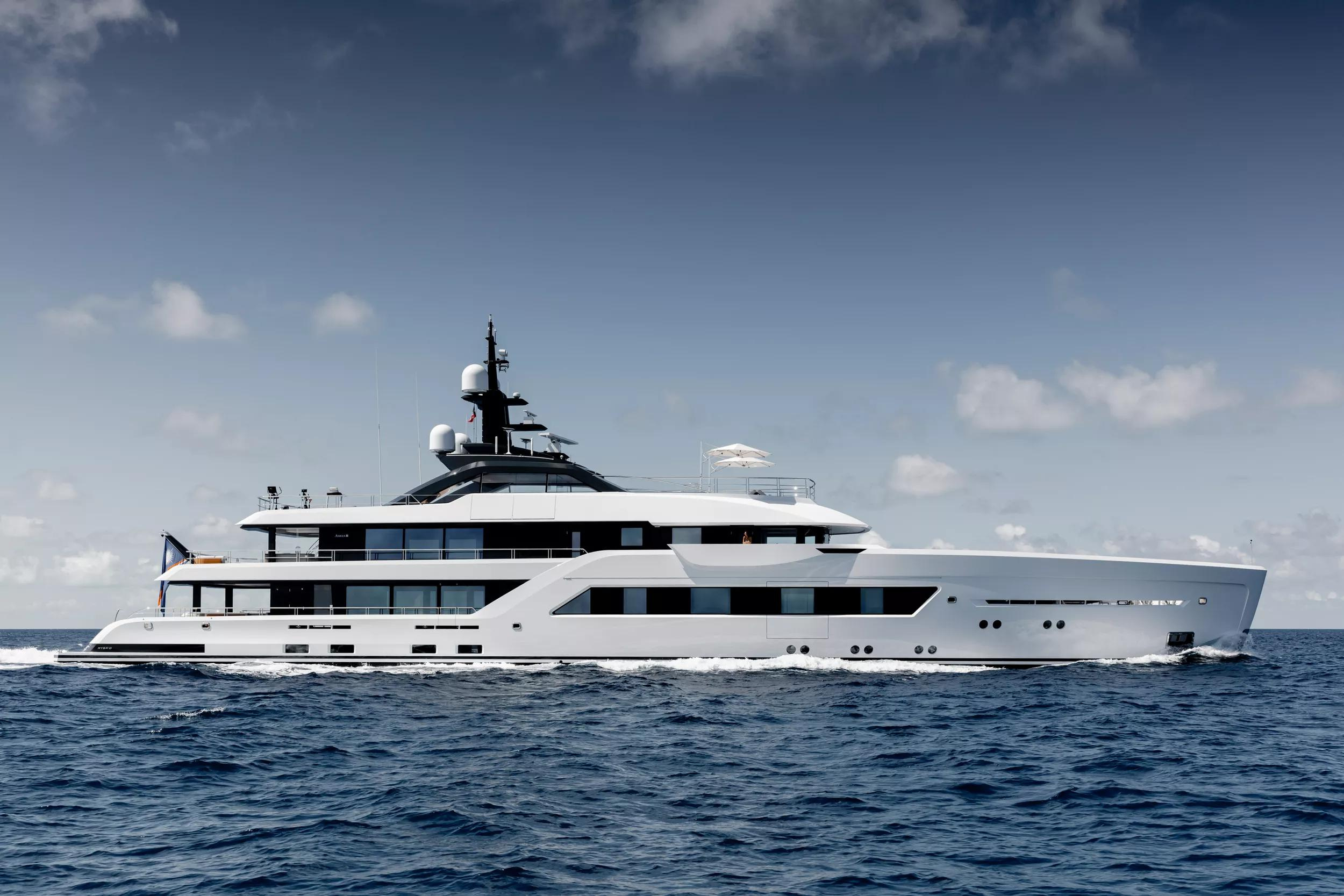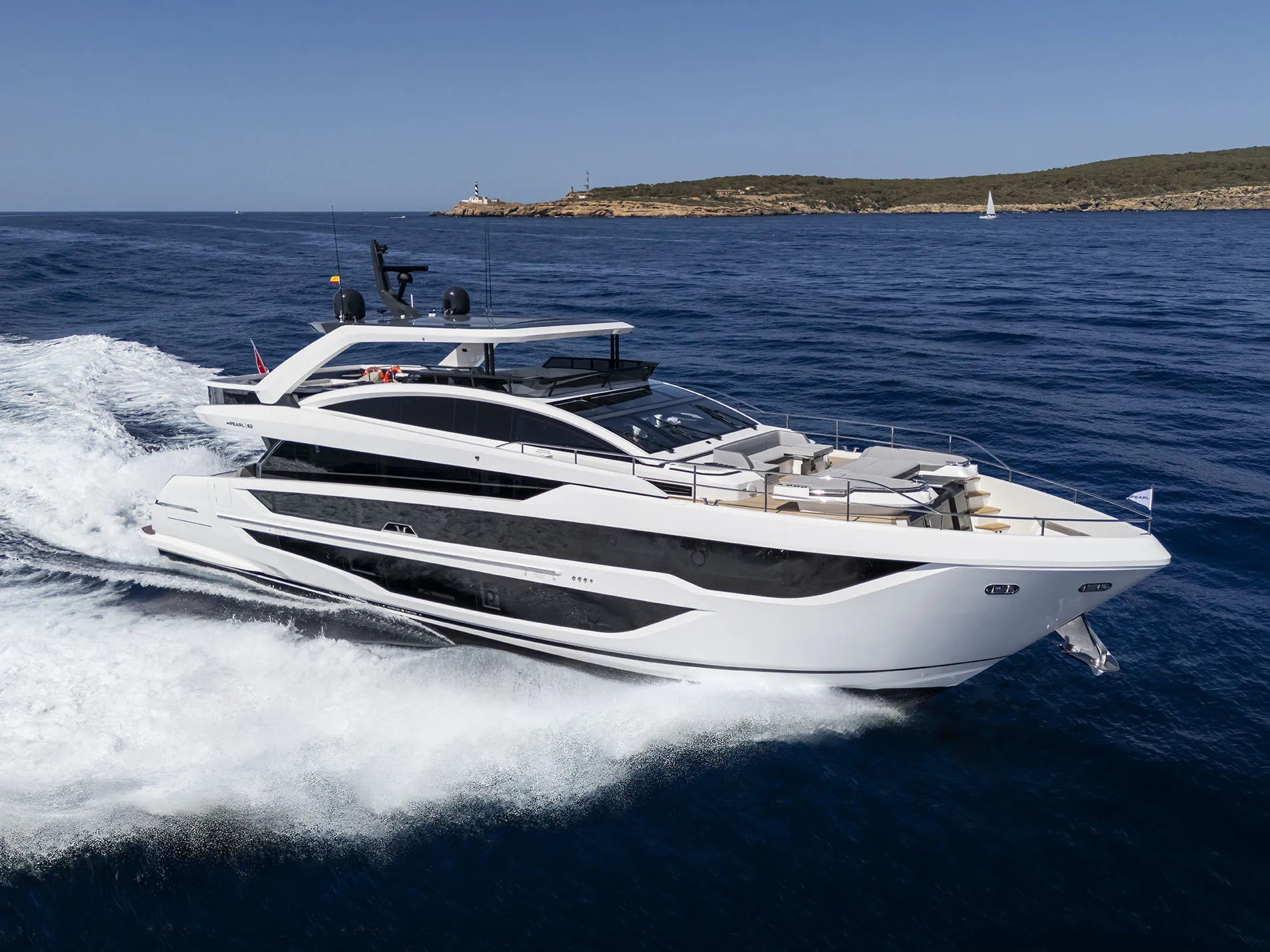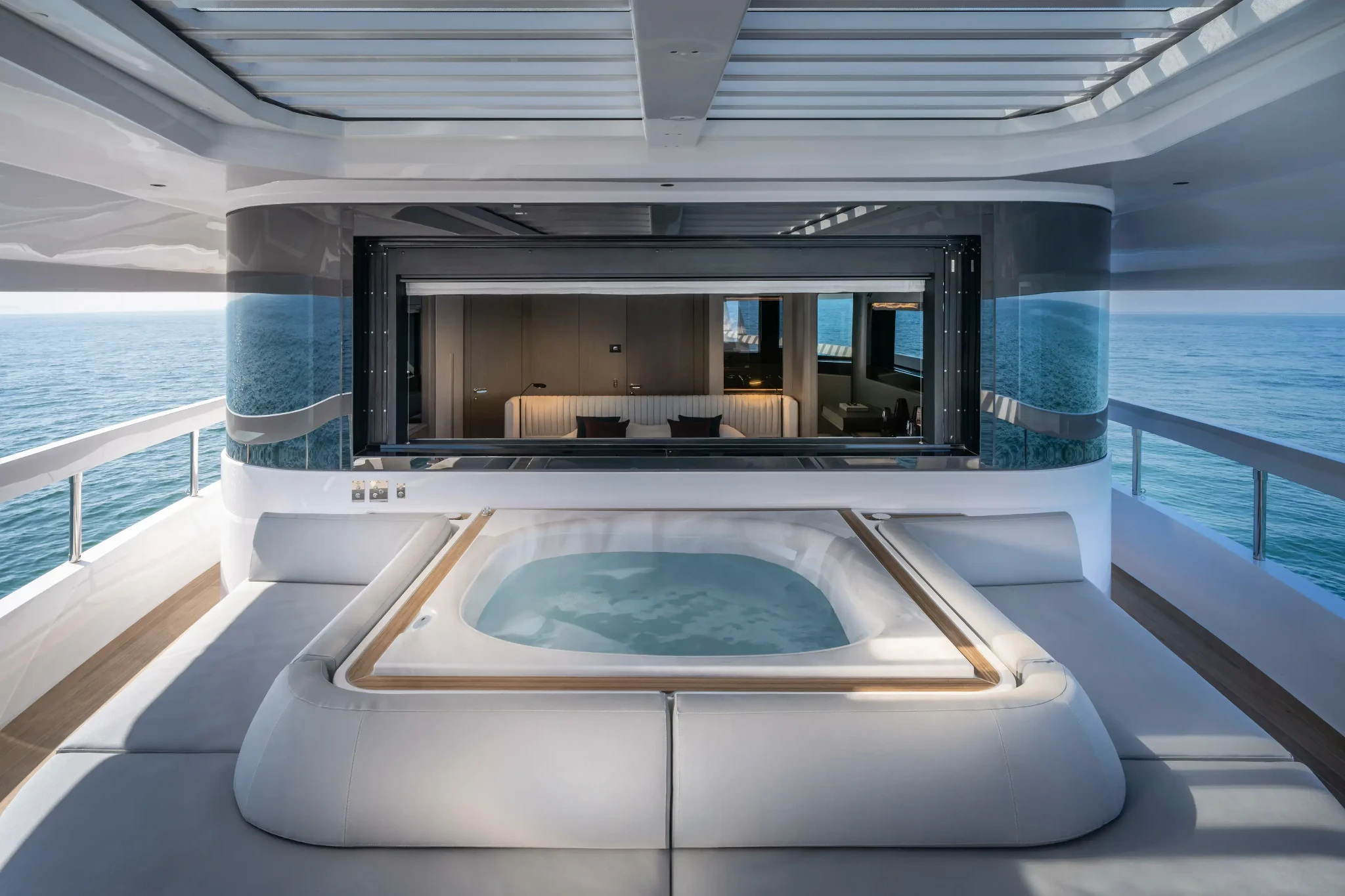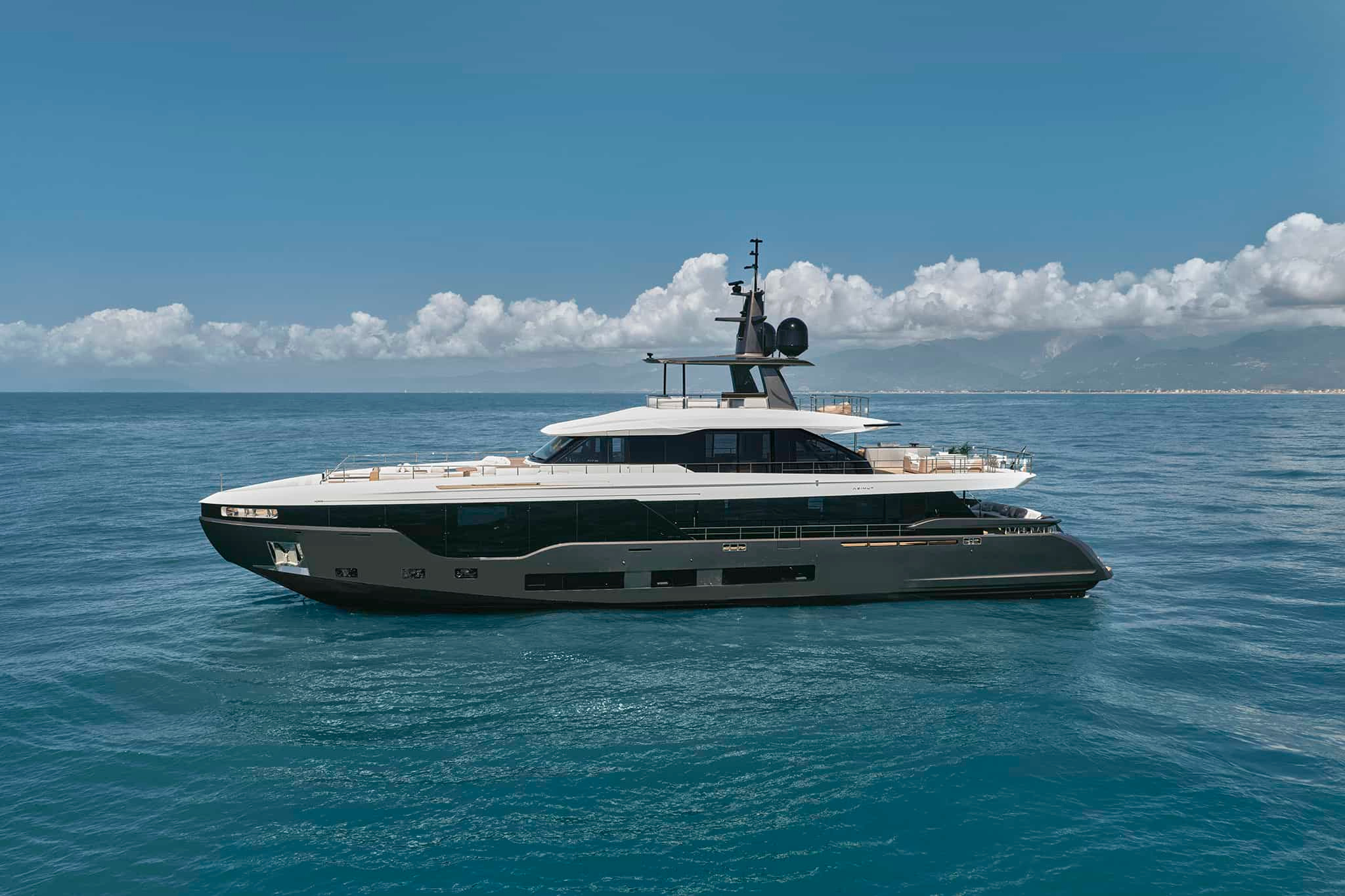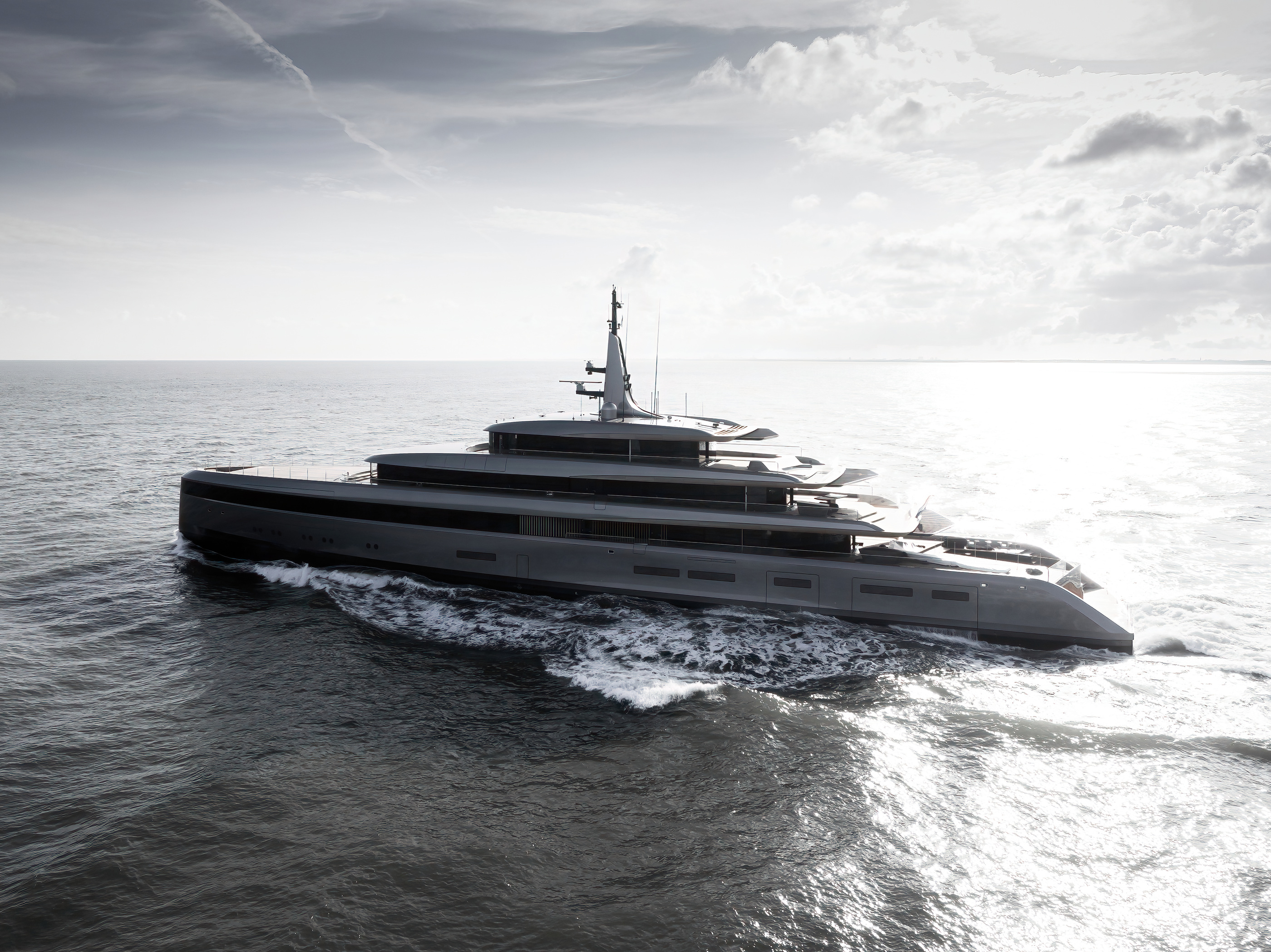
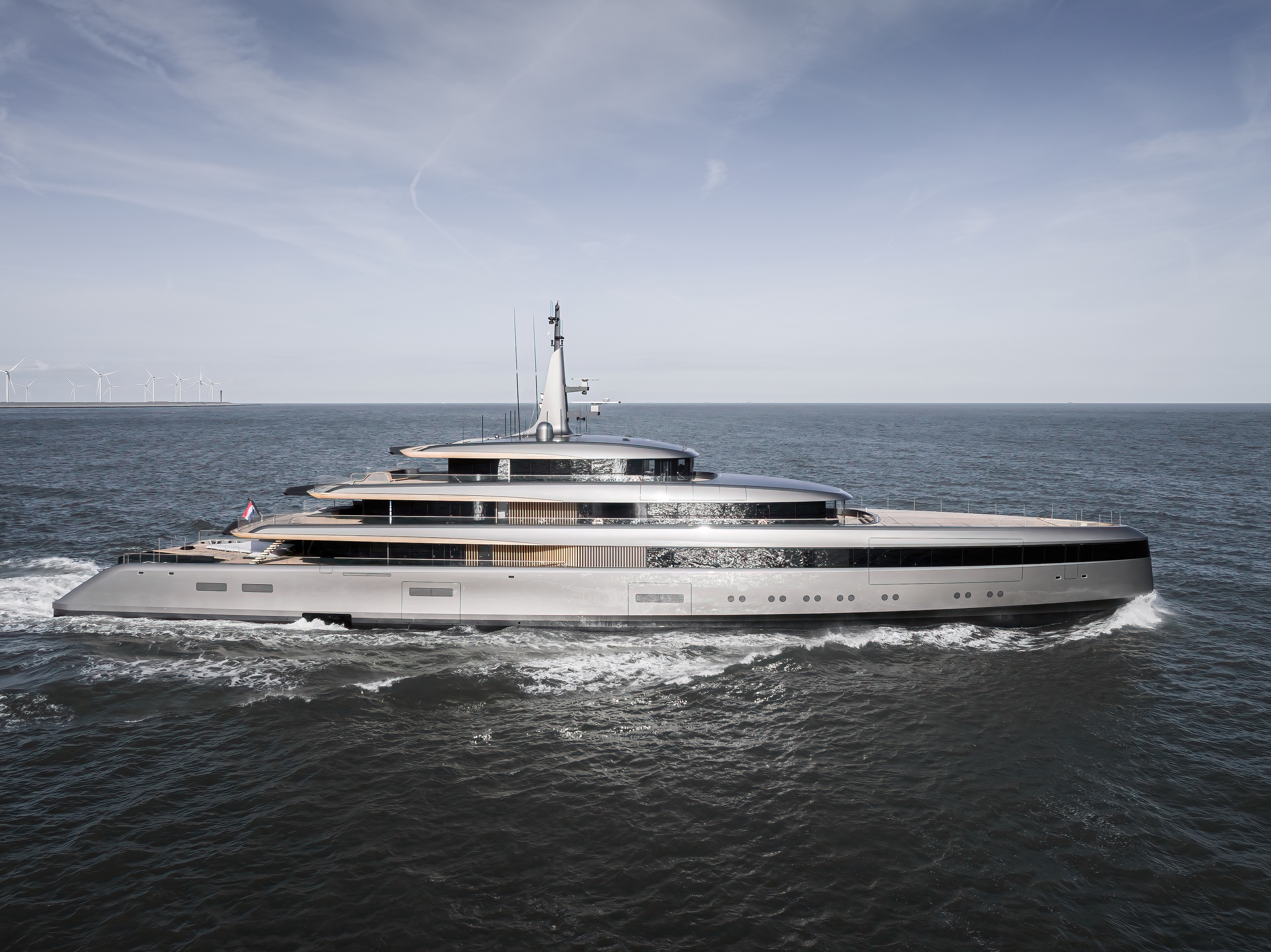
Obsidian’s first impression is horizontal. Dark bands, pale deck edges and a bow that seems to continue the waterline draw the eye along the vessel before it begins to climb. This is the 84.20-metre Feadship delivered in 2023, hull 710. Read as architecture, its interest lies in how a restrained outline can contain a much less conventional sequence of spaces. The exterior gives an unusually composed introduction to a yacht whose engineering and internal arrangement reward a closer look.
The deck reveals the geometry
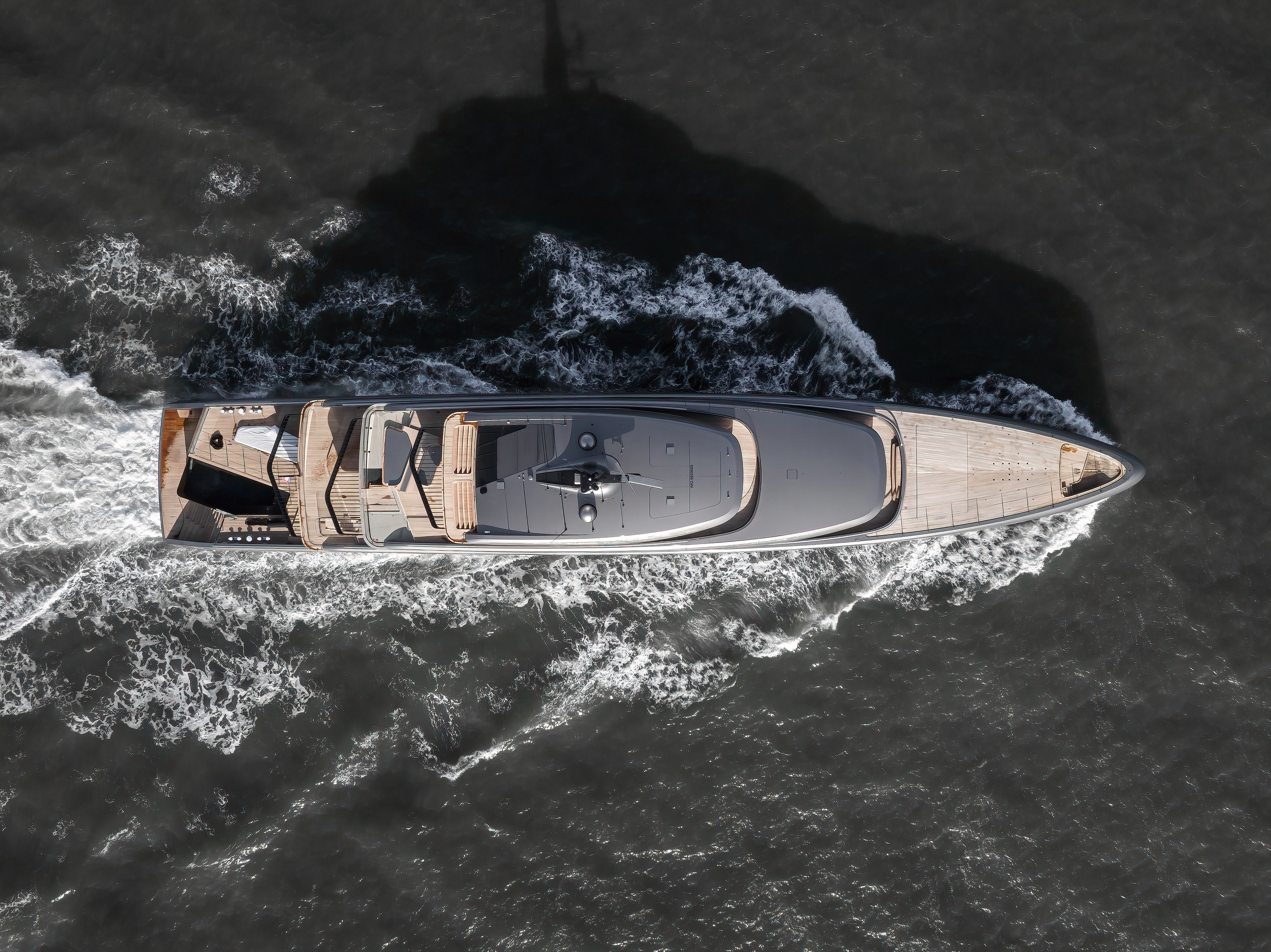
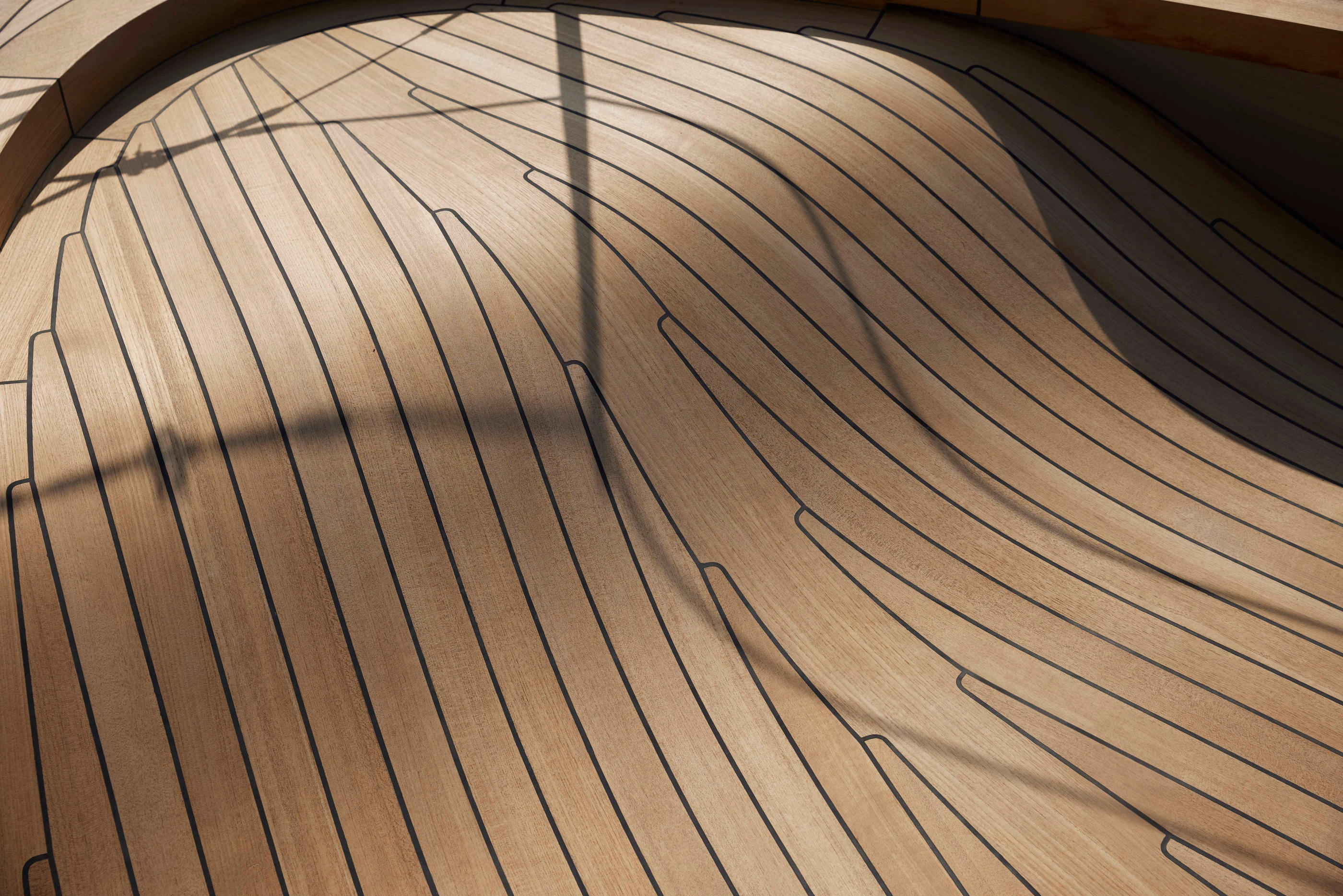
An overhead photograph changes the reading. From the side, decks appear to form long, parallel shelves. From above, the edges turn, seating areas gather around curves and the outline becomes a series of carefully adjusted relationships. The photograph of the planking is particularly revealing: individual lines follow an architectural decision rather than a simple rectangular platform. It is a small view that helps explain the whole vessel.
The current Feadship fleet record credits RWD / Monk Design for exterior and interior, with naval architecture by Feadship De Voogt. Those disciplines meet most clearly where the outline creates an inhabited edge. A deck can be measured by its area, but its character also depends on where a person sits in relation to the rail, the overhang and the horizon. Obsidian’s photographs invite that second reading.
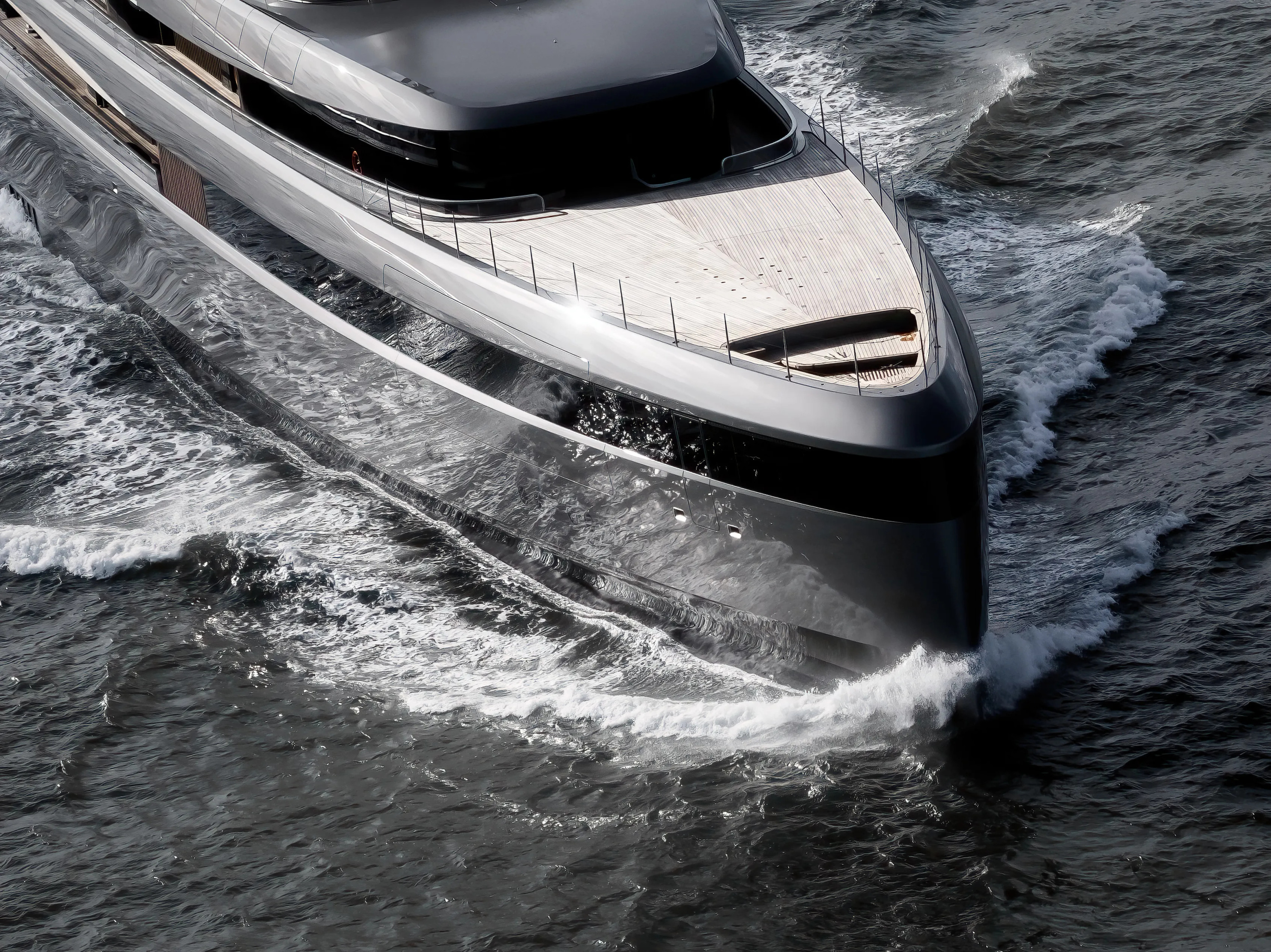
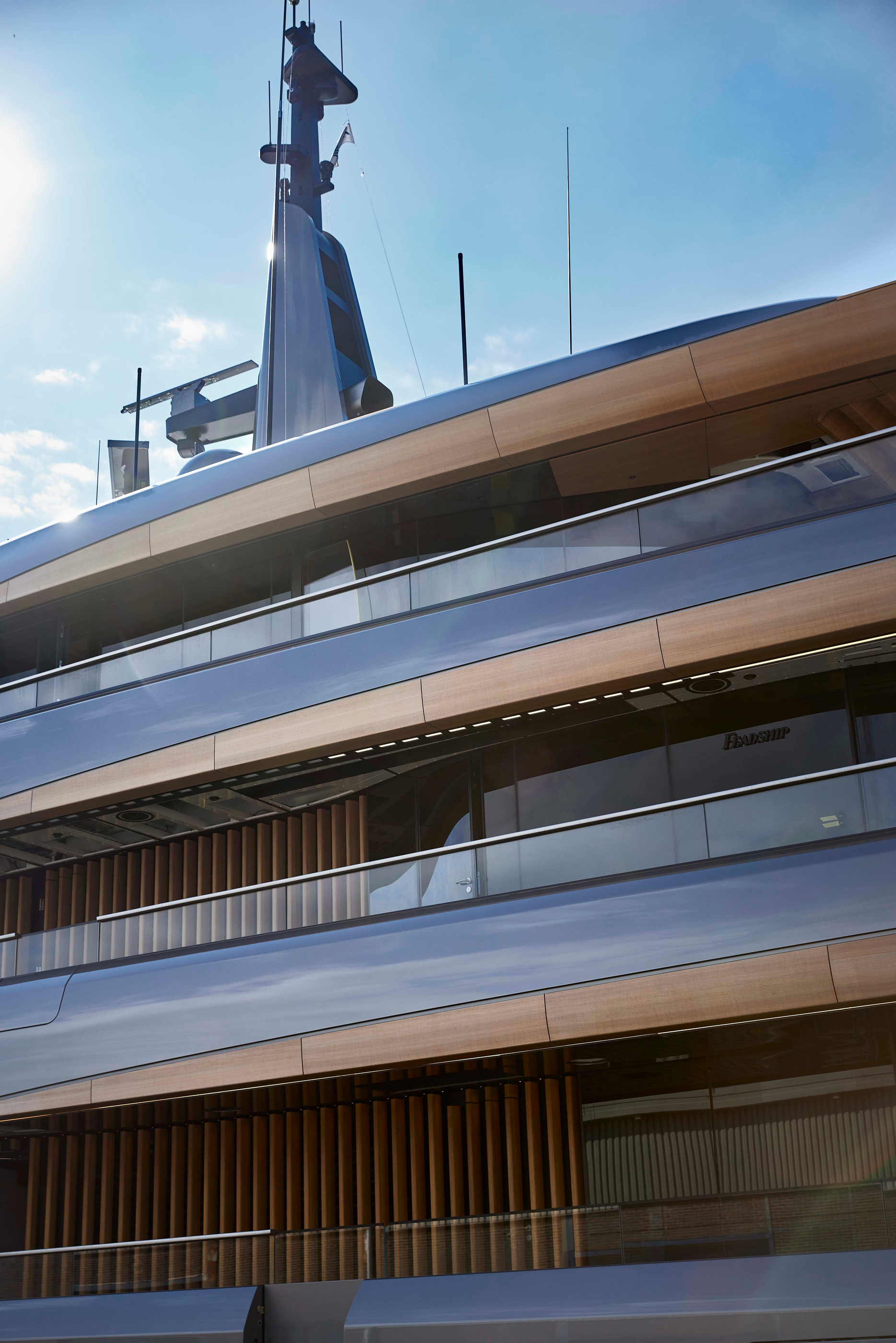
The long dark glazing is more than a graphic stripe in the profile. Its continuity makes individual decks seem connected, while the pale undersides of overhangs give each level a visible boundary. In the close vertical photograph, these layers become almost abstract. Glass, metal and timber each hold a different kind of light. The effect is neither a single uninterrupted wall nor a stack of unrelated balconies.
For a prospective owner, this suggests a useful way to read design proposals. Ask for the same part of the vessel in profile, plan and an eye-level view. A form that looks calm from a distance may create a surprisingly complex room at its edge. Equally, an impressive aerial arrangement needs to make sense from a chair, with the actual shade, furniture and sightline that will be specified.
Systems that change the plan
Obsidian’s technical story matters to its architecture. Feadship’s 2023 delivery account describes a 4.5 MWh battery bank and propulsion through contra-rotating thrusters. The published machinery photographs make the scale of that organisation tangible. They show that the apparently effortless exterior depends on substantial, deliberately arranged equipment below and within the vessel.
The contrast between an anchoring installation and the battery room is useful. One is a recognisable mechanical assembly; the other reads as rows of repeated modules and service aisles. These are different spatial demands, each requiring access, cooling, inspection and maintenance. Attractive deck imagery becomes more informative when the technical spaces supporting it are visible too.
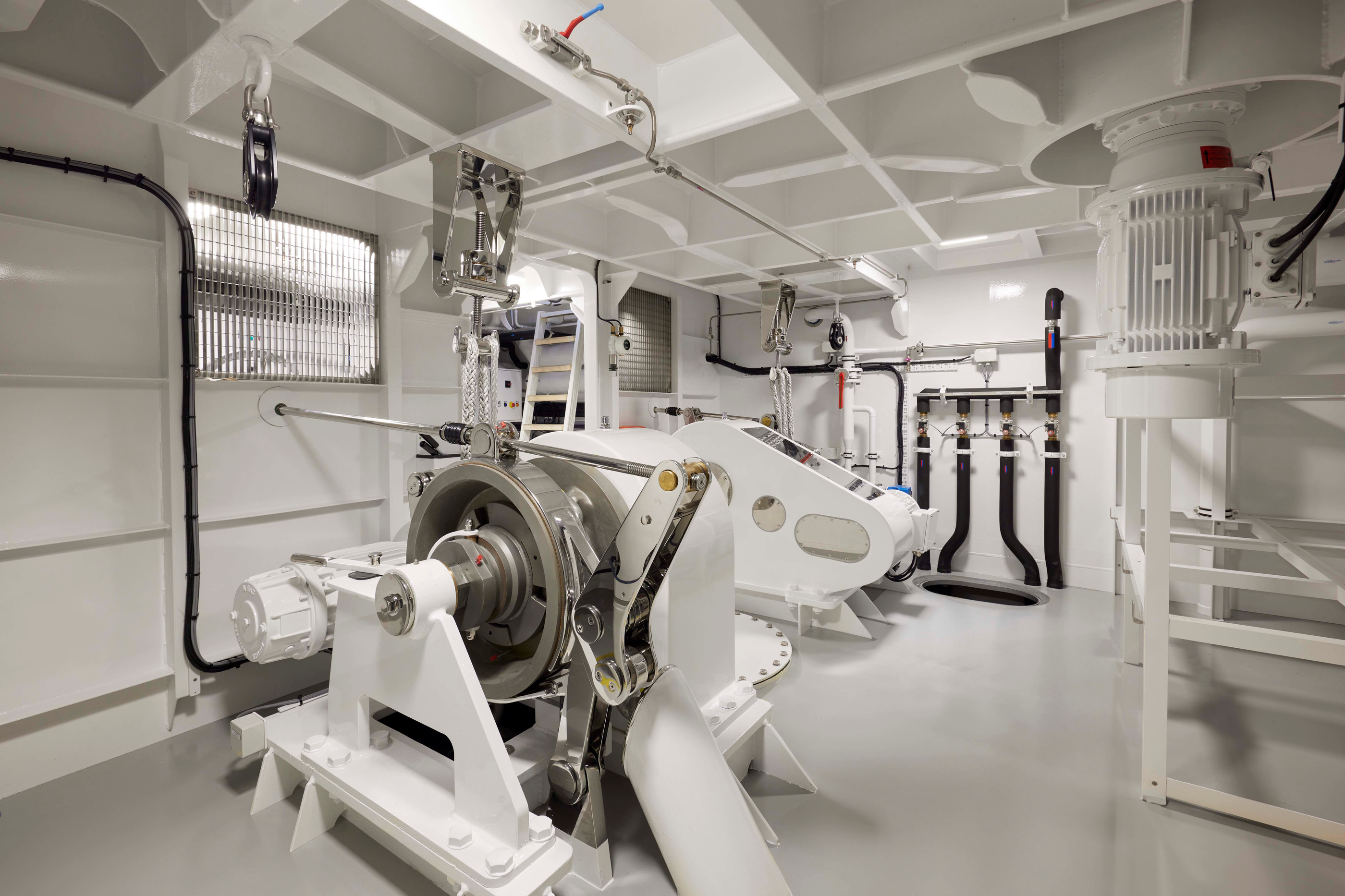
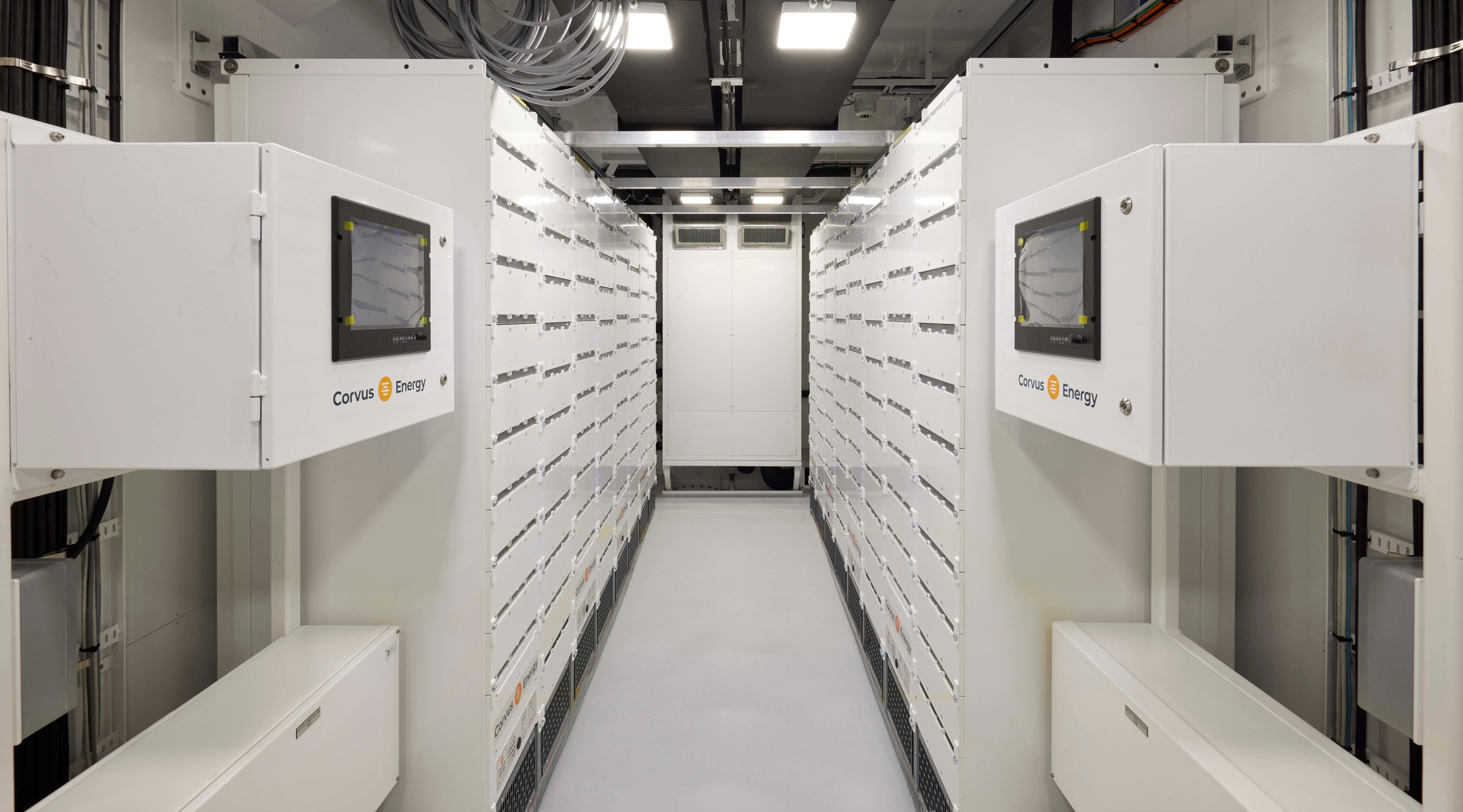
There is a broader design lesson here. A propulsion decision can influence where weight sits, which spaces must be connected and how machinery is serviced. It belongs in the early architectural conversation. Treating the machinery specification as a separate appendix risks missing the opportunities, and the constraints, it creates elsewhere aboard.
This does not turn a photographed installation into an independent performance test. The valuable editorial distinction is between what the yard documents, what the images show and what an owner should establish for a particular operating programme. Battery capacity is a meaningful engineering figure; endurance depends on the loads, speed and conditions attached to it. Obsidian is interesting without compressing all those variables into a single environmental slogan.
A different way to meet the sea
Feadship describes an asymmetrical stair leading to a lower-deck dining area with an opening terrace close to the water. It also describes a forward observation lounge enabled by submarine anchors. These are unusually specific relationships between technical arrangement and the place where someone spends time. They make the yacht’s design intelligible beyond its length or its number of decks.
The public photographs selected here establish the exterior geometry and machinery rather than claiming to show every interior room. That distinction leaves an important question open for a viewing: how does the journey to each space feel? A destination can be exceptional while its approach determines whether it becomes part of everyday life or a place visited only occasionally.
Near-water dining, for example, changes the height of the horizon relative to the table. A forward observation room changes the direction of attention. These are different experiences, and a strong owner brief would describe when each is likely to be used. Breakfast, an afternoon passage and an evening at anchor do not necessarily favour the same room.
The most revealing questions concern transitions. Where does an outdoor route become an indoor one? Can guests find their way without crossing working areas? What is visible while seated, rather than standing for a photograph? On a yacht with unconventional geometry, the answers deserve as much attention as the dramatic destinations themselves.
The owner’s notebook
The current fleet record and the dated delivery account serve different purposes. Together they identify the vessel and explain the decisions behind it. They are a starting point for a properly specified conversation with the builder and advisers, rather than a substitute for vessel documents or operational evidence.
| Published reference | What it establishes | What to explore next |
|---|---|---|
| Hull 710, delivered 2023 | The exact yacht discussed here | Documents and subsequent changes for this vessel |
| 84.20 metres overall | The scale of the project | Usable space, circulation and service routes |
| RWD / Monk Design | Current fleet-record design credits | Authorship and responsibility for any later works |
| 4.5 MWh battery bank in the delivery account | A documented system capacity | Loads, operating modes and current battery condition |
| Thruster-based propulsion | A different machinery arrangement | Service access and the intended cruising programme |
A good technical presentation should help the owner connect a system to a lived consequence. It might concern access for maintenance, the sound of a space at anchor or how a room can be arranged. Those consequences need evidence of their own. Keeping the questions precise makes a discussion more productive than collecting impressive figures without their operating context.
The Luxe Digital view
Obsidian is most compelling where engineering becomes a spatial decision. The low profile supplies the visual coherence; the documented arrangements suggest how much is happening behind it. A reader can admire the silhouette and still ask to understand the rooms, routes and systems that make it possible.
That is a useful standard for presenting a large yacht. The complete story should move from the vessel on the water to the person inside it, then to the equipment that supports that experience. Obsidian offers a particularly clear reason to keep those scales connected.
Obsidian is most compelling where engineering becomes a spatial decision.
Sources & credits
Sources and methodology
Independent yacht design and spatial analysis of the named official records and imagery, checked on 15 October 2026. Original delivery and model dates are retained. Images show the named vessel or identified model configuration. Independent design analysis of official model and individual-vessel records and photographs. No visit, sea trial or charter availability is claimed. Original dates, individual hulls, alternative layouts and dated/current specifications are kept distinct. Operational decisions require the exact vessel documents.