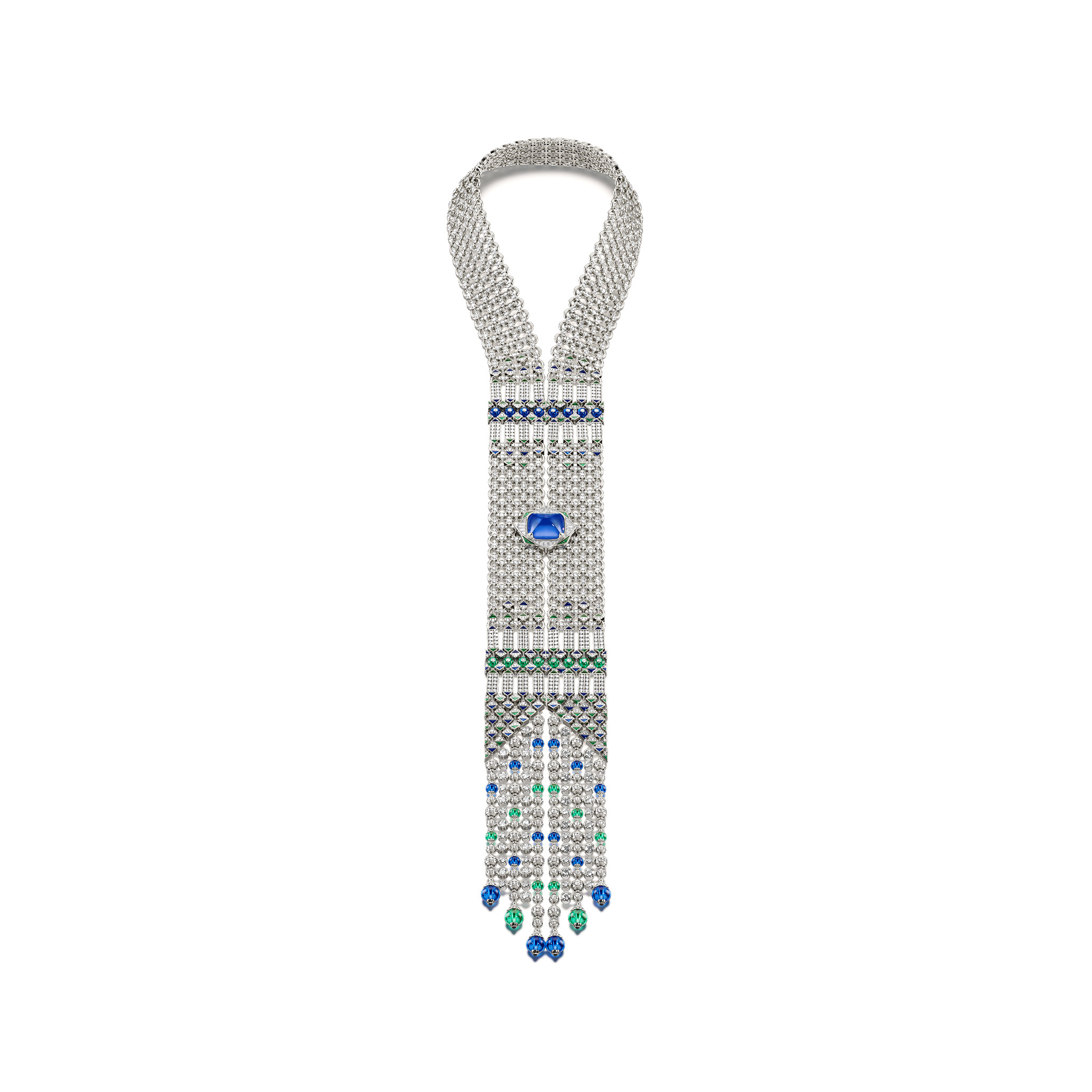
Seres Scarf is most revealing when the eye stops treating it as a necklace and begins to follow a fold. Bvlgari’s official images show a jewel with width, fall and several possible routes around the body. It has a central stone, but its presence depends just as much on the linked field surrounding that stone: a pattern that has to carry colour while allowing the composition to change direction.
A fold, held in precious matter
This is a close reading of one Eclettica creation, rather than a survey of the collection. The distinction matters because Seres has a specific design problem. A textile can turn, overlap and drape with little apparent resistance. A jewel must create those visual effects from individual components. The official studio view, worn photograph and workshop images let us consider the relationship between the complete pattern and the smaller units from which it is assembled.
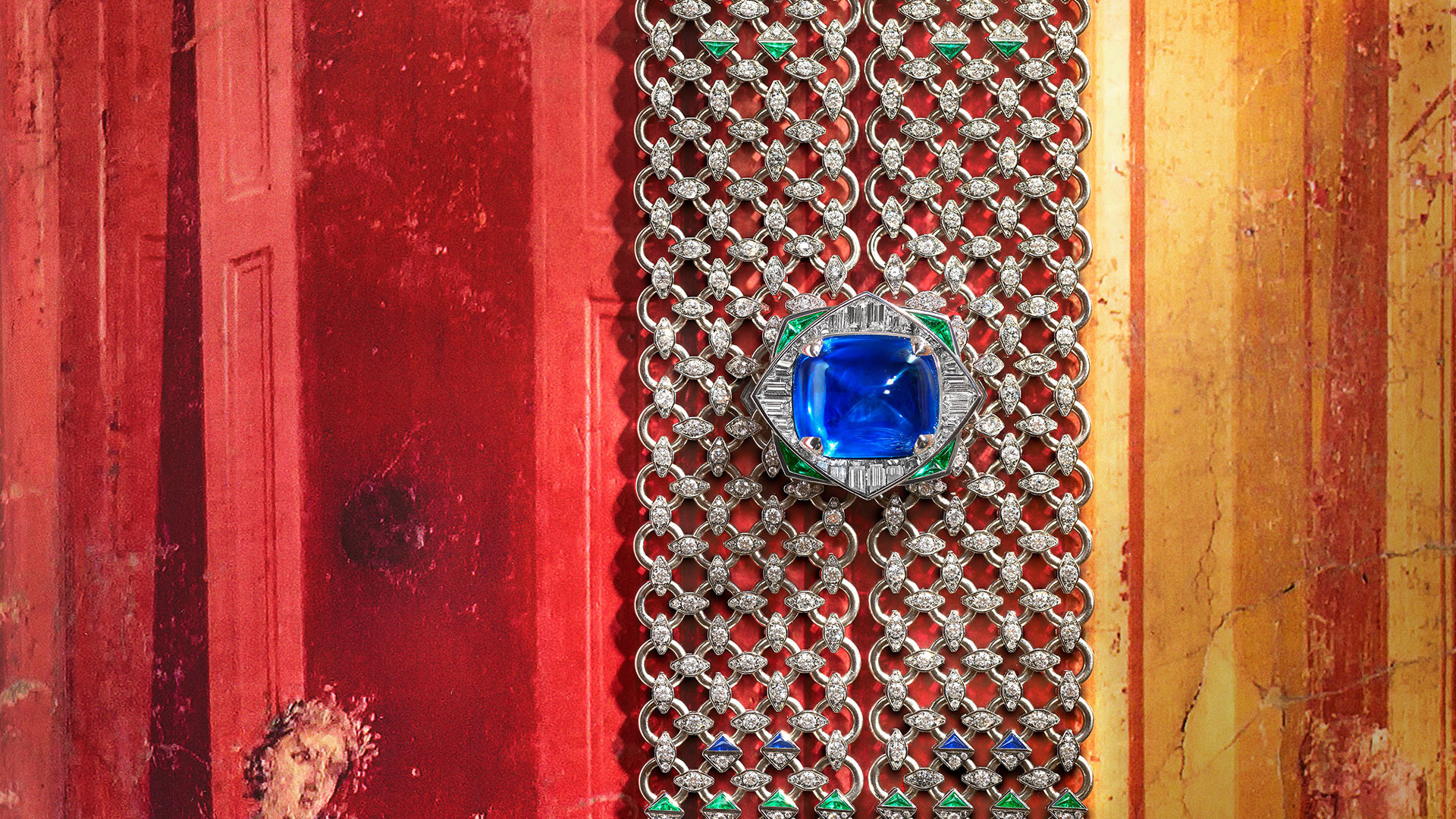
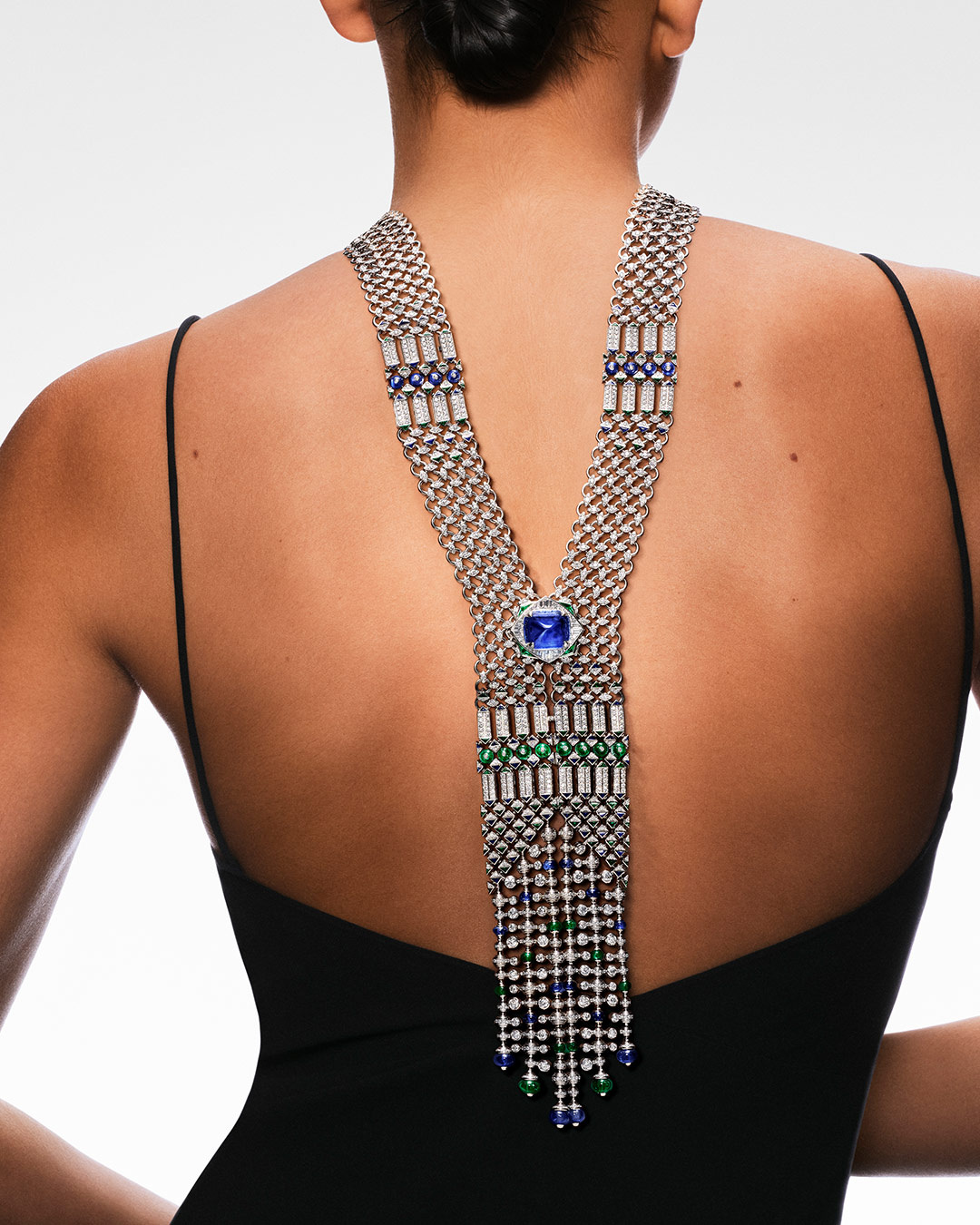
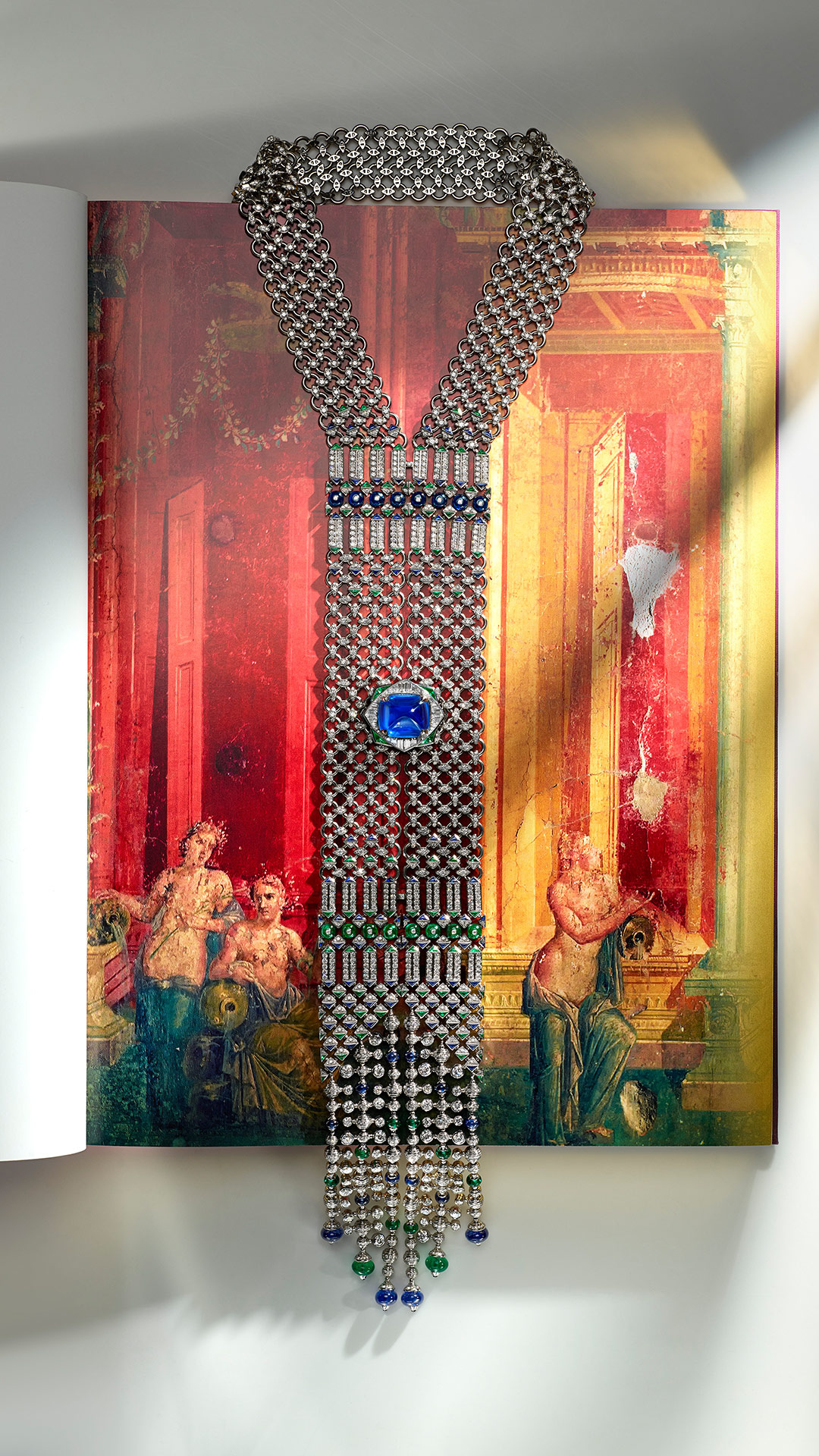
Against a red display field, the sapphire becomes an emphatic blue centre. In the photograph worn down the back, that centre is part of a longer route through the body. The two images explain different things: one isolates colour and construction, the other restores direction and scale. Neither needs to stand in for the sensation of wearing it, which has not been independently tested here.
The sapphire gives the pattern a centre
Bvlgari identifies the central stone as a 31.09-carat sugarloaf sapphire from Sri Lanka. Its form is important to the composition: the official close views show a rounded blue volume rather than the flat, tessellated face one might expect from a densely faceted centre stone. The surrounding pattern is much busier. That contrast gives the eye somewhere to pause before it begins following the smaller coloured elements across the jewel.
The stone’s published identity, weight and origin are manufacturer statements. The photograph supplies visual evidence of its shape and position, not an independent gemmological determination. Keeping those two kinds of information separate makes the object more legible. The specification tells us what Bvlgari has documented; the image lets us ask how the sapphire functions within the design. Here it appears as an anchor that does not prevent the rest of the composition from travelling.
The larger field introduces a second rhythm. Blue, green and dark elements alternate across closely placed sections, building something that can be read from far away as a patterned surface. Move nearer and the outline resolves into many separate units. This change of viewing distance is essential. If the article remained only at gemstone scale, it would miss the scarf-like breadth; if it remained only at portrait scale, it would miss the assembly that makes such a broad surface possible.
The workshop explains the flexible architecture
The maker describes sapphires, emeralds and onyx threaded into hundreds of worked elements, with 1,180 individual elements and 1,600 hours of craftsmanship reported for the piece. Those numbers are attributed to Bvlgari, not independently timed or counted. Their editorial value lies in directing attention towards the construction. The jewel’s complexity is distributed across repeated connections, rather than confined to one spectacular centre.
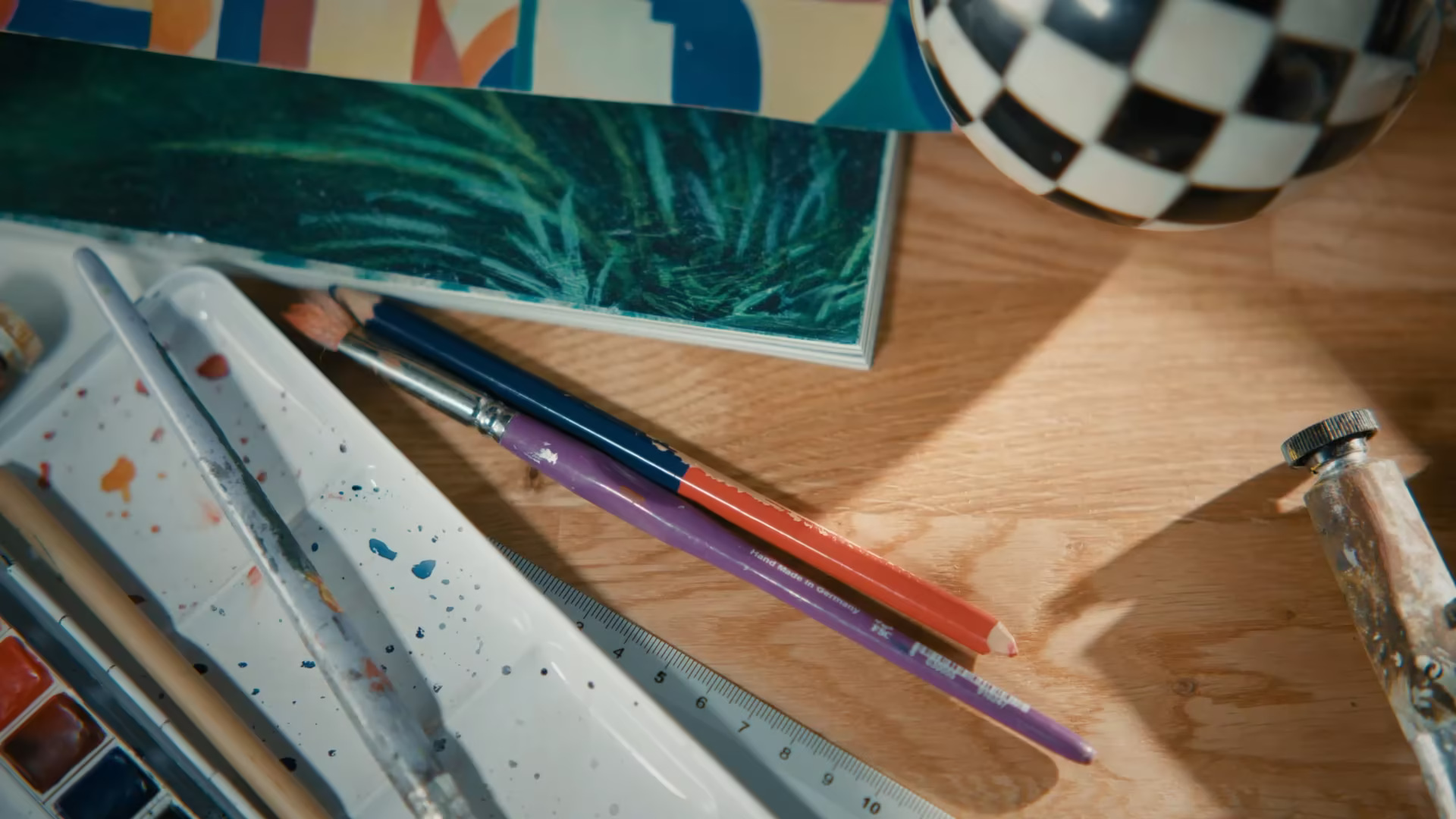
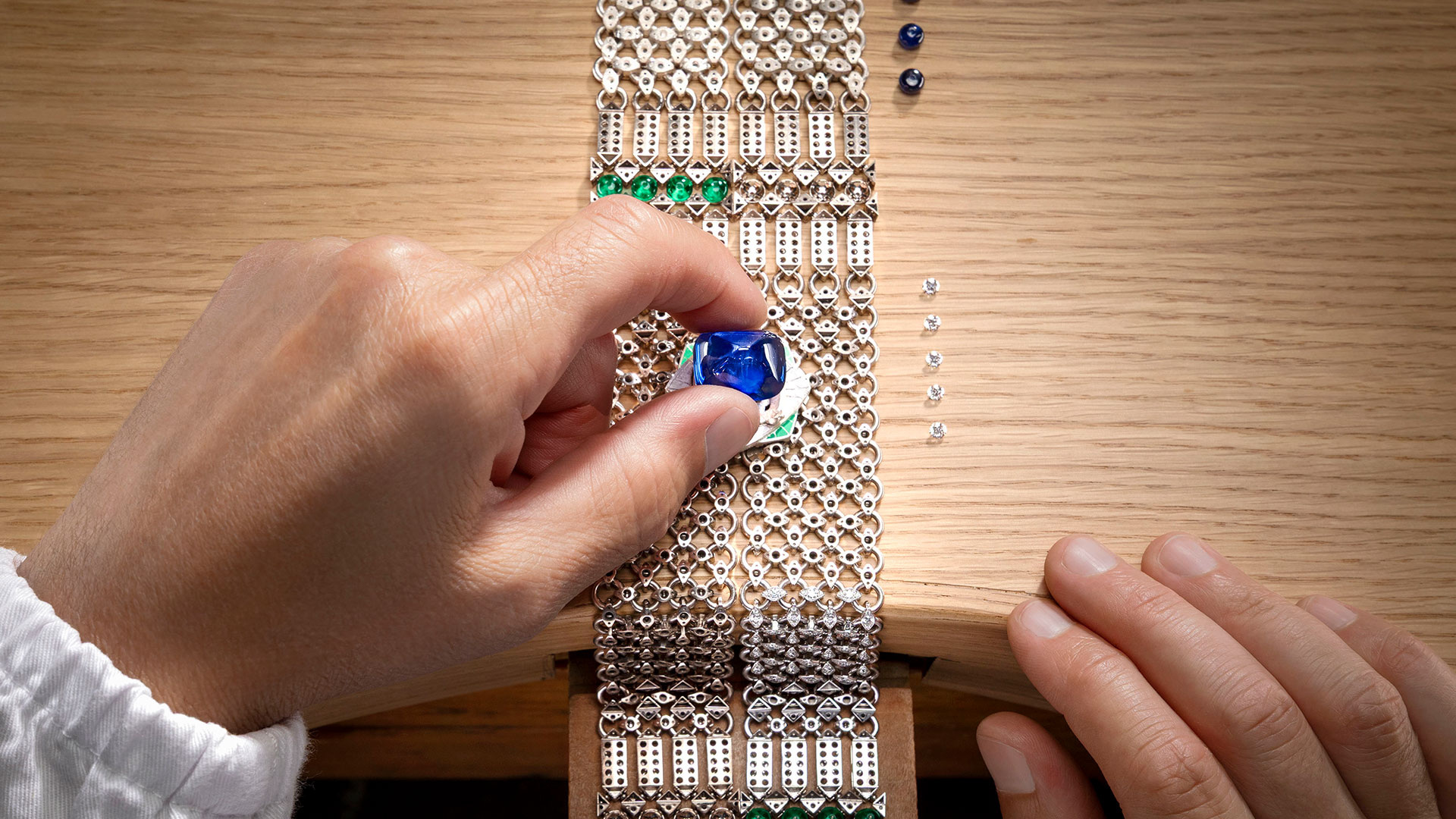
The workshop photographs are therefore more than supporting atmosphere. A drawing on the bench sets the complete composition beside the tools and working surface; a closer image shows hands around the central stone and its surrounding structure. Together, they give the viewer a change of scale. The finished object is no longer simply a polished pattern. It is a sequence of parts that must meet one another accurately for the whole to retain its visual continuity.
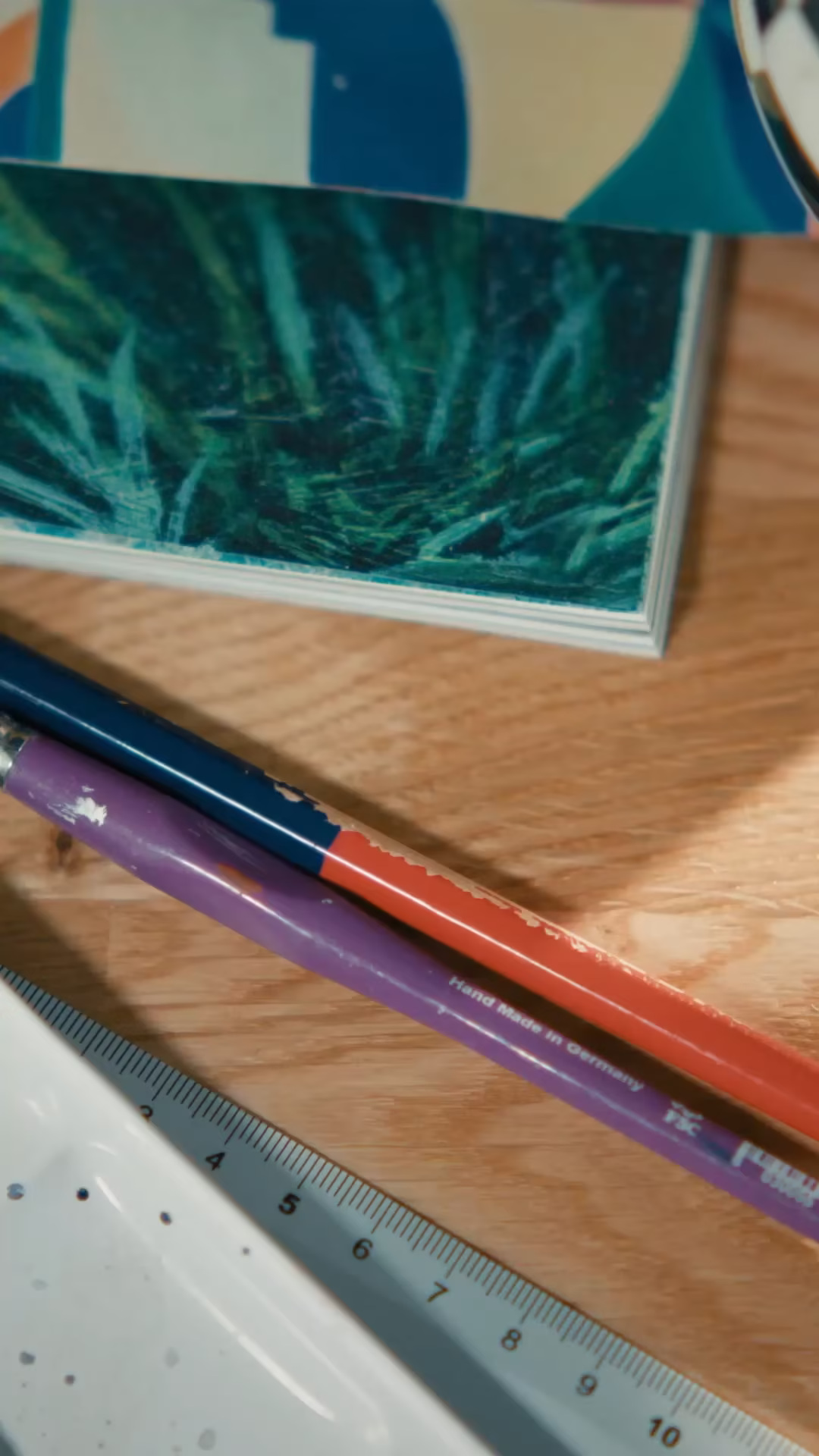
A still image cannot show the resistance of a joint, its range of movement or how the weight is distributed when worn. Yet it can make the relevant questions precise. Which connections allow a section to turn? Where does the pattern change direction? How does the central stone meet the linked field? These are better questions than a general claim of flexibility, because they identify the places where construction and appearance depend on each other. The workshop view gives the eye permission to look for them.
Wearing changes the route of the jewel
The official account describes Seres Scarf as modular, with sautoir, scarf and choker configurations. These are stated possibilities for this creation, not an invitation to assume that every arrangement visible in a photograph can be recreated without instruction. With a complex jewel, the fastening sequence and handling guidance are part of the design. The maker’s description establishes the range; a demonstration would be needed to understand the process in full.
The worn back view nevertheless offers a clear visual lesson. The composition does not finish at the front of the neckline. It can create a long axis down the body, bringing the surrounding clothing into the picture as a field of contrast. What looked like a concentrated object in the studio now has a relationship to shoulder width, the exposed back and the distance over which its pattern falls. The jewel becomes a spatial arrangement rather than a single point of brilliance.
That is where the textile analogy earns its place. A scarf changes an outfit through direction, overlap and the distribution of colour. Seres makes those same issues central to a high-jewellery composition. The analogy should not be stretched into a claim that stones feel like silk. It is a way to describe the visual problem: making a precious surface appear capable of following a fold while retaining a clearly organised pattern and a distinct centre.
The documented construction
| Element | Bvlgari’s published description | What the imagery adds |
|---|---|---|
| Central sapphire | 31.09 ct sugarloaf sapphire from Sri Lanka | Position, rounded volume and blue focal point |
| Linked field | Sapphires, emeralds and onyx | Alternating colour and closely repeated units |
| Assembly | 1,180 individual elements; 1,600 hours | Workshop context and change of construction scale |
| Wearing range | Sautoir, scarf and choker | A worn view showing a longer route down the back |
The figures describe this creation according to the maker. They are not collection-wide specifications. Photographs and workshop views help explain the composition, but do not establish independent certification, a wear test or a measured assessment of comfort. Any fitting or reconfiguration should follow the house’s instructions for the actual piece.
The Luxe Digital view
Seres Scarf succeeds as a visual proposition because its construction and its silhouette address the same problem: how a precious surface can follow a fold. The central sapphire is memorable, but the more distinctive idea is the route around it. The official imagery gives that route enough space to be understood, from the bench to the complete jewel and finally to the body.
Seres Scarf succeeds as a visual proposition because its construction and its silhouette address the same problem: how a precious surface can follow a fold.
Sources & credits
Sources and methodology
Independent visual analysis of current official imagery and named product records, checked on 14 October 2026. Historical introductions, manufacturer specifications and visual observations are kept distinct. No visit, interview, independent handling or appraisal is implied.
- Bvlgari — source 1: Current official collection, named designs, dated context and selected image provenance.
- Bvlgari — source 2: Current official collection, named designs, dated context and selected image provenance.