
A yacht’s silhouette is easy to understand at a distance. Its operating structure is less visible, yet it shapes the experience of every day aboard. A management proposal deserves to be read as carefully as a general arrangement: who does what, which decisions return to the owner, and how the work becomes visible over time.


Look behind the single word
Burgess’s published management offer separates marine operations, technical management, accounting, safety and security, crew services, procurement and insurance. That structure is a useful example of the breadth hidden inside the phrase yacht management. It does not establish which services a particular owner has commissioned, or what another provider includes under the same heading.
Begin by describing the intended operation. Where does the owner expect to use the yacht, what periods of use are anticipated, and which responsibilities are already carried by the captain or an existing team? These questions frame a conversation with the appointed professionals. They are not a substitute for a vessel-specific operational or regulatory assessment.
A clear proposal should connect its scope to that brief. Ask the provider to identify the tasks it performs, the tasks it coordinates and the decisions it expects someone else to make. The owner needs an intelligible map, not a claim that every possible responsibility has disappeared into a comprehensive service.
Draw the line between support and authority
Identify who can instruct expenditure and where approval is required. Ask how an urgent request reaches the right person and how the decision is recorded afterwards. A proposal can explain the service relationship without publishing sensitive operational details. Those details belong in the appropriate private documents and procedures.
The captain’s role deserves explicit treatment. Ask how communication with the management team is organised, how overlapping responsibilities are resolved and who becomes the owner’s regular point of contact. The objective is to support a coherent operating team rather than create parallel channels that leave each person assuming another has acted.

Request a hypothetical example. A maintenance issue is identified while the owner is preparing to use the yacht. Who assesses it, who coordinates the response and which decisions require approval? Let the provider explain the actual process it proposes. The answer is more revealing than a general assurance of availability.
A report should help an owner decide
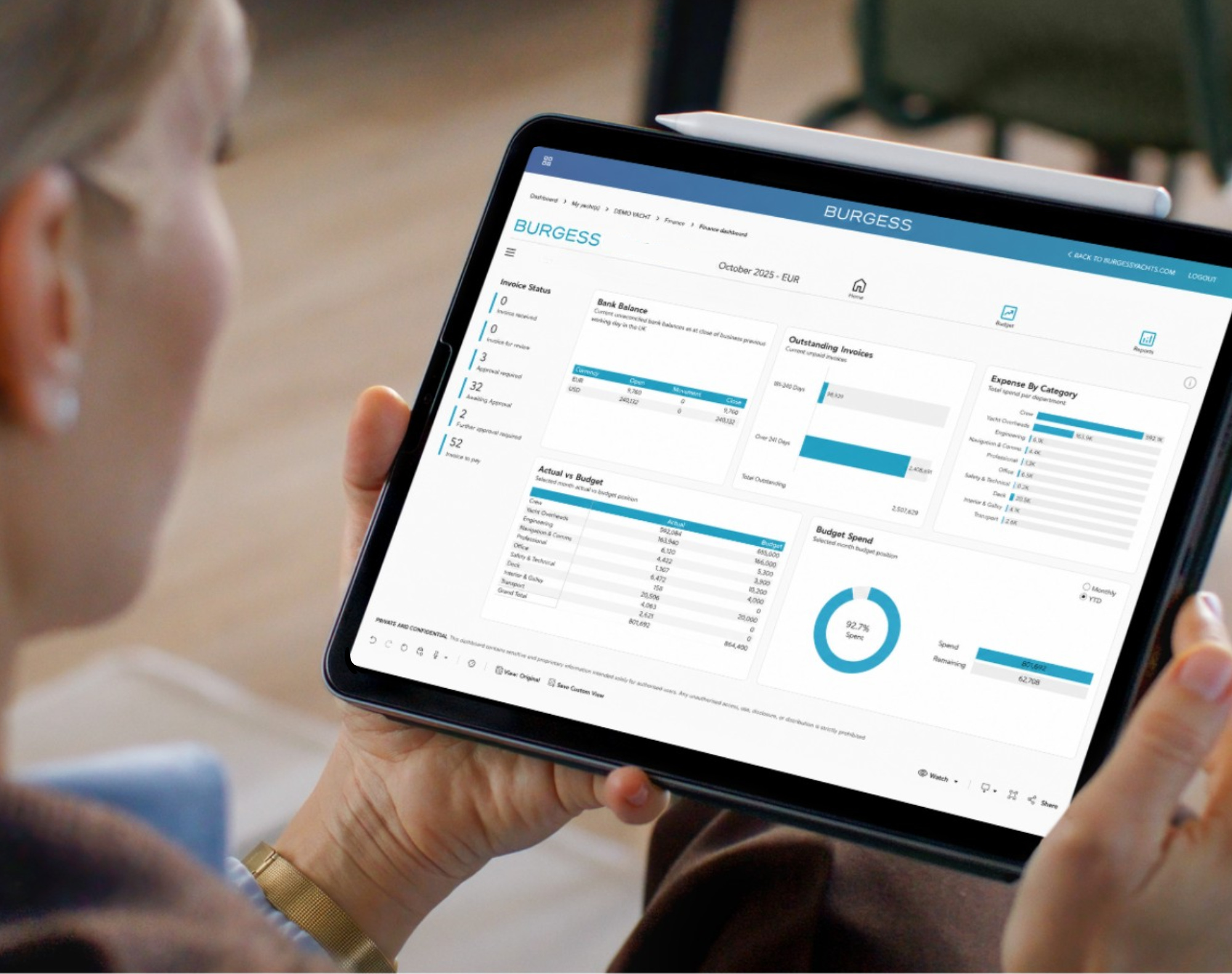
Burgess’s public offer includes accounting and technical support. Our editorial question is what an owner should ask to see when evaluating any such service. Request a redacted or synthetic sample that shows how agreed work, current issues and pending decisions are distinguished. A report should not force the reader to infer priorities from a long list of activities.
Ask how the proposed budget relates to the stated operating plan, what assumptions it contains and how changes are presented. Avoid treating a generic percentage of yacht value as a dependable answer to the cost of a specific operation. A useful comparison starts with equivalent scope and documented assumptions, with the relevant advisers responsible for the financial and technical detail.
The official photographs accompanying this article show operational, crew and owner-service contexts from Burgess’s published materials. They illustrate the work behind the experience. They do not show an operation audited by LuxeDigital, prove a service outcome or establish that a pictured yacht is managed under the same terms as a future proposal.
Read a proposal in layers
| Layer | Question to put in writing | What to compare between providers |
|---|---|---|
| Operating brief | Which intended use does this proposal assume? | Equivalent use and scope |
| Responsibilities | Which tasks are performed, coordinated or excluded? | The actual division of work |
| Authority | Who can approve a change or expenditure? | Decision routes and boundaries |
| Reporting | Which information reaches the owner and when? | Usable sample reports |
| Continuity | How are records and responsibilities handed over? | Exit and transition arrangements |
The table is an editorial reading aid, not a model management contract. Vessel-specific requirements must be addressed by appropriately qualified professionals. Its purpose is to make the commercial conversation precise enough for the owner to understand what is being purchased and what remains outside it.
Clarify how third-party work is commissioned. Ask who selects a supplier, who approves the instruction and how the owner can understand any relevant commercial relationship. Where specialist work sits outside the management fee, request a clear explanation. An attractive retainer is difficult to compare if the surrounding work remains undefined.
Think about the eventual handover
An owner may change a manager, captain or operating plan. Discuss how the records needed for continuity will be maintained and made available to the next authorised team. Ask which documents the provider holds, which belong elsewhere and how unresolved items are transferred. The time to define that process is before the relationship becomes dependent on personal memory.
Set an initial review point around the agreed service, not a vague promise of satisfaction. Ask whether the reporting is useful, whether decisions reach the correct person and whether the scope still matches the intended operation. Record changes explicitly. A management structure should remain understandable as the yacht’s use evolves.

Set a useful first review
Agree what the first service review should establish. Ask whether the owner receives decisions at the right time, whether the captain understands the division of work and whether the reports answer the questions in the original brief. A review organised around those points can identify a small ambiguity before it becomes a recurring administrative problem.
Keep the revised instruction with the current proposal. If a responsibility moves from one party to another, make the change visible to everyone affected. The goal is a structure that remains readable through a season, a personnel change or a different pattern of use. That continuing clarity is a tangible part of what an owner should seek from a professional relationship.
The Luxe Digital view
Good management is visible through clear responsibility. Read the proposal for its operating assumptions, authority, reporting and continuity, then ask the provider to demonstrate those elements through realistic examples. The owner’s freedom aboard is better supported when the work ashore can be understood.
Good management is visible through clear responsibility.
Sources & credits
Sources and methodology
Independent editorial analysis of the identified primary records and official imagery, checked on 15 October 2026. Project and product descriptions are attributed to their publishers; commissioning frameworks, hypothetical scenarios and editorial judgements are LuxeDigital’s own analysis. We did not visit, purchase, test or audit the illustrated installations, services, software or passport flows. The scope is general editorial information. It does not establish private ownership, authenticity, condition, insurance cover, personal suitability or a provider’s future performance. Images retain their identified subject and context; illustrative product photographs are not private collection evidence.