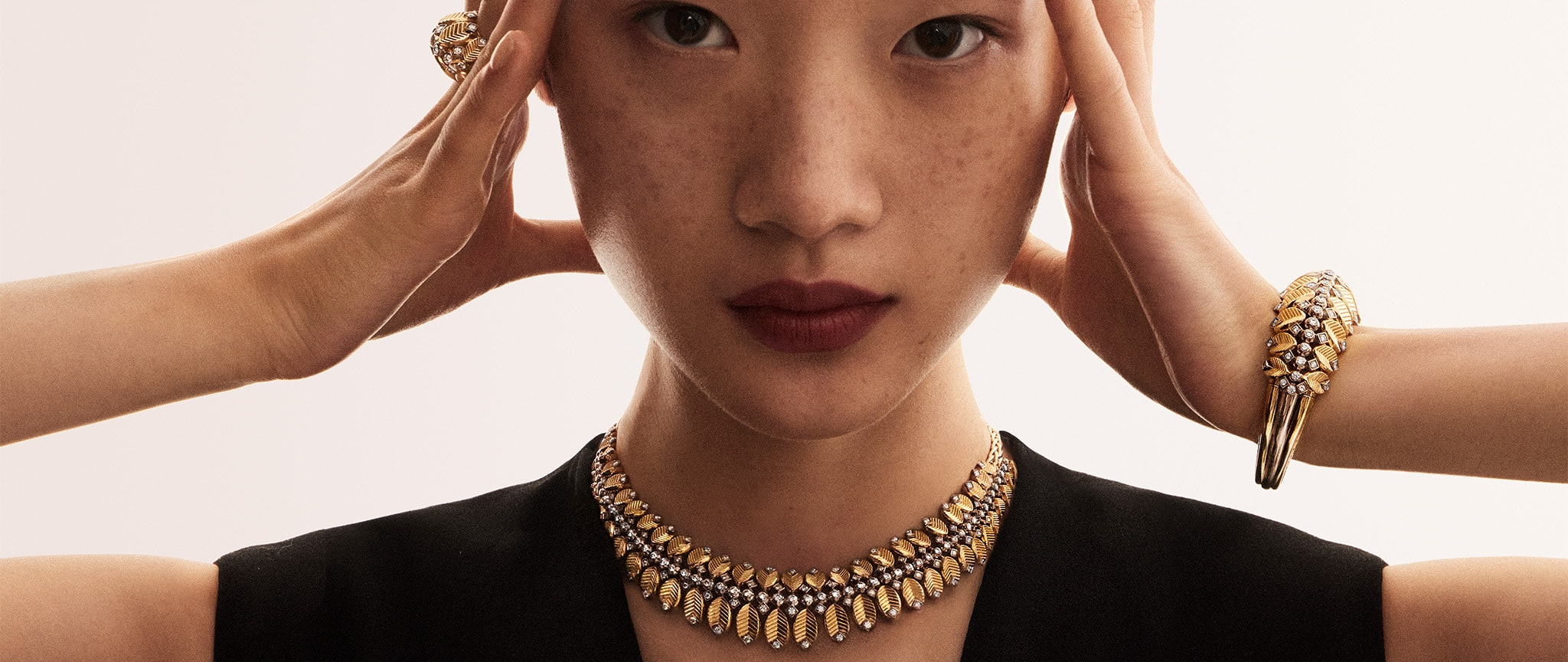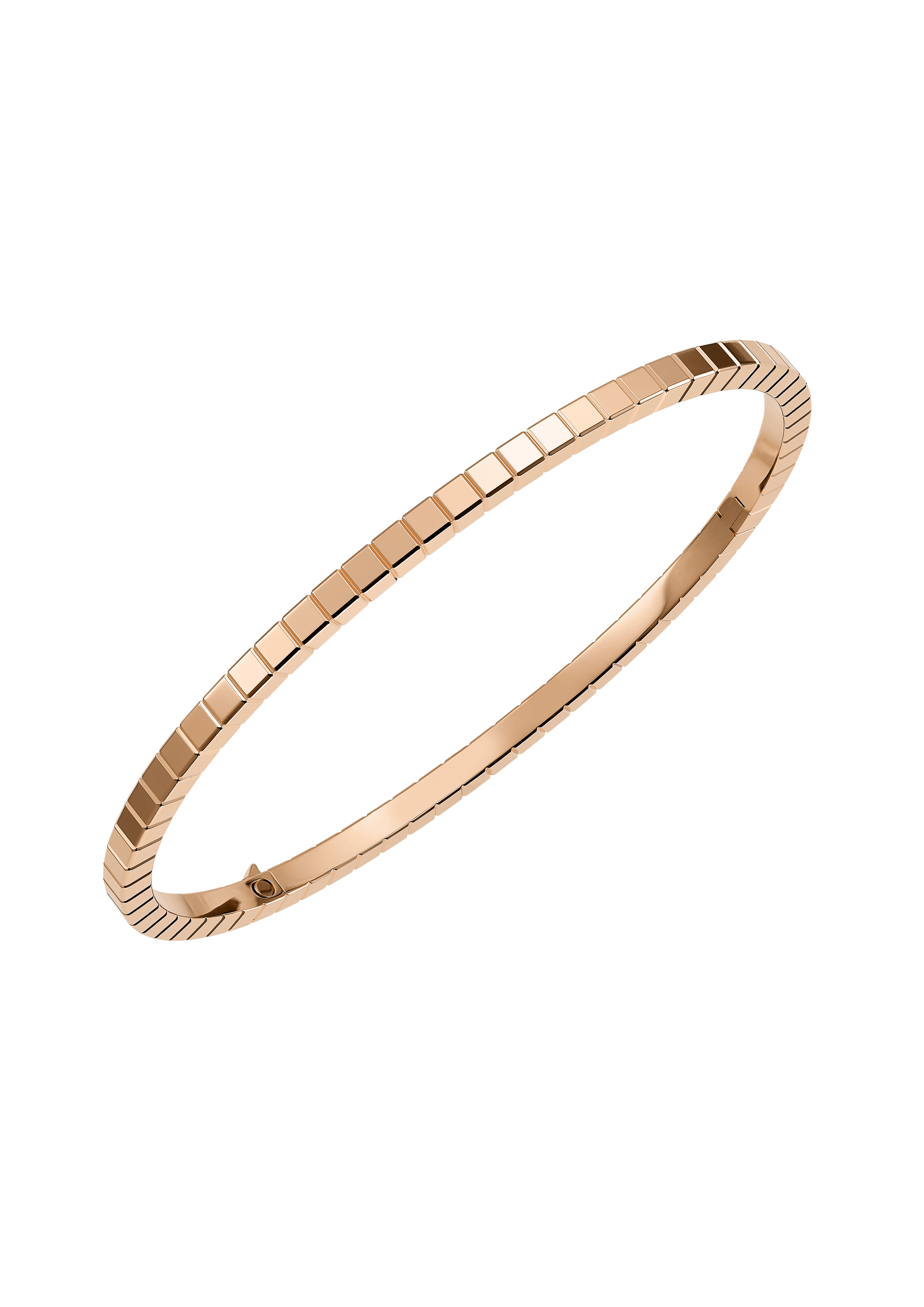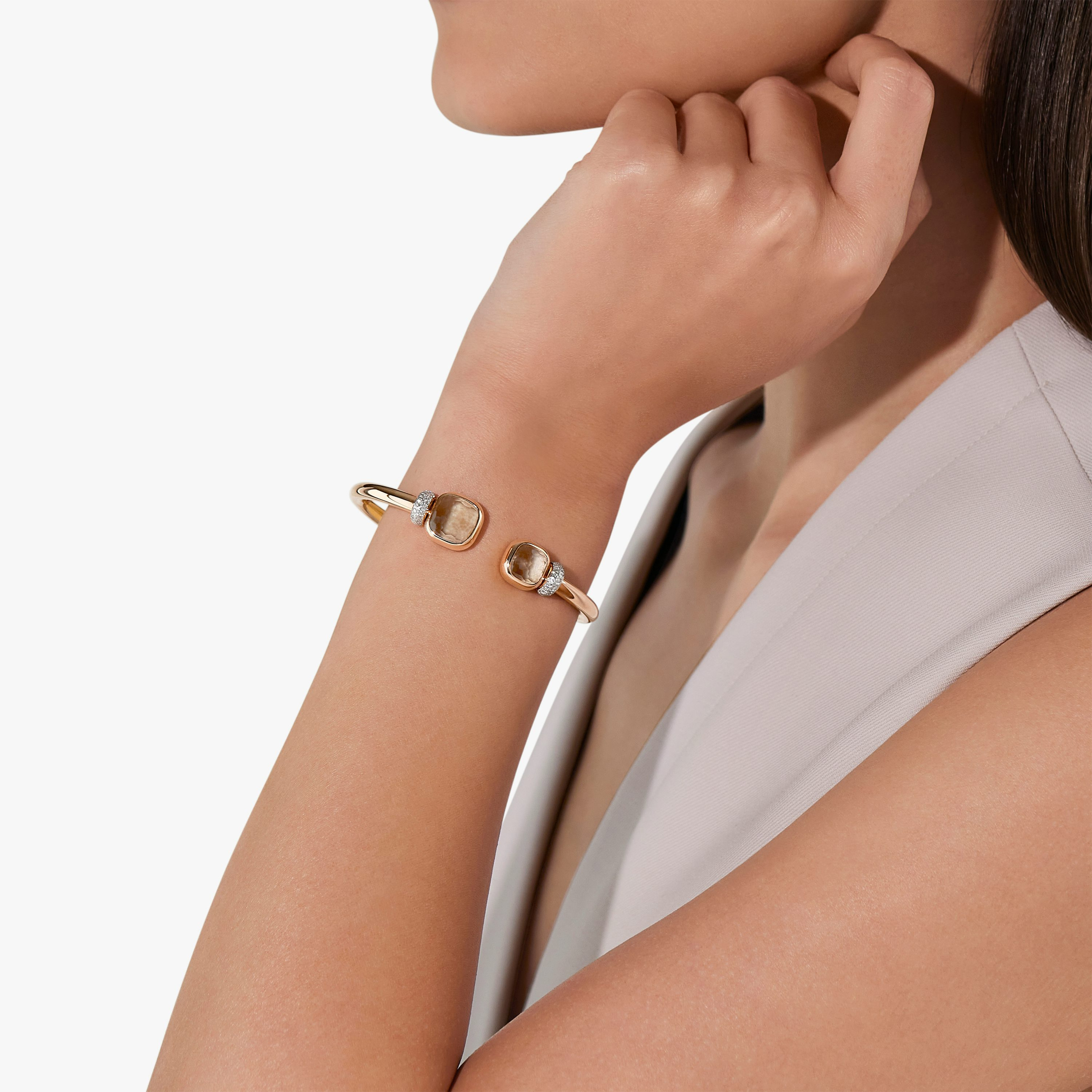
Macri is a collection to approach through the surface. Buccellati’s official photographs show gold-coloured fields crossed by fine, closely placed lines, with brighter accents interrupting that texture. The effect is not simply a pattern added to an object. The engraved field changes how a cuff, pendant or ring is read, making the quieter areas as significant as the points that catch the most light.
Texture takes the leading role
The worn portrait gives that surface a scale. At the wrist and against clothing, the jewellery appears as a broad, textured presence rather than a collection of details waiting to be counted. Move closer and the lines become visible; move back and they form a continuous field. That transition between texture and tone is the central visual interest of Macri.
The current collection presentation and the maison’s official Icona catalogue provide the context for this study. The catalogue documents Buccellati’s rigato vocabulary and its Macri designs. The selected objects include distinct Classica, AB and Giglio interpretations, rather than treating every piece under the wider Macri heading as the same reference. The photographs are the basis of the visual analysis; workmanship descriptions remain attributed to the maker.
A line can change the reading of gold
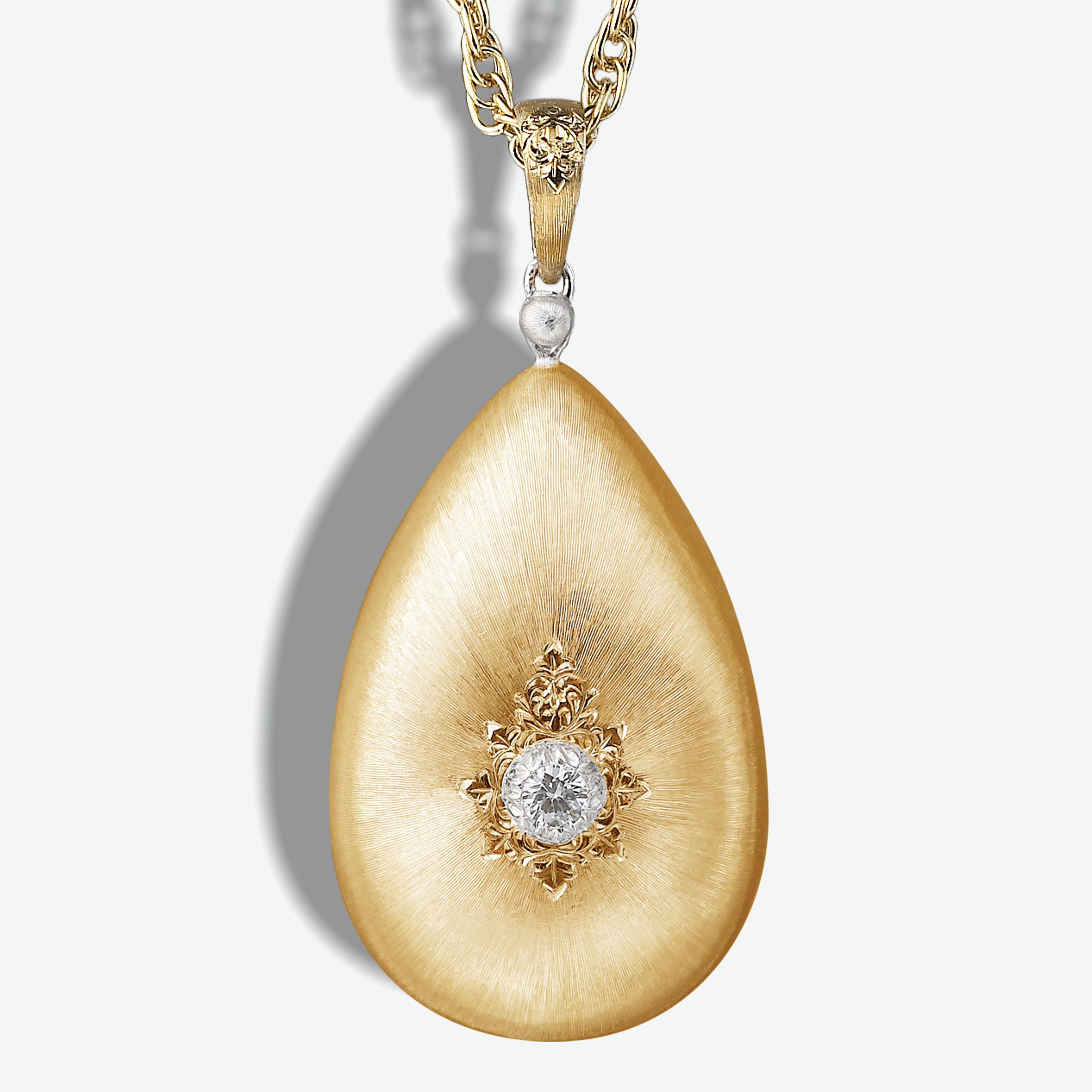
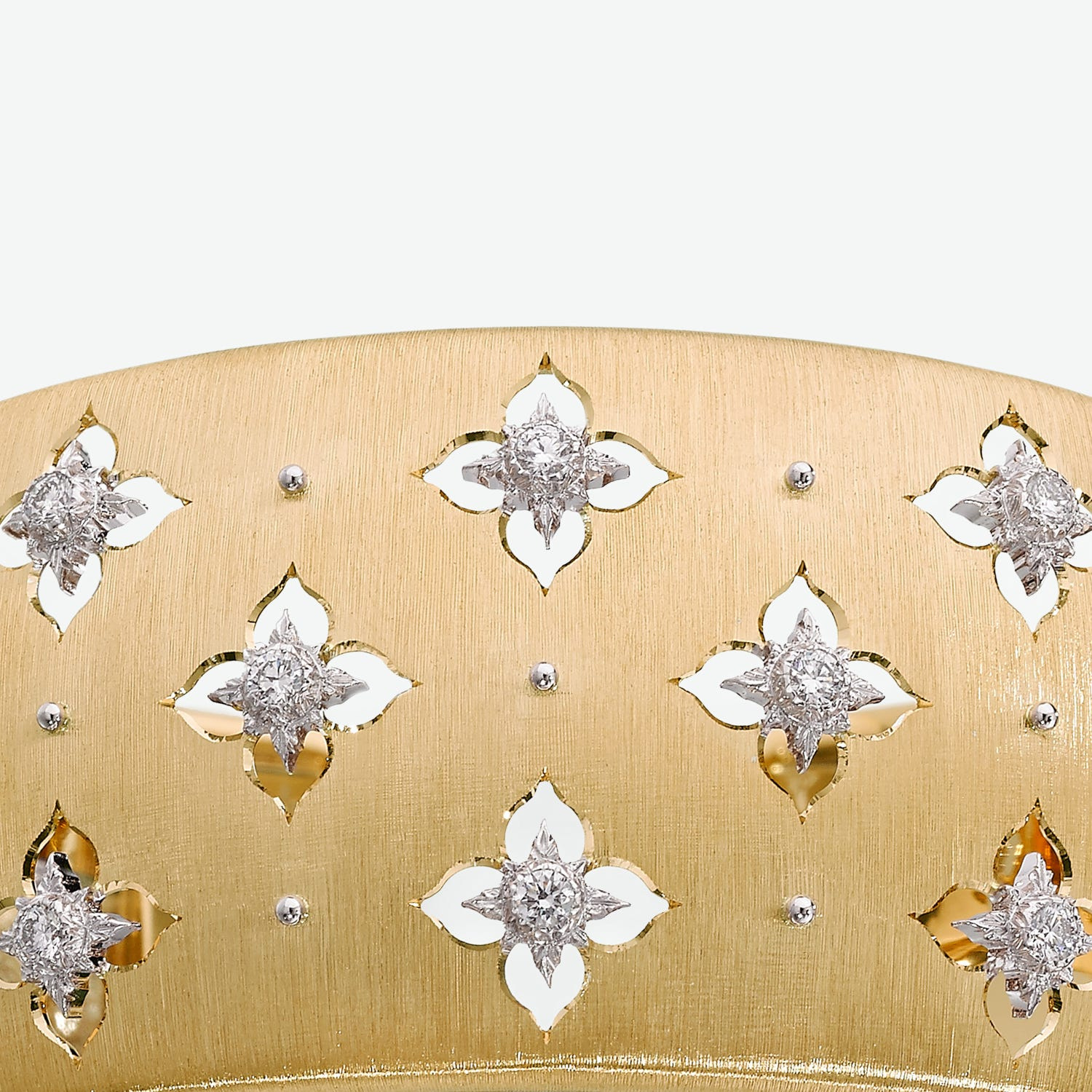
In the pendant close view, the engraved field gives the eye a direction to follow. The closely repeated lines break up what might otherwise be a uniformly polished surface. Brighter rosette-like accents then become distinct points within that field. Their contrast is clearer because the surrounding area has its own quieter rhythm, rather than competing with them through an equally bright finish.
The complete teardrop-shaped Classica pendant restores the outline that a detail photograph removes. Its perimeter contains the engraved field, while the narrowing shape gives the object a clear direction. The relationship between edge and interior is important: the surface can be visually dense without making the silhouette difficult to read. A compact outer boundary allows the smaller lines and accents to be encountered in stages.
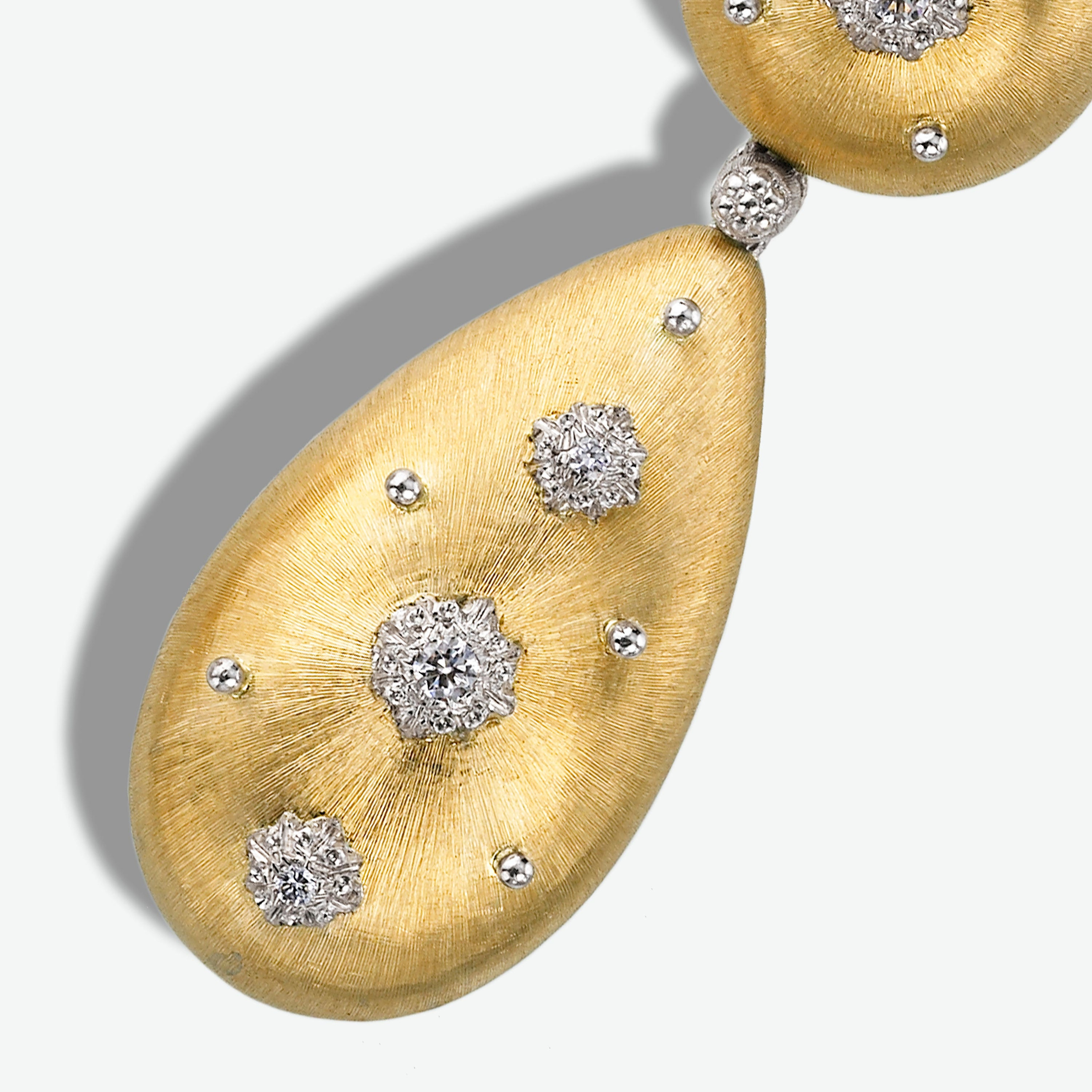
Buccellati’s rigato term belongs to the maker’s engraving vocabulary. It is useful here because it directs attention to the parallel-line character visible in the official images. A photograph does not independently establish every operation performed on a particular object, but it can show how the resulting surface contributes to the composition. Macri’s appeal is easier to explain through that visible contrast than through a broad claim that texture automatically makes one jewel superior to another.
The cuff gives the surface room to continue
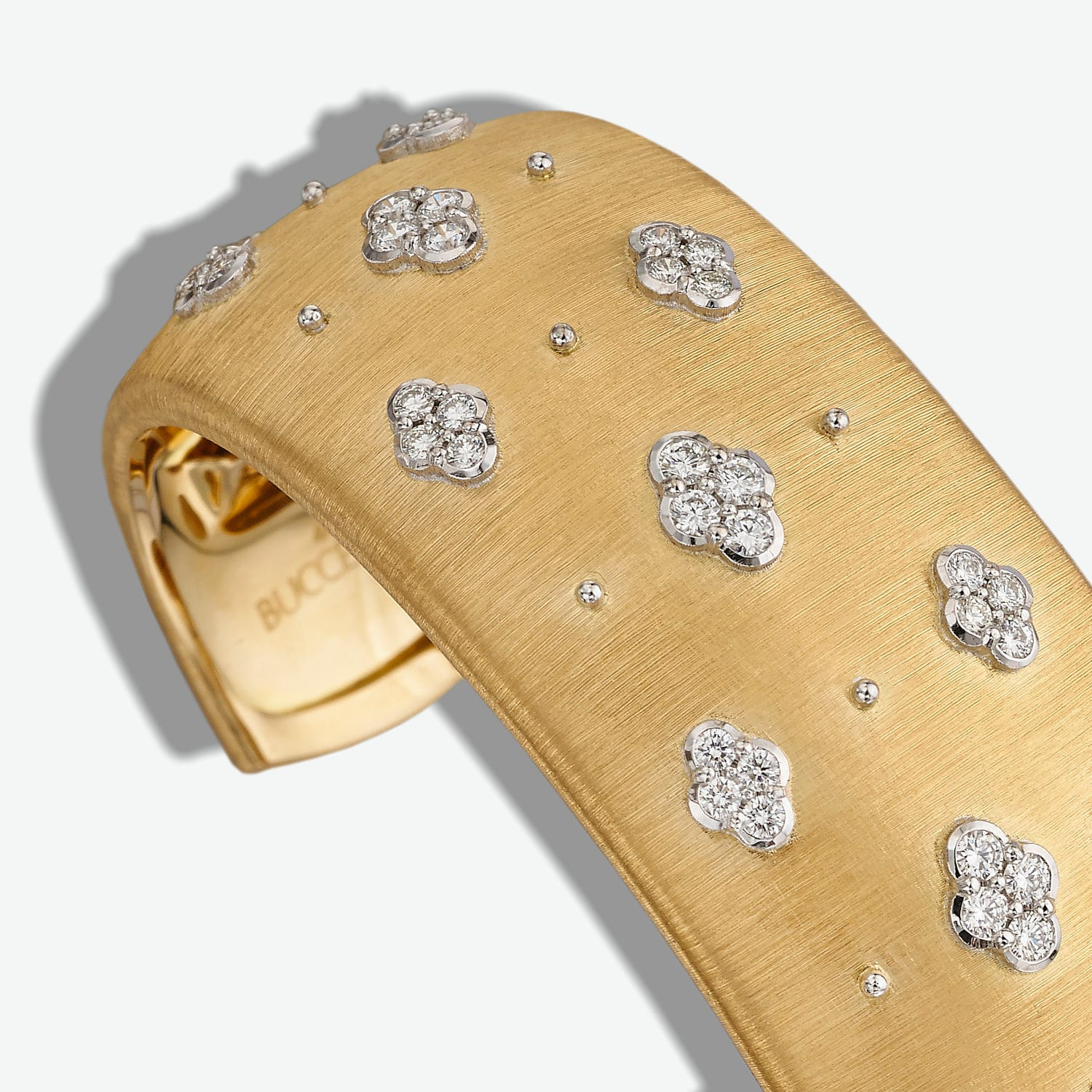
A cuff has more uninterrupted area than a small pendant, and the Macri AB product view uses that area to make the engraved field a leading feature. The outer curve creates a broad route around the wrist; the lines and brighter accents travel within that route. Seen complete, the object has a clear relationship between its circumference, width and surface pattern.
The Giglio detail should remain a distinct interpretation. Its more concentrated ornament changes the distribution of attention across the field, and a collection comparison is more useful when those differences are allowed to remain visible. The Macri AB and Giglio views share a maison’s surface language, but they need not carry an identical arrangement of accents. Their family resemblance is a vocabulary rather than a duplicate design.
The cuff also demonstrates why negative space matters in an apparently texture-led collection. Its internal opening and the quiet background around the product prevent the engraved field from occupying the whole photograph. The viewer can understand the object’s curvature before examining its smaller marks. Without that complete view, a rich surface could become an abstract image with little sense of the body around which it is intended to sit.
Worn scale lets the engraving become a tone
The official portrait is not merely a decorative pause between product images. It changes what the eye notices first. The engraving becomes less individually legible, while the jewellery’s overall width, colour and location against the body become more prominent. Small bright accents remain visible within a broader textured tone. The surface has not disappeared; it has changed scale.
This is a useful way to consider dress and jewellery together. A smooth or softly coloured garment can provide a quiet background for Macri’s line-work, while more patterned clothing can create another layer of rhythm around it. The official portrait offers one considered arrangement. The design does not depend on copying that outfit, but the image shows why the surrounding fabric belongs in a visual account of the jewel.
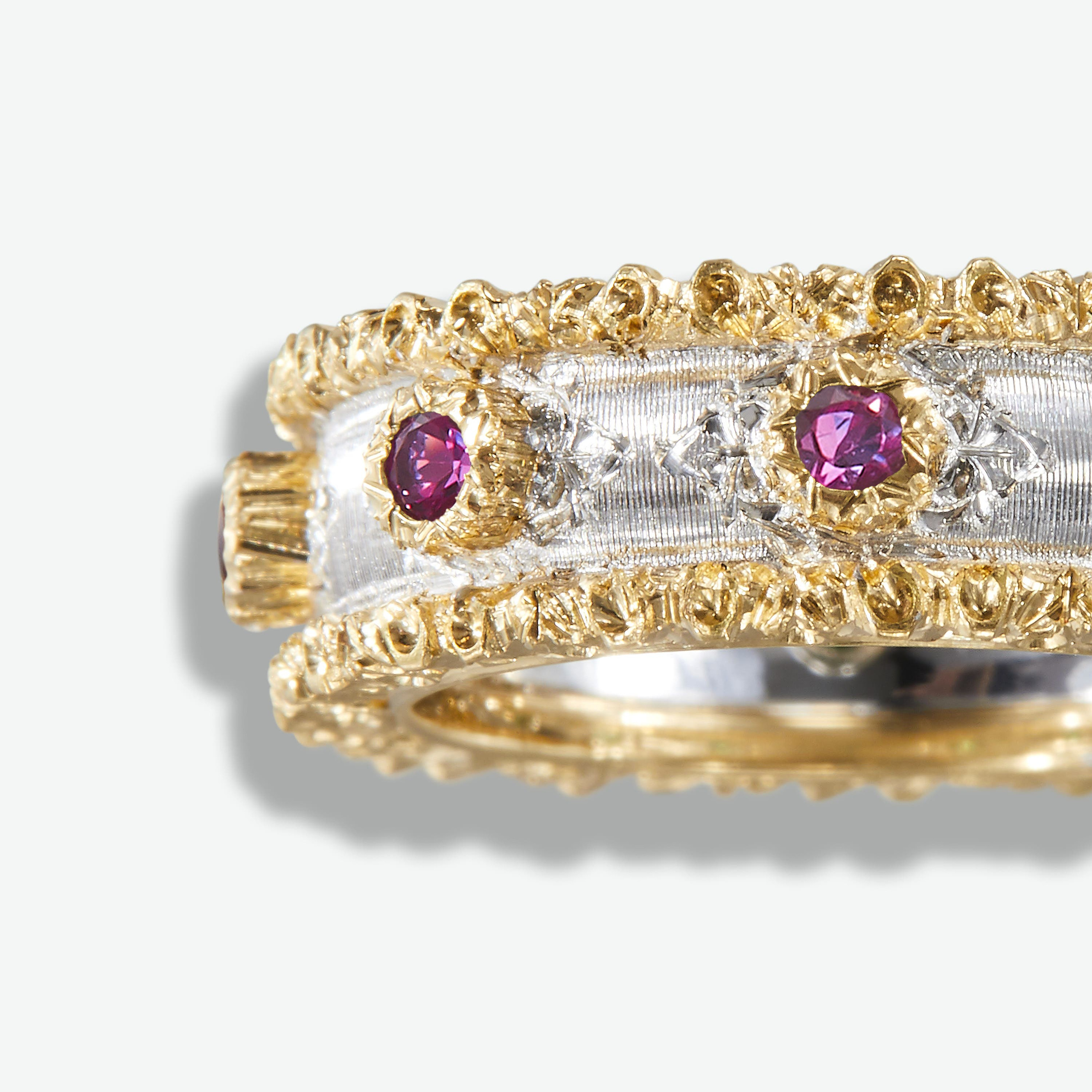
The coloured-stone ring from the wider Macri presentation introduces a different focal point. Its more concentrated colour alters the balance between textured metal and the object’s centre. It is included as a broader family comparison, not as another view of the featured cuff or pendant. Its exact gemstone identity and specification should come from its own reference; the photograph’s contribution here is the visible change in hierarchy.
The detail should return to the whole object
An engraved surface rewards magnification, but an article can lose the jewel by remaining too close. The line-work, rosettes and edges are only part of the composition. The complete pendant, cuff and worn portrait restore the distance needed to understand how those details are distributed. The viewing sequence should move in both directions, rather than treating closer as automatically more informative.
For a collector examining an actual piece, that same sequence gives useful questions. Is the surface pattern consistent with the named design and its documentation? What is the condition of the edges and the more exposed areas? How does the exact size sit at the wrist? Those questions require the physical object and an appropriate inspection. The current official images introduce the design, while a record of condition would describe an individual jewel at a particular moment.
Reading Macri from surface to silhouette
| View | What it reveals | What remains distinct |
|---|---|---|
| Engraved detail | Parallel-line field and brighter accents | Maker technique versus independent inspection |
| Classica pendant | Surface held inside a teardrop outline | Its own dimensions and material record |
| Macri AB cuff | A broader textured route around the wrist | Size and condition of an actual object |
| Giglio interpretation | A different distribution of ornament | A separate design within the family |
| Worn portrait | Texture becoming a tone at body scale | A styled image rather than a personal wear test |
The official catalogue provides design context; it should not be treated as a current availability or pricing promise. No value forecast or appraisal is inferred from a maker’s technique description. The article concerns the collection’s visible language and the objects selected from its official presentation.
The Luxe Digital view
Macri gives the quieter surface enough character to carry the composition. Buccellati’s engraved field and brighter accents work together, changing from individual lines to a textured tone as the viewing distance grows. The collection is most clearly presented when close craftsmanship detail is allowed to return to a complete silhouette and then to the body.
Macri gives the quieter surface enough character to carry the composition.
Sources & credits
Sources and methodology
Independent visual analysis of current official imagery and named product records, checked on 14 October 2026. Historical introductions, manufacturer specifications and visual observations are kept distinct. No visit, interview, independent handling or appraisal is implied.
- Buccellati — source 1: Current official collection, named designs, dated context and selected image provenance.
- Buccellati — source 2: Official Icona catalogue and rigato design vocabulary.