Quatre is a ring to read across its bands. Boucheron brings several apparently different surface languages into one circumference: rounded lines, a ribbed texture, a geometric field and a brighter diamond line. The identity comes from their adjacency. A single smooth surface would be a different object; the collection’s graphic character depends on the eye being able to distinguish its parts.
Four surfaces, held in one circumference
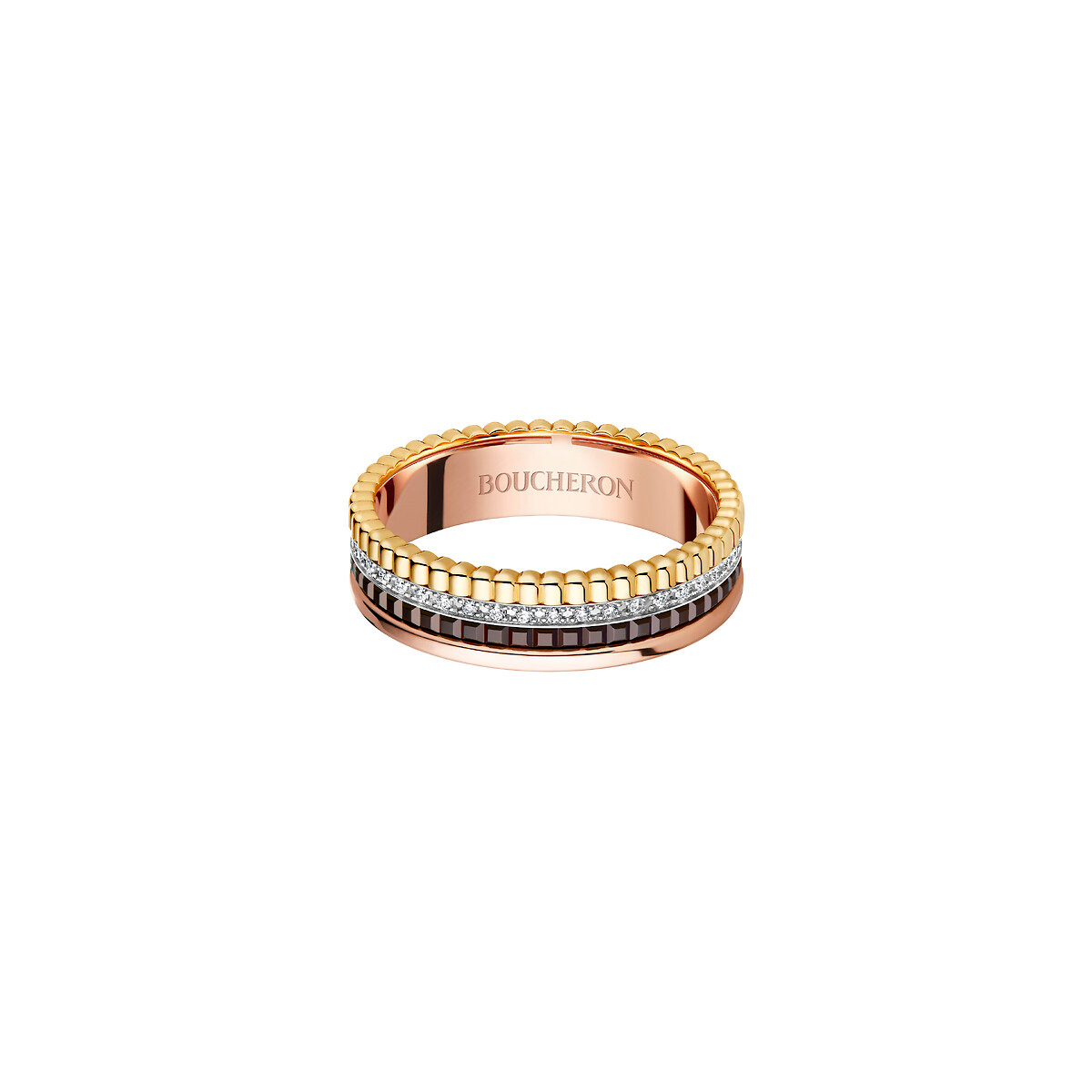
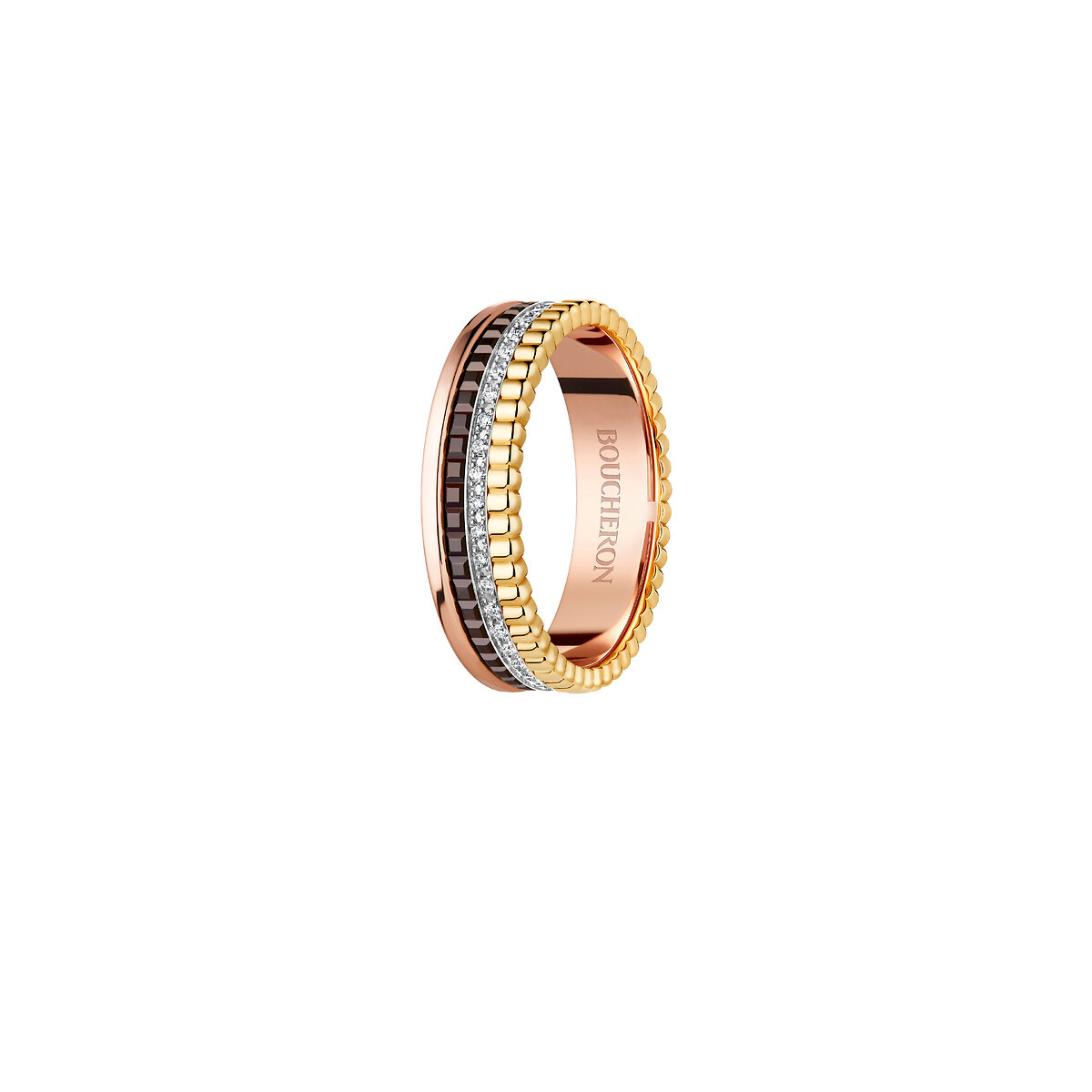
The official portrait with a white shirt introduces that character at body scale. The Classique rings become concentrated sets of textures against fabric, rather than large isolated objects. The complete Classique ring photographs then bring the viewer closer to the stack, including an angled view and the interior. Together, those frames make the design legible without relying on four nearly identical front-facing images.
Boucheron dates Quatre’s introduction to 2004. The named product considered here is the Classique XS ring, JRG03330, within the current collection. Its smaller format does not remove the visual contrast between the codes. This is a study of that contrast and its relation to worn scale, not a new-launch claim or a universal specification for every Quatre interpretation.
The four codes have different rhythms
The maison names Double Godron, Grosgrain, Clou de Paris and Ligne de Diamants in the Classique XS product account. The names are useful because they distinguish the surfaces rather than flattening them into a general description of texture. Rounded repetition, ribbing, a small geometric field and a diamond line give the eye several kinds of rhythm within a compact object.
The complete front view establishes their order as a stack. The angled view adds depth, showing how the bands relate at their edges and how the outer surfaces differ from the inner curve. The ring is not only a set of patterns seen from above. It has a width, a projection and a continuous interior that brings the separate visual languages together around one opening.

This is where the collection’s graphic identity becomes clear. The surfaces are different enough to remain individually readable, but their common circumference makes them one composition. A reader can follow a quieter rounded line, then a more closely repeated texture, then a brighter sequence, without leaving the object. The design offers contrast inside a defined boundary rather than depending on extra ornaments placed outside it.
Brown PVD is part of the named record
For JRG03330, Boucheron lists 18K yellow, white and pink gold, diamonds and brown PVD. The brown area should therefore retain the maker’s PVD description for this reference, rather than being casually relabelled as ceramic because it appears dark in a photograph. The product account also gives 43 round diamonds totalling 0.13 carat, with a notice that stone and metal weights are indicative.
Those details provide a concrete basis for the visual reading. The changing gold colours and brown field help the neighbouring textures separate in the image, while the diamond line introduces a different kind of brightness. The material list belongs to the actual Classique XS record. It should not be applied to the blue Quatre imagery or the slimmer bracelet simply because the family name and some surface codes are shared.
The distinction is especially useful for a collection with several visible colour treatments. A recognisable design can retain its identity while a material or finish changes the contrast between its parts. The photograph shows the result; the reference record identifies what has produced it. A considered comparison needs both, with each object allowed to keep its own combination rather than borrowing a more familiar Classique specification.
The hand gives the stack its measure
The white-shirt portrait shows Quatre rings in relation to fingers and the folds of a garment. The stack becomes a small, dense accent within a much larger field of light fabric. Its layered surfaces remain readable, but their apparent scale is changed from the studio photograph. This is why a full worn image belongs beside a complete object view: one explains the ring’s construction as a visual whole, the other explains its proportion.
The second worn view offers a different context, with the hand placed against darker tailoring. The surrounding fabric changes the contrast without changing the ring’s layered identity. The photograph is a styled arrangement, not an instruction that the wearer must assemble an identical set. Its value lies in showing how the recurring codes can retain a clear presence while the background, posture and distance of the hand change.
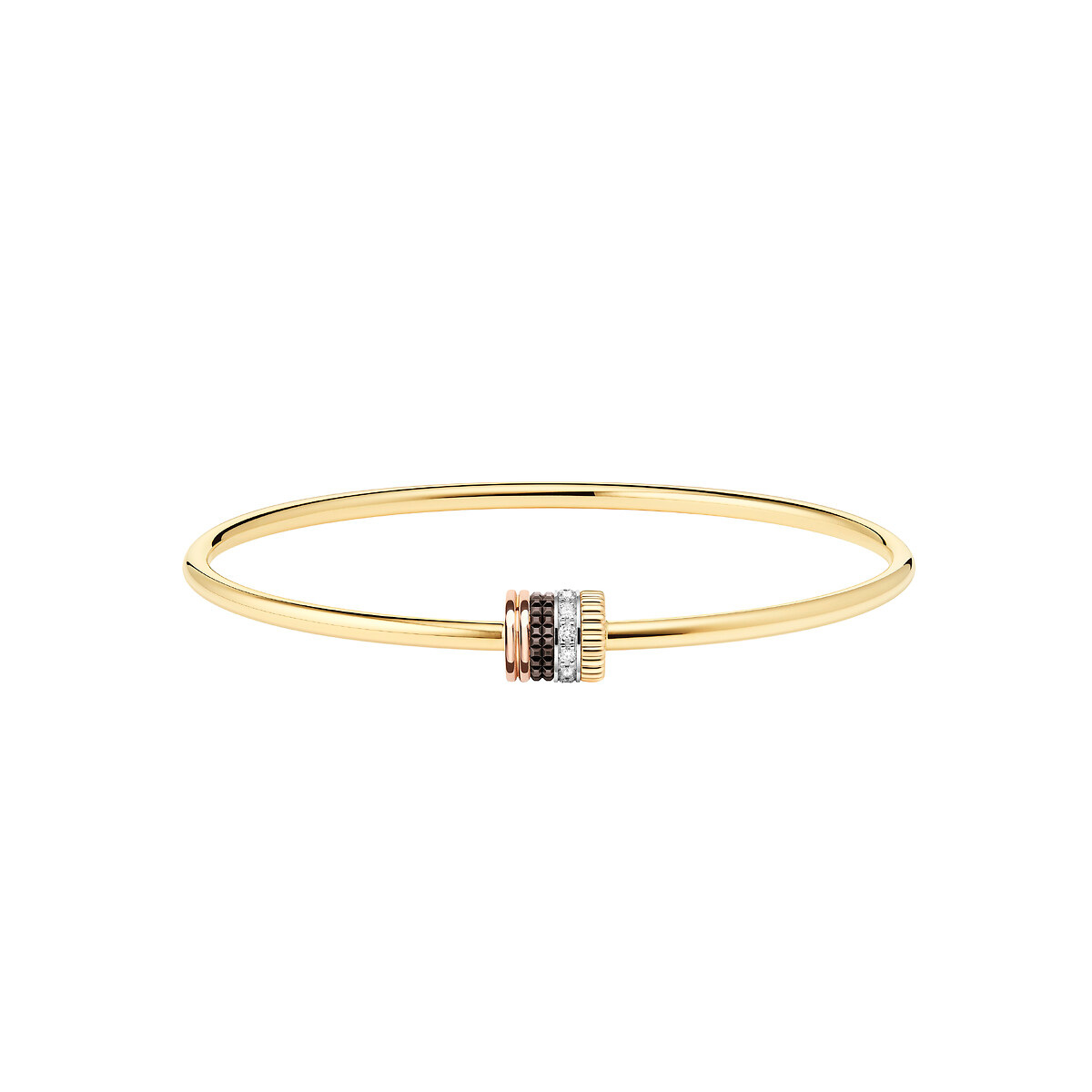
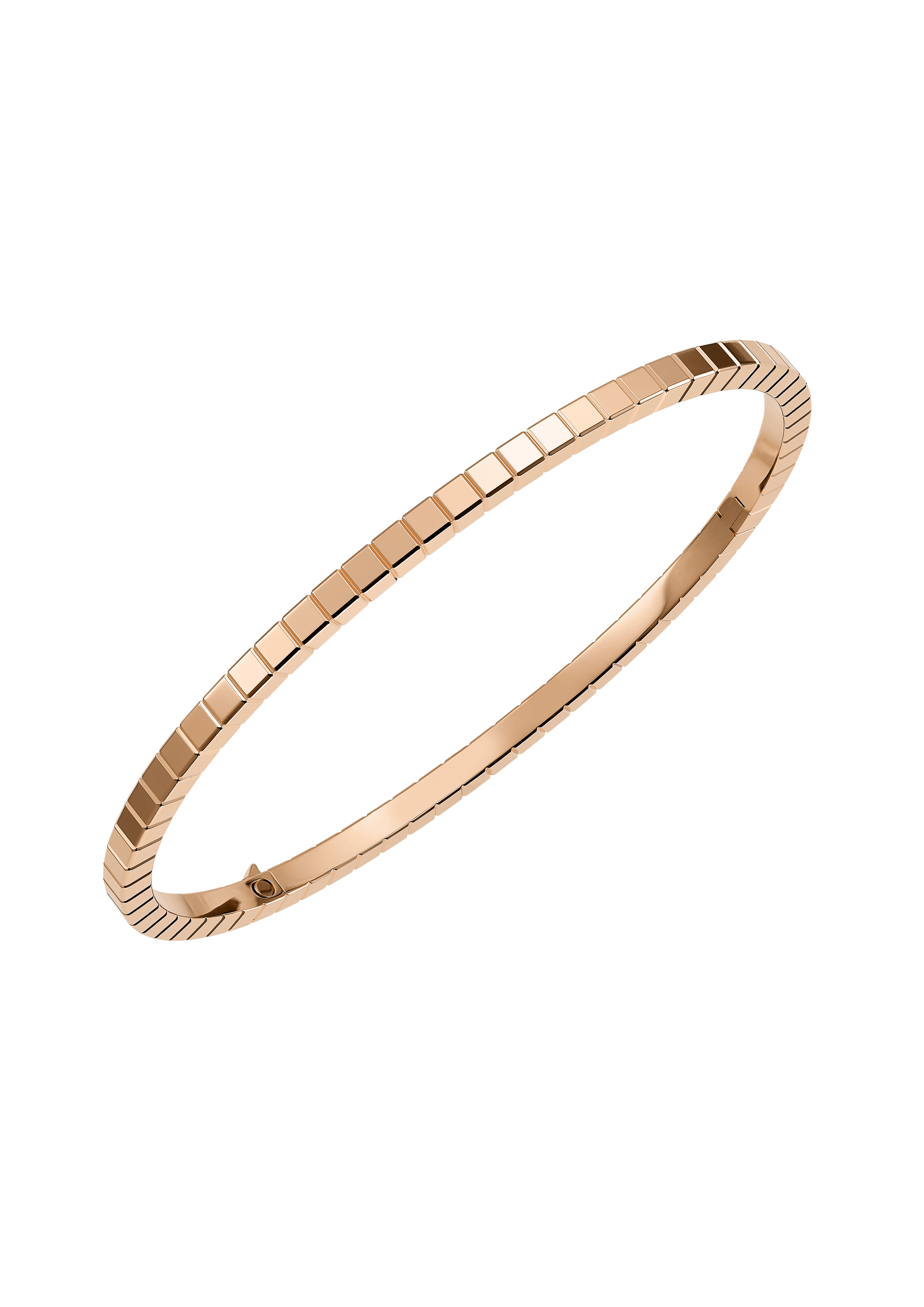
The complete bracelet makes that continuity broader. The ring’s stacked circumference is no longer the only way to encounter Quatre’s textures. A slender bracelet concentrates the codes in a smaller area within a longer gold-coloured curve. The related object remains distinct in the article: its presence demonstrates a design language travelling to the wrist, not an assumption that it contains the same metals, stone arrangement or diamond count as the featured XS ring.
The interior completes the product view
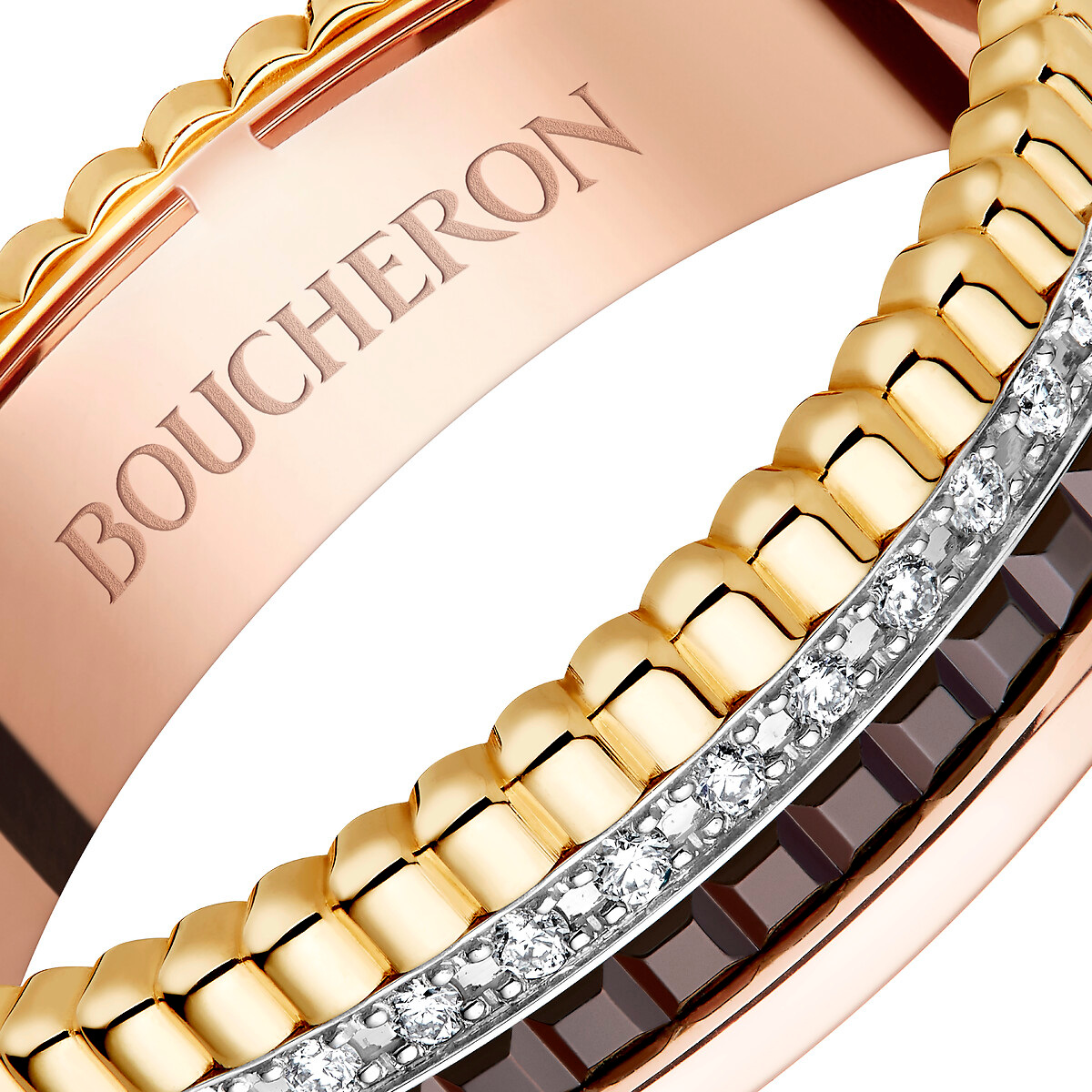
The ring’s interior photograph deserves space because it restores the part of the object that meets the finger. The outer stack carries most of the graphic identity, but the inner opening gives that stack its complete form. Seen alongside the angled view, it prevents the article from treating the ring as a flat strip of decorative textures.
For an actual fitting, the XS designation describes a model format rather than replacing ring-size information. The maker’s advice and the selected size should be checked for the intended finger. A wider layered appearance can be judged visually, but the sensation of wearing it requires the real object. The studio and worn photographs provide a considered starting point without claiming that a reference can be sized or assessed physically from an image alone.
The Classique XS reference
| Detail | Boucheron’s JRG03330 description | How it contributes to the reading |
|---|---|---|
| Codes | Double Godron, Grosgrain, Clou de Paris, Ligne de Diamants | Four distinct surface rhythms |
| Gold | 18K yellow, white and pink gold | Colour changes between neighbouring areas |
| Dark field | Brown PVD | The actual finish description, not an inferred ceramic identity |
| Diamonds | 43 round diamonds, 0.13 ct total stated | A bright line within the stack; published weights are indicative |
| Format | Classique XS | The featured model, kept distinct from other Quatre references |
The official record’s qualifications remain attached to its figures. Other Quatre objects shown for context require their own specifications. No appraisal, value forecast or independent handling assessment is implied by the article’s design analysis.
The Luxe Digital view
Quatre’s coherence comes from holding different surface rhythms inside one clear circumference. Boucheron’s Classique XS makes that principle visible at a compact scale, while the worn portraits show how the dense stack returns to proportion against the body. The identity is strongest when the differences between its four codes remain legible.
Quatre’s coherence comes from holding different surface rhythms inside one clear circumference.
Sources & credits
Sources and methodology
Independent visual analysis of current official imagery and named product records, checked on 14 October 2026. Historical introductions, manufacturer specifications and visual observations are kept distinct. No visit, interview, independent handling or appraisal is implied.
- Boucheron — source 1: Current official collection, named designs, dated context and selected image provenance.
- Boucheron — source 2: Current official collection, named designs, dated context and selected image provenance.