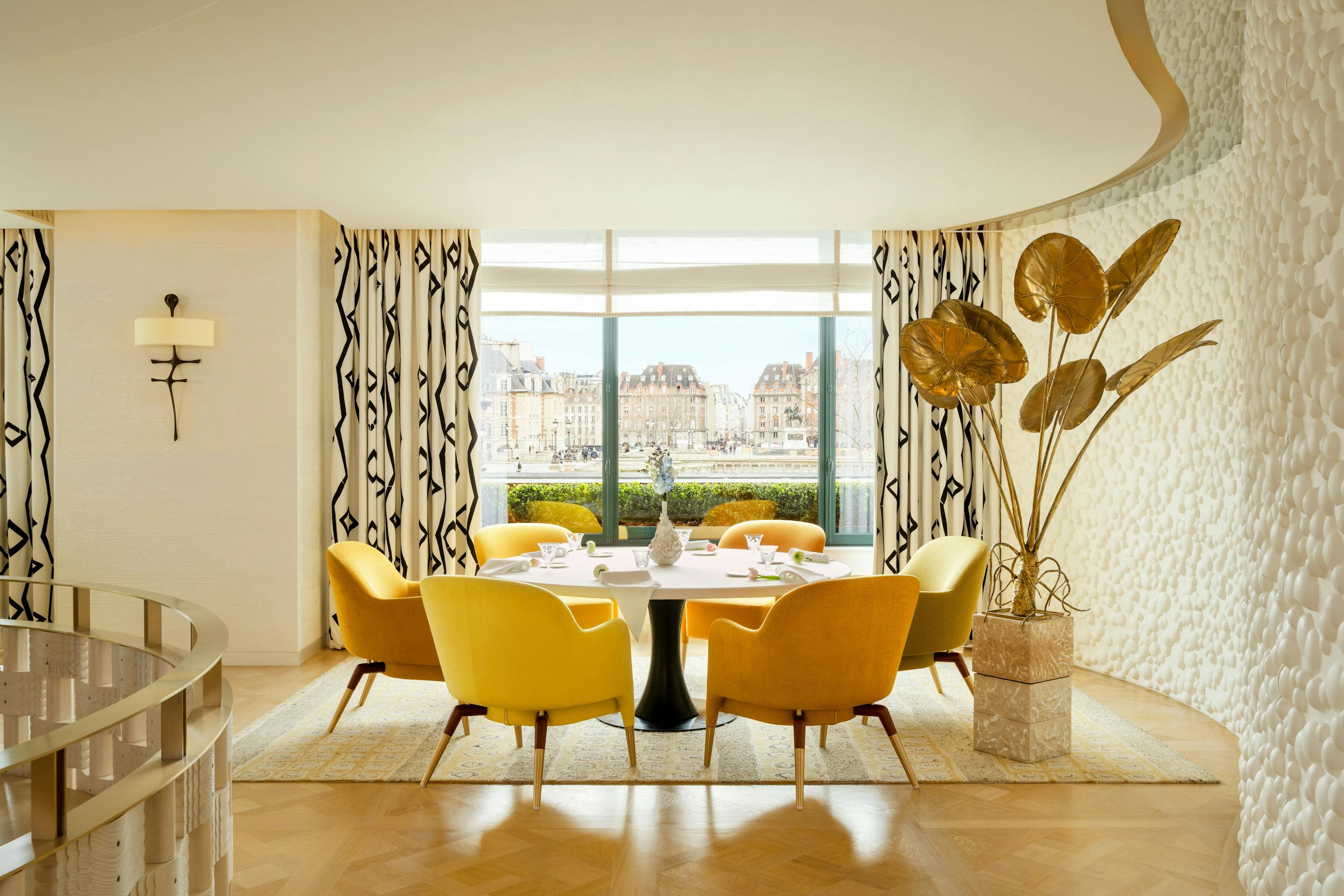
At Plénitude, a sauce is given the position usually reserved for the principal ingredient. Arnaud Donckele’s restaurant at Cheval Blanc Paris makes that change of hierarchy the centre of its culinary account. The idea can be read across a sequence of plates, small vessels and a dining room whose quiet palette gives the table room to command attention.
A different centre for the plate
Cheval Blanc’s account places sauces at the heart of Donckele’s approach. That is a useful starting point because it asks a different question of a dish. Instead of identifying a central piece and treating everything around it as support, the reader is invited to consider the liquid element as a substantial composition of its own.
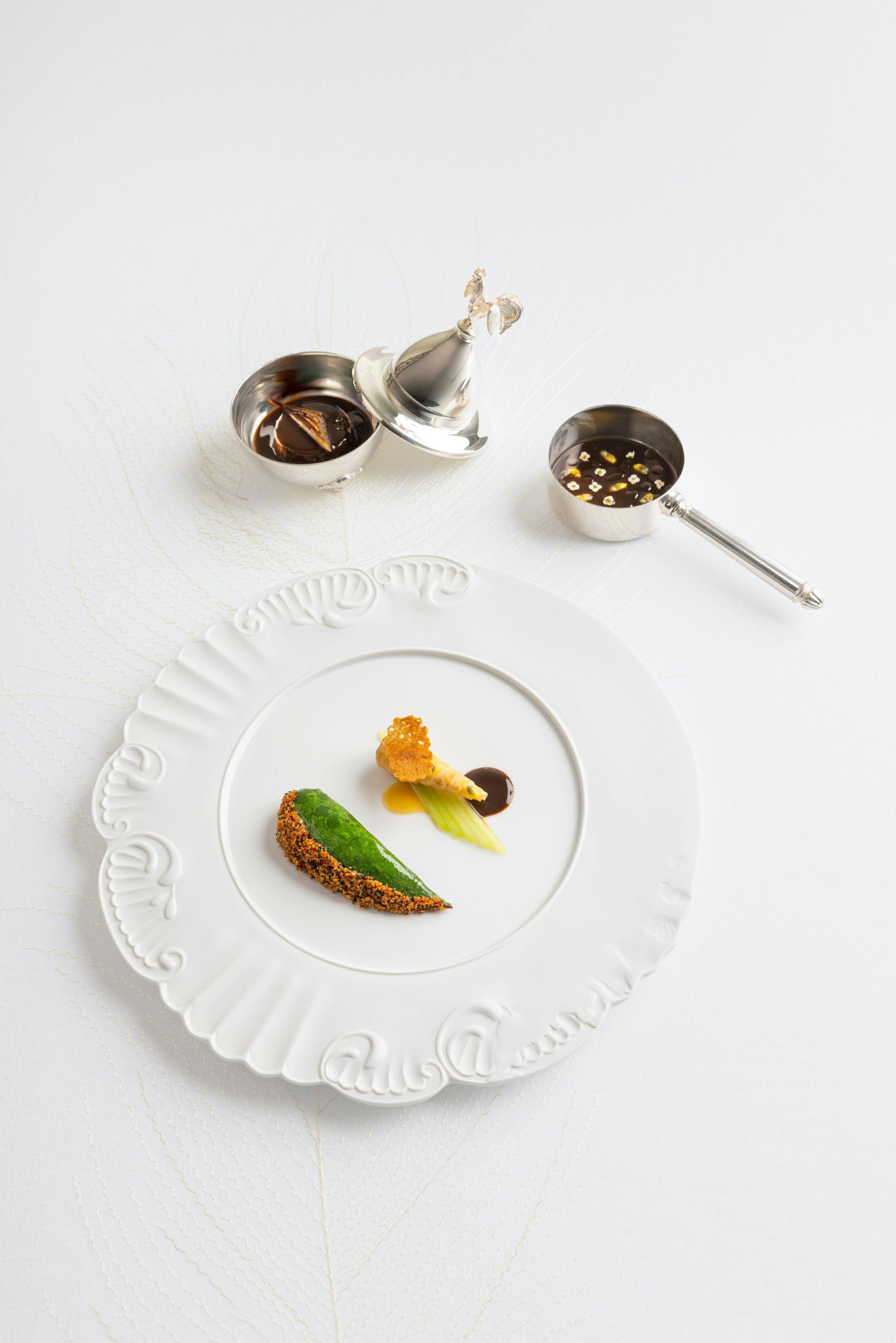
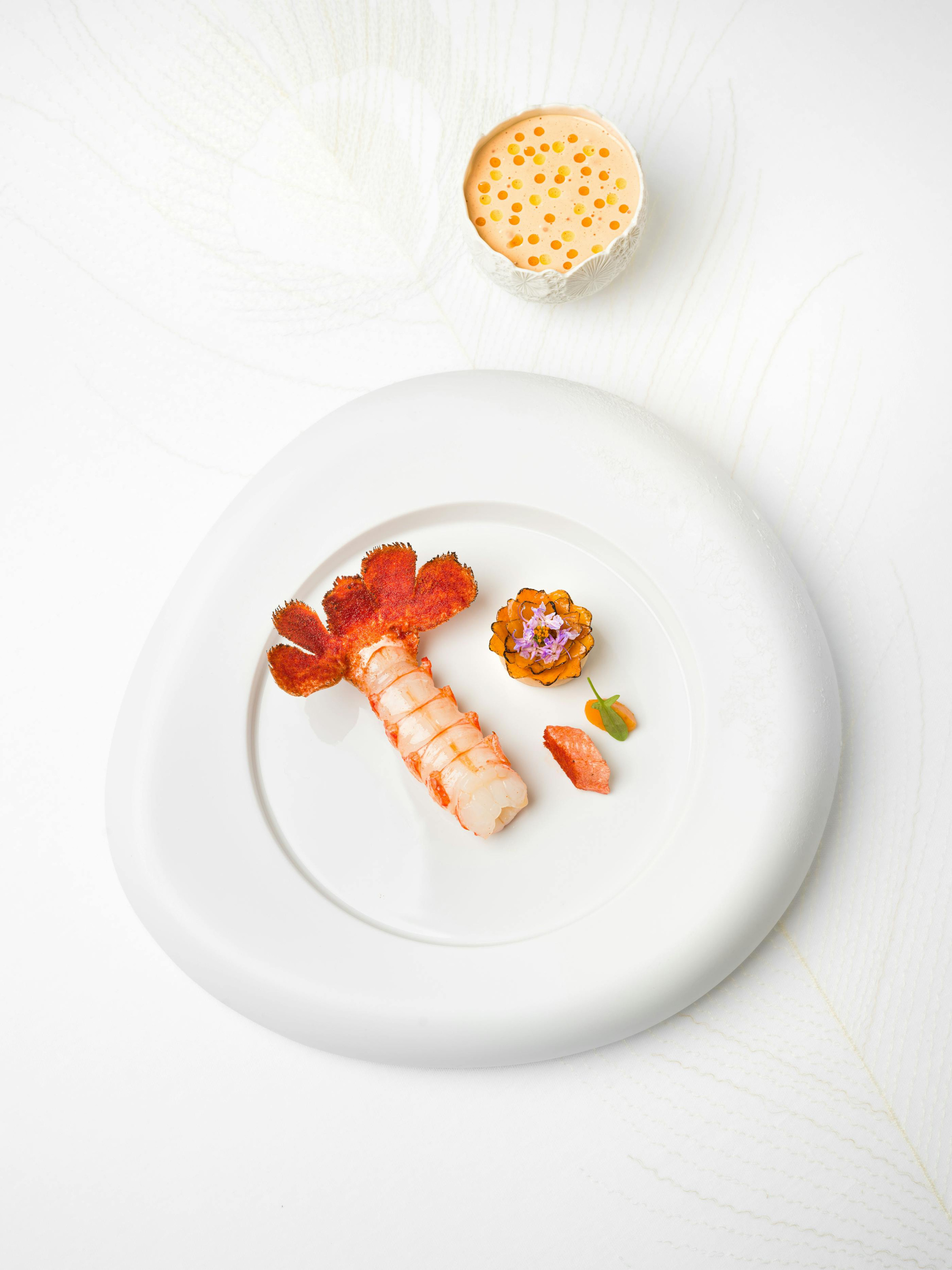
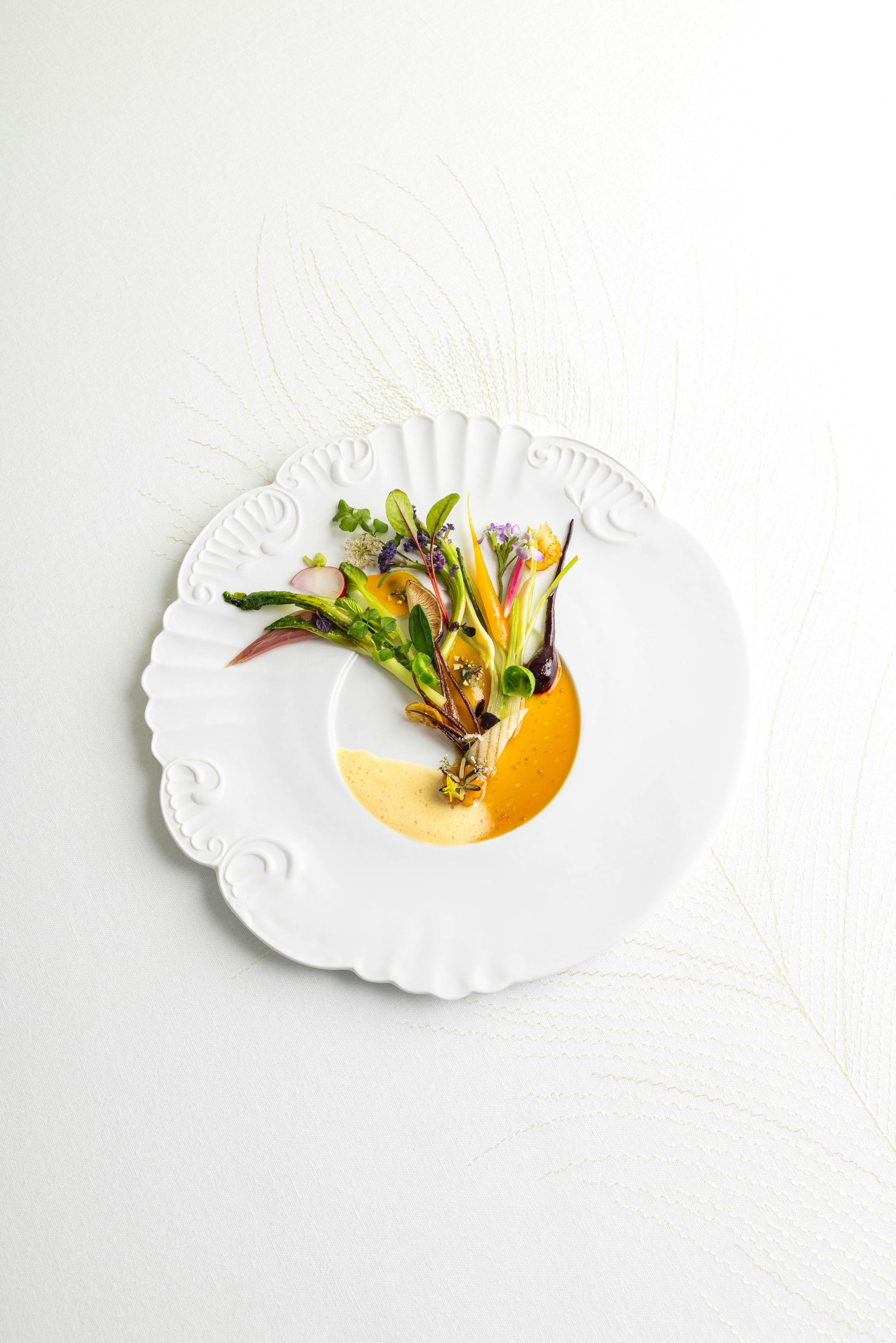
The official culinary imagery makes the proposition visible. Small vessels sit beside a plate, or a concentrated area of colour occupies a large white surface. In either case, the relationship between components becomes more important than a single isolated ingredient.
This is a visual and conceptual reading of the restaurant’s documented approach, rather than a report of tasting. A photograph can explain proportion, placement and the distinction between separate elements. Flavour, temperature and the way a dish changes during service require the experience of the meal itself.
White space gives each element a role
Several of the published compositions use a broad pale plate, leaving substantial space around the food. That space makes small changes of scale visible. A spoon, a jug or a few pieces placed at the centre can carry more emphasis because the surrounding area remains quiet.
The effect is especially clear when two kinds of vessel appear together. A plate establishes the principal setting, while a smaller container introduces another action or element. Their relationship gives the table a more complex organisation than a single flat composition.
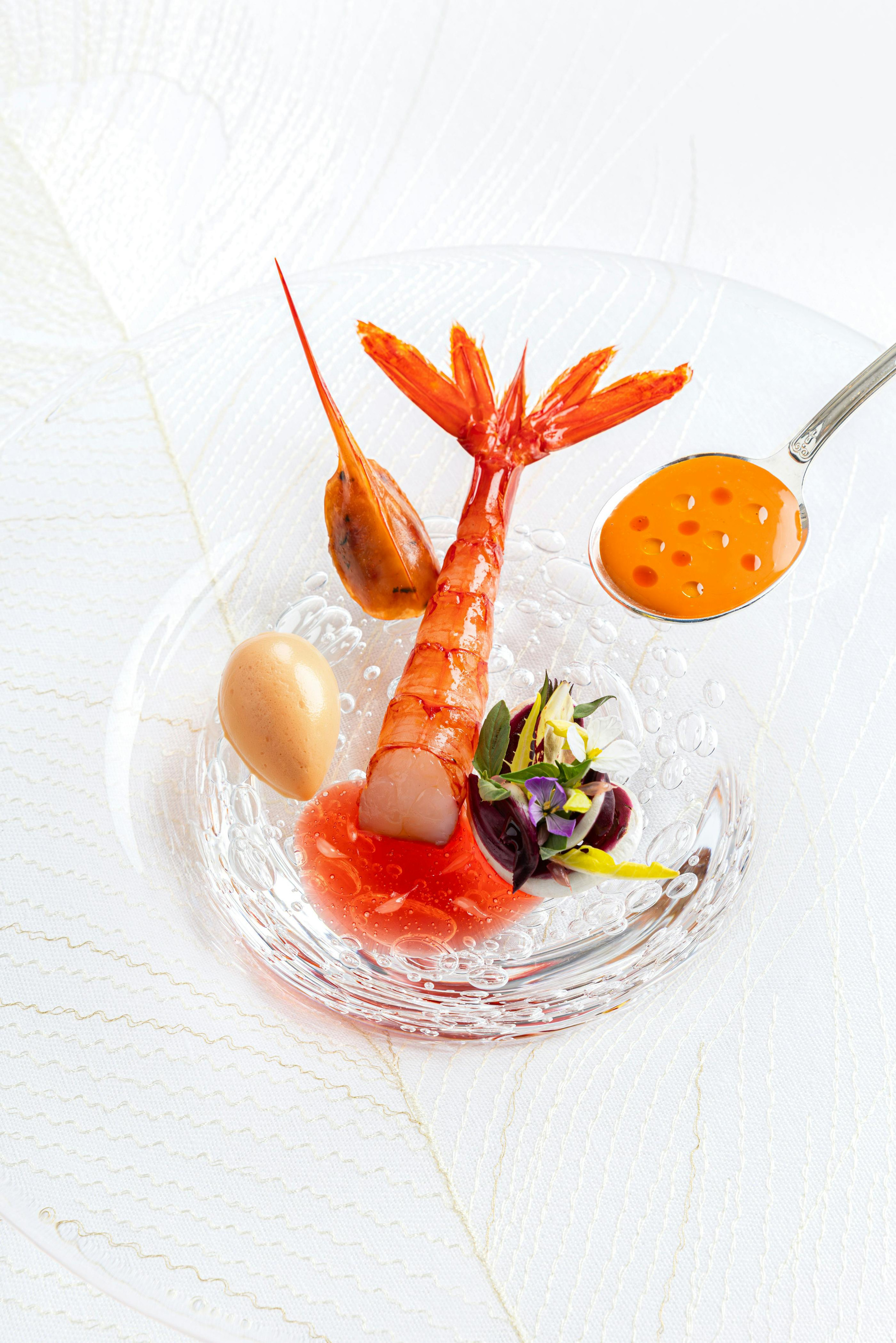
The colours also remain legible. A concentrated orange or green can be followed without competing with a heavily patterned surrounding surface. The interest lies in how much information is held in a small area, and in how the eye moves between food, vessel and the space left around them.
The dining room provides a wider frame
Plénitude is located on the first floor of Cheval Blanc Paris. The official dining-room photograph shows a closely resolved interior, with a window view, rounded seating and pale textured surfaces. Its scale is intimate enough for the table to remain a distinct place within the room.
The architecture adds another kind of framing. A window gives the eye a distant point; furniture gathers attention around the table; smaller decorative elements create interest at hand and shoulder height. These are different distances within one occupied setting.
That relationship matters in a restaurant whose culinary language asks for close attention. The room need not disappear, but it can support the act of looking carefully without filling every surface with an equally strong statement. The plate and the interior then work at complementary scales, each retaining its own identity.
A gallery of dishes is also a record of work
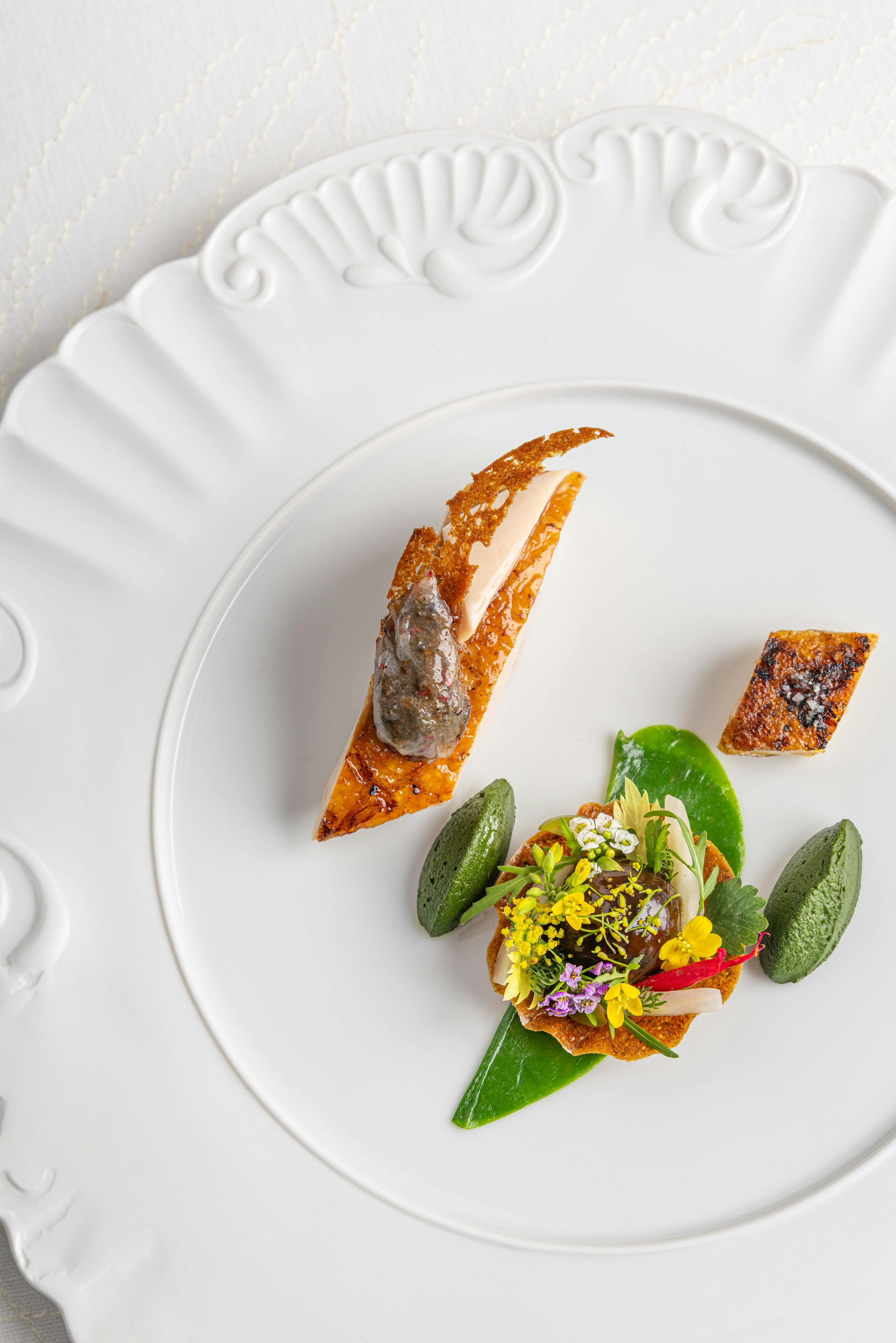
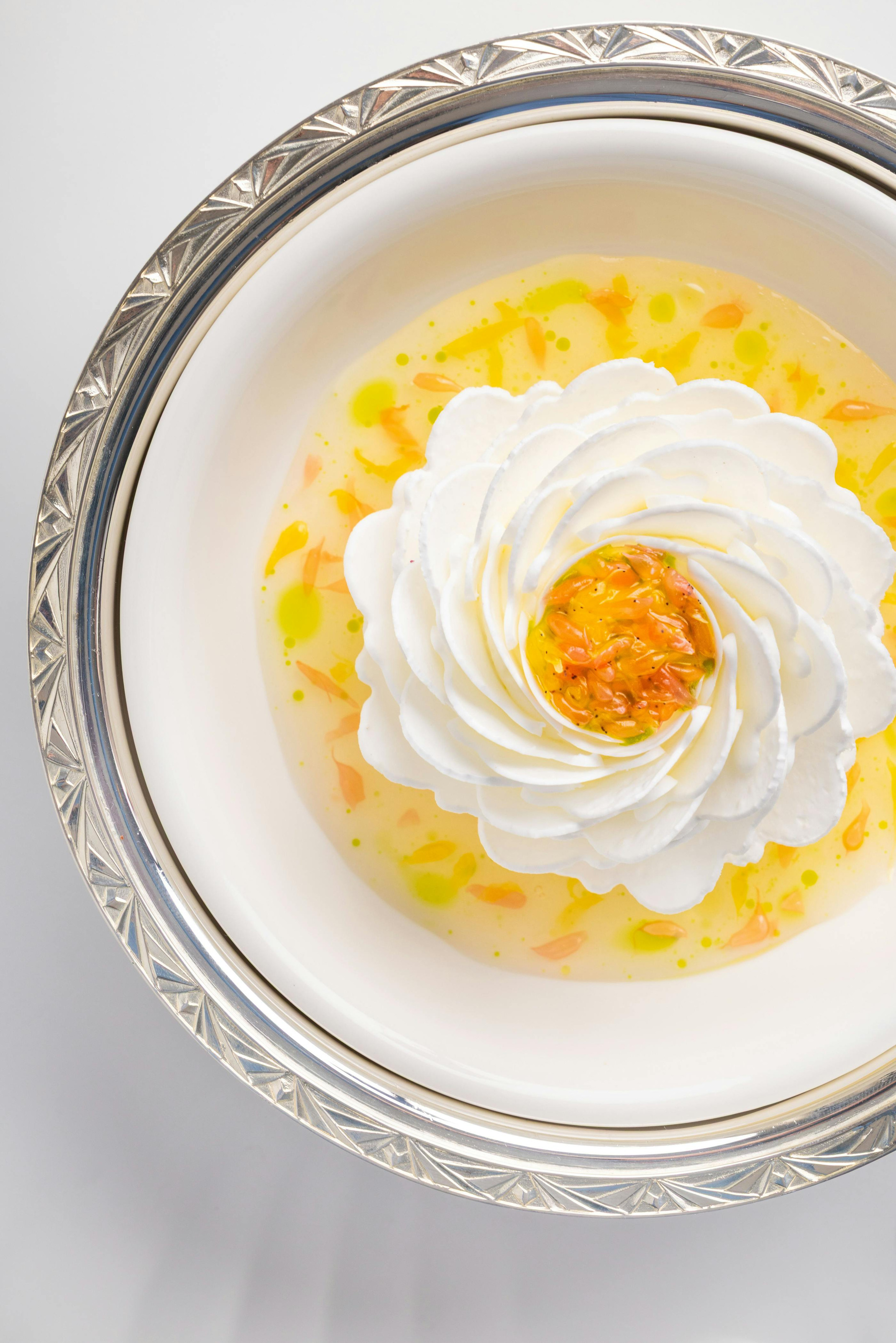
The current official image sequence includes distinct fish, poultry, vegetable and dessert compositions. They demonstrate a range of forms within the restaurant’s published visual language, from a complete plate with separate accompaniments to a tighter detail where texture becomes the main subject.
Those images should not be mistaken for a guaranteed menu for a future reservation. A restaurant’s repertoire and its live offering are different kinds of information. The first helps explain its creative approach; the second determines what can be selected and served on a particular date.
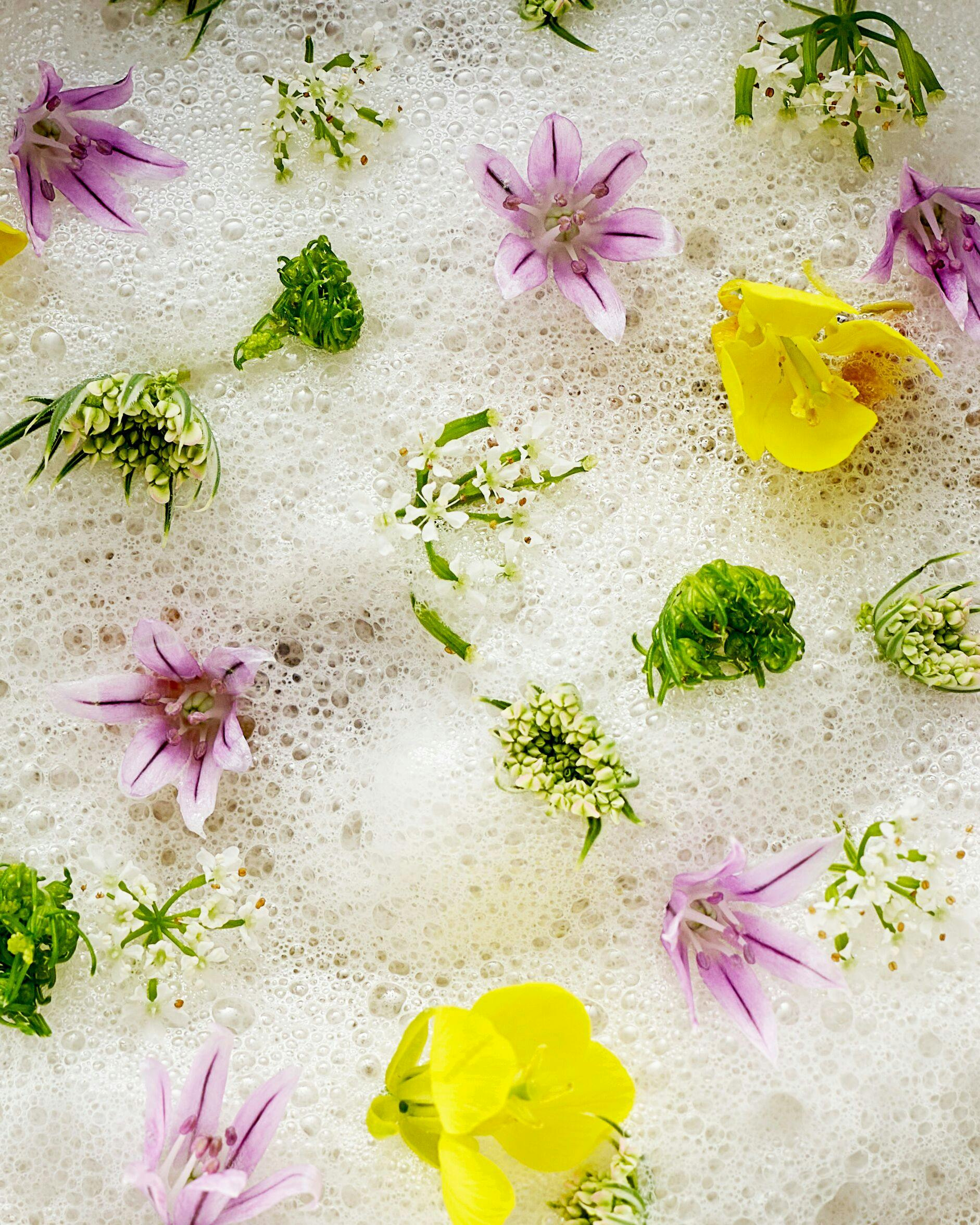
That distinction makes the imagery more useful. Each composition can be considered for the relationship it demonstrates, while the current menu remains the basis for a booking. A prospective diner can arrive with an informed question about the chef’s approach without assuming that a photographed dish will appear unchanged.
How to read the restaurant’s proposition
A considered reservation begins with the relationship between culinary approach, room and occasion. The published material gives a clear conceptual centre in sauces and a particular Paris setting. The detail of an evening still needs to be confirmed through the live restaurant information.
| Element | What the documented presentation explains | What belongs to the reservation |
|---|---|---|
| Culinary approach | Sauces occupy a central creative role | The current menu and available sequence |
| Separate vessels | Components can have distinct positions at the table | The service of the selected dishes |
| Dining room | A first-floor setting at Cheval Blanc Paris | Table arrangements and party requirements |
| Published dish imagery | The restaurant’s repertoire and visual language | Availability on the intended date |
| Dietary needs | A question individual to the diner | Confirmation directly with the restaurant |
This framework also makes comparisons between restaurants more useful. An evening can be chosen for a particular culinary idea, the character of a room or the occasion it needs to support. Those priorities are personal, and none requires an invented ranking of meals that have not been experienced.
The Luxe Digital view
Plénitude’s most interesting proposition is a change in attention. By giving sauces a central role, Donckele’s documented approach asks the diner to reconsider which part of a dish carries the composition. The table becomes a set of relationships rather than a pedestal for one principal object.
The visual presentation supports that idea with restraint. Broad pale surfaces make small forms and concentrated colours legible, while separate vessels introduce another scale. The room then gives the table a wider frame, holding its own texture and view without overwhelming the close work taking place within it.
For a design-minded traveller, that coherence is a substantial reason to investigate the restaurant. The next step is the current menu and the practical arrangements for the evening. The attraction already established is specific: a Paris dining room in which the smallest liquid element is asked to carry an unusually large creative role.
Plénitude’s most interesting proposition is a change in attention.
Sources & credits
Sources and methodology
Independent design and reference analysis of the named official records and imagery, checked on 15 October 2026. Launch specifications and later product records retain their own dates and references. Images show the identified configurations. This is a design and repertoire study, without a claimed visit or tasting. Published compositions do not establish future menu availability.