



The Rolex Daytona, a name synonymous with motorsport heritage and horological excellence, stands as an undisputed icon in the realm of luxury timepieces. Among its illustrious lineage, the reference 116520 holds a particularly significant position, representing a pivotal moment in the model’s evolution. For discerning collectors and astute investors, understanding the nuances of the Rolex Daytona 116520 investment guide for 2026 is paramount, as this reference continues to command considerable attention in the secondary market.
- The Enduring Legacy of the Rolex Daytona 116520: A Chronological Perspective
- Caliber 4130: The In-House Revolution and Its Investment Implications
- Design Purity and Aesthetic Evolution: The 116520’s Distinctive Features
- Market Dynamics and Valuation Trends for the Rolex Daytona 116520
- Identifying Investment-Grade Examples: Condition, Provenance, and Rarity
- The 116520 Versus Its Successors and Predecessors: A Comparative Investment Analysis
- Maintaining Value: Care, Servicing, and Documentation for Your 116520
- Conclusion: The Enduring Appeal of the Rolex Daytona 116520 as an Investment
This comprehensive guide delves into the intrinsic value, historical context, technical prowess, and market dynamics that define the 116520, offering an expert perspective on its enduring appeal and potential as a tangible asset. We will explore why this particular Daytona, with its groundbreaking in-house movement, remains a cornerstone for serious horological portfolios.
The Enduring Legacy of the Rolex Daytona 116520: A Chronological Perspective
The Rolex Oyster Perpetual Cosmograph Daytona, first introduced in 1963, was conceived as a robust chronograph for endurance racing drivers. Its early iterations, particularly the manual-wind references, established a legendary status, culminating in the iconic “Paul Newman” dials. However, the transition to automatic movements marked a new era, with the Zenith-powered 16520 series paving the way for Rolex’s ultimate horological independence.
The reference 116520, launched in 2000, represented a monumental leap for the Daytona. It was the first Daytona to house an entirely in-house manufactured automatic chronograph movement, the Caliber 4130. This development was not merely an incremental upgrade; it was a declaration of Rolex’s unparalleled commitment to vertical integration and self-sufficiency in high-precision watchmaking.
The introduction of the 116520 solidified the Daytona’s position not just as a tool watch, but as a luxury object of desire. Its production run, spanning from 2000 to 2016, witnessed subtle yet significant evolutions in dial aesthetics, bezel engravings, and bracelet construction, all contributing to its rich narrative. This period also coincided with a burgeoning interest in luxury watches as investment vehicles, placing the 116520 at the forefront of collector demand.
The 116520’s legacy is further cemented by its role as the last all-steel Daytona with a steel bezel before the introduction of the ceramic Cerachrom bezel on its successor, the 116500LN. This distinction imbues it with a unique historical significance, appealing to purists who appreciate the classic metallic aesthetic and the direct lineage to earlier references. Its place in the Daytona chronology is therefore not just a sequential number, but a landmark achievement.
Caliber 4130: The In-House Revolution and Its Investment Implications
At the heart of the Rolex Daytona 116520 lies the Caliber 4130, a self-winding mechanical chronograph movement entirely designed and manufactured by Rolex. This caliber was a revelation upon its debut, replacing the modified Zenith El Primero movement (Caliber 4030) that powered the preceding 16520 series. The transition to an in-house movement was a strategic masterstroke, enhancing Rolex’s control over quality, performance, and supply.
Technical Prowess of Caliber 4130
The Caliber 4130 is a marvel of modern horological engineering. It features a column wheel and vertical clutch mechanism, a superior configuration for chronographs that ensures precise start, stop, and reset functions without the “jump” or “stutter” often associated with cam-actuated systems. The vertical clutch, in particular, allows for continuous running of the chronograph seconds hand without excessive wear or loss of amplitude, a testament to its robust design.
Rolex significantly reduced the number of components in the 4130 compared to its predecessor, simplifying assembly and enhancing reliability. This efficiency is a hallmark of Rolex’s engineering philosophy. The movement incorporates a Parachrom hairspring, developed and patented by Rolex, which offers exceptional resistance to shocks and temperature variations, ensuring superior chronometric precision. It is also anti-magnetic, a crucial attribute for modern timekeeping.
The Caliber 4130 operates at a frequency of 28,800 vibrations per hour (4 Hz) and boasts an impressive power reserve of approximately 72 hours. This extended power reserve, achieved through a larger mainspring and a more efficient oscillating system, allows the watch to be set aside for an entire weekend without needing to be rewound. The movement is a certified Swiss chronometer, having passed the stringent tests of the Contrôle Officiel Suisse des Chronomètres (COSC), guaranteeing its accuracy to -4/+6 seconds per day.
Investment Implications of the In-House Movement
The Caliber 4130’s in-house status is a significant driver of the 116520’s investment appeal. It represents Rolex’s complete mastery over the chronograph complication, elevating the Daytona from a watch powered by an external (albeit highly regarded) movement to one that is entirely a product of Rolex’s own innovation. This self-reliance resonates deeply with collectors who value authenticity and technical independence.
From an investment perspective, watches with proprietary, in-house movements often command higher premiums and demonstrate greater long-term value retention. They signify a brand’s commitment to horological excellence and differentiate them from manufacturers that rely on outsourced calibers. The 4130’s robust construction and ease of service, due to its simplified architecture, also contribute to lower maintenance costs over its lifespan, a practical consideration for long-term ownership.
The 4130’s introduction marked the beginning of the modern Daytona era, setting the standard for all subsequent references. Its technical superiority and the prestige of being Rolex’s first fully integrated chronograph movement make the 116520 a historically significant piece, underpinning its desirability and solidifying its position as a strong investment for 2026 and beyond.
Design Purity and Aesthetic Evolution: The 116520’s Distinctive Features
The Rolex Daytona 116520 embodies a design philosophy that balances iconic heritage with contemporary refinement. Its aesthetic is instantly recognizable, yet it possesses subtle characteristics that distinguish it within the broader Daytona family. Understanding these design elements is crucial for appreciating its unique position and investment potential.
Case, Bezel, and Pushers
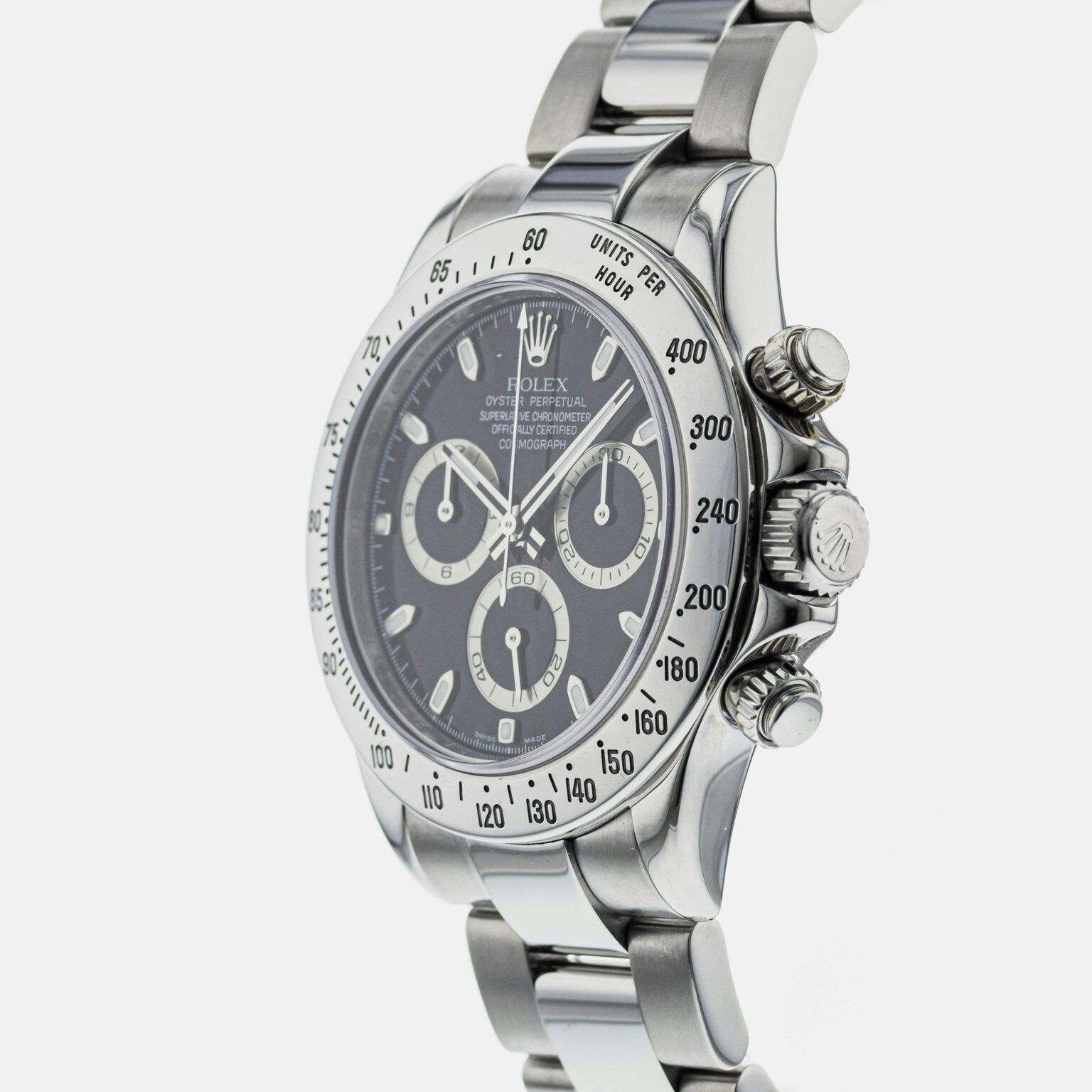
The 116520 features a 40mm Oyster case, meticulously crafted from 904L stainless steel, a superalloy known for its exceptional corrosion resistance and high polishability. This robust construction ensures a water resistance of 100 meters (330 feet), making it a truly versatile sports chronograph. The case profile is classic Daytona, with elegant lugs that integrate seamlessly with the Oyster bracelet.
A defining characteristic of the 116520 is its fixed bezel, also made from 904L stainless steel, engraved with a tachymetric scale. This metallic bezel provides a distinct visual contrast to the later ceramic versions, offering a more traditional and understated aesthetic. The engraving quality is precise, allowing for accurate average speed measurements up to 400 units per hour. The screw-down chronograph pushers, along with the Triplock winding crown, ensure the watch’s water integrity and contribute to its robust tool-watch appeal.
Dial Variations and Subtleties
The 116520 was primarily offered with two classic dial options: black and white. Both feature contrasting sub-dials, a signature Daytona trait. The black dial typically has silver-ringed sub-dials, while the white dial features black-ringed sub-dials. These contrasting rings enhance legibility and add depth to the dial architecture. The applied hour markers are crafted from white gold and filled with Chromalight luminescence, ensuring excellent readability in low-light conditions.
Over its production run, subtle variations in the dial emerged, which can be of interest to collectors. Early models (Y-series, P-series) featured thinner sub-dial rings and sometimes a slightly different font for the “DAYTONA” text. Later models (e.g., G-series, random serials) often had thicker sub-dial rings and a more pronounced “DAYTONA” script. The white dial, in particular, is sometimes referred to as the “Panda” dial by enthusiasts, though it’s not a true panda due to the lack of a black main dial. The “Cream Dial” phenomenon, where some early white dials developed a unique patina, is a rare and highly sought-after characteristic, significantly impacting market value.
Bracelet and Clasp
The 116520 is fitted with the iconic Oyster bracelet, also in 904L stainless steel. This three-piece link bracelet is renowned for its comfort, durability, and timeless design. Early 116520 models featured hollow end links (SELs were introduced later in the production), and the clasp evolved over time. Initial models came with the Oysterlock clasp, while later versions incorporated the Easylink extension system, allowing for a 5mm adjustment without tools. The solid end links (SELs) and the improved clasp contribute to a more robust feel and are generally preferred by collectors for their enhanced quality and comfort.
The overall aesthetic of the 116520 is one of understated sportiness and enduring elegance. Its metallic bezel and classic dial configurations offer a timeless appeal that contrasts with the more contemporary, high-tech look of the ceramic bezel Daytonas. This classicism is a key factor in its sustained desirability and investment potential.
Market Dynamics and Valuation Trends for the Rolex Daytona 116520
The Rolex Daytona 116520 has consistently demonstrated robust performance in the secondary market, making it a compelling subject for any investment guide. Its valuation trends are influenced by a confluence of factors, including its historical significance, technical specifications, and the broader luxury watch market sentiment.
Secondary Market Performance
Since its discontinuation in 2016, the 116520 has seen a steady appreciation in value. Initially, the introduction of the ceramic bezel 116500LN caused a temporary dip in demand for the steel bezel model. However, this proved to be short-lived, as collectors soon recognized the unique appeal and historical importance of the 116520 as the last steel Daytona with a steel bezel. Prices began to climb, often surpassing their original retail price by a significant margin.
The market for the 116520 is characterized by strong demand and relatively limited supply, especially for examples in pristine condition with full sets of box and papers. Auction results frequently highlight the premium placed on originality and provenance. For instance, well-preserved examples with desirable dial characteristics or early serial numbers can fetch prices considerably higher than average market values. The white dial variant, often perceived as rarer or more aesthetically distinct by some collectors, has historically shown slightly stronger appreciation compared to its black dial counterpart, though both are highly sought after.
Factors Influencing Valuation
- Condition: An unpolished case, sharp lugs, and an unblemished bezel are paramount. Any signs of excessive wear, deep scratches, or over-polishing can significantly detract from value.
- Completeness (Full Set): The presence of the original box, warranty card (or papers), hang tags, and instruction manuals adds substantial value. A “full set” provides authenticity and provenance, reassuring potential buyers.
- Dial Variation: While subtle, specific dial characteristics, such as the “Cream Dial” patina on early white dials, can command a significant premium due to their rarity and unique aesthetic.
- Service History: A documented service history from an authorized Rolex service center, especially if original parts were used, can be a positive factor. However, an unpolished case is often prioritized over a recent service.
- Market Sentiment: The overall health of the luxury watch market and the specific demand for Rolex sports models play a crucial role. The Daytona, as a flagship model, tends to be less susceptible to market fluctuations than other references.
Future Projections for 2026
Looking towards 2026, the Rolex Daytona 116520 is poised to maintain its strong investment trajectory. The enduring appeal of the steel bezel, coupled with the historical significance of the in-house Caliber 4130, ensures its continued desirability. As the gap between the 116520 and its successor, the 116500LN, widens in terms of production years, the 116520’s status as a “neo-vintage” classic will only strengthen.
The scarcity of truly pristine, full-set examples will continue to drive prices upwards. While rapid, exponential growth seen in some market segments might temper, a steady and reliable appreciation is highly probable. The 116520 represents a safe haven asset within the luxury watch market, appealing to both seasoned collectors and new entrants seeking a tangible investment with a proven track record. Its position as a bridge between the vintage Zenith Daytonas and the modern ceramic models gives it a unique and enduring appeal.
Identifying Investment-Grade Examples: Condition, Provenance, and Rarity
For the discerning collector aiming to acquire a Rolex Daytona 116520 as a robust investment, the criteria extend far beyond merely securing the reference. Identifying truly investment-grade examples requires a meticulous examination of condition, a thorough understanding of provenance, and an appreciation for subtle rarities. These elements collectively dictate long-term value retention and appreciation.
The Primacy of Condition
Condition is arguably the single most critical factor in determining the investment potential of any vintage or neo-vintage timepiece, and the 116520 is no exception. An “unpolished” case is the holy grail for collectors. This means the original factory finishes—the sharp bevels on the lugs, the crisp lines of the case, and the distinct brushed and polished surfaces—remain intact. Over-polishing can soften these lines, diminish the watch’s original character, and significantly reduce its value.
The stainless steel bezel, with its engraved tachymetric scale, should be free from deep scratches, dents, or significant wear that would obscure the numerals. While minor hairline scratches are acceptable for a watch that has been worn, any damage that requires extensive restoration will detract from its investment appeal. Similarly, the crystal should be free of chips or deep scratches, and the dial and hands should be original and free from moisture damage, corrosion, or reluming.
The bracelet should also be assessed for stretch, which is the loosening of the links over time. A tight bracelet with minimal stretch indicates careful wear and contributes to the overall integrity of the watch. The clasp should operate smoothly and securely, with its original coronet logo clearly defined.
Provenance and Completeness
A strong provenance provides an unbroken chain of ownership and authenticity, significantly enhancing a watch’s value. The ideal scenario is a “full set,” which includes the original Rolex box, the warranty card (or punched papers for earlier models), the chronometer certification tag, the green hang tag with the reference and serial number, and the instruction manual. These accompanying accessories are not mere trinkets; they are vital components that authenticate the watch and tell its complete story.
The warranty card, in particular, is crucial as it bears the watch’s serial number, the date of purchase, and the authorized dealer’s stamp. This documentation confirms the watch’s originality and provides a verifiable history. Watches with complete sets consistently fetch higher prices at auction and in private sales compared to “watch only” examples, sometimes by as much as 20-30% or more, depending on the reference and market demand.
Rarity and Desirable Characteristics
While the 116520 was produced in significant numbers, certain subtle variations can introduce an element of rarity. The “Cream Dial” phenomenon, where some early white dials developed a distinct creamy patina due to a specific lacquer formulation, is a prime example. These rare dials are highly coveted by collectors and command substantial premiums. Identifying such nuances requires an expert eye and deep knowledge of the reference’s production history.
Early serial numbers (e.g., P-series, K-series, Y-series) can also be more desirable to some collectors, particularly those seeking the earliest examples of the in-house movement. While not as dramatic a value driver as a “Cream Dial,” it can contribute to a watch’s overall appeal. Furthermore, watches that have remained untouched by Rolex service centers, retaining all their original components (dial, hands, bezel, pushers), are often preferred over those with service replacement parts, even if the replacements are genuine Rolex components. The pursuit of originality is paramount for investment-grade pieces.
The 116520 Versus Its Successors and Predecessors: A Comparative Investment Analysis
To fully appreciate the investment standing of the Rolex Daytona 116520, it is essential to position it within the broader context of the Daytona lineage. A comparative analysis with its predecessors and successors reveals its unique value proposition and why it occupies a distinct niche in the collector’s market.
Predecessors: The Zenith-Powered 16520
Before the 116520, the automatic Daytona era was defined by the reference 16520, produced from 1988 to 2000. This model was powered by a modified Zenith El Primero movement, designated by Rolex as Caliber 4030. The 16520 was a groundbreaking watch, marking Rolex’s first automatic Daytona and rescuing the model from near obscurity. It introduced the 40mm Oyster case, sapphire crystal, and screw-down pushers, setting the modern aesthetic.
From an investment perspective, the 16520, particularly its early “floating dial” or “inverted 6” variants, has seen extraordinary appreciation, often surpassing the 116520 in value due to its “transitional” status and the allure of the Zenith movement. These early 16520s are considered true vintage pieces. However, the 116520, with its in-house Caliber 4130, represents Rolex’s ultimate technical independence, a factor that appeals to a different segment of collectors who prioritize proprietary innovation over outsourced movements, however legendary.
While the rarest 16520s might command higher prices, the 116520 offers a more accessible entry point into the in-house Daytona era, with strong and consistent growth. It lacks the extreme rarity of certain 16520 dial variants but compensates with its technical purity and modern reliability.
Successors: The Ceramic Bezel 116500LN and 126500LN
The 116520 was succeeded in 2016 by the reference 116500LN, which introduced the black Cerachrom ceramic bezel. This model instantly became one of the most sought-after watches globally, with waiting lists stretching for years and secondary market prices soaring to multiples of its retail price. The ceramic bezel offers superior scratch resistance and a distinct, modern aesthetic that resonated with a new generation of collectors.
In 2023, Rolex updated the Daytona again with the 126500LN, featuring a slightly redesigned case, new sub-dial rings, and the updated Caliber 4131 movement. Both ceramic bezel references represent the pinnacle of modern Daytona design and technology, and their market values reflect this intense demand.
The 116520, however, holds its own against these newer models by offering a classic, all-steel aesthetic that many purists prefer. It is the last of its kind with a metallic bezel, a feature that connects it more directly to the vintage Daytonas. While the 116500LN and 126500LN command higher premiums in the current market, the 116520 offers a more understated elegance and a distinct historical position. Its investment appeal lies in its status as a “neo-vintage” piece that bridges the gap between the highly collectible vintage Daytonas and the hyper-modern ceramic versions. It offers a blend of modern reliability with a classic aesthetic that is increasingly appreciated as the ceramic models become more ubiquitous.
For an investor, the 116520 provides a compelling alternative to the higher-priced ceramic models, offering strong value retention and appreciation potential without the extreme volatility sometimes associated with the newest, most hyped releases. It represents a more mature and stable investment within the Daytona family.
Maintaining Value: Care, Servicing, and Documentation for Your 116520
Acquiring a Rolex Daytona 116520 is merely the first step in a long-term investment strategy. To ensure its value is not only preserved but potentially enhanced over time, meticulous care, proper servicing, and diligent documentation are absolutely essential. These practices are fundamental for any serious collector.
Regular Care and Handling
While the 116520 is a robust sports watch, careful handling is paramount to preserve its aesthetic and mechanical integrity. Avoid exposing the watch to extreme shocks, magnetic fields, or harsh chemicals. Regular cleaning with a soft cloth and mild soapy water, followed by a thorough rinse and dry, will keep the case and bracelet free from grime and maintain their luster. Always ensure the crown and pushers are fully screwed down before any contact with water to maintain its 100-meter water resistance.
Storing the watch properly when not in use is also important. A watch winder can keep the movement running, but for long-term storage, a cool, dry place away from direct sunlight is ideal. Avoid storing it with other watches or jewelry that could cause scratches. The goal is to minimize wear and tear, especially to the case and bezel, which are critical for maintaining its “unpolished” status.
Authorized Servicing and Originality
Rolex recommends servicing its watches approximately every 10 years, though this can vary based on usage. When the time comes for service, it is imperative to use an authorized Rolex service center or a highly reputable independent watchmaker with genuine Rolex parts. The key directive for an investment-grade 116520 is to explicitly instruct the service center *not* to polish the case or bracelet.
Polishing, while making a watch look new, removes a thin layer of metal and can soften the original factory lines, significantly diminishing its collector value. Similarly, insist on retaining all original parts, including the dial, hands, and bezel, unless absolutely necessary for the watch’s functionality. If a part must be replaced, request that the original component be returned to you, as even damaged original parts can contribute to the watch’s provenance.
The Caliber 4130 is designed for longevity and reliability, but like any precision instrument, it requires periodic maintenance to ensure optimal performance. A well-documented service history from an authorized center can actually add value, demonstrating responsible ownership and mechanical integrity, provided the aesthetic originality is preserved.
Documentation and Record Keeping
Maintaining comprehensive documentation is as important as the watch’s physical condition. Keep all original papers, including the warranty card, chronometer certificate, instruction manuals, and any service receipts, in a safe and secure place. These documents are integral to the watch’s “full set” status and provide irrefutable proof of authenticity and history.
Consider taking high-resolution photographs of your watch from various angles upon acquisition and periodically thereafter. These images can serve as a visual record of its condition over time. For insurance purposes, obtain a professional appraisal and update it regularly to reflect current market values. This meticulous approach to documentation not only protects your investment but also significantly enhances its appeal and value to future collectors.
Conclusion: The Enduring Appeal of the Rolex Daytona 116520 as an Investment
The Rolex Daytona 116520 stands as a testament to Rolex’s horological prowess and strategic vision. Its introduction marked a pivotal moment in the Daytona’s history, ushering in the era of the in-house Caliber 4130 and solidifying Rolex’s position as a fully integrated manufacture. This technical independence, combined with its classic all-steel aesthetic, imbues the 116520 with a unique and enduring appeal that resonates deeply with collectors and investors alike.
As we look towards 2026, the Rolex Daytona 116520 investment guide remains highly favorable. Its status as the last steel Daytona with a metallic bezel, bridging the gap between highly coveted vintage references and the modern ceramic models, ensures its continued relevance and desirability. For those seeking a tangible asset that combines horological significance, robust performance, and a proven track record of value appreciation, the 116520 represents an astute and sophisticated choice, a true cornerstone for any serious collection.